


The African wild dog, also known as the painted dog or painted wolf (Lycaon pictus / African Wild Dog / Painted Dog), is not a dog breed. It is a biological species in its own right, the only living member of the genus Lycaon, and the IUCN Red List places it in the Endangered category: roughly 6,600 adults in 39 separated subpopulations, of which only some 1,400 count as mature. This page is about the species: its systematics, its range, the workings of the pack, the hunt — and why its fate is settled not deep in the savannah but at the edges of reserves. More about wild and domestic animals on Tvaryny.
African Wild Dog (Painted Dog): Scientific Classification and Brief Overview
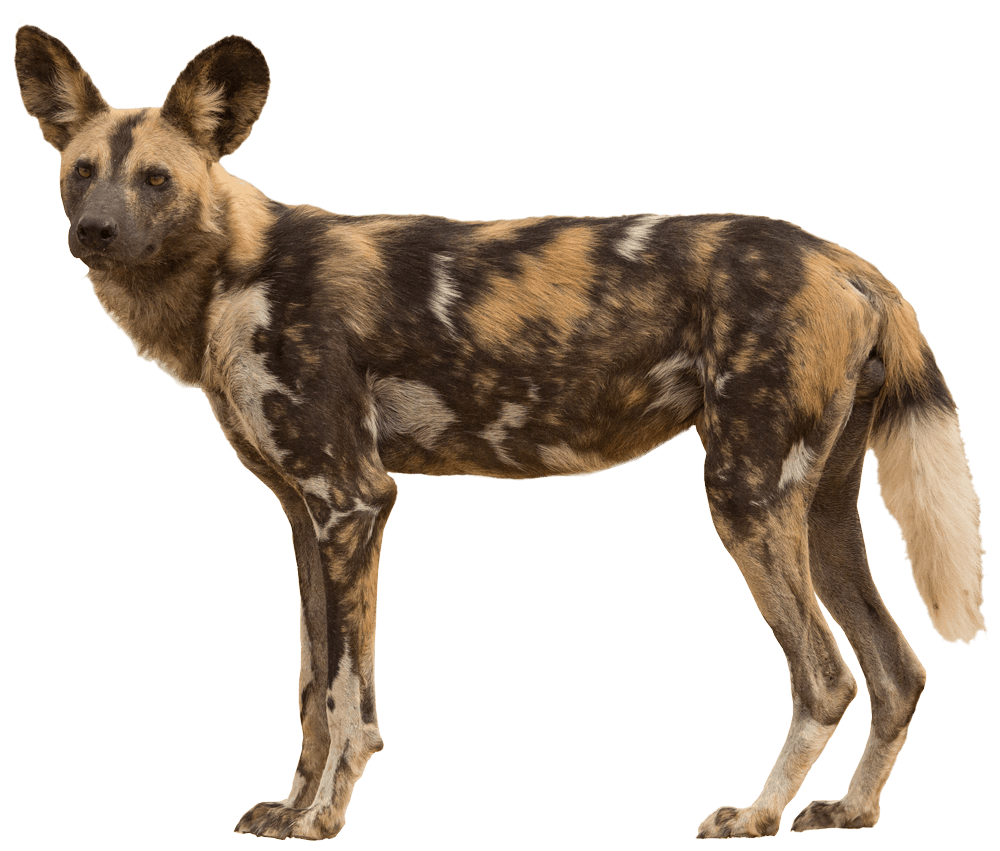
The first thing worth fixing: the African wild dog has no standard, no register and no clubs — and cannot have them. It is a wild species, described by the Dutch zoologist Coenraad Temminck in 1820, and every “parameter” below comes from field measurements and censuses, not from a description of a desired conformation.
| Characteristic | Description |
|---|---|
| Scientific name | Lycaon pictus (Temminck, 1820) — “painted wolf” |
| Genus | Lycaon — the only living species in the genus (not a subgenus or a form of Canis) |
| Conservation status | Endangered (criterion C2a(i)); population trend decreasing |
| Population estimate | ≈6,600 adults in 39 subpopulations, of which ≈1,400 mature (IUCN estimate) |
| Average weight | 20-30 kg |
| Height at the withers | 60-75 cm |
| Running speed | Up to 70 km/h; GPS sensors recorded a peak stride speed of 19 m/s (≈68 km/h) |
| Lifespan | 10-12 years (in captivity), less in the wild; the generation length used by the IUCN is 5 years |
| Social structure | Pack (from 6 to 50 animals) |
| Typical prey | Ungulates in two weight bands: 16-32 kg and 120-140 kg |
A Genus of Its Own, Four Toes and a Trenchant Heel: Why This Is Not a Dog
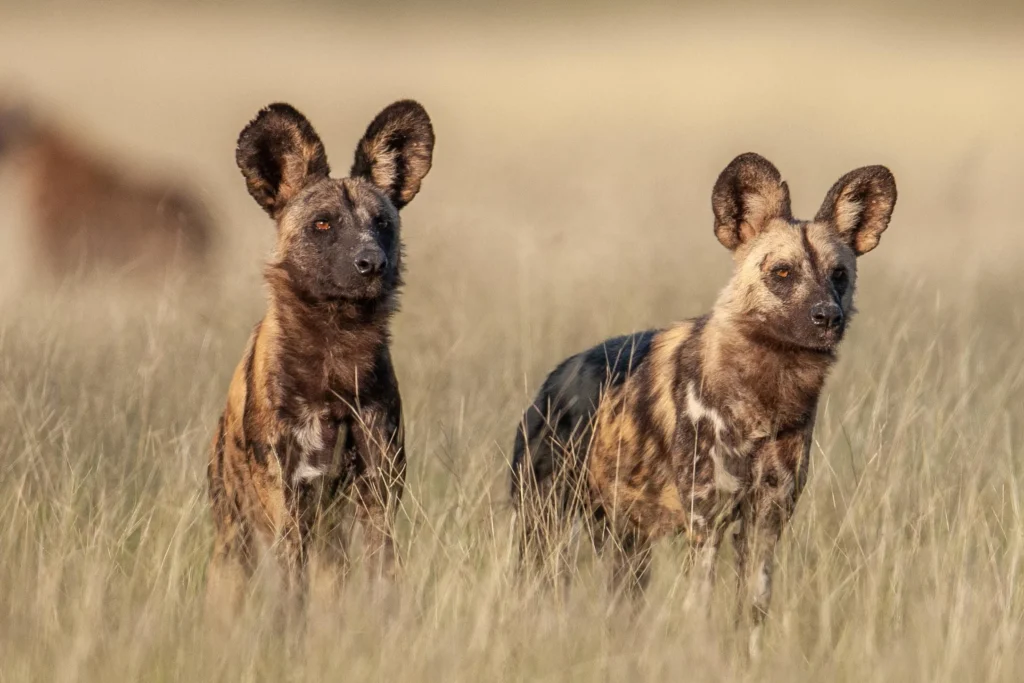
The everyday names of this species mislead the reader twice over. “Dog” — because we are indeed looking at a member of the family Canidae, but not of the genus Canis, which holds the wolf, the jackal, the coyote and the domestic dog. And the resemblance to a hyena, invoked in so many popular descriptions, is an illusion: hyenas (Hyaenidae) belong to the feliform suborder and are only very distantly related to canids. Lycaon is a genus of its own, and today a single species lives in it.
That separateness is not a terminological convention but a set of anatomical differences visible even in the tracks.
- Four toes on the front feet. Among all canids only Lycaon is built this way: the first toe (the dewclaw) is absent. Comparative genomics of the species showed that the loss of the toe came about not through simple underdevelopment but through expanded cell death (apoptosis) in the first-digit bud — characteristic amino-acid deletions linked to that mechanism were found in the genome (Campbell et al., Scientific Reports, 2019).
- A carnassial with a trenchant heel. The lower first molar of the African wild dog carries a distinctive blade-like cusp that turns the tooth into a meat-slicing tool. The trait is rare: among all canids only three species have it — the African wild dog, the Asiatic dhole (Cuon) and the South American bush dog (Speothos) (Wayne et al., Systematic Biology, 1997). The same 2019 genomic work linked the rearrangement of the molar cusps to changes in the sonic hedgehog signalling pathway, which governs the spatial patterning of teeth.
- Obligate carnivory. This is a hypercarnivore: plant food is practically excluded from the diet, and the typical prey often weighs more than the hunter itself.
- A coat pattern unique to every individual. Sequencing the genomes of two wild animals — from Laikipia (Kenya) and KwaZulu-Natal (South Africa) — produced a list of candidate genes that most likely create this “painting”: ASIP, MITF, MLPH and PMEL (Campana et al., BMC Genomics, 2016).
Roughly when that set of traits came together is known as well. Divergence-time analysis in the same 2019 paper dates the assembly of the adaptive complex — cursorial, dental and pigmentary — to about 1.7 million years ago, and it coincides with the heyday of large ungulates, that is, with the appearance of the prey the species is built around.
One more trace of the past can be read straight from the genome: over the past million years the species has crashed at least twice (Campana et al., 2016). The present decline is not the first in its history, but for the first time it is caused not by climate but by people.
Range: What Is Left of a Continuous Africa
Historically African wild dogs lived across virtually the whole of Africa south of the Sahara — from semi-deserts to mountain summits; only lowland rainforest and the driest deserts were closed to them. Of that continuous band, islands remain. The species has effectively been wiped out in North and West Africa and heavily thinned in Central and North-East Africa.
The largest surviving populations are concentrated in the south of the continent and in the southern part of East Africa:
- Botswana (the Okavango Delta);
- Zimbabwe;
- Namibia;
- Tanzania (the Serengeti);
- Mozambique.
Western Zambia belongs on that list too: long-term monitoring in the Luangwa Valley showed it to be one of the densest strongholds of the species, with a median density of about 4 animals per 100 km² (Reyes de Merkle et al., Ecology and Evolution, 2024). For comparison: the Selous reserve in Tanzania, 43,000 km² — roughly the size of Switzerland — holds about 800 African wild dogs. That is what normal density looks like for this species: very low.
A widespread notion hides here, and it is worth turning on its head. Early research in the Serengeti National Park created the image of an animal of open plains — and that image still travels from text to text. Later data showed the opposite: African wild dogs reach their highest densities in denser bush landscapes — in Selous, in Mana Pools in Zimbabwe, in northern Botswana. Some relict groups even live in montane forest, as in Ethiopia’s Harenna Forest. In other words, today’s distribution is set not by vegetation type but by the availability of prey and the absence of human pressure.
The west of the continent is a story apart. African wild dogs show morphological and genetic variation in different parts of the range, so alongside the global assessment the IUCN carries out separate regional assessments for West and North Africa: those regions are cut off by belts of unoccupied land and by geographic barriers, and no restoration of connectivity is expected there. The best-known West African stronghold is Niokolo-Koba National Park in Senegal: with its buffer zones about 25,000 km², yet by IUCN estimate it can hardly hold more than 50-100 African wild dogs.
How fragmented the population has become is shown by genomics as well. Sequencing 71 genomes of free-ranging African wild dogs in Kruger National Park (South Africa) revealed low genomic diversity — and at the same time a low level of inbreeding: closely related pairs were almost absent from the sample (Meiring et al., Scientific Reports, 2022). Isolation has therefore already told on diversity, even though the pack system itself still successfully avoids matings between close relatives. Across South Africa as a whole, a 2024 estimate leaves about 600 animals.
The history of relations with people across this range consists almost entirely of conflict: for decades farmers regarded African wild dogs as vermin and destroyed them. The value of the species to the ecosystem was recognised by the world only in recent decades.
Appearance: Why It Is Called the Painted Wolf
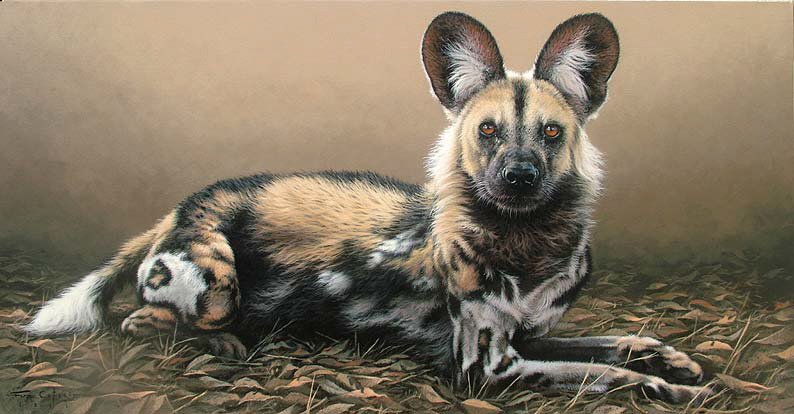
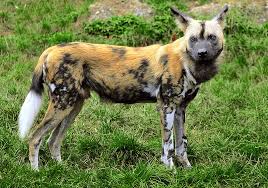
The Latin name Lycaon pictus means literally “painted wolf”. The pattern on the coat of every individual is absolutely unique, like a human fingerprint — and it is by those blotches that researchers identify particular animals on camera traps and in field observations. The practical consequence of this trait is enormous: censusing the species in the wild rests on individual recognition, and without it there would be neither demographic time series nor survival estimates.
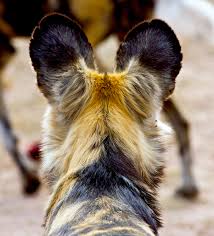
Anatomical features
Outwardly African wild dogs may recall hyenas, but genetically they are very far from them. These are the main features of their build:
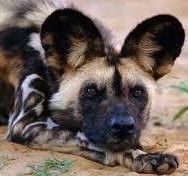
- Ears: The huge, rounded ears serve both as “locators” for communicating in tall grass and as a tool of heat regulation. Dissection of an adult male showed the ear musculature to be very well developed in this species: it provides greater leverage and finer tuning of the mobile pinnae (The Anatomical Record, 2024).
- Feet: This is the only canid species with just four toes on the front feet (the fifth toe, the so-called dewclaw, is missing). It is an evolutionary adaptation for running.
- Teeth and jaws: The bite force of the African wild dog is among the highest of carnivorous mammals. A dissection combined with contrast-enhanced computed tomography, however, produced an unexpected result: the mass of the jaw-closing muscles is not enlarged in this species relative to body size compared with other canids (The Anatomical Record, 2024). So the point is not “overpowered muscles” but skull geometry, the arrangement of the fasciae and the specialised slicing tooth.
- Coat: Coarse and bristly, in places so sparse that the dark, almost black skin shows through. This helps the animal avoid overheating.
- Facial muscles: The very muscles that raise the inner brow and produce the “puppy-dog eyes” of domestic dogs (LAOM and RAOL) are well developed in Lycaon pictus and comparable in size to a dog’s. That casts doubt on the popular claim that such an expression arose solely through domestication, for communicating with humans: a wild species that was never tamed has it too — evidently for communication inside the pack.
- Scent: The animals carry a strong, distinctive musky odour that helps them identify members of their own pack.
The Pack: Hierarchy, Voting by Sneeze and Care for the Injured
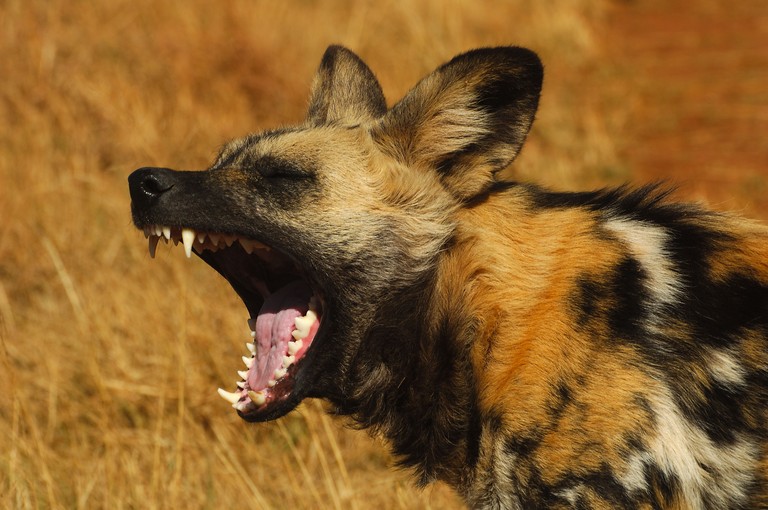
African hunting dogs do not conceive of themselves outside society. Their pack is not a mere group of animals but a complex family with a high level of mutual aid. All males are subordinate to the alpha male and the females to the alpha female, yet aggression within the group stays minimal: in its place come greeting rituals, licking and play bows, with which the pack reassembles itself again and again.
Democracy that could be measured
The most interesting discovery about the sociality of this species in recent years is “voting by sneeze”. Researchers watched five packs in the Moremi Game Reserve in the Okavango Delta (Botswana) from June 2014 to May 2015 and recorded 68 “rallies” — noisy greeting ceremonies after which the pack sometimes sets off to hunt and sometimes does not (Walker, King, McNutt, Jordan, Proceedings of the Royal Society B, 2017).
It turned out that the outcome of a rally is predicted by the number of sharp nasal exhalations — those very “sneezes”. But the threshold is not fixed, and that is what makes the finding important:
- if a dominant animal started the rally, three sneezes were enough for the pack to depart;
- if the initiator was low-ranking, the same probability of success required about ten sneezes;
- rallies started by dominants ended in departure in 76.5% of cases (n=17), and those started by subordinates in 27.3% (n=22) and 33.3% (n=18) depending on the initiator’s rank.
In other words, the participation of a dominant makes the decision far cheaper but is not a necessary condition: if enough subordinates are “in favour”, the will of the group overrides the leader’s advantage. This is one of the few cases in which quorum voting in a wild social animal could be counted rather than merely described by metaphor.
Who eats first
Care for the weak is the second trait that makes the pack unique. After a successful hunt the adults return to the den and regurgitate meat for the pups and for sick, old or injured pack members who could not join the chase. The order of access to the kill is not chaotic either: in free-ranging packs it is arranged by age, and this age structure of feeding can be reproduced even in zoos when the animals are given a whole carcass rather than cut pieces (Jordan et al., Zoo Biology, 2025).
The Hunt: What the GPS Collars Showed
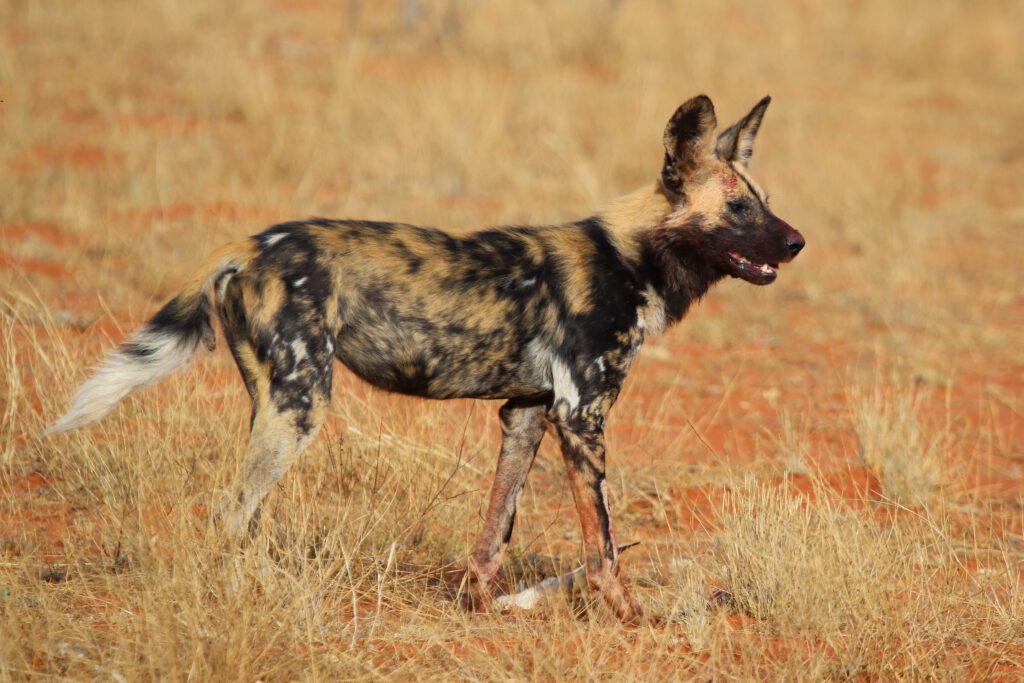
The diet of the African wild dog consists almost entirely of meat. These are obligate predators: they ignore plant food and, unlike hyenas, almost never scavenge, preferring a fresh kill.
What exactly they eat was established by a large analysis of 24 assessments of prey preference from 18 studies, in which 4,874 kills of 45 species across the whole range were counted in total (Hayward et al., Journal of Mammalogy, 2006). The preferences proved bimodal: African wild dogs choose prey of 16-32 kg and, separately, of 120-140 kg. Greater kudu and Thomson’s gazelle they kill wherever they coexist with them and statistically prefer these species; impala and bushbuck are on the preference list as well. By IUCN figures the dogs themselves weigh 20-30 kg, while their average prey is around 50 kg, sometimes up to 200 kg.
How they actually hunt
The classic description is a gruelling marathon: the pack drives the victim for tens of minutes, taking turns, until it gives up. The efficiency of this method became textbook material too: lions catch their prey in roughly 30% of attempts, and wild dogs, on widely quoted figures, in up to 80%.
Then a pack of six adults in northern Botswana was fitted with high-precision GPS sensors carrying inertial measurement units — and 1,119 high-speed chases were recorded (Hubel et al., Nature Communications, 2016). The picture came out different from the textbook:
- mean chase distance 447 m, median 324 m. That is not a marathon but a sprint;
- each animal made on average 2.43 chases per day;
- the proportion of chases ending in a kill, calculated per individual, was 0.155 — most runs, in other words, came to nothing;
- all six animals reached a peak stride speed of 19 m/s (about 68 km/h) at least once, but most runs were considerably slower.
There is no contradiction between these figures and the “80%” — they measure different things: the classic estimate concerns the success of the pack’s hunt overall, while 0.155 concerns a single chase by a single animal. The 2016 conclusion nevertheless changes the picture of the species. The energy balance showed that many short, cheap sprints plus shared feeding on the kill bring in more energy than they cost — and African wild dogs are energetically far more resilient than was assumed while long and expensive chases were attributed to them.
That margin, however, is finite. When ungulates thin out across the landscape, packs have to travel more, spend more energy and settle for smaller prey — this was measured for 13 packs in two Zambian ecosystems (Creel et al., PNAS, 2025). Formally, as the ungulates disappear so do the lions, so pressure from the competitor eases — but the gain does not offset the loss: density, survival and reproduction of African wild dogs in prey-depleted areas remain lower all the same.
Why they are so quiet. African wild dogs are noticeably quieter than one would expect of such a “talkative” animal, and there is a reason for it. Playback experiments showed that lions come very readily to the calls of African wild dogs — and a lion kills any wild dog it catches. Spotted hyenas responded to the same recordings far more cautiously (Ethology, 2010). Every loud signal therefore carries, for the pack, the risk of summoning a lethal competitor.
Breeding, the Den and the Poverty Trap of Small Packs
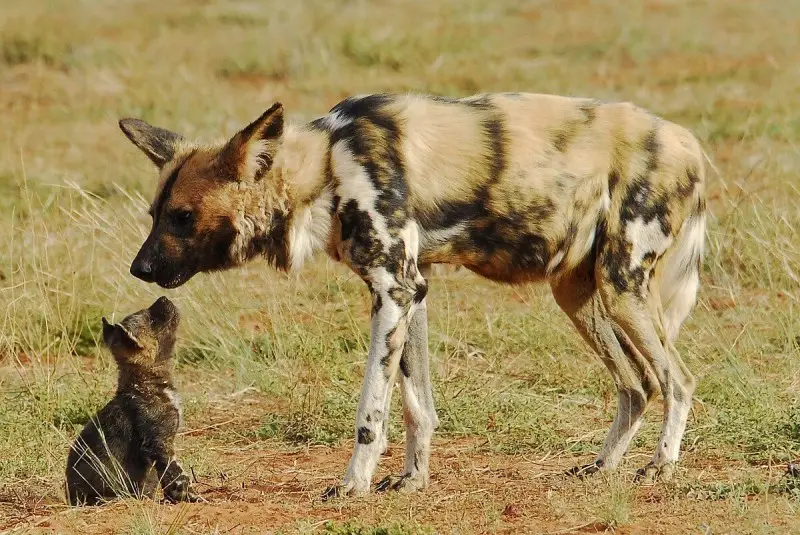
The African wild dog is an obligate cooperative breeder: as a rule only the dominant pair breeds within the pack, while the remaining adults raise other animals’ pups. The alpha female’s litter is among the largest of any canid; the pups are born in deep burrows, often taken over from aardvarks. The whole pack guards the den and brings food to the mother and later to the pups.
Because of this system, “adult” and “capable of breeding” are different things, and that is exactly why the IUCN figures are so strict. Of roughly 6,600 adults, about 1,400 count as mature under Red List methodology: alpha males, alpha females and that small share of subordinates who manage to raise offspring. The death of an alpha usually does not “open a vacancy” — in a mature pack most adults are its own offspring, so there is simply no mate for them there, and the pack often breaks up.
From this follows the species’ most important demographic property — the energetic poverty trap. Data from 22 packs underpinned a model that calculated the costs and benefits of group hunting: as the pack grows, hunting time, prey size and the probability of a capture all increase, while chase distance, on the contrary, shortens. The net rate of energy intake climbs steeply up to five animals, peaks at around ten and then begins to fall (Rasmussen, Gusset, Courchamp, Macdonald, The American Naturalist, 2008).
The consequence is harsh: a small pack feeds worse, produces smaller litters and therefore has even less chance of growing. Every animal lost makes the next loss more likely. The authors called this “the Achilles heel of sociality”: the very thing that makes the species efficient makes it fragile.
Sooner or later new litters spread the pack across the continent. Young animals leave in single-sex groups of brothers or of sisters and found new packs with a matching group of the opposite sex; that is the mechanism by which the species colonises empty ground. Kinship ties survive dispersal: analysis of data from 21 packs showed that neighbouring unrelated packs overlap in their ranges only at the edges, whereas related neighbours overlap far more deeply — right into the most intensively used areas (Movement Ecology, 2017). The expensive price of clashes between packs, in other words, drops sharply where the neighbours are family.
This is not a sentence, though. Observations of a population recovering on private and communal land in northern Kenya showed something else: larger packs did produce larger litters, but pack size did not depend on population size — so at the population level growth was not held back (Woodroffe, Journal of Mammalogy, 2011). Within a decade that population rose from almost nothing to the sixth largest in the world: in 1999 there was not a single dog in Laikipia, in 2000 there were 17 in two packs, and by 2006 about 170 adults and yearlings.
Why This Is Neither a Breed nor a Pet
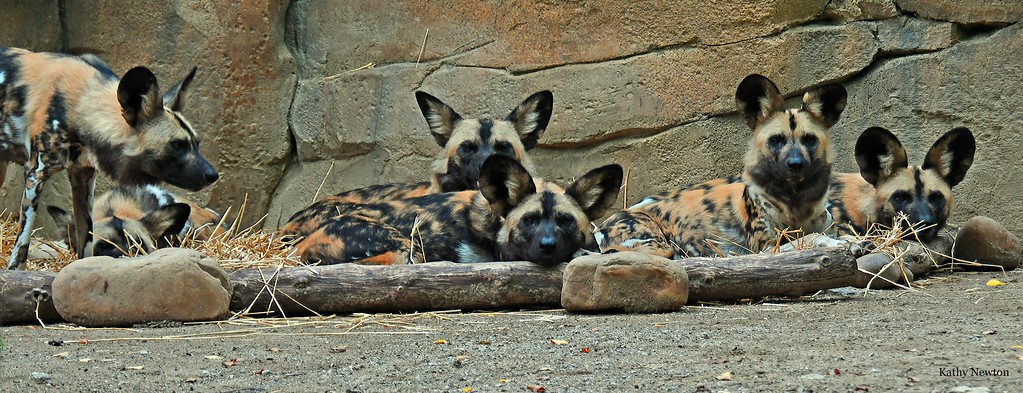
The question of whether one could keep such a puppy comes up every time somebody sees a photograph of this animal for the first time. The answer is categorical: no. The African wild dog is a wild, endangered species and not a breed: it has no standard, no register and no kennels, and in the whole history of observation not one individual has been tamed.
- Social need: the species is an obligate cooperative breeder, and a solitary animal is deprived of everything its biology rests on — from group hunting to the rearing of young.
- Space: a pack patrols hundreds of square kilometres. The scale is clear from the IUCN assessment: in a reserve of 5,000 km² there is no point more than 40 km from the boundary — and that is a distance a pack covers in its ordinary pattern of movement.
- Even zoos are a difficult case: in captivity packs sometimes show outbursts of within-group aggression that are almost never seen in the wild (Zoo Biology, 2025). Keeping this species is a task for international conservation programmes, not for a private individual.
If what draws you is the wild aesthetic or the “wolfish” look, it is worth looking towards recognised dog breeds that carry similar traits but developed alongside people over millennia. The Saarloos wolfdog and the Czechoslovakian wolfdog, for instance, are recognised breeds that combine the look of a wolf with the biddability of a herding dog.
For those after rare, aboriginal breeds from warm regions, an interesting option might be the Aruba cunucu dog or the shaggy Armant (Egyptian sheepdog). They look exotic, yet they are genuine domestic companions.
Conservation Status: What the IUCN Red List Says
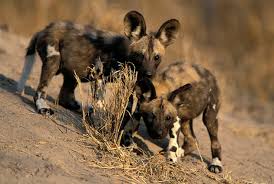
This is the central theme of the page, and precision of wording matters here. The IUCN assessment places Lycaon pictus in the Endangered category under criterion C2a(i), with a decreasing population trend. The key numbers of the assessment:
- ≈6,600 adults in 39 subpopulations;
- of which ≈1,400 are counted as mature;
- subpopulation size ranges from 2 to 276 mature individuals; the two largest are estimated at 268 and 276;
- the generation length adopted for the assessment is 5 years; the minimum age of first breeding is about three years.
That last detail matters more than it seems. The two largest subpopulations only just exceed the threshold of 250 mature individuals used by the Red List criterion. Had only alpha animals been counted as mature, as in the previous version of the assessment, those same subpopulations would give 246 and 253. The species’ category, in other words, is balanced on the edge of the counting methodology — and any refinement here has direct consequences for its status.
The main threat is not the rifle but the geometry. As early as 1998 it became clear that for large carnivores population size is a poor predictor of extinction inside reserves; what decides matters is how widely the species ranges, because most mortality occurs at reserve boundaries, in contact with people (Woodroffe and Ginsberg, Science, 1998). For the African wild dog this “edge effect” is total: on later estimates, reserves smaller than about 10,000 km² provide only partial protection.
Worse still, a buffer zone around a park can work as a trap. Radio-tracking of 15 packs around Hwange National Park in Zimbabwe showed that over the years the packs shifted their ranges towards the park boundary and beyond it, and human-caused mortality rose along with that. Conditions outside looked attractive — litters born beyond the park were even larger — but mortality exceeded natality (Oryx, 2013). Animals cannot recognise a risk that has no smell and does not move: the wire snare, the poison, the car at night.
The scale of snaring deserves its own picture. Wire poaching is now regarded as the most widespread form of hunting in Africa: by estimate, tens of millions of snares are set across the continent each year, and at least 100 million kilograms of wild meat is wasted through them (BioScience, 2025). The African wild dog mostly does not enter those statistics: the snares are not set for it, it simply dies in them.
| Type of threat | Details |
|---|---|
| Habitat fragmentation | The principal threat on the IUCN assessment. Expanding farmland breaks the territory into isolated parts and raises the frequency of contact with people and domestic animals. |
| Conflict with people | Poisoning and persecution by livestock keepers, death in wire snares set for other game, and on roads. A comparison of eight populations showed that human-caused mortality does not replace natural mortality but is added to it. |
| Diseases from domestic dogs | Rabies and canine distemper can destroy a pack within weeks. In the Tuli area (Botswana) a rabies outbreak in 2014-2015 took 29 of the 35 animals in one pack; separate outbreaks are documented in South Africa as well. |
| Competitors | Lions kill African wild dogs as competitors and spotted hyenas take their kills. This holds the species’ numbers below what the prey base could support. |
| Heat | At high temperatures packs hunt less, especially while rearing pups, and bring through fewer young. In Botswana, over 24 years of observation, rising temperatures coincided with declining recruitment. |
The last row of the table is relatively new knowledge. The African wild dog has none of the traits by which a species is usually classed as climate-vulnerable, and that is precisely why this influence went unnoticed for so long. Analysis of long-run series from Botswana (24 years), Kenya (12 years) and Zimbabwe (6 years) showed that at high temperatures packs shorten their hunting time, and those rearing pups in the heat bring through fewer young (Woodroffe, Groom, McNutt, Journal of Animal Ecology, 2017). A follow-up paper added that heat does not act on its own but amplifies the human threats already present: in Kenya, during the hottest periods the risk of dying at human hands and from the diseases of domestic dogs rose; at the same time, in all three countries a larger pack size increased survival (Rabaiotti et al., Ecology and Evolution, 2021).
One further indirect consequence of warming was shown by GPS data from 43 lions, cheetahs and African wild dogs collected in Botswana between 2011 and 2018: as temperature rises the spatial behaviour of the predators changes, and the probability of close encounters between the species increases (Movement Ecology, 2026). For a species that loses every such encounter with a lion, this is no abstraction.
What works. Despite everything, the species can recover quickly if given room. The Kenyan example from Laikipia is given above. Another is Mozambique: in Gorongosa National Park, where most large carnivores disappeared during the civil war of 1977-1992, African wild dogs were brought back by transboundary translocation, and over 28 months of monitoring all five success indicators were met, survival stood at 73% and every death had a natural cause (PLOS ONE, 2021). It was the first successful reintroduction of the species into a large unfenced landscape in Mozambique.
The main hope, meanwhile, lies in the species’ capacity for very long-distance movement. It is thanks to this that subpopulations sometimes turn up where none had been seen for years: in 2023 camera traps documented African wild dogs for the first time in the Vwaza Marsh Reserve in Malawi — the animals had probably arrived along a transboundary corridor from the Luangwa Valley in Zambia.
Pros and Cons (As a Species in the Ecosystem)
| Pros | Cons |
|---|---|
| Sanitarians of the savannah: They regulate herbivore numbers efficiently, weeding out the sick and the weak. | Vulnerability to infections from domestic dogs: Outbreaks of rabies and distemper can destroy an entire pack within weeks. |
| Social uniqueness: They display the highest level of care for kin among predators. | Need for enormous territories: Reserves smaller than ≈10,000 km² provide only partial protection. |
| A tourist magnet: Many people go on safari precisely for the “Painted Dog”. | Potential for conflict: They may take goats and sheep, drawing the anger of local people. |
Interesting Facts About Painted Dogs
- Unique sounds: They do not bark. Instead they produce sounds resembling birdsong, the chime of a small bell or the hooting of an owl (the “hoo” call), in order to find one another at a distance.
- They are very hard to count: even where the species is present it is rarely seen. In the unfenced part of the Kavango-Zambezi transfrontier area a team with a specially trained detection dog found just 21 African wild dog scats over 2,304 km² in two weeks — and it was those finds that led them to the animals themselves.
- Sterile cleanliness: Unlike many animals, these dogs keep their den impeccably clean, which helps them avoid parasites.
- Nomads: They almost never stay long in one place, except during the period when the alpha female is rearing pups (about 3 months).
- The art of camouflage: Their mottled coat hides them perfectly in the play of light and shade of tall grass and scrub.
- To mark or to hunt: the choice between patrolling boundaries and hunting depends on who exactly is in the pack that day and whose territory lies alongside — as shown by an analysis of field observations from 2010-2021 together with GPS collar data.
Frequently Asked Questions About the Species (FAQ)
Is the African wild dog a breed?
No. It is a biological species in its own right, Lycaon pictus, the only living representative of the genus Lycaon. A breed is a category that applies to domestic animals: it presupposes a standard, a register and human-controlled breeding. The African wild dog has none of this.
Is it a relative of the hyena?
No, the resemblance is purely external. Hyenas (Hyaenidae) belong to the feliform suborder, while the African wild dog belongs to the canid family. Popular comparisons reflect an old impression of observers, not kinship.
Do African wild dogs attack people?
In the wild, attacks on people are exceedingly rare. They usually avoid contact with humans. However, like any wild predator, they can be dangerous if cornered or if they are defending their young.
Can an African wild dog be crossed with a domestic dog?
The African wild dog belongs to the genus Lycaon and the domestic dog to the genus Canis; these are different branches of the canid family that parted long before the dog appeared alongside humans, and no hybrids between them have been described. The real, well-documented link between the two animals is a different one and considerably more dangerous: domestic dogs are a source of rabies and canine distemper for wild packs.
How many African wild dogs are left?
On the IUCN Red List assessment, about 6,600 adults in 39 subpopulations, of which roughly 1,400 count as mature. The category is Endangered and the population trend is decreasing.
Is it true that they “vote” by sneezing?
Yes, and it has been measured. In five packs in the Okavango Delta 68 ceremonies preceding departure for the hunt were recorded: if the initiator was a dominant animal, three sneezes sufficed; if it was low-ranking, about ten were needed (Walker et al., 2017).
Why is a small pack doomed?
A model built on data from 22 packs showed that the net rate of energy intake rises as the group grows to five animals and peaks at around ten. Smaller packs feed worse, produce smaller litters and therefore have less chance of recovering — the authors called this a “poverty trap”.
Are researchers to blame for the disappearance of African wild dogs from the Serengeti?
That hypothesis (the so-called Burrows hypothesis) held that the stress of immobilisation and marking reactivated a latent rabies virus and destroyed the population. Twenty-five years later it could be tested against data: of the 121 animals handled between 2006 and 2016, 87.6% lived longer than 12 months, and among the 67 individuals that were additionally moved and held in a boma before release, 95.5% (Jackson et al., Ecology and Evolution, 2019). Such figures do not support the hypothesis; the authors regard a high level of interspecific competition as the more likely explanation.
Where in Africa are the chances of seeing African wild dogs highest?
In the southern part of the range and in the south of East Africa: northern Botswana (the Okavango Delta), western Zimbabwe, eastern Namibia, western Zambia, Tanzania and northern Mozambique. In West and North Africa the species has effectively been wiped out; in Senegal’s Niokolo-Koba, together with its buffer zones, the IUCN estimate leaves at most 50-100 animals.