

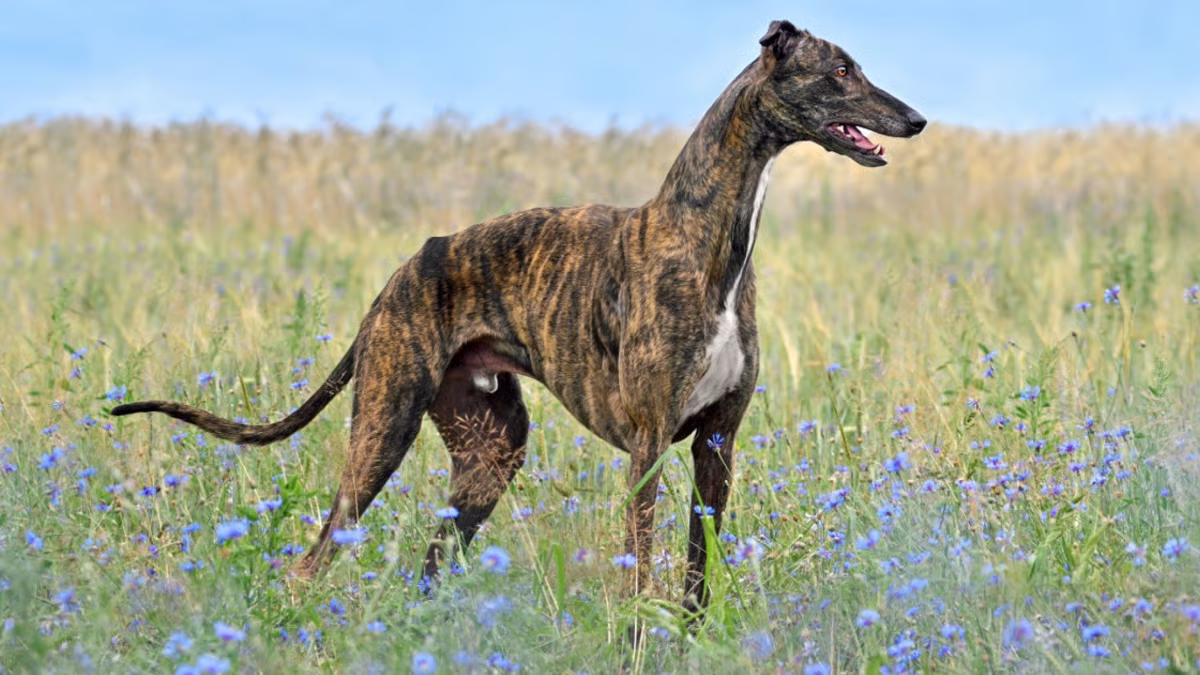
| Height | ♂ 71–76 cm · ♀ 68–71 cm (FCI) |
| Weight | ♂ 29.5–31.7 kg · ♀ 27.2–29.5 kg (AKC) |
| Lifespan | 11.5 years (median) |
| FCI group | 10 · sighthounds |
| Origin | Great Britain |
Exact ratings
Common health issues
Nutrition
The English Greyhound, or simply the Greyhound (English Greyhound), is a dog assembled by evolution and human selection for a single task: to run down the prey its eye has seen. Behind that aerodynamic perfection hides one of the quietest companions imaginable: at home the fastest dog on the planet turns into a “couch potato” capable of sleeping 18 hours a day. But the breed’s central paradox runs deeper than the domestic one. The registries describe the Greyhound as a dog of “remarkable stamina and endurance”, while peer-reviewed physiology shows a pure sprinter in whom a hundred metres of running raise blood lactate roughly fivefold. This page keeps apart what the standards assert and what researchers have measured — because for an owner the difference between those two descriptions turns into very concrete decisions: how to walk the dog, how to feed it, how to operate on it. Find out more at Tvaryny.
The standard: the FCI, the Kennel Club and the AKC describe the breed differently
The world’s three principal registries give three different descriptions of the Greyhound — and the divergence between them is not an error but a consequence of documents being updated at different rates. A standard is the primary source for what is written in it. But it is the position of a registry, not the result of a measurement, and that is precisely why it helps to see all three texts side by side.
| Parameter | FCI No. 158 (13.10.2010) | The Kennel Club (rev. 01.08.2025) | AKC |
|---|---|---|---|
| Height at the withers, dogs | 71–76 cm (ideal) | 71–76 cm | the standard gives no height |
| Height at the withers, bitches | 68–71 cm (ideal) | 69–71 cm | the standard gives no height |
| Weight | the standard gives no weight | the standard gives no weight | dogs 65–70 pounds (≈29.5–31.7 kg), bitches 60–65 pounds (≈27.2–29.5 kg) |
| Colour | black, white, red, blue, fawn, fallow, brindle — or any of these broken with white | the same list, but without fallow | “immaterial” |
The most conspicuous divergence is the minimum height of the bitch: the FCI writes 68 cm, the British Kennel Club 69 cm. This is neither a misprint nor a case of different breeds. The FCI text was fixed in its 2010 edition and has not been revised since, whereas the Kennel Club updates its standards regularly: the latest revision of the Greyhound is dated 1 August 2025. When two documents describe the same dog fifteen years apart, a discrepancy of one centimetre is only to be expected.
The second divergence is more interesting for the breeder. The FCI list of colours includes fallow — a separate dull sandy shade that is simply absent from the British text. The same dog, in other words, may be described in its pedigree by a colour the other registry does not recognise. The AKC removes the question altogether: in its standard the colour is called “immaterial”, of no consequence for judging.
And the third point, the most practical of all: neither the FCI nor the Kennel Club gives a weight at all. The only one of the three registries that does is the American AKC, and it does so in pounds: 65–70 for dogs and 60–65 for bitches. Mirror-fashion, the AKC gives no height. So any “official weight of the Greyhound in kilograms” is always somebody’s paraphrase of the AKC, never the text of a European standard. In the breed card at the top of this page we have said where each figure comes from.
History: what is documented and what is retold
The Greyhound’s history is that rare case in which the most attractive episodes turn out to be the worst supported. Let us take apart the two that migrate from text to text.
Egyptian origins
The historical note inside the FCI standard traces the breed to Ancient Egypt, and images of long-legged dogs in tombs do indeed exist. The trouble is that a fresco records a phenotype, not a breeding line. Genetic studies of sighthounds show a different picture: the sighthound type — long limbs, deep chest, narrow head — arose independently in several regions, as a convergent answer to the same task of running prey down by sight. A resemblance between a silhouette on a tomb wall and the silhouette of a modern Greyhound does not prove kinship between them.
The law of King Cnut
The second storyline, beloved of every breed article: a law of 1016 that supposedly forbade commoners to keep sighthounds and so preserved the purity of the blood. The document the claim leans on — the so-called forest laws of Cnut — is recognised as a twelfth-century forgery, composed a good hundred years after the king’s death. We have taken this episode off the page and would advise treating it as a literary plot rather than as the legal history of the breed.
What is reliably documented is the British chapter. It was in Great Britain that the standard took shape, that coursing and track racing were formalised, and it was from there that the breed spread around the world in its modern form. All three registries name Great Britain as the country of origin, without dissent.
Appearance and aerodynamics of the Greyhound
The Greyhound is a large yet strikingly light dog of aerodynamic build: a deep chest, a tucked-up belly, long muscular legs and a fine short coat with no undercoat.
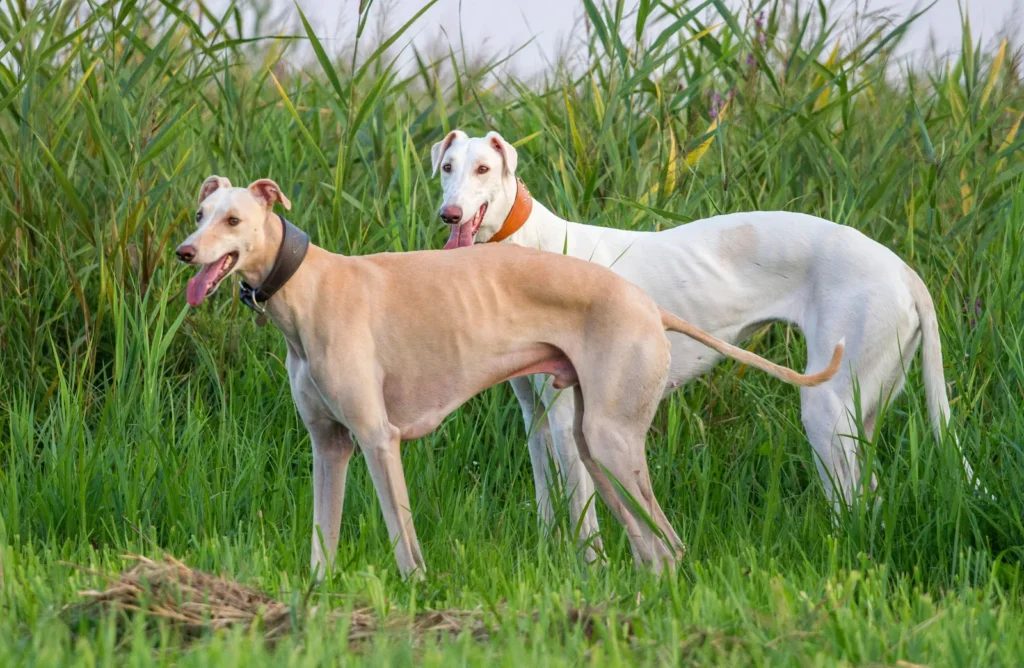
The Greyhound’s body is a triumph of functional anatomy. Every curve works to minimise air resistance and to maximise thrust. It is a big dog, but it never looks a heavy one.
- Head: Long and narrow, with a flat skull. The ears are small and rose-shaped (rosette); they lift when the dog is roused, but are normally folded back against the head for better aerodynamics.
- Body: Marked by a deep ribcage (to house capacious lungs and a large heart) and a strongly tucked-up belly. The back is broad and muscular.
- Limbs: Long and powerful. The hind legs carry extraordinarily developed thigh muscles that work like springs.
- Coat: Short, fine and close-lying. It has no undercoat, which leaves the dog vulnerable to cold (we come back to that separately).
What happens on the bend
The most interesting biomechanics of the Greyhound are found not on the straight but in the turn. Usherwood and Wilson (Nature, 2005) measured that on the bend of a racing track the load on the limbs rises by about 65% compared with the straight. And the dog holds the turn not by “leaning”, nor by the grip of its feet on the ground, but by the moment its muscles develop at the hip joint. That explains two practical things: why sighthound injuries are so often tied to bends, and why a healthy pet Greyhound is better off opening up along a straight stretch than carving circles round a small fenced paddock.
One more thing should be said about that same paper. It is often cited for a top-speed figure — whereas what it actually deals with is limb loading in the turn. The Greyhound’s speed was measured by other researchers, and that is the subject of the next section.
Speed: the measured figure and the claimed one
In a peer-reviewed measurement (Hudson et al., Journal of Anatomy) the Greyhound’s top speed is about 17 metres per second — roughly 61 km/h. That is the number we are prepared to put our name to.
Now compare it with what the standard itself asserts. The FCI historical note says the Greyhound reaches “over 45 miles per hour” — about 72 km/h, that is, roughly seven miles per hour more than the measured value. The figure from the standard’s note has spread across hundreds of sites and until recently stood on this page as well; we have replaced it with the result of the measurement and left both versions side by side, so that the reader can see where the divergence comes from.
The difference is not an academic one. 61 km/h is the speed at which a dog covers a hundred metres in about six seconds. No person, no lead and no fence of the “he’ll never clear that” variety has time to react to a start that begins with a glance. It is from this figure that the breed’s central management rule follows, discussed below in the section on training.
A sprinter, not a stayer: physiology against reputation
The FCI and Kennel Club standards describe the Greyhound as a dog of “remarkable stamina and endurance”. Peer-reviewed physiology describes it as a sprinter capable of one powerful and very short burst. That is a direct contradiction, and it is the most important thing to know about the breed.
Let us go through the evidence on the physiology side — there are three pieces of it, from different decades and different laboratories.
- Muscle composition. Guy and Snow (1981) showed that in the Greyhound’s skeletal muscle practically 100% of the fibres have high ATPase activity — these are “fast” fibres, built for power rather than for prolonged work. At the same time the activity of 3-hydroxyacyl-CoA dehydrogenase, the enzyme needed to oxidise fat, is reduced in them. In plain words: the fuel that stayers run on is fuel the Greyhound metabolises poorly.
- What happens over 800 metres. Dobson (1988) measured that after a distance of 800 m the lactate content in the Greyhound’s muscle rises 6–7 times over, while intramuscular pH falls to 6.40. This is a state of deep anaerobic acidification — precisely what makes carrying on impossible.
- What happens over 100 metres. Pellegrino (2018) showed that even a hundred metres raise blood lactate from 1.70 to 9.08 mmol/l. A distance most dogs would not even notice is already metabolically expensive for a Greyhound.
The practical conclusion for the owner is paradoxical and rather pleasant: the Greyhound is not a dog you have to run with for hours. Two short walks a day, plus the chance to open up a few times a week on fully fenced ground, cover its exercise needs. Trying to make it a partner for long runs works against its own physiology: it will give you the burst, and then spend a long time recovering.
The heart: constitution, not training
Schoning (1995) examined 230 Greyhounds post mortem and obtained a heart-mass to body-mass ratio of 1.3% in bitches and 1.2% in dogs. The key detail in that work is not the numbers themselves but the fact that the ratio did not depend on whether the animal had raced. The Greyhound’s large heart, in other words, is a constitutional feature of the breed and not a consequence of training.
For the owner this has an entirely practical consequence: a Greyhound’s heart can look enlarged on a radiograph and be perfectly normal all the same. If your veterinary surgeon is seeing your dog for the first time and has no experience of the breed, it is worth mentioning this particularity before an investigation of the “enlarged heart” gets under way.
Relatives and differences: who is who in the world of sighthounds
Newcomers to the dog world often confuse the similar-looking breeds of the sighthound group. The Greyhound is the golden mean for size, but it has close relatives too. If, for instance, you are looking for a dog like a Greyhound but smaller, the Whippet deserves your attention. It is effectively a scaled-down copy, ideally suited to a town flat. And if even the Whippet seems too big, there is the Italian Greyhound — the smallest of the sighthounds, weighing under 5 kg yet keeping all the grace of its larger kin.
The comparison with the Whippet is worth a line of its own. It is almost the same body plan scaled down — and yet, on the evidence of a large study of lifespan (McMillan et al., 2024), the Whippet’s median lifespan is 13.4 years against 11.5 in the Greyhound. Two sighthounds of near-identical construction live differently, and the reason for that difference does not lie in the construction.
At the other end of the spectrum stands the stately Deerhound. Unlike the smooth-coated Greyhound, the Deerhound carries a rough coat and was bred to hunt deer in the rugged conditions of Scotland. The Greyhound is a sprinter of the plains. We shall come back to the Deerhound below: it is in that breed that the genetic cause was found for the post-operative bleeding so often ascribed to the Greyhound as well.
Character and temperament: a rocket, or a flat calm
In character the Greyhound is a quiet, gentle and reserved introvert: it barks almost not at all, does not guard, and settles easily with people — but it has a strong prey drive towards anything that moves quickly.
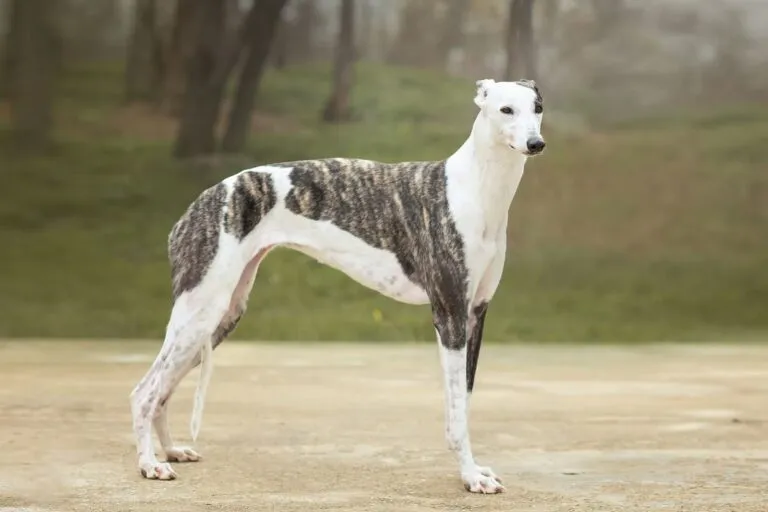
There is a widespread myth that Greyhounds need gigantic amounts of exercise and constant running. As shown above, physiology says the opposite. At home these dogs behave remarkably quietly, almost unnoticeably. They rarely bark, adore soft surfaces and will often try to burrow under their owner’s blanket.
Traits of character that matter:
- Reserve: Greyhounds are frequently indifferent to strangers. They will not bounce at your guests with joy the way a Labrador does, but neither will they show aggression.
- Sensitivity: These are emotionally vulnerable dogs. Shouting or harsh discipline can put a Greyhound into a state of stress. They remember being wronged.
- Prey drive: This is the crucial point. The Greyhound is a sighthound: it hunts by eye. Anything that moves quickly — a squirrel, a cat, a small dog, a plastic bag — is read automatically as quarry.
This chasing instinct sets them fundamentally apart from the scent hounds, which work with the nose. An English Foxhound, for example, can follow a line for hours without ever seeing the quarry, whereas a Greyhound reacts instantly to a visual stimulus. Owners should be careful during off-lead walks in open country.
Are Greyhounds aggressive?
The racing muzzle is regularly misread, so let us put it plainly: the racing regulator’s rules name a single reason why a dog runs muzzled — the prevention of bites in a bunch of dogs finishing side by side. The popular version, “so that the dogs can be told apart in the photo finish”, is not borne out by the rules. In ordinary life Greyhounds are not aggressive towards people. Many confuse their muscular power with fighting potential. Unlike the American Pit Bull Terrier, however, which may show dog-directed aggression or guarding qualities, the Greyhound is a hunter, not a fighter and not a guard. It is likelier to fall asleep on a burglar than to stop one.
Training and socialisation: why the sighthound “will not listen”
A Greyhound can perfectly well be brought up, but it is harder to train than the working breeds: it is independent, bored quickly by repetition, and works for a reward rather than “for its owner’s sake”. This is neither stubbornness nor a shortage of intelligence — for centuries sighthounds were selected for the ability to take their own decisions in the field, not to carry out a handler’s commands. So the key to teaching is short (5–10 minute), playful sessions with high-value treats, without pressure and without raised voices.
The hardest and the most important cue is the recall. Because of that instantaneous response to movement, no Greyhound has a hundred-per-cent reliable recall in an open field: on sighting a hare or a cat it is gone before you can call. Go back to the figure from the section on speed: 17 metres per second is the distance the dog covers while you are drawing breath to shout. That is exactly why the golden rule of the breed is to let it off the lead only within a fully fenced area, with no exceptions of the “but there is nobody about here” kind.
Basic obedience (settling on a bed, the down, walking to heel) comes easily to sighthounds, because more than anything they love peace and comfort. Teaching a calm examination works well too: since this breed faces more veterinary handling than the average dog — from tooth-brushing to routine check-ups — a dog that will quietly let you look at its mouth and feet saves both sides years of frayed nerves.
A subject of its own is getting used to domestic life in former racing dogs: a whole life in kennels may have left them never having met a slippery floor, a mirror or a glass door, and with no idea what stairs are. Patience in the first weeks decides everything.
Care: cold, feet and — above all — teeth
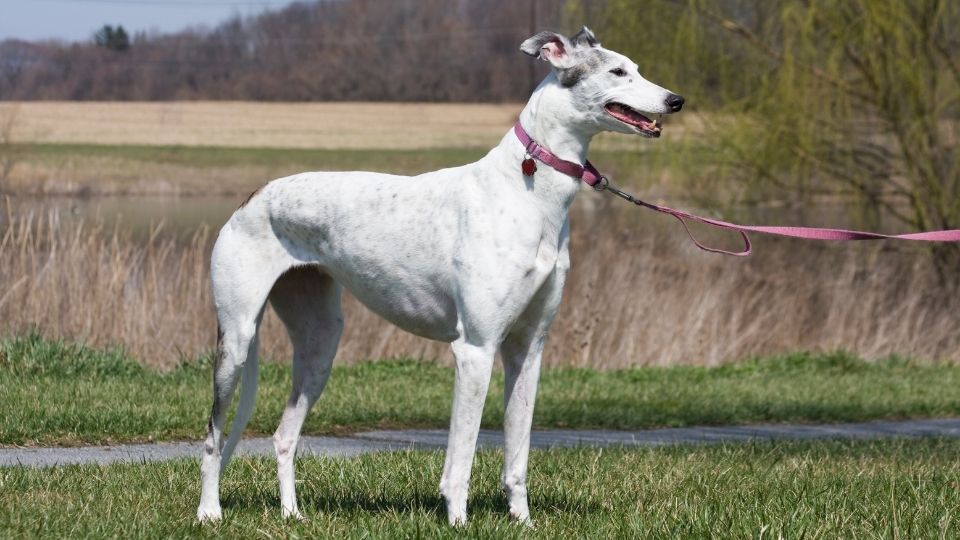
Keeping a Greyhound differs from looking after an ordinary shepherd dog or a spaniel. Here are the three things that genuinely determine this breed’s quality of life — and the most important of them is not the one usually talked about.
Teeth — the breed’s main real problem
On the data of the VetCompass programme (O’Neill et al., 2019), periodontal disease was recorded in 39.0% of Greyhounds against 9.3% across all breeds together. That is fourfold the overall level and, on the available evidence, the most common documented problem of the breed — noticeably more frequent than anything usually listed among “Greyhound diseases”.
The practical consequence is simple and unpopular: daily tooth-brushing is not a hygienic detail for a Greyhound but the core care procedure, more important than anything else in this section. Begin on the first day in the home, and for a former racing dog in the first week of settling in. Regular veterinary examination of the mouth is worth scheduling more often than “once a year, while we are here for the vaccination”. A further argument: a dental scale and polish in a Greyhound means an anaesthetic, and anaesthesia in this breed has particularities of its own (the section below), so it is wiser not to let matters reach an intervention.
Temperature
The Greyhound has a very fine coat with no undercoat and little subcutaneous fat. That means it feels the cold roughly as a person without clothes does. In winter, in autumn and even on chilly spring mornings the dog needs a coat — this is not a whim of fashion.
With heat the situation is symmetrical, and here there are measured data. McNicholl and co-authors (2016) tracked the body temperature of Greyhounds after a run: on average it rose by 2.1 °C. Dark dogs, moreover, heated up more than light ones — +2.2 against +2.0 °C — and the difference proved statistically significant (p = 0.005). For the owner of a black Greyhound that means something far simpler than any theory: in hot weather their dog needs more shade, more water and shorter active spells than the fawn neighbour on the same field.
Foot pads and corns
Hard keratin formations have been described in the pads of Greyhounds — the so-called corns. They grow into the pad and cause severe pain on hard going. Annual prevalence on the available data stands at 2.4% — so not a mass phenomenon, but for the individual dog the difference between lame and sound. The cause of corns has still not been established, so there is no universal prevention either: what remains is regular inspection of the feet and attention to sudden lameness on hard ground.
Health: where the breed genuinely differs
Lifespan: the number that contradicts the reputation
On the largest study of canine lifespan to date (McMillan et al., Scientific Reports 14:531, 2024; sample of 584,734 dogs), the median lifespan of the English Greyhound is 11.5 years (95% CI 11.4–11.6).
Taken on its own, that is a normal number for a large dog. The interesting part begins with comparison. In the same work the median for crossbreeds is 12.0 years, and the hazard ratio for the Greyhound is 1.19. On this sample, in other words, the breed lives a little less long than dogs of mixed origin, not longer.
And the second reference point is more telling still: the Whippet — effectively the same construction on a smaller scale — has a median of 13.4 years. Almost two years of difference between two breeds with the same body plan.
We give this a section of its own deliberately. The idea of the Greyhound as a long-lived breed rests on one real fact — the rarity of dysplasia — and on an unspoken assumption that long life follows from it automatically. The McMillan data do not bear that assumption out. That is why our description of the breed avoids evaluative wording: where there is a number we give the number, and where there is none we do not put an epithet in its place.
The Greyhound’s “normal” blood results are different
This is the most practical section on the page. A healthy Greyhound consistently falls outside the all-breed reference intervals on several parameters at once — and a veterinary surgeon who does not know that begins treating a healthy dog.
Below are the breed reference intervals published by IDEXX (2025) on a sample of 220 dogs and constructed to CLSI methodology. An important caveat: these limits are given for IDEXX’s own methods. In another laboratory, with other analysers and reagents, the limits may differ, so the table is a reason to talk to your vet, not grounds for a conclusion of your own.
| Parameter | Breed interval for the Greyhound (IDEXX, 2025; n = 220) |
|---|---|
| Haematocrit | 52–68.4% |
| Haemoglobin | 16.9–23.1 g/dl |
| Platelets | 97–232 thousand/µl |
| White cells | 3.6–8.6 thousand/µl |
| Creatinine | 1.2–2.1 mg/dl |
| Total T4 | 0.5–1.7 µg/dl |
| SDMA | 0–20 µg/dl |
Read that table again through the eyes of a clinician seeing a Greyhound for the first time. A high haematocrit, reduced platelets, reduced white cells, a raised creatinine and a low T4 are, by all-breed limits, the picture of several diagnoses at once. In the Greyhound this is normal.
Creatinine: muscle, not kidney
A raised creatinine in the Greyhound is a consequence of large muscle mass, not of renal failure. Direct evidence came from Drost and co-authors (2006): the glomerular filtration rate in the Greyhound proved to be higher than in dogs of other breeds — 3.0 against 2.5 ml/min/kg. The kidneys are not worse; they simply work harder. Urine specific gravity helps to tell “breed normal” from “a genuine problem”: if the kidneys concentrate urine normally, a high creatinine is not in itself a diagnosis.
The thyroid: do not rush to hypothyroidism
Gaughan and Bruyette (2001) showed that Greyhounds have reliably lower basal T4 and lower free T4, while TSH does not differ from other breeds. That is the key to the diagnosis: a low T4 in a Greyhound does not by itself mean hypothyroidism. The diagnosis has to rest on three things together — a low T4, a raised TSH and the clinical picture.
How widespread this is was shown by the work of Shiel (2007): in 91.3% of young untrained Greyhounds total T4 was below the all-breed norm. The sample of untrained dogs is the point here — it demonstrates that this is a property of the breed and not a consequence of racing work.
Why Greyhounds are asked to be blood donors
Two reasons. The first is the high haematocrit from the table above. The second is blood groups: only 13% of Greyhounds are DEA 1.1 positive, and that makes the breed a convenient source of blood for the banks.
And here is a common confusion worth untangling. “Universal donor” and “DEA 1.1 negative” are not synonyms: universality is not settled by a single antigen, and among Greyhounds the proportion of genuinely universal donors is about 57%. So “my Greyhound is DEA 1.1 negative” does not yet mean “suitable for anyone”: typing is decided by the laboratory, not by the breed on the pedigree.
Anaesthesia: why this breed needs a different protocol
This is the information worth giving your veterinary surgeon before the start of any procedure involving an anaesthetic — a dental included. Court (1999) formulated a practical rule that has entered veterinary practice since: thiobarbiturates are not used in Greyhounds. Propofol, ketamine combined with diazepam, and methohexital are named among the acceptable options.
The mechanism is enzymes, not “too little fat”
The most popular explanation — “the Greyhound has little fat, so the drug has nowhere to redistribute to” — does not survive checking. There are two arguments against it from the studies themselves: oxybarbiturates of similar lipophilicity produce no breed difference, and induction of the liver enzymes accelerates recovery. Both facts point to metabolism, not to distribution in the tissues.
The molecular answer came from two papers. Martinez and co-authors (Scientific Reports 10:69, 2020) pointed to the enzyme CYP2B11, and a paper from 2024 (PLoS ONE 19:e0297191) to POR (cytochrome P450 reductase). So the matter comes down to particular liver enzymes and to variants of the genes that encode them.
A counter-intuitive detail: “it is the racers who are at risk” is a simplification
You would think peculiarities of metabolism ought to concentrate in the racing lines. The data say otherwise, and in two directions at once. The CYP2B11-H3 variant occurs in 18% of racing against 59% of show dogs. The POR-H3 variant runs the other way: 35% in racing against 10% in show dogs. Two genes affecting the same system are distributed between the lines in opposite directions. So the simple rule “be careful with the racers” does not work: care is needed with the breed, regardless of whether the individual dog ran on a track or walked the show rings.
What not to say to your vet
The formula “Greyhounds metabolise drugs slowly” has become a convenient shorthand — and it is too broad. KuKanich and co-authors (2012) tested several drugs and showed that phenytoin, theophylline and diazepam behave within the usual limits in Greyhounds. The metabolic particularity of this breed is substrate-specific: it concerns particular drugs, not the whole of pharmacology. The right sentence for the consulting room runs roughly like this: “this is a Greyhound; the breed has described particularities in thiobarbiturate metabolism and reference intervals of its own for blood work”.
A checklist for the veterinary appointment
Gather everything breed-specific from this page into one short list and you get exactly what is worth going through with the clinician before the procedure rather than after it:
- Anaesthesia: do not use thiobarbiturates; propofol, ketamine with diazepam and methohexital are named among the acceptable options (Court, 1999).
- Blood work: the breed has reference intervals of its own — high haematocrit, reduced platelets and white cells, raised creatinine, low total T4. The IDEXX table above will serve as a printout for the practice.
- Kidneys: interpret a high creatinine together with urine specific gravity — in the Greyhound the glomerular filtration rate is higher, not lower (Drost, 2006).
- Thyroid: a low T4 without a raised TSH and without clinical signs is not hypothyroidism (Gaughan & Bruyette, 2001).
- After surgery: plan a check on the second day — late bleeding begins 36–48 hours in, and the pre-operative coagulation screen does not predict it.
- Heart: an “enlarged heart” on a radiograph in this breed calls for an interpretation of its own (Schoning, 1995).
Bleeding 36–48 hours after surgery
The Greyhound’s most dangerous breed particularity is not the operation itself but the second day after it. Lara-García and co-authors (2008) described late post-operative bleeding in 26% of Greyhounds after castration, beginning 36–48 hours after the intervention. For comparison, in other breeds the same figure in their observations came to 0–2%.
The practical conclusion sounds mundane, but it is the one that saves dogs: the critical watch is not on the day of surgery but on the second day. Bruising, swelling around the wound, lethargy, pale mucous membranes a day and a half after discharge — that is a reason to telephone the practice, not to wait until morning.
What can be done about it
Marín and co-authors (2012) ran a randomised controlled trial on 100 dogs. In the placebo group bleeding occurred in 30%, in the aminocaproic acid (EACA) group in 10%, and the difference was statistically significant (p = 0.012). This is one of the cleanest pieces of evidence in breed-specific veterinary medicine.
Dosages we deliberately do not give: in the accessible sources the recommended doses diverge sevenfold, and the choice between them belongs to the surgeon who operates, not to a page about a breed. That is our editorial decision, not a doubt about the drug itself.
The subject is not closed, though. A retrospective study from 2024 on tranexamic acid (TXA) showed no effect — so the question of which antifibrinolytic, and for whom, remains a matter of discussion rather than a ready-made protocol.
Why the standard tests show nothing
The most insidious feature of this condition: prothrombin time and APTT in such dogs are normal. The pre-operative coagulation screen looks clean — and gives warning of nothing at all. The finding that does correlate with the bleeding is a reduced antiplasmin level, that is, accelerated dissolution of a clot that has already formed.
Molecular confirmation of this mechanism does exist: Court and co-authors (2023) found a causal variant in the SERPINF2 gene. One important caveat is usually lost in the retelling: that finding was made in Scottish Deerhounds, not in Greyhounds. Carrying the mechanism across to the Greyhound remains a reasoned assumption rather than a proven fact, and we mark that plainly.
Nutrition: fuel for a sprinter
Rehoming a Greyhound from racing: a champion’s second life
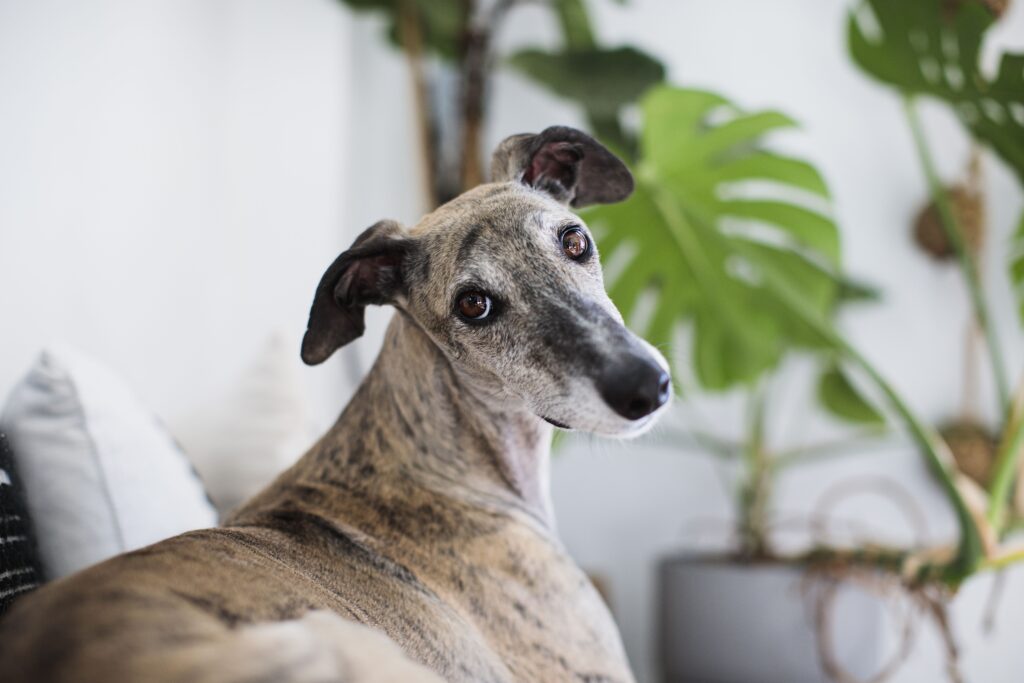
Most Greyhounds come into families not from breeders but through the rehoming of former sporting dogs: they finish their racing careers at 2–4 years old and then live another decade as affectionate house dogs. That makes the breed one of the few in which an adult, already formed dog can be taken on with equanimity — the sighthound character is stable, and there will be no surprises of adolescence.
Former athletes have adaptation quirks of their own. They are used to a strict routine and to the company of other dogs, so the first days in the quiet of a flat can leave them at a loss. Usually the dog “thaws” within a few weeks: it learns to play, discovers toys and gets its own soft bed for the first time in its life. Many rehoming centres test such dogs in advance for compatibility with cats and children — that settles the prospective owner’s main question, so it is worth asking about the result of the test directly.
The veterinary side is worth preparing for separately. A former racing dog often arrives with dental calculus — see the section on periodontal disease — and almost always has spaying or castration ahead of it. Both procedures have rules of their own for a Greyhound: the anaesthetic protocol and the check on the second day. The most useful thing you can do in the first week is to find a practice that has already heard about the breed’s particularities, and to take along a printout of the breed reference intervals.
How to read racing statistics
Greyhound racing is a sharp subject, and the public argument around it is easy to get lost in. It helps to grasp the main thing: the sides mostly disagree not about the data themselves but about the denominator and the boundary of the count. Injury rates “per race” and “per dog per season” are two different numbers describing the same reality, and they are not interchangeable. In the same way, “left the register” and “died” in regulators’ reporting are two different populations, not parts of one whole. When you meet a striking figure, the first question to put to it is not “true or false” but “divided by what, and what exactly was counted”.
Who the Greyhound suits, and who it does not
Let us gather together everything taken apart above. The portrait of the owner who will do well with this breed is composed not of character traits but of domestic conditions.
The Greyhound will suit you if
- You live in a flat and value quiet. This is the rare case of a tall dog that really is comfortable indoors: it hardly barks and sleeps for most of the day.
- You have access to a fully fenced area. Not a “quiet park”, not a “field where there is nobody about”, but a fence. This requirement is not up for discussion, and it follows from the figure of 17 metres per second.
- You are prepared to brush the dog’s teeth every day. Given 39% periodontal disease, that is not a wish but the breed’s core care procedure.
- You are content with an adult dog of settled character. Most Greyhounds come into a home through rehoming after a racing career.
- You are ready to act as “interpreter” between your dog and the vet — at least until the first appointment at a practice that knows the breed.
It is worth looking for another breed if
- You want a partner for long runs. The Greyhound’s physiology is built for a burst, not for distance: a hundred metres already raise blood lactate several times over.
- There is a cat or small livestock in the house. This is not an automatic “no” — many rehoming centres test dogs for exactly this compatibility — but taking a Greyhound into a home with a cat sight unseen is unwise.
- You are looking for a guard. The breed has neither a guarding instinct nor any leaning towards territorial behaviour; the watchdog score in the breed card above is the lowest for a reason.
- You are not prepared to dress your dog. A fine coat without undercoat and little subcutaneous fat make clothing in cold weather not an accessory but part of the care routine.
- You want a dog for competitive obedience. Sighthounds were selected over centuries for independence of decision, and a reliable recall in an open field is out of their reach in principle.
What people get wrong about the Greyhound
A set of striking claims circulates about this breed, copied from one text into the next. Being striking is a signal of risk, not grounds for trust, so we have checked each of them and taken the commonest off the page. Here they are, together with what is known instead.
- “The dog spends 75% of the gallop in the air.” A pretty figure that travels from site to site. That number is no longer on this page: we give only figures for which we can name a measurement. What has genuinely been measured about Greyhound movement is the +65% limb loading in the turn (see the section on aerodynamics).
- “A 270-degree field of view” and “it can see for a kilometre”. A dog’s field of view is in general about 240–250°, and visual acuity about 20/75 on the human scale — that is, noticeably poorer than a person’s. The Greyhound’s strength lies not in distance and not in the angle of view but in its response to movement: it launches at a moving object faster than it can make the object out.
- “The only breed mentioned in the Bible.” The claim leans on the English translation of 1611 (the Book of Proverbs, 30:29–31). It is an artefact of that particular translation: modern renderings of the same passage give “cockerel”, not “greyhound”.
- “The racing muzzle is for telling dogs apart in the photo finish.” The regulator’s rules name a single reason — the prevention of bites at the finish.
- “A Greyhound has less than 1% fat.” The figure comes from a measurement of dissectible fat — the fat that can be separated out by dissection. That is not the same as body fat percentage: a substantial part of the fat is distributed within the tissues and is not counted that way. The correct wording, without a number: the Greyhound has very little subcutaneous fat — hence both its sensitivity to cold and the definition of its muscles.
- “Cnut’s law forbade commoners to keep sighthounds.” The document is recognised as a twelfth-century forgery (see the section on history).
- “The Greyhound comes from Ancient Egypt.” The FCI standard does say so in its historical note, but sighthound genetics point to the independent emergence of this type of dog in several regions.
One stock claim, by contrast, did survive the checking, and with a number attached: the Greyhound really does have more red cells than the average dog. The haematocrit of 52–68.4% from the table of breed references is that same fact, only measured. It is that, and not the legend, which stands behind Greyhounds being asked so often to give blood.
Video about the breed
- Quiet and gentle, hardly ever barks
- Calm in a flat despite its height
- Minimal coat care
- Hip dysplasia — 2.1% (a rarity at this height)
- Taken on as an adult: the character is already formed
- Strong prey drive — off the lead only behind a fence
- Periodontal disease in 39% — needs daily tooth-brushing
- A different anaesthetic protocol — warn your vet
- Late bleeding 36–48 hours after surgery
- Feels the cold — needs a coat in winter
| Whippet | Italian Greyhound | Deerhound | |
|---|---|---|---|
| Height | 44–51 cm | 32–38 cm | 71–81 cm |
| Energy | 4 | 3 | 3.5 |
| Apartment | 5 | 5 | 4 |
| Beginners | 4 | 3.5 | 3 |
How fast does a Greyhound run?
Is the Greyhound really an enduring dog?
Why does a Greyhound need a different anaesthetic?
My Greyhound’s blood results look bad — is that normal?
What should I watch for after spaying or castration?
How long do Greyhounds live?
Can a Greyhound live in a flat?
Do Greyhounds get on with cats?
FCI Standard No. 158 (2010) · The Kennel Club (rev. 2025) · AKC · McMillan 2024, Sci Rep 14:531 · O'Neill 2019, VetCompass · Oberbauer 2017 · Court 1999 · Martinez 2020, Sci Rep 10:69 · Lara-García 2008 · Marín 2012 · IDEXX 2025
For apartments · For kids · For beginners · Active · Smartest · Hypoallergenic · All rankings →