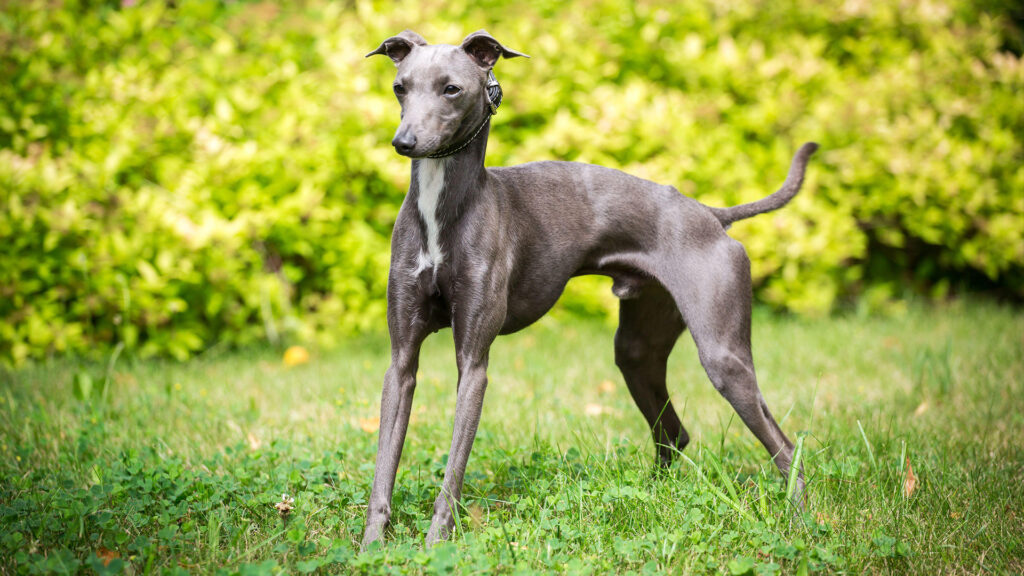
The smallest sighthound with the nobility of a statuette: delicate, fragile, gentle and devoted. The Italian Greyhound blends a sighthound’s grace with a lapdog’s attachment; it loves warmth and sofa comfort, but has fragile bones and so needs careful handling.
ApartmentKids · with caveatsCats · with caveatsOther dogsBeginners · with caveats
The Italian Greyhound, also known as the Piccolo Levriero Italiano or simply the Iggy, is a refined pet that combines an aristocratic, decorative appearance with the genuine, fiery temperament of hunting sighthounds. A courtly dog, happily depicted in the art of antiquity, the Renaissance, and Classicism, it has today become the ideal companion for many city dwellers who value aesthetics and loyalty. Handling the Italian Greyhound's character is not simple, but in return, it requires relatively uncomplicated physical care. This dog needs a sensitive owner, a family with older children, or a couple who have time to communicate with the animal. The main thing is to provide this miniature athlete with a friendly atmosphere, protection from the cold, and a sufficient amount of attention. Learn more on Tvaryny.
Italian Greyhound: brief overview and profile
Italian Greyhound: brief overview and profile · 7
Characteristic
Data
Country of origin
Italy
Purpose
Companion dog, racing dog
FCI Classification
Group 10 (Sighthounds), Section 3 (Short-haired sighthounds)
Life span
12–15 years (some live to 16–17)
Height at withers
32–38 cm (FCI standard), up to 38–40 cm (AKC standard)
Weight
Maximum 5 kg (ideally 3.5–4.5 kg)
Coat type
Short, fine, satin-like, without undercoat
Anatomy of grace: what the Italian Greyhound looks like
Italian Greyhounds are aerodynamics in pure form. They are easily recognised on painted canvases and at the modern dog park among other breeds. This is a model of the canine world: long-legged, dry, without a drop of excess fat. The body of the Italian Greyhound fits into a square, although visually the dog often seems taller than it is long.
Head: Narrow and long, resembling an arrow tip. The length of the head can reach almost 40% of the dog's height at the withers. The transition from forehead to muzzle (stop) is very poorly expressed.
Eyes: Very large, dark, set wide apart. The Italian Greyhound's gaze is often described as "moist" or "pleading". It is so expressive that it is capable of melting the heart of even a stern dog critic.
Ears: Small, with thin cartilage, set high. In a calm state, they are folded back along the neck (the so-called "rose" ear). When the dog is alert, the ears rise at the base, and the tips remain pointing sideways ("flying ears").
Body: Characterised by a curved top line (arch), which is typical for sighthounds. The chest is narrow but deep, descending to the elbows, which ensures a large lung volume for running. The stomach is tucked up tightly.
Limbs: Long, lean, with expressed thigh musculature. The feet are elongated ("hare feet"), which allows for a powerful push.
Tail: Set low, thin even at the base, tapering towards the end. Often tucked between the hind legs, which does not always mean fear, but is an anatomical feature.
The coat of the Italian Greyhound is very short, fine, silky to the touch, and completely devoid of undercoat. It gleams in the sun like satin, however, it sheds noticeably with tiny "needles" throughout the year, especially during stress. Regarding colour, there are discrepancies between standards here. The European standard (FCI) recognises only solid colours: black, grey (blue), and isabella (beige) in all shades. White markings are permitted only on the chest and feet. The American standard allows any colours and spotting, except for brindle and black-and-tan.
Interesting facts about Italian Greyhounds
Royal status: The Italian Greyhound was the only breed of dog allowed to be present at official receptions at the court of Queen Victoria.
Living hot water bottles: In medieval castles, where it was cold and damp, Italian Greyhounds were used as living heaters in the beds of aristocrats.
Speed record: Despite its small stature, the Italian Greyhound can reach speeds of up to 40 km/h.
Smile: Many owners claim that Italian Greyhounds know how to smile, baring their teeth in a moment of joy (which non-specialists might confuse with a snarl).
History of the breed: from Pharaohs to modern sofas
The history of the Italian Greyhound is a fascinating journey through the ages, starting in the palaces of Egyptian pharaohs. Mummified remains of miniature sighthounds, very similiar to modern Italian Greyhounds, are found in the tombs of the Valley of the Kings. From the banks of the Nile, these elegant creatures made their way to Ancient Greece (Laconia), where they posed for vase paintings and frescoes, and from there - in the 5th century BC - they moved to Ancient Rome.
It was on the territory of modern Italy that the breed reached its greatest flourishing and acquired its current appearance, for which it received the name "Italian Greyhound". Roman patricians highly valued the decorative qualities of these dogs. They were looked after like the most expensive ladies, had silk cushions sewn for them, and were depicted in the murals of Pompeii. There is a legend that the famous inscription "Cave Canem" (Beware of the dog) was sometimes placed with irony exactly where these tiny but vocal guards lived.
The fashion for four-legged aristocrats was adopted by Europe during the Renaissance. The Italian Greyhound became a symbol of status and refined taste. Among the famous owners of the breed were the powerful Medici family, French kings, and later - the British Queen Victoria, the Russian Empress Catherine II, and the Prussian King Frederick the Great. The latter loved his dogs so much that he requested to be buried next to them at Sanssouci.
However, excessive popularity almost played a cruel joke on the breed. By the beginning of the 20th century, the desire of breeders to make the dog as small and refined as possible led to degeneration due to close inbreeding. The dogs became sickly, with distorted skulls and brittle bones. To save the breed, in the 1920s and 30s, cynologists took a risky step: Italian Greyhounds were carefully crossed with Whippets to strengthen the skeleton and Miniature Pinschers to maintain the small size. Thanks to such a renewal of the gene pool, it was possible to preserve not only the short stature but also - most importantly - the true sighthound qualities and instincts of the dog.
Psychology and character: a gentle soul in a sprinter's body
This aristocratic dog has a delicate, almost "exposed" nervous system, so the mood and behaviour of the Italian Greyhound depend heavily on the emotional state of the owner. They are high-level empaths: if you are sad, the Iggy will lie next to you and sigh; if you are joyful, it will zoom in circles around the room. One must not treat these sensitive pets too harshly; shouting or physical punishment can break the dog's psyche forever, making it timid.
Temperament features
However, having shown weakness once, the Italian Greyhound is easily spoiled. It will instantly understand that it is allowed to sleep on the owner's head (literally) and steal food from the table. The Italian Greyhound is easily excited; trembling for it is a normal reaction not only to cold but also to joy, fear, or the anticipation of a walk.
It is worth remembering that despite its fragility, at heart, this is a true hunter, just like its larger relatives. If you want to understand the difference in temperament between different types of sighthounds, it is worth reading about the Whippet, which is the "big brother" of the Italian Greyhound, or about the giant Greyhound. They all share a common trait - a passion for chasing moving objects.
Representatives of the breed get along wonderfully with each other, often sleeping in a "pile" of several dogs. But they should not be housed next to other large active dogs that might accidentally injure the Italian Greyhound in play. A cat is also not the best neighbour for an Iggy unless they grew up together, as for a sighthound, anything that runs is prey. Italian Greyhounds are "velcro dogs". They will try to be in physical contact with a human 24/7. They are characterised by insight, and along with that - shyness before strangers.
Training and socialisation: how to negotiate with an aristocrat
Despite good intelligence and natural cleverness, Italian Greyhounds do not take well to classical training (of the "service" type). Stubbornness accompanies representatives of the breed even in classes with a beloved owner. They might execute a command 5 times, and on the 6th look at you with an expression: "But why?". This is not a Kunming Wolfdog that lives for work, nor even a hunting Schwarzwald Bracke (Forest Dachshund) which has greater persistence in tracking. The Italian Greyhound works only for positive reinforcement and only while it is interested.
Key moments of upbringing:
Toilet: This is the most difficult aspect. Italian Greyhounds hate cold and rain, so in bad weather, they may refuse to do their business outside. These domestic pets can and should be trained to use a puppy pad or litter tray in the house as an "emergency option".
Socialisation: From an early age, an Italian Greyhound puppy must be introduced to different people, sounds, and situations to overcome natural shyness.
Recall: Never let an Italian Greyhound off the lead in an unfenced area! The instinct to chase is stronger than any command. If it sees a squirrel or a flying plastic bag, it will run, not hearing your shouts.
If you want to play sports, then coursing (running after a mechanical hare) or agility is the ideal programme for an Italian Greyhound. Without physical exercise, the dog will start using its energy for mischief, chewing furniture, and destructive behaviour.
Pros and cons of the breed
Before getting this breed, it is worth weighing all the pros and cons, because the Italian Greyhound is not a dog for everyone. Compared to other small breeds, for example, a dog like the Russian Toy Smooth-haired, the Italian Greyhound requires more movement and has a more complex character.
Pros (+)
Cons (-)
Almost no "doggy" smell and sheds little.
Difficult to house train (especially in rain/snow).
Very affectionate, people-oriented.
Excessive "clinginess", prone to separation anxiety (howling when alone).
Convenient size for travel and apartments.
High risk of limb fractures.
Economical in nutrition.
Requires expensive and varied clothing.
Aesthetically perfect beauty.
Hunting instinct: may run after prey.
Care and maintenance: warmth above all
Italian Greyhounds belong exclusively to apartment dogs. They are categorically not adapted to life outdoors or in a kennel. Moreover, in the cold season, the apartment must be warm, otherwise, the dog will constantly hide under the blanket. By the way, if you like to sleep alone, the Italian Greyhound is not the option for you. It will persistently ask to come into your bed.
Clothing and walks
Sighthound blood gives them no peace within four walls - such a pet should be walked often and actively. The best solution would be a joint jog or a visit to a fenced area where the dog can safely gather speed. Dogs of this breed are critically sensitive to cold and dampness. They have almost no fat layer, so the wardrobe of an Italian Greyhound is often larger than that of the owner. You will need:
Demi-season: light jumpers, raincoats.
Winter: insulated overalls with a covered tummy, snoods (to protect thin ears), sometimes shoes.
Hygiene
The short and silky coat of the Italian Greyhound is sufficient to wipe with a damp towel or a special mitt. Representatives of the breed are bathed only when necessary, using mild shampoos for sensitive skin. However, teeth cleaning should become a daily ritual, as the breed is prone to rapid tartar formation and tooth loss at an early age. Claw trimming is another important procedure. Due to their low weight, claws are not worn down naturally, and overly long "talons" change the posture of the paw and can lead to injuries.
Nutrition
Nutrition: not a vegan, but a carnivore
Health and risks
Health of the Italian Greyhound: weak spots and prevention
Frequently Asked Questions about the breed (FAQ) · 3
Do Italian Greyhounds bark? They are not "yappers" like some other small breeds, but they will bark to warn of the arrival of strangers or during play. Their bark is quite ringing, however, they rarely bark without reason.
Are they suitable for families with children? Only if the children are older (school age) and understand how to behave with a fragile dog. For toddlers, the Italian Greyhound is too delicate - a child can accidentaly injure the dog simply by falling on it or squeezing it too hard in a hug.
Can they be left alone at home? Italian Greyhounds tolerate loneliness very poorly. If you work 10 hours in an office, this dog will suffer. A good solution often becomes getting a second Italian Greyhound - it is calmer for them together.
Video about the breed
FAQ
Is it true the Italian Greyhound has fragile bones?
Yes — the thin long legs are prone to fractures, especially when young; avoid jumps from a height and rough play.
Does the Italian Greyhound feel the cold?
Yes — the short coat and small mass hold heat poorly; in cold weather it needs clothing and a warm home.
Is the Italian Greyhound good for a flat?
Very — compact, clean and barely sheds; it loves warmth and a soft spot beside its person.