

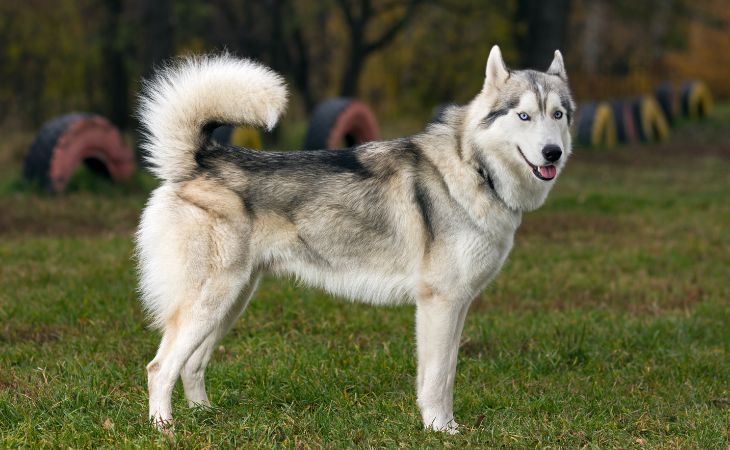
| Height | ♂ 53.5–60 cm · ♀ 50.5–56 cm |
| Weight | ♂ 20.5–28 kg · ♀ 15.5–23 kg |
| Lifespan | median 11.9 years |
| FCI group | 5 · spitz, section 1 |
| Origin | USA by the FCI standard; ancestors from Siberia |
Exact ratings
Common health issues
Nutrition
The Siberian Husky is a medium-sized working sled dog carrying more durable myths than any other northern breed: half-wolf, untrainable, blue-eyed by definition, unable to live anywhere warm. None of it survives a meeting with the primary source — the text of the breed standard, or the genomic work of recent years. This page is built in that order: first the document or the study, then the conclusion. Learn more on Tvaryny.
FCI Standard No. 270, and the Kennel Club edition beside it
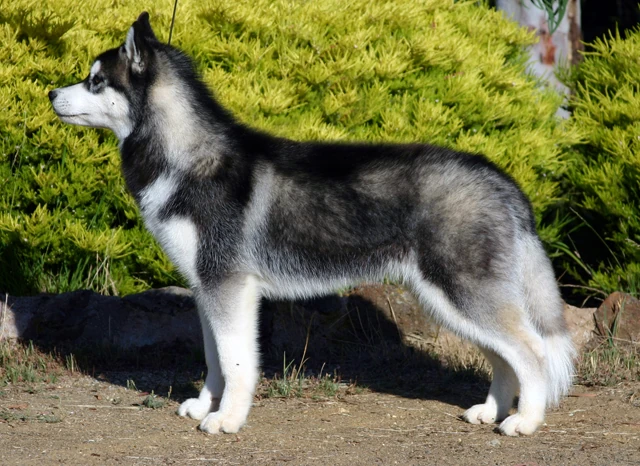
The current edition of the Fédération Cynologique Internationale standard was published on 18 November 2022. The breed sits in Group 5 (spitz and primitive types), section 1, Nordic sledge dogs, without working trial. The document describes a medium-sized working dog, quick and light on his feet, moving freely and gracefully, with a gait called smooth and seemingly effortless. Balance is spelled out: the husky “never appears so heavy or coarse as to suggest a freighting animal, nor so light and fragile as to suggest a sprint racing animal”.
That sentence is a working criterion, not decoration. The breed was built neither to shift the greatest load nor to post the greatest speed, but to carry a light load at a moderate pace over a long distance. Everything else follows from that one job.
A British reader meets the breed through a second document. The Kennel Club registers the Siberian Husky here, publishes its own edition of the standard, and files the breed in the Working group rather than a numbered FCI group. It also runs Breed Watch, the scheme under which judges look for visible points of concern in the ring and report them. Two registries, two editions, one dog: the papers differ in wording and filing, not in the animal in front of you. Still worth knowing which one a breeder is quoting when they tell you what is “correct”.
Height and weight: why a single figure for the breed is a mistake
The commonest inaccuracy in popular descriptions is merging the male and female limits into one range. The standard separates them, and the numbers only mean anything separated.
| Measurement | Dogs | Bitches |
|---|---|---|
| Height at the withers | 53.5–60 cm | 50.5–56 cm |
| Weight | 20.5–28 kg | 15.5–23 kg |
| Disqualified on size | over 60 cm | over 56 cm |
The standard adds a caveat that matters: these are outer limits, and none is preferred. A dog near the top of the range is not better in type than one near the bottom. Any suggestion of excessive bone or weight is, in the words of the document, to be penalised in the ring.
The American Kennel Club publishes the same standard in imperial units: 21–23.5 in for dogs and 20–22 in for bitches, 45–60 lb and 35–50 lb. Not a different breed and not a different requirement — the same document in other units, since the American edition is what the international one was built on. In the AKC popularity listing the breed sits 26th of 210: no rarity, but a mass-market breed, with everything mass demand brings.
Country of origin: why the standard says USA and not Siberia
Under “origin” the FCI standard records: U.S.A. For many that is a surprise, given the name. There is no contradiction. In the language of the registries, country of origin means the country responsible for the standard and in which the breed was fixed as a breed — not the geography the ancestors came from.
The ancestors did live in north-eastern Asia. But the dog with a name, a standard, a stud book and a fixed type came together in Alaska, from lines imported to Nome at the start of the twentieth century. Siberian roots, American breed-making — which is why descriptions of the breed carry two “right” answers at once, each correct depending on whether you ask about ancestry or about the register.
Chukchi dogs and Arctic lines: what the DNA actually says
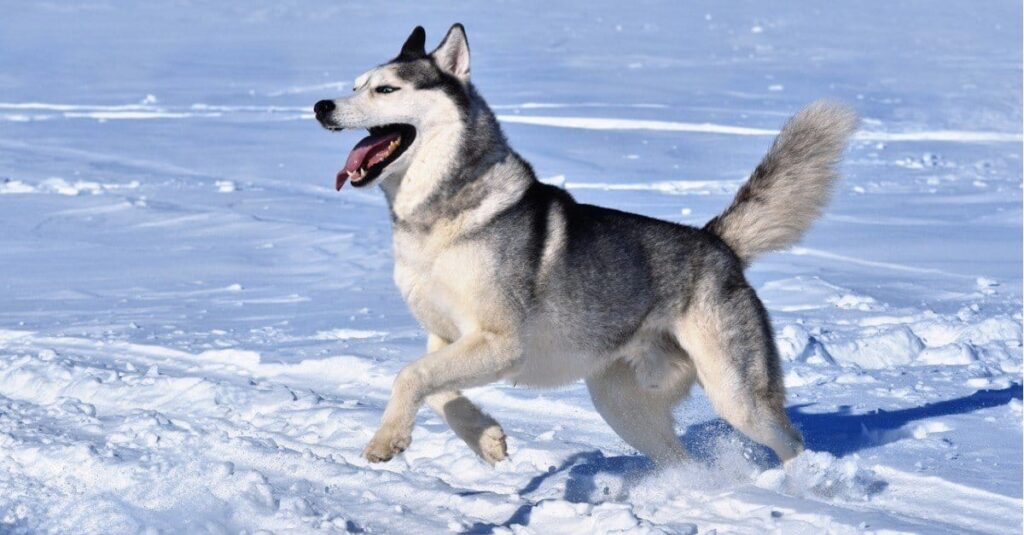
The traditional account says the modern Siberian Husky was made by the Chukchi, who needed a dog able to cover long distances with a light load in extreme cold while eating very little. That fits what we know of Arctic dog keeping in general, and there is no reason to abandon it.
Its status is worth being clear about. It is breed history, supported by twentieth-century documents and oral tradition — not a direct genetic test of a modern husky against ancient Chukchi bone. Arctic dog palaeogenomics consistently shows Siberian dog populations taking in a substantial flow of genes from outside over the last few thousand years, from the Eurasian steppe and from Europe. A sealed, unbroken line from a Chukchi team to today’s show husky therefore simplifies something more complicated. The breed has Arctic roots; it has no hermetic pedigree.
“Half wolf”: what the genomes show
This is the most persistent myth about the breed, and it feeds on appearance: pricked ears, a masked face, pale eyes. The answer is assembled from three separate findings.
First. A 2004 study of 85 breeds did identify breeds of “ancient” origin, set apart from the rest with their modern European roots; differences between breeds accounted for roughly 30% of all genetic variation, and dogs were assigned correctly to their breed in 99% of cases. Later work on single-nucleotide polymorphisms confirmed the Siberian Husky among the strongly divergent breeds and set out a “northern group” of the Alaskan Malamute and the Siberian Husky. That same study states plainly that convincing evidence of admixture with wolves is found only in a minority of breeds.
Second, and most important. In 2012 a study compared 49,024 autosomal markers across 1,375 dogs from 35 breeds and 19 wolves, then laid the genetic data over the world archaeology of the oldest dog remains. The authors deliberately changed the terminology: instead of “ancient” they use “basal”, and they explain why — to avoid conflating genetic differentiation with presumed ancient heritage. The conclusion is sharper still: what unites the basal lineages is not age but geographical or cultural isolation from the nineteenth-century European centre of breed-making, that is, an absence of gene flow with other breeds.
The label “ancient breed”, then, never meant “closer to the wolf” but “mixed less during the European breed-making boom”. The bridge from ancient to wolf-like to half-wolf collapses at the first step.
Third — direct evidence rather than reasoning, and it deserves its own section.
Balto under the microscope: the genome of a dog from 1925
Balto’s mounted body is kept at the Cleveland Museum of Natural History, and in 2023 a complete genome was read from it and set against an alignment of 240 mammals and 682 twenty-first-century genomes of dogs and wolves. The sentence that closes the wolf question reads: he carried no discernible wolf ancestry.
The rest is no less interesting. In an admixture analysis across 2,166 dogs and 116 clusters, 68% of his ancestry fell to clades of Arctic origin and 24% to Asian ones; a further 8% could not be assigned with confidence. Alaskan sled dogs accounted for 34% of his ancestry. Balto was therefore not a pure-bred Siberian Husky in the modern sense: he shared only part of his ancestry with the breed.
From genetic markers of stature he was predicted at 55 cm at the withers, inside the modern limits of 53–60 cm. He had a double coat, dark eyes, and was mostly black with a little white. His population was also more varied genetically than modern breeds: shorter runs of homozygosity than any pure-bred dog in the sample, lower inbreeding, fewer rare variants at functionally important positions.
Digestion makes a separate story. Balto carried the “dog” rather than the “wolf” version of MGAM, the gene behind starch digestion, so he handled starchy food better than Greenland sled dogs. But he had fewer copies of the amylase gene AMY2B than many modern dogs — a neat warning about simple claims regarding a breed’s “natural diet”.
The 1925 Serum Run: the figures and the limits of counting
In the winter of 1925 an outbreak of diphtheria in Nome threatened an isolated town, and the weather ruled out delivery of the antitoxin by aeroplane. The nearest point the serum could reach by rail was Nenana, 674 miles (1,085 km) away. The relay was assembled from 20 teams; 300,000 units of serum crossed that distance in five and a half days.
Here the sources do not contradict one another but mislead easily, because they count different things. Leonhard Seppala, with Togo in lead, covered 264 miles (425 km), while the average for every other team was around 31 miles (50 km). Balto led the final leg of 53 miles (85 km). All three are true at once, which is why “whose contribution was greater” has no arithmetical answer: one number is one team’s total run, the second an average across the relay, the third one closing stretch.
On top of that sits a difference in kind that does not show up in miles. Seppala cut straight across the frozen Norton Sound: shorter, but over ice that could break up beneath the team. That risk does not fit into a table of distances.
Togo and Balto: why the fame went to the wrong dog
Balto got a statue in Central Park in New York and became the name everybody knows. Togo, who was 12 at the time of the run, received a monument of his own in Seward Park only in 2001. Historians and dog people have long pointed out that it was Seppala’s team that covered the decisive section.
Togo’s own story is worth a paragraph. Born in 1913 to a bitch called Dolly, he struck Seppala as too small and unsuited to work; given away to neighbours, he broke a window and came home. At eight months he went into harness for the first time and covered 75 miles that same day, growing into a lead dog at the first attempt.
The run gave the breed worldwide fame: it was after Nome that the American Kennel Club recognised the Siberian Husky. But the first Siberian dogs reached Nome earlier, brought by the fur trader William Goosak, and in 1909 his team came third in the All-Alaska Sweepstakes despite the locals looking down on these small dogs. The next year the driver Fox Ramsay imported 60 dogs from Siberia, and in 1910 an all-Siberian team under the driver nicknamed “Iron Man” Johnson came home first, setting a course record. Seppala himself won the race three years running, in 1915, 1916 and 1917.
Blue eyes: the duplication beside the ALX4 gene
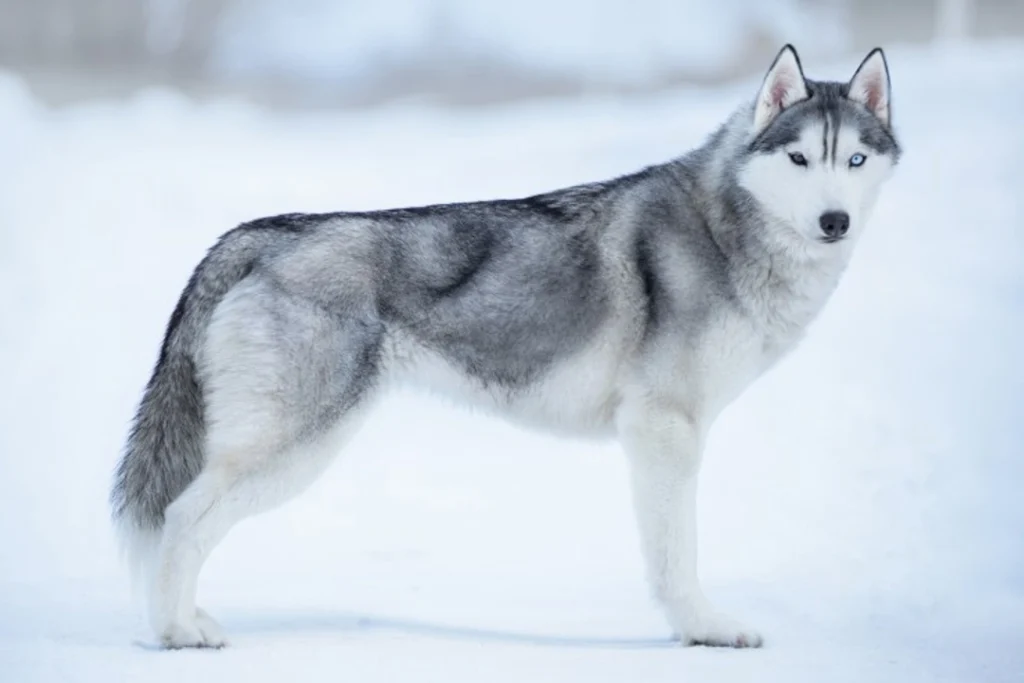
The FCI standard puts it briefly and without ceremony: eyes almond-shaped, moderately spaced, set a little obliquely; “eyes may be brown or blue; one of each or parti-coloured are acceptable”. No preference is given to a blue eye. It is a permitted variant, not a breed requirement and not a mark of quality. A brown-eyed husky is exactly as much a husky.
The genetics were worked out in a large 2018 study built on consumer DNA tests: more than 3,000 dogs in the discovery sample and almost as many again in validation. A new locus turned up on chromosome 18, and the likely causal variant proved to be a tandem duplication 98.6 kilobases long, immediately upstream of the homeobox gene ALX4. The association is striking: by chi-square the P value came out at 5.2×10⁻²⁹⁰.
The figures an owner should keep hold of: the minor allele was carried by only 10% of all dogs in the sample, but by 78% of non-merle blue-eyed dogs and by all 22 blue-eyed pure-bred Siberian Huskies in the analysis. A single copy is enough to turn an eye blue, yet penetrance is incomplete — in a panel of 314 non-merle carriers, 87 dogs (26%) had at least one blue eye. Carrying the variant guarantees nothing, which is why one litter can produce puppies with different eyes. Overall the duplication accounts for at least 75% of blue-eyedness in the sample: 81 cases out of 108.
Where it was not found is just as telling: absent from the sequenced whole genomes of the Alaskan Malamute, the Samoyed, the East Siberian Laika and the German Shepherd Dog. That fits the malamute standard, which treats a blue eye as a disqualifying fault outright.
Why a husky’s blue eye is not merle
This is where the confusion does the most damage, because it is the confusion on which the advertising of “rare merle huskies” is built.
In that same 2018 study, blue eyes produced two independent signals. One was the known merle locus on chromosome 10, the gene PMEL17. The other was the new locus on chromosome 18 beside ALX4, the one that operates in huskies. Different genes on different chromosomes. A Siberian Husky’s blue eye has nothing to do with merle.
The consequence is direct. The FCI standard lists the merle and brindle patterns among the disqualifying faults, and separately defines merle so it will not be confused with the banded guard hairs among white that are normal on a piebald dog. A “merle husky” is therefore either a normal colour read wrongly or another breed mixed in. It cannot be a breed rarity by definition: the standard does not admit the pattern.
One further clarification removes a common worry. The parent club states directly that inherited eye defects in this breed occur in any eye colour. A blue eye does not by itself make a dog more prone to sight problems and is not a risk marker — unlike merle breeds, where double merle genuinely is linked to sensory defects.
The Alaskan husky is a working type, not a breed
The dogs that win the Iditarod and the sprint races are mostly called Alaskan huskies, and that is not a breed. No standard, no stud book, no register — just a population selected for a century on one thing: the result on the trail.
It has been taken apart genetically. In a 2010 study, 199 Alaskan sled dogs were genotyped at 96 microsatellite markers and compared against 141 pure-bred groups. The population proved to have a molecular signature of its own, and its profile distinguishes sprint dogs from distance dogs. The contribution of the Alaskan Malamute and the Siberian Husky was associated with endurance; the pointer and the saluki with speed; the Anatolian shepherd with what the researchers called work ethic.
Later work sharpened the picture: the Alaskan sled dog genome is enhanced by the differential contribution of four unmixed breeds — the Alaskan Malamute, the Siberian Husky, the German Shorthaired Pointer and the borzoi. Principal component analysis on 115,000 markers separated the sprint and distance populations cleanly; linkage blocks in the distance dogs are longer (7.5–10 kilobases) than in the sprinters (2.5–3.75 kilobases).
The most interesting result came from comparing the best dogs with the weakest. The only region of the genome significantly associated with performance concerned heat tolerance: seven markers in the gene MYH9, two matching conserved promoter and enhancer regions of the human orthologue. The limiting factor in racing turned out to be overheating rather than cold — and resistance to it entered the population with pointer blood, not northern blood.
For a buyer this yields something simple: when a seller promises “a working line of real racing huskies”, ask which dogs are meant. An Alaskan husky and a Siberian Husky are different things, and their paperwork differs by nature.
Malamute, Samoyed and Klee Kai: how not to muddle them
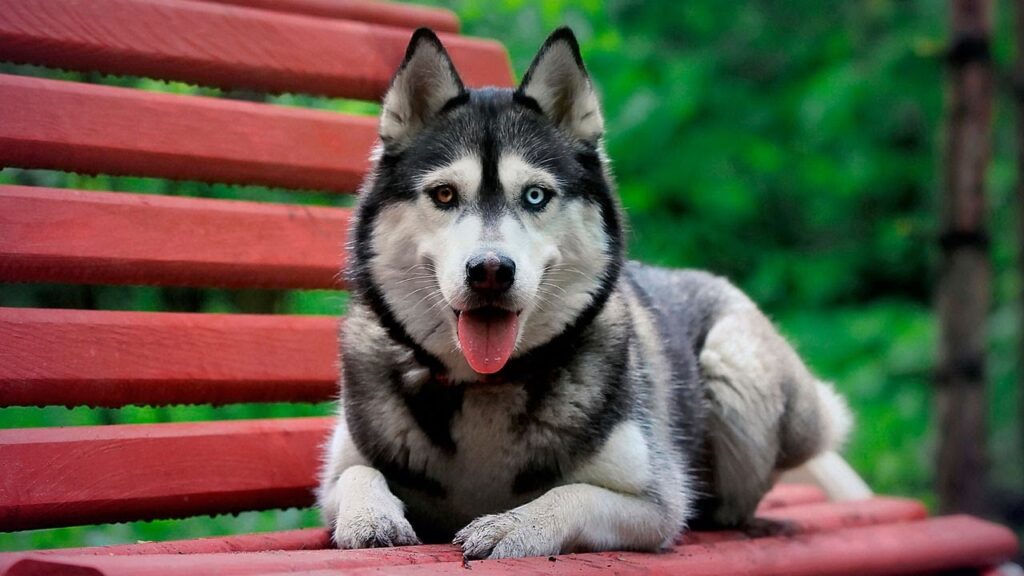
The Alaskan Malamute is a freighting dog, and its standard says so through a “desirable freighting size”: 63.5 cm and 38 kg for dogs, 58.5 cm and 34 kg for bitches. Not a range but a target — all else being equal, preference goes to the dog closer to the point. And here is the marking that identifies a malamute in a second: a blue eye in a malamute is a disqualifying fault. If the large northern dog in front of you has blue eyes, it is not a malamute.
The Samoyed has a standard of its own, setting an ideal height of 57 cm for dogs and 53 cm for bitches with a tolerance of 3 cm either way. That standard calls the hunting instinct very weak and notes that the Samoyed cannot be used as a guard dog — an important difference from the husky, whose prey drive is strongly expressed.
The Alaskan Klee Kai looks like a scaled-down husky and is marketed as a “mini husky”. Its status, precisely: the FCI does not recognise it, the American Kennel Club has not granted it full recognition, while the United Kennel Club recognised it long ago. It is not a reduced Siberian Husky but a separate breeding programme with its own history, and the hope that smaller size means smaller exercise needs mostly goes unrewarded.
Three huskies inside one breed: show, sled and pet
This is one of the most useful things a buyer can know, and it entered the literature only recently. In 2025 a study genotyped 237 Siberian Huskies on a panel of 234,990 markers and divided them by purpose: pets, show dogs, sprint sled dogs and distance sled dogs.
The groups separated on the first principal component, which explains 20.30% of the genetic variation and splits sled dogs from show dogs; the second component (18.86%) separated the subcategories within. This is not a cosmetic difference in type but different directions of selection, already visible in the genome.
In substance: in show lines the traces of selection fall on genes for immune function, tissue and nervous-system development and cytoskeletal motor activity; in sled lines on the development of muscular organs and the vasculature of the lungs, on what works directly under load; in pet lines, on genes of olfactory function.
The practical conclusion: asking “which line?” is not snobbery but a way of understanding what dog you will live with. A distance sled dog in a town is a different proposition from a dog out of a show kennel.
Temperament: what the standard promises and what owners see
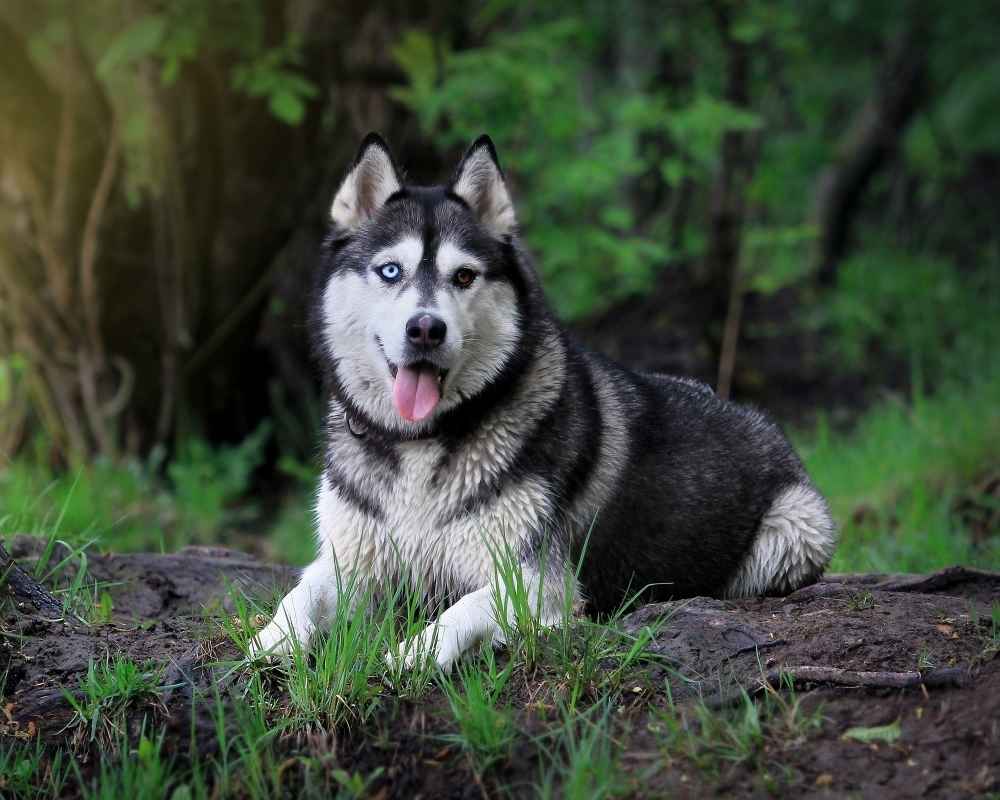
The standard describes character with unusual precision: friendly and gentle, but also alert and outgoing; the breed “does not display the possessive qualities of the guard dog” and is neither unduly suspicious of strangers nor aggressive with other dogs. A degree of reserve and dignity is expected of the mature dog.
The wording about guarding repays a careful reading. This is not an incidental weakness but a property written into the document. A husky that barks at a visitor and holds the garden is not a better representative of the breed but an atypical one. If you want a guard, this breed does not fit by design, not through some failure of upbringing.
The other side of the same trait is sociability. The breed took shape where dogs lived close to people in a confined space and aggression towards humans was intolerable. Tolerance of other dogs comes from the same place: a husky is used to working in a team rather than alone.
Training: why “untrainable” is the wrong word
The claim that a husky cannot be trained contradicts the standard itself, which calls the breed tractable and lists intelligence, tractability and eagerness among the qualities that make it an agreeable companion and a willing worker. The document describes a dog capable of learning.
What lies behind the complaints, then, is the difference between learning a command and performing it in all circumstances. A dog selected for centuries on the ability to make decisions on the trail — to go round unsafe ice, hold a pace, not stop because the driver is out of sight — was never meant to become an executor awaiting instructions. That independence has not gone anywhere.
In practice, methods built on pressure and repetition work badly on a husky, and methods that give the dog a reason work well: motivation, short sessions, work on real ground rather than drilling on a training field. And an honest limit — obedience beside a road and obedience out in the open with a cat flickering past ahead are two different things, and the second cannot be trained to the point of a guarantee.
Escaping and prey drive: the owner’s real risk
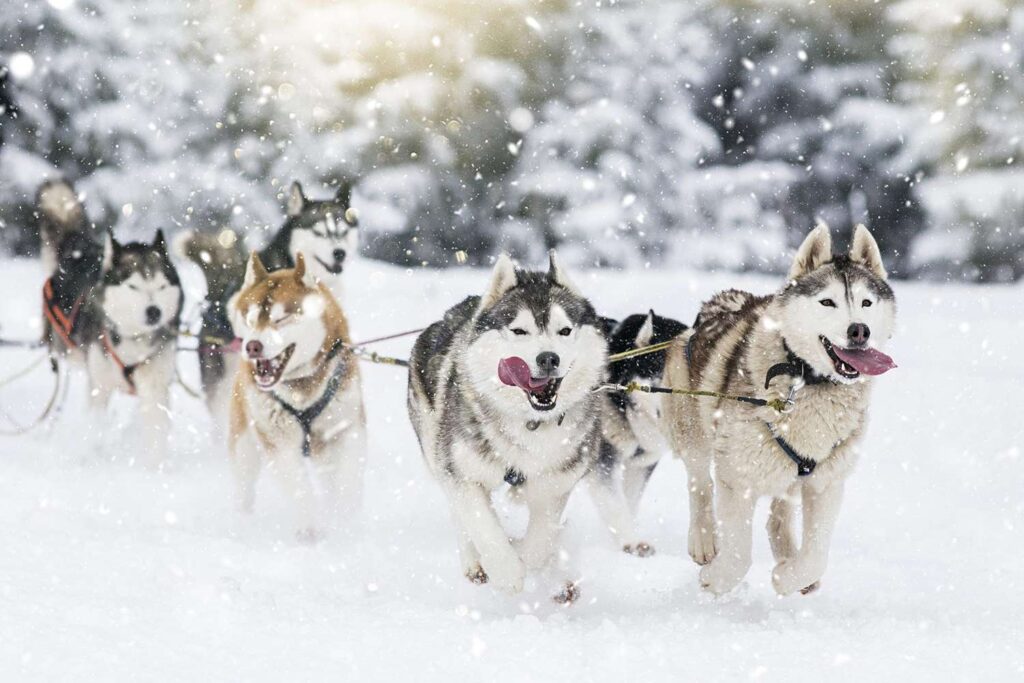
If you remember one paragraph from this page, make it this one. The commonest reason a husky dies or ends up in rescue is not disease but escape. The breed combines three traits, none critical alone, which together produce a high risk: a strong drive to keep moving forward, a marked prey drive towards small animals, and an almost engineering inventiveness with fences — digging under, going over, opening the latch.
A comparison with breeds developed for hunting helps. Unlike, say, the Podenco Campanero, which works in partnership with the hunter and stays oriented on him, a husky chases quarry for itself. That changes everything: the dog does not come back to report, it simply carries on. Which is why a husky should not be let off the lead outside a fully enclosed area — and no level of obedience cancels that.
What works: a high fence with dig protection, a self-closing gate, a lead, or trained work in harness — canicross, bikejoring, skijoring, the sled. What does not: hoping that “ours isn’t like that” and that the dog will grow out of it. Prey drive does not disappear with age, it merely becomes less impulsive.
The same instinct answers the question about cats. A cat that has grown up alongside the puppy often counts as one of the household. A strange cat in the street stays quarry, and that is not upbringing but the wiring of a response to the quick movement of a small object.
Coat and moulting: why huskies are not clipped
The standard describes the coat as double and of medium length: a soft, dense undercoat able to support the guard hair, and guard hair that is straight and lies smooth, never standing off. It notes separately that the absence of undercoat during the moult is normal, not a fault to be disguised.
On clipping the standard is almost legalistic. Trimming the whiskers and the hair between the toes and around the feet for tidiness is permitted. Trimming the coat on any other part of the dog is, word for word, “not to be condoned and should be severely penalised”. In the ring, then, a clipped husky is not a matter of taste but a breach.
Outside the ring the argument is mechanical: a double coat insulates in both directions, holding warmth in winter, slowing the heating of the skin in summer and shielding it from the sun. The status of that advice deserves precision. It does not rest on controlled trials of clipped against unclipped dogs in heat; it rests on a mechanism and on professional consensus rather than on a clinical study. Stated honestly: there is nothing to be gained by clipping, and the possible harm — sunburn and a disturbed coat structure once it regrows — is real enough.
Day-to-day grooming is simple. The seasonal moult runs for several weeks twice a year, and the dog then needs daily work with a slicker brush and a comb; out of season, once a week is enough. The breed has practically no “doggy” odour, so frequent bathing is unnecessary.
Heat: what has been measured and what is still only advice
The claim that a husky cannot live in a warm climate is too categorical, but the opposite claim — no problem at all — does not match reality either. Here is what is known.
A classic physiological study on 22 sled dogs showed rectal temperature rising during the first 15–20 minutes of running, then reaching a plateau. The key observation: the size of that rise correlates with air temperature, not with speed or distance covered. Risk is set by the weather, not by how hard the dog works. The same work noted that conditioning reduces the rise.
The second piece of evidence has been mentioned: in racing Alaskan sled dogs the only region of the genome significantly associated with performance was the one concerning heat tolerance. That shows how far overheating is a limiting factor even in the Arctic.
There is data from a warm country too. A survey of Siberian Husky owners in Brazil found them well aware of how poorly their dogs adapt to heat — excessive drinking, panting, seeking shade — and around 97% choose the cooler hours for walks. The status of the data matters: this is a survey of owner perception, not physiological measurement, so it describes the behaviour of people rather than the thermodynamics of the dog.
The summary all three sources support: huskies do live in warm countries, but only on a managed routine. Exercise moves to the cooler hours, shade and constant water are provided, hard work in the heat is dropped — and the dog is not shaved in the hope that this helps. Even a British summer is worth planning around: a hot spell here catches out more northern dogs than a hard winter does.
Eyes: cataract, corneal dystrophy and XLPRA
SHPN1 and SPS1: diseases we only learned about recently
Epilepsy: what is actually known about it
Epilepsy appears on almost every list of Siberian Husky health problems, and almost nowhere is it said what that line rests on. It rests on two kinds of number that are easy to confuse: how often the disease occurs, and how often the breed occurs among the dogs that have it. Not the same statement.
Prevalence. In dogs generally, epilepsy is estimated at roughly 0.6–0.8%. For Huskies a figure of 0.67% is quoted (95% CI 0.42–0.92) — but the researchers citing it add their own caveat: it is unclear whether it covers Siberian Huskies alone or all “husky-type” dogs, Alaskan huskies included. A blurred denominator, and blurred exactly where the breed and the working type get mixed up.
Share among affected dogs — a different claim. A retrospective study of a US primary-care network identified, over four years, 853 dogs with idiopathic epilepsy, or 0.03% of the population searched. The Siberian Husky was the second most frequent breed in that sample: 7.5% (64 of 853), behind the Labrador Retriever (8.3%, 71 of 853). Median age at diagnosis was 3.3 years; males were 60.6% of cases.
How to read that is stated by the authors themselves, and it matters more than the percentages: the affected sample was never compared with a cohort of unaffected dogs, so the figure describes the breed’s share among diagnosed dogs, not evidence of predisposition. They add plainly that current literature does not strongly support treating the Siberian Husky as predisposed, and that its visibility may simply reflect how common the breed is. Recall the number from the top of this page: 26th of 210 in popularity. The more dogs of a breed a country holds, the more turn up on any list of the sick — even at ordinary risk.
The genetics is the most concrete thing available. A genome-wide association study on this breed covered 113 Siberian Huskies: 24 with idiopathic epilepsy and 89 controls, seizure-free at enrolment and at least 7.5 years old. The lead marker was then checked in a further 57 dogs. The signal was single and sharp — on chromosome 3, inside the gene KCNIP4.
In the pooled sample of 170 dogs, carriers of one copy were affected in 61% of cases (19 of 31), and all five dogs carrying two copies were affected. The distribution across lines is telling too: in an independent set of 279 Siberian Huskies the frequency was 0.068, concentrated in show and pet lines and rare to absent in the racing ones — the same Seppala and racing split described in the section on show, sled and pet dogs.
And now what matters most — the limit of this knowledge. The authors write plainly that the marker is a research finding rather than a predictive test, and that commercial use would be premature for now: the causal variant has not been found or functionally confirmed. That males among carriers are affected more often and earlier they likewise call hypothesis-generating, not causal; the same goes for the note on neutering before five years of age. For a buyer this is simple: epilepsy is documented in the breed, but there is as yet no DNA test to ask a breeder for — unlike SHPN1, SPS1 and XLPRA. Ask about seizures in close relatives, not about a certificate.
Hips, skin, zinc and feeding
Working physiology your vet ought to know about
This section concerns dogs that genuinely work in harness, but the town owner should read it too: it explains why some blood results in this group are read differently.
The thyroid. In a study of 86 retired sled dogs aged 9–13 years, all sound on examination and in normal body condition, thyroid values fell below the reference interval in a substantial share: 38% on total thyroxine, 45% on free thyroxine, 37% on triiodothyronine. Thyroglobulin antibodies were absent in every one and thyroid-stimulating hormone stayed normal, so there was no autoimmune thyroiditis. In earlier work on racing dogs, about a quarter fell below the range. The authors’ conclusion is blunt: such dogs may be misdiagnosed as hypothyroid and started on replacement therapy they do not need. A separate study showed training, and exercise itself — there a sled pull of 68 kilometres — significantly lowering these values.
For an owner: if a dog that works seriously, or has recently stopped, comes back with a low T4, that is a reason to re-read the result against its workload and investigate further, not to start treatment. The decision belongs to the vet — who should hear about the dog’s working past.
The stomach. The second peculiarity concerns endurance work. An endoscopic study after the longest Alaskan race found that of 70 animals examined, 34 — 48.5% — had gastric mucosal lesions, ulcers, erosions or haemorrhages, significantly more often than a control group of 87 clinic dogs. In the pilot part of the same study, signs appeared in 10 of 28 dogs (35%). Later capsule endoscopy showed that even on daily omeprazole prophylaxis, gastric erosions were present in 8 of 9 dogs examined, and small-intestinal erosions in all of them.
These are data about racing Alaskan sled dogs, not about a family Siberian Husky, and the percentages should not be carried across to the sofa. But the direction is clear: prolonged intense work damages the lining of the gastrointestinal tract, and an owner taking sled sport seriously should discuss this with a vet in advance.
What to ask a breeder
How long a Siberian Husky lives
It helps to separate two kinds of number, because they answer different questions. The American Kennel Club gives the breed’s life expectancy as 12–14 years, the sort of guideline figure breed descriptions usually carry.
The second number comes from a large population study of dogs in the United Kingdom: 584,734 unique animals, of which 284,734 had died, across 155 breeds. On that data the median lifespan of the Siberian Husky is 11.9 years (confidence interval 11.7–12.0) on a sample of 4,453 dogs, of which 1,947 had died. For comparison, the overall median across the whole sample is 12.5 years, and for crossbreeds 12.0. For a British owner this is the most directly relevant figure on the page: it was measured on dogs living here, in this climate and under this veterinary system.
The gap between 12–14 and 11.9 is not a contradiction: the first is a range of expectation, the second the median of deaths actually recorded in a particular population with a particular record-keeping system. Both are useful, and both should be understood exactly as they were calculated.
What does that leave the owner with? Above all, that most of the risks here are manageable. The inherited diseases of the eye and the nervous system have examinations and tests applied before mating. The stomach problems concern working dogs in the main. Overheating is controlled by routine. And the commonest cause of tragedy — an open gate and a dog gone after quarry — is not medical at all, which is why a fence and a lead matter as much for a Siberian Husky as the vaccination record.
Video about the breed
- Friendly with people, not aggressive
- Hardy — built for covering distance
- Clean, almost odourless
- Striking northern looks
- Used to living and working in a group of dogs
- Escape artist — digs, jumps, opens latches
- Strong prey drive: a danger to cats
- Moults heavily twice a year
- Not a guard dog — that is how the standard describes it
- Needs a great deal of daily exercise
| Alaskan Malamute | Samoyed | Alaskan Klee Kai | |
|---|---|---|---|
| Height | ♂ 63.5 · ♀ 58.5 cm | ♂ 57 · ♀ 53 cm (±3) | 33–43 cm |
| Energy | 4 | 4 | 4 |
| Apartment | 2 | 2.5 | 3.5 |
| Beginners | 2 | 3 | 3 |
Can a husky be let off the lead?
Is a husky half wolf?
Are blue eyes a compulsory feature of the breed?
Is there such a thing as a merle husky?
Is the Alaskan husky the same breed?
Do huskies get on with cats?
Can a husky be kept in a warm climate?
What screening should the puppy's parents have?
FCI Standard No. 270 · FCI Standards No. 243 and No. 212 · AKC · The Kennel Club · Siberian Husky Club of America · Deane-Coe et al., PLOS Genetics · Moon et al., Science · Parker et al., Science · Larson et al., PNAS · Huson et al., BMC Genetics and Mammalian Genome · Uhl et al., Veterinary Ophthalmology · the CPT1A study, PLOS ONE · Zangerl et al., Journal of Heredity · Jahns et al., Veterinary Pathology · Smith and Potisk, Genes · Pompermaier et al., Frontiers in Veterinary Science · Lenfest et al., Frontiers in Veterinary Science · Krogh et al., Acta Veterinaria Scandinavica · Davis et al., Journal of Veterinary Internal Medicine · Mabry et al., Journal of Small Animal Practice · Phillips et al., Journal of Applied Physiology · Veríssimo et al., Animals · Colombini, Veterinary Clinics of North America · McMillan et al., Scientific Reports
For apartments · For kids · For beginners · Active · Smartest · Hypoallergenic · All rankings →