not recognised by the FCI; private US registries · United States of America
American Indian Dog
The American Indian Dog is a rare primitive-type breed created in the United States by a private breeding programme as a reconstruction of the type of dog kept by the indigenous peoples of North America. It is recognised neither by the FCI nor by the AKC: its records are kept by private registries in the United States. Per the founding kennel's standard this is a medium-sized dog — self-reliant, wary of strangers, with a strong prey drive and a need for space and daily work.
Self-reliant and quick-witted; works well with its head
Hardy and suited to living outdoors
An attentive watchdog that warns with its voice
Bonds strongly with its own family
Coat care is simple outside the moulting season
Cons
Independent, with strong primitive instincts
Needs space, secure fencing and plenty of occupation
Pronounced prey drive — a risk to small animals
Not for a flat or an inexperienced owner
Outside the major registries: ancestry is attested only by a private registry
Size
ToySmallMediumLargeGiant
Compatibility
Apartment · not suitableKidsCats · with caveatsOther dogsBeginners · with caveats
The American Indian Dog is a rare primitive-type dog developed in the United States within a private breeding programme whose aim was to recreate the appearance and working qualities of the dogs of the indigenous peoples of North America. This page deliberately separates three things that popular descriptions usually run together: what the breed standard says, what the peer-reviewed genetics of ancient American dogs shows, and what the registry claims. The breed is recognised neither by the FCI nor by the American Kennel Club; its records are kept by private registries, and that has a real bearing on what exactly a buyer receives along with the paperwork. For more on breeds, visit Tvaryny.
American Indian Dog: the breed in brief
The figures below come from the written breed standard published by the founding kennel, Song Dog Kennels (the document was approved on 7 April 1978 and revised on 1 January 1991). The standard gives height and weight separately for dogs and for bitches — so collapsing them into a single shared range is incorrect, and we do not do it. The standard's primary units are inches and pounds; the metric values are given as conversions.
American Indian Dog: the breed in brief · 7
Origin
United States of America
Type
A primitive dog of working herding build, lightly framed
dogs 30–45 pounds (14–20 kg); bitches 25–40 pounds (11–18 kg)
Status in the major registries
not recognised by the FCI, the AKC or the UKC
Who keeps the records
private registries in the United States (see the section on registration)
Purpose per the standard
an all-round working dog, watchdog and companion
Note the figures: this is a medium-sized dog, not a large one and certainly not a giant. The detail matters, because descriptions of a considerably bigger animal circulate online under a similar name — the reason for that confusion is dealt with separately below.
Who keeps the registry, and what that means for the buyer
Reconstruction or continuity: how to read the registry's claims
Now let us set that against what the breed says about itself. The Song Dog Kennels standard opens with the assertion that the American Indian Dog has been “traced back 30,000 years in North and South America”. That is a statement of the standard, not an established fact: the datings cited above give an order of about ten thousand years for the dogs of the continent, and about 14,600 years for the common ancestor of the pre-Columbian lineage. The discrepancy here is not a detail but a difference of an order of magnitude, and the reader is entitled to know that the figure in the standard does not rest on archaeological material.
The registry's home page frames a stronger thesis as well: that modern science has supposedly “proved” that the DNA of ancient dogs is still present in some modern breeds and is “as pure as it can be” precisely within the American Indian Dog registry. The registry cites no publication containing such a result for this breed, and the peer-reviewed works described in the previous section point the opposite way. The correct formulation is therefore this: that is the registry's position, not the result of a study.
At the same time it would be unfair to present matters as though the breed passes itself off as something else in all of its texts. The same founder, in an address on the registry's site, describes his dogs as “the Ultimate Mutt” — that is, he explicitly rejects the frame of “pure breeding” in the usual sense and asks separately that the breed not be “improved” for the sake of popularity. He also warns against abuses: against breeders who pass wolf and coyote hybrids off as American Indian Dogs, and he calls that false advertising. Within the community itself, in other words, there is both a romantic retelling of history and a sober warning.
The most accurate description of this breed is this: it is a reconstruction of a type, not a documented unbroken lineage. The dogs were selected for the appearance and working behaviour held to be characteristic of the dogs of indigenous peoples, and fixed by selection over several decades. Such work has its own value and its own result — a recognisable, consistent type of animal. But it is not the same thing as an inherited genetic lineage, and it is precisely that distinction that popular descriptions usually blur.
Two different dogs under similar names
A large part of the contradictory data online arises because two separate breeding programmes exist under almost identical names, with different founders, different standards and a markedly different size of animal. The confusion is not harmless: it is exactly why the parameters of a large dog, taken from the other programme, keep appearing in descriptions of the American Indian Dog.
Trait
American Indian Dog (AID)
Native American Indian Dog (NAID)
Who founded it
Kim La Flamme, Song Dog Kennels
Karen Markel
Registry kept since
1965
the mid-1990s
Height at the withers
dogs 48–53 cm, bitches 46–51 cm
per common descriptions — 58–86 cm (sources vary)
Weight
dogs 14–20 kg, bitches 11–18 kg
per common descriptions — 25–55 kg (sources vary)
General impression
medium, lightly framed
noticeably larger and heavier
This page describes the first of the two programmes — the American Indian Dog per the Song Dog Kennels standard. If you see a description of an “Indian dog” weighing over forty kilograms, it is not this breed. Checking is simple: in correspondence with a breeder, ask for the full name of the registry and request the text of the standard he breeds to.
How long they live, and where the figure came from
Breed descriptions cite a lifespan of 14–18 years. That figure comes from the founding kennel's own material; other directories give differing ranges, and none of these numbers comes from a veterinary population study. We therefore give it as claimed rather than as measured, and we do not present it as an advantage of the breed.
The practical conclusion for the buyer is simpler than the argument about the number. The lifespan of a particular dog is determined by the weight it is kept at, its level of exercise, regular veterinary care and the genetics of its own parents — and none of those factors can be guessed from a breed name. If a breeder offers longevity as an argument, the apt question is not “how long does the breed live” but “how long did the ancestors of this litter live, and what did they die of”.
Housing: space, fencing and climate
A cramped flat is a poor choice for this breed. A dog left without movement and without tasks does not “pine” in the abstract: it starts rebuilding its environment to suit itself, and that looks like ruined doors, digging under fences and prolonged vocalising. The optimal conditions are a detached house with a large fenced yard, or a spacious run with the possibility of long daily outings beyond the plot.
The fence deserves a paragraph of its own, because it is the commonest reason such dogs are lost. Primitive breeds can jump, dig under and open simple latches. The working minimum is a high solid fence with no footholds beside it, a buried or concreted base, latches that cannot be opened with a nose and a paw, and a compulsory identity tag together with microchipping. A dog that has once got beyond the perimeter successfully will almost always try to repeat it.
Climate. A double coat with a thick undercoat holds cold well, so in temperate latitudes such a dog lives comfortably with access to an insulated shelter. Heat is tolerated less well — a general property of thick-coated breeds: in summer it needs shade, constant water, and exertion shifted to the morning and evening. Keeping such a dog tethered is inadvisable at any time of year: it is a direct route to destructive behaviour and aggression born of frustration. Comparable demands on space and weather are made, for instance, by the rare Alpine Shepherd (Savoy Shepherd), which likewise took shape outside the system of the major registries.
Who this breed suits, and who it does not
The breed will suit someone who lives in a detached house with securely fenced grounds, has experience of self-reliant dogs, is prepared to give several hours of movement and mental work every day, and takes a calm view of seasonal moulting and of the voice. There is one further, less obvious condition: a readiness to live with uncertainty about ancestry — to take the dog as it is, without demanding of the paperwork what the paperwork cannot give.
The breed will not suit those getting their first dog; those who spend a lot of time away from home; flat-dwellers with no real scope for long daily exercise; families with small animals roaming free. And separately — those drawn precisely by the legend: if a dog's value to its owner rests on a conviction about its direct pre-Columbian ancestry, disappointment is likelier than attachment.
Before buying it makes sense to put a few specific questions to the breeder: the full name of the registry and the litter number; the text of the standard the breeding follows; the results of joint examinations on both parents; the chance to see the dam with her litter on her own ground; and exactly what the contract provides for if health problems come to light. An evasive answer to any of these questions is more informative than any description of the breed.
The questions people ask most often · 5
Is this really a dog of the indigenous peoples of the Americas? It is a modern reconstruction of a type, created in the United States by a private breeding programme. The pre-Columbian dogs of the continent did exist and have been studied, but their lineages all but disappeared after the arrival of Europeans, and genetics has not shown continuity between them and this breed.
Is the breed recognised by the FCI or the AKC? No. The records are kept by private registries in the United States, first of all the founding kennel's own registry. That means there is no international standard and no compulsory breeding examinations.
Why do different sources give such different sizes? Because two different breeding programmes exist under similar names. The American Indian Dog standard describes a medium-sized dog: dogs 48–53 cm and bitches 46–51 cm at the withers.
Can a dog like this be kept in a flat? Technically yes; in practice it rarely ends well without several hours of active exercise a day and without work on being calm alone. A detached house with a yard suits considerably better.
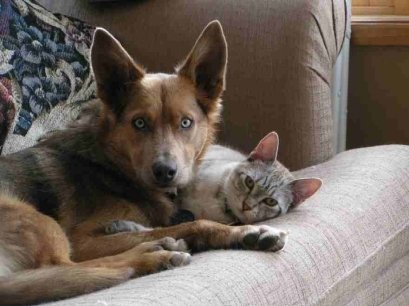
How do they get on with children and other animals? With the children of the family they are usually patient, provided there is supervision and sensible rules for play. With small animals it is harder: prey drive is pronounced, and growing up together reduces the risk without removing it.
The Coast Salish woolly dogs: a history often pinned on the wrong dogs
Descriptions of the American Indian Dog often carry a striking detail: that indigenous inhabitants supposedly combed the undercoat out of these dogs and spun it into yarn for woven goods. The practice did indeed exist and is well documented — but it concerns a different dog, and attributing it to the modern breed would be a substitution.
What is meant is the woolly dog of the Coast Salish peoples of the Pacific Northwest. Coast Salish weavers used the wool of these dogs for blankets and other woven pieces, including ceremonial ones, and the dogs themselves were kept and bred apart from other dogs for centuries. In 2023 the journal Science published a paper by Lin and co-authors, “The history of Coast Salish “woolly dogs” revealed by ancient genomics and Indigenous Knowledge”, in which genomic and isotopic data are combined with interviews with Coast Salish elders, knowledge keepers and weavers.
The researchers read the genome from the pelt of a dog named Mutton, collected in 1859 and preserved in the Smithsonian Institution's collection. It is the only known specimen of a native North American dog of predominantly pre-colonial ancestry that dates from after colonisation had begun. Mutton showed only limited admixture from European dogs and, overall, modest genetic diversity — consistent with a population deliberately kept isolated in order to preserve the quality of the wool. The authors also describe how colonial policy led, over the course of the nineteenth century, to the disappearance of both the tradition of weaving with dog wool and the population itself.
This history is worth telling exactly that way: as a specific documented practice of specific peoples, with a name, a date and a study behind it, rather than as an unattributed ornament to the description of a modern breed. For the same reason we do not carry over to this page the stock claims about the “spiritual abilities” of Indian dogs: they have no source behind them, they reduce dozens of distinct peoples to a single cliché, and they tell the reader nothing about the animal he is considering.
Appearance per the founding kennel's standard
What follows is a rendering of the written Song Dog Kennels standard. It is the primary source for what the breed is meant to be: the standard describes a desired type, not the result of measuring the population.
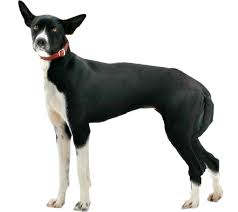
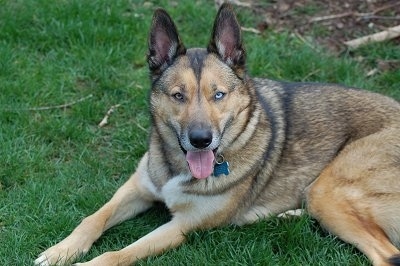
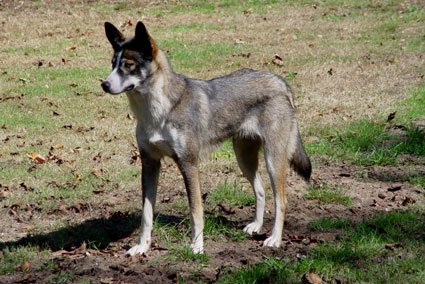
The standard defines the general build as a working herding type, medium-sized and lightly framed, with a natural-looking muzzle and longish pricked ears. The back is straight, the body slightly longer than tall, the loins strong, the chest deep but not broad, with a good tuck-up. The forelegs are finely boned, with well laid-back shoulders; the hindquarters are long and very angulated, almost to the point of being sickle-hocked, and well muscled. The feet are small and cat-like, with thick pads and short strong nails. The tail is long, reaching to the hock, carried down with a slight curve; it may be raised when showing dominance or held straight out on the move, but it never curls forward past the perpendicular.
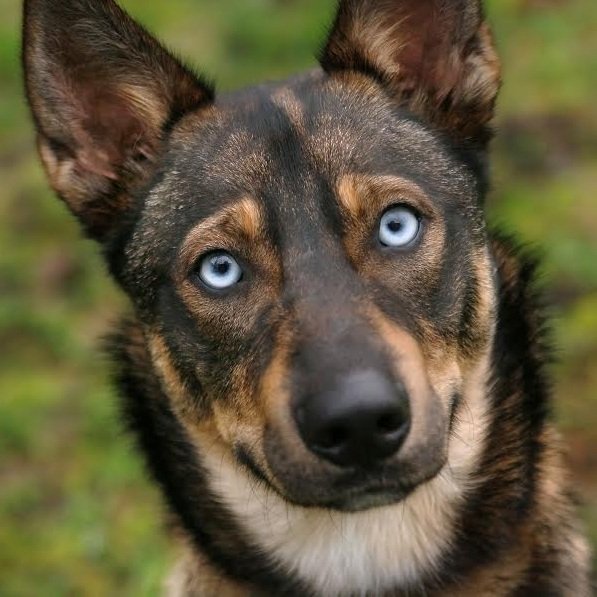
Head. In proportion to the body; the muzzle is wedge-shaped and moderately long, to balance the longish pricked ears. The stop is gentle, and the skull is slightly domed between the ears.
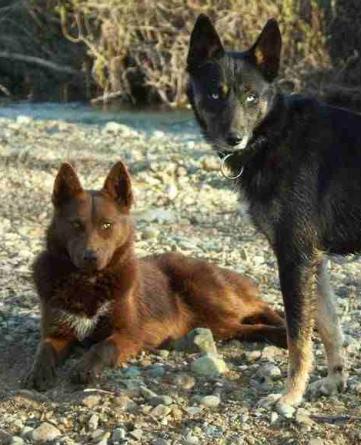
Eyes. Medium-sized and almond-shaped. The colour per the standard is pale yellow or pale blue, occasionally amber, with the lighter shade preferred. The eyelids are close-fitting and black.
Ears. Moderately long, wide-set, triangular, well furred, firmly pricked and tilted slightly forward. Very mobile.
Teeth. Scissor bite only; the standard requires full and sound dentition.
Coat. Medium in length and shiny: a short, thick, plush undercoat with long guard hairs that stand off from the body. The hair is longer on the chest, ruff, shoulders, backs of the legs and tail.
Colours. Black, blue, white, golden red, grey, red and tan, tan, chocolate, cream, fawn and silver. All colours carry a sable shading with darker-tipped guard hairs, blend gently into one another, and show no clear dividing line and almost no spotting. The tail has a dark marking about three quarters of the way up from the tip; some white on the chest, feet, ruff and tip of the tail is accepted.
Gait. The standard describes it as effortless and flowing, with the ability to change gait easily, turn quickly and spring straight up.
By coat type these dogs are sometimes compared to spitz-type breeds such as the Alaskan Klee Kai. One difference is obvious at once and is written into the standard: the Klee Kai's tail curls over the back, whereas here the tail is by definition carried down. The standard also contains a scale of points of its own, in which the greatest weight — 15 points each — goes to the head and to “natural appearance and balance”, and the least, 5 points each, to coat and tail. That is a telling detail: the document deliberately puts working integrity above individual decorative features.
Character and behaviour
A caveat about the status of the data is needed here. Everything that follows is what the breed standard describes and what breeders and owners consistently report. It is a description of a desired and observed type of behaviour, not population characteristics measured on a large sample, and it should be read that way.
The standard defines the breed as “thinking”, strongly attached to its territory and inclined to a close bond with its own group. It states separately that these dogs are “never vicious” but always alert and cautious with strangers, and that they are good house and family watchdogs. Working versatility the standard calls one of the breed's defining qualities.
In practice this means a dog that makes its own decisions. Primitive behaviour is not “stubbornness” and not a lack of intelligence: it is a different structure of motivation. Working breeds were selected over centuries for readiness to await instruction and to work in partnership with a person; here selection went towards self-reliance. The difference shows up not in how quickly the dog learns but in how willingly it performs what it has learnt without a reason obvious to itself. A comparison with the German Shepherd (short-haired) is apt here precisely as a contrast of approaches, not as a scale of cleverer against duller.
Two consequences are worth taking into account before buying. The first is the guarding response to strangers: the dog is more likely to warn with its voice than to rush in, but without early socialisation that watchfulness easily hardens into constant tension. The second is prey drive. Small animals — cats, rabbits, poultry — are perceived as prey if the dog has not grown up alongside them; and even growing up together is no guarantee, so leaving them unsupervised is unwise. With the children of the family such dogs are usually patient, but patience has a limit: an adult should be watching when a child and a dog play, and the child should be taught that a dog is not to be pulled about or squeezed.
Voice is a subject of its own and one reason the breed is called a “song dog”. These dogs bark little, but use a wider range of sounds instead: howling, grumbling, a drawn-out “song”, whining. In a detached house that is a characteristic; in a block of flats it is a thoroughly real cause of trouble with the neighbours.
Training and socialisation
Socialisation begins as soon as the puppy moves into the home and is pursued intensively until about four months — the period in which new experience is absorbed most easily. The point is not the quantity of impressions but their quality: the dog should meet different people, surfaces, sounds, traffic and calm adult dogs in situations that end well. Wariness of strangers is expected in this breed, and the aim of socialisation is not to remove it but to keep it restrained, so that it does not tip over into panic or aggression.
Method matters more than usual. Positive reinforcement works, as do short, varied sessions and clear, unchanging household rules. Coercive pressure does not work and does direct harm: a primitive-type dog answers pain and intimidation not with submission but by breaking contact, and rebuilding trust afterwards is far harder than not losing it. Worn-out formulas such as “become the pack leader” are more of a hindrance here — modern behavioural practice has abandoned the dominance model, and in its place stands something simpler: predictability. A dog obeys whoever's signals are consistent and whose decisions work out well for it.
Two skills are worth working on as priorities. The first is the recall, which for a dog with prey drive is never reliable a hundred per cent of the time: it is trained for life, rewarded generously, and not tested in dangerous places. The second is calm when alone: the ability to stay by itself without destruction and vocalising is built up gradually, from short stretches. Mental work — search games, puzzles, nose work — tires such a dog no less than running does, and often solves the problem of boredom better than an extra hour of walking.
Coat care and seasonal moulting
Grooming is uncomplicated but seasonal and heavy. Twice a year — in spring and autumn — the undercoat comes out in quantity, and in those weeks the dog is combed almost daily; outside the moult, once or twice a week is enough. Convenient tools are a long-toothed comb and a slicker brush; tools with a cutting edge should be used with care, because they trim the guard hair and spoil the structure of the coat.
Bathing. Rarely and as needed: a double coat largely cleans itself, and frequent washing with shampoo dries the skin. Dirt mostly combs out of the coat once it has dried.
Nails. On an active dog they wear down by themselves, but they are worth checking monthly — especially the dewclaws, which do not touch the ground.
Ears. Pricked and well ventilated, so they need only regular inspection — after walks in woodland it is worth checking for ticks and grass seeds.
Teeth. The standard requires full dentition and a scissor bite, so the state of the teeth is worth assessing when choosing a puppy, and maintaining afterwards with regular brushing.
Nutrition
Feeding
Health and risks
What genetics says about the pre-Columbian dogs of the Americas
The most important claim that accompanies this breed concerns direct descent from the dogs of the indigenous peoples of the Americas. It can be set against the data: pre-Columbian American dogs have been studied reasonably well, and the results are published in peer-reviewed journals.
The key work is the paper by Ní Leathlobhair and co-authors, “The evolutionary history of dogs in the Americas”, in Science (2018, volume 361, pp. 81–85). The authors read 71 mitochondrial and 7 nuclear genomes of ancient dogs from North America and Siberia, spanning roughly 9000 years. The main conclusions are these:
American dogs are not descended from North American wolves. They form a separate monophyletic lineage that most probably arose in Siberia and reached the continent together with people.
The common ancestor of all the pre-Columbian dogs studied lived approximately 14,600 years ago (the 95 per cent interval runs from 16,484 to 12,965 years ago).
The oldest reliable dog remains in North America come from the Koster site in Illinois and are radiocarbon-dated to roughly 9,900 calibrated years ago — about 4,500 years later than the earliest unambiguous evidence of a human presence on the continent.
After the arrival of Europeans the native American dogs all but disappeared, leaving, in the authors' phrasing, a minimal genetic trace in modern populations.
The closest known living lineage to the pre-Columbian dogs is not a dog breed at all but CTVT, the canine transmissible venereal tumour: a clone of tumour cells descended from a single animal that lived up to 8000 years ago.
The authors checked separately whether a pre-Columbian trace survives in modern dogs. Among the 169 village and breed dogs of North and South America whose mitogenomes they read, only two animals — a chihuahua and a mongrel from Nicaragua — carried pre-Columbian mitochondrial haplotypes; that corresponds to a pre-Columbian ancestry share of under 2 per cent. On nuclear data from more than 5000 modern dogs the analysis found no significant signal of pre-Columbian admixture in any modern American dog of European descent. Most modern American populations — including 138 village dogs of South America, the hairless breeds and the catahoula — showed no detectable trace of pre-Columbian ancestry at all.
The exception concerns Arctic dogs: in Alaskan huskies, Alaskan malamutes and Greenland dogs the authors obtained pre-Columbian ancestry estimates in the range of 7–20 per cent. The authors themselves caution that this result may reflect ancient Arctic population structure rather than genuine admixture. Another separate case is the Carolina dog: in three individual animals, between 0 and 33 per cent “pre-Columbian or Arctic” ancestry was detected, but the method could not distinguish those two sources, and the authors state plainly that they cannot rule out admixture from modern Arctic dogs. You can read about that breed in our article on the Carolina dog (American dingo).
The scientific picture is not unanimous, and it is only honest to show that. An earlier work by van Asch and co-authors (Proceedings of the Royal Society B, 2013, volume 280, article 20131142) reached a milder conclusion on mitochondrial data: the authors found evidence of pre-Columbian ancestry in Inuit, Eskimo and Greenland dogs, in the chihuahua, the xoloitzcuintli and the Peruvian hairless dog, and judged the replacement by European lineages to be partial — at most 30 per cent of maternal lineages in North and South American breeds. The difference between the two works is not a dispute of truth against untruth: in 2013 the maternal line was analysed, in 2018 nuclear genomes on a far broader sample, and it was the nuclear data that showed how small the remainder is. For the reader the practical upshot is one thing: continuity between the ancient dogs of the continent and any modern breed has not been demonstrated, and where a signal was nevertheless detected it is either small or indistinguishable from the Arctic one.
Health and genetics: what matters
FAQ
Do the parents need to be examined before buying a puppy?
Yes. The breed sits outside the compulsory breeding-screening systems of the major registries, so risk has to be assessed by the particular line rather than by the breed. Ask the breeder for a finding on the hip status of both parents: in the United States that is an OFA evaluation or a PennHIP distraction index.
Is the breed really hypoallergenic?
No. It is often called conditionally hypoallergenic, but there is no such thing as a hypoallergenic dog — the reaction depends on the individual person and the individual animal. On top of that, this is a double-coated dog with heavy seasonal moulting.
How long does the American Indian Dog live?
Breed descriptions cite 14–18 years. That figure comes from the founding kennel, not from a veterinary population study, so we give it as claimed rather than as measured.