

| Height | 33–43 cm |
| Weight | 8–15 kg |
| Lifespan | 12–13 years |
| FCI group | 6 · scenthounds |
| Origin | Switzerland (Schwyz) |
Exact ratings
Common health issues
Nutrition
The Small Swiss Hound (Schwyz Type) embodies a passion and dedication for hunting, all wrapped up in a compact yet incredibly resilient body. This rare breed, carefully developed by Swiss farmers from the larger Swiss Hounds, is a true treasure for those who appreciate working dogs. They are tireless and loud-voiced companions on the hunt, capable of working in the most challenging conditions. Yet, away from the forest trails, they transform into calm and affectionate family members. We’ll tell you more about all aspects of this unique breed right here on Tvaryny.
A notable working trait of these Swiss “hunters” is their extraordinarily powerful and ringing voice, which easily carries for miles, alerting the owner to a discovered trail. Although the smaller variant develops a lower pursuit speed compared to its high-legged ancestors, in all other respects, it fully replicates the outstanding characteristics of the original breed. The calm, balanced, and obedient nature of the dog allows it to integrate easily into family life, but one should never forget its origins. The Small Swiss Hound will never be a mere lapdog, as it requires serious work and plenty of space to release its boundless energy.
The Small Swiss Hound (Schwyz Type): Key Breed Information
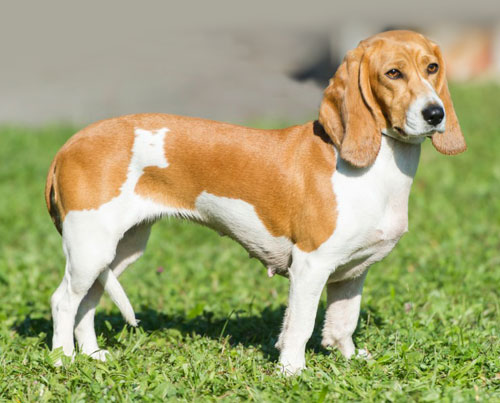
| Characteristic | Description |
| Origin | Switzerland |
| FCI Classification | Group 6 (Scent Hounds and Related Breeds), Section 1.3 (Small Hounds). Standard No. 60. |
| Life Expectancy | 12-15 years |
| Height at the Withers | Males: 35-43 cm, Females: 33-40 cm |
| Weight | 8-15 kg |
| Temperament | Passionate hunter, brave, resilient, calm, sensitive, very attached to their owner, not aggressive. |
| Usage | Hunting small game (hare, roe deer, fox, boar), companion dog for active people. |
| Activity Level | High |
| Tendency to Bark | High, especially when working |
| Coat Care | Minimal |
History: How Did the Small Swiss Hound (Schwyz Type) Emerge?
The history of the Small Swiss Hound is inextricably linked to its “big brother”—the Swiss Hound, a breed with deep roots dating back to the Holy Roman Empire. These dogs were valued for centuries for their exceptional hunting abilities. However, at the start of the 20th century, specifically in 1905, a new hunting law was passed in Switzerland which significantly changed the game. It introduced a system of hunting grounds and prohibited the use of high-legged, fast hounds in many cantons, as they would drive game (especially roe deer) beyond the designated territories.
This put the existence of beloved national breeds at risk. Swiss hunters, unwilling to give up their proven companions, found an ingenious solution. They decided to create a miniature version of their hounds—a short-legged one, or “Niederlaufhund.” To do this, they purposefully selected smaller specimens of Swiss Hounds and crossed them with dachshund-like Bracco dogs to establish the short-legged trait. This process allowed them to retain all the valuable working qualities: a superb nose, stamina, a ringing voice, and a hunting passion, while making the dog slower and capable of working in a smaller area, which fully met the new legislative requirements.
Thus, in the early 20th century, four varieties of the Small Swiss Hound emerged, corresponding to the four types of the larger breed. On 1st June 1905, the Swiss Small Hound Club (Schweizer Niederlaufhund-Club) was founded, and the breed received official recognition and its own standard. The Small Swiss Hound (Schwyz Type), as one of these varieties, was able to pursue game not only in dense thickets but also in burrows, assisting hunters in the chase for badgers, roe deer, boars, and hares. Today, this breed remains quite rare and is hardly ever found outside Switzerland and neighbouring France.
The Four Musketeers: An Introduction to the Small Swiss Hound Variants
While we focus on the Small Swiss Hound (Schwyz Type), it’s important to understand that it is only one of four officially recognised types of this breed. They are all united under a single FCI standard but differ in colour and sometimes coat type, reflecting their origins from their corresponding “big” hounds. Each has its own unique appearance and history.
- Small Swiss Hound (Schwyz Type) (Schwyzer Niederlaufhund): The hero of our article. They have a short, smooth coat that is primarily white with large tawny (from yellowish-tawny to intense orange-tawny) patches or a solid “saddle.”
- Small Bernese Hound (Berner Niederlaufhund): The most recognisable due to its classic tricolour pattern—white with black patches (or a black “saddle”) and tan markings above the eyes, on the cheeks, chest, and legs. They come in two variations: smooth-haired and wire-haired.
- Small Jura Hound (Jura Niederlaufhund): Looks like a miniature version of the Bruno de Jura Hound. It has a smooth black coat with tan markings above the eyes, on the muzzle, and on the legs. A small white chest patch is sometimes permitted.
- Small Lucerne Hound (Luzerner Niederlaufhund): Features a unique “blue” colouration created by heavy black ticking on a white background. They also have black patches or a “saddle” and tan markings.
| Variant | Primary Colour | Coat Type |
|---|---|---|
| Small Swiss Hound (Schwyz Type) | White with tawny patches/saddle | Smooth, short |
| Small Bernese Hound | Tricolour (white, black, tawny) | Smooth or wire-haired |
| Small Jura Hound | Black with tan markings | Smooth, short |
| Small Lucerne Hound | “Blue” ticked with black patches and tan markings | Smooth, short |
Appearance: Standard and Description
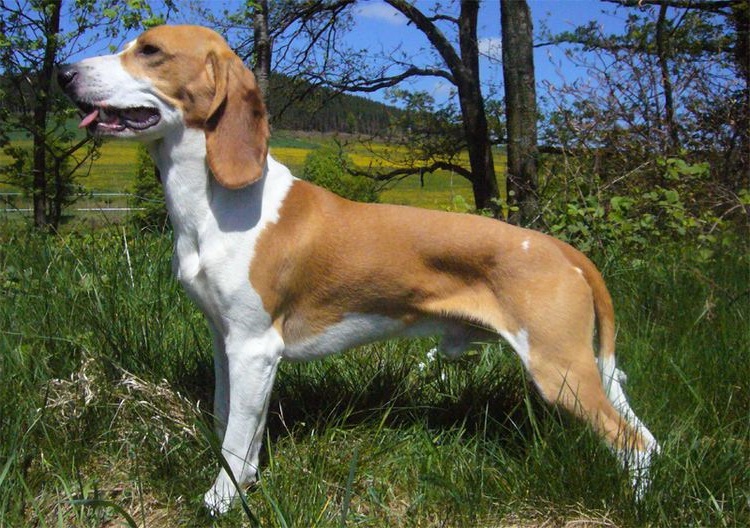
Small Swiss Hounds are noble-looking dogs that, despite their short legs, appear harmonious and robust. Their appearance is a miniature replica of the large Schwyz Hounds. They have an elongated body with short but very muscular limbs, which makes them incredibly resilient.
- Head: Dry, elongated, with a slightly convex skull. The transition from the forehead to the long and narrow muzzle is well-defined.
- Eyes: Oval, dark brown, with a lively and friendly expression. The eyelids are tight and have black pigmentation.
- Ears: One of the breed’s most expressive features. They are set low, very long, narrow, hanging, and elegantly twisted like a corkscrew. They are covered in fine hair and have rounded tips.
- Body: Moderately long, with a strong back and a deep, well-developed chest that provides ample space for the heart and lungs.
- Tail: Set low, of medium length, and shaped like a sabre. It hangs down when at rest but may rise when the dog is in motion, though it never curls over the back.
- Coat and Colour: The Small Swiss Hound (Schwyz Type) has a short, smooth, dense, and close-lying coat. The main colour is white, with large patches ranging from yellowish-tawny to an intense orange-tawny. Minor speckles (ticking) are permissible but not desirable. A solid tawny “saddle” is also common.
Temperament and Behaviour
The short-legged descendant of the Schwyz Hound has a dual character. When hunting, he transforms into a determined, independent, and avid hunter who will work energetically in dense thickets, on rocky terrain, or in any other difficult landscape. He can work both alone and in a pack with other dogs. His main tools are a phenomenal nose and an incredibly ringing voice, which he uses to track the quarry.
At home, he is a completely different dog. He is calm, balanced, and extremely gentle. The Small Swiss Hound (Schwyz Type) forms a strong bond with his owner and the entire family. He is friendly with familiar people and generally gets along well with children, especially if he has grown up with them. However, one should not forget his strong hunting instinct. Because of this, relationships with cats and other small pets can be difficult. Early and proper socialisation is absolutely necessary for harmonious coexistence.
Care and Maintenance: What Owners Need to Know
The small size of the short-legged Small Swiss Hound (Schwyz Type)s theoretically allows them to be kept in a flat, but this is far from ideal. These dogs vitally need space and the opportunity to express their energy.
Physical Exercise: This is the most crucial aspect of their care. The Small Swiss Hound (Schwyz Type) is not a breed that is satisfied with two short walks on the lead. They need a minimum of 1.5-2 hours of active exercise every day. Ideally, this would involve long walks in the woods or fields where the dog can run off-leash (in a safe place!) and use its nose. If hunting is not a part of the dog’s life, its energy can be channelled into canine sports such as nose work, coursing, or simply long hikes.
Grooming: Caring for the short coat of the Small Swiss Hound (Schwyz Type) is straightforward. A weekly brush with a rubber mitt or grooming glove is enough to remove dead hair. The dog should only be bathed when necessary. What you should pay special attention to are their ears. Their long, hanging shape creates ideal conditions for the growth of bacteria and fungi. It is essential to regularly (once a week) inspect and clean the ear canal with a special lotion to prevent ear infections.
Safety: Due to their extremely strong hunting instinct, these dogs are prone to running away. If they catch an interesting scent, they can forget about everything else and follow it. Therefore, it is extremely important to have a securely fenced area and never to let the dog off the lead in unsafe places.
Training and Socialisation
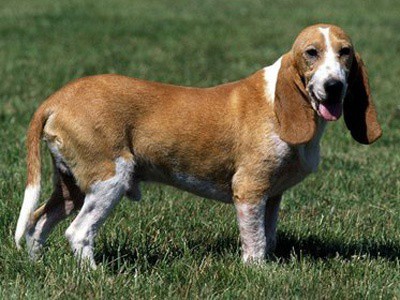
Training the Small Swiss Hound (Schwyz Type) has its own peculiarities. On the one hand, its intelligence, obedience, and strong attachment to its owner are natural prerequisites for success. On the other hand, one should not forget the independence and stubbornness characteristic of all hounds. They were bred to make decisions at a distance from the hunter, so blind obedience to commands is not their strong suit.
Training sessions should be persistent but not harsh. These dogs are sensitive and react poorly to shouting and physical punishment. Positive reinforcement works best: praise, treats, and toys. The most important and most difficult command to teach is “Come!”. You should start practicing it from an early age in a controlled environment. If you cannot provide the “little one” with regular hunting activities, pay more attention to intellectual training and search games to satisfy its natural needs.
Nutrition: Key Recommendations
Health: Typical Illnesses and Prevention
Pros and Cons of the Small Swiss Hound (Schwyz Type)
| Pros | Cons |
|---|---|
| ✅ Extremely loyal and gentle with family | ❌ Requires a very high level of physical activity |
| ✅ An excellent hunter with a superb nose and voice | ❌ Very strong hunting instinct, prone to running away |
| ✅ Compact size, easy to transport | ❌ Loud, prone to barking (especially on the trail) |
| ✅ Generally a robust and healthy breed | ❌ Stubborn and independent, which complicates training |
| ✅ Easy coat care | ❌ High risk of chronic ear infections |
| ✅ Gets along well with other dogs | ❌ Not suitable for inexperienced owners |
| ✅ Unique and rare breed | ❌ Can be difficult with cats and small pets |
Interesting Facts
- The name “Niederlaufhund” literally translates from German as “low-running hound.”
- The voice (or “baying”) of the Small Swiss Hound is so valued by hunters that they can often distinguish their dog from others just by the tone of its bark.
- Despite their small size, these dogs are known for their bravery and are used to hunt not only hares but also roe deer and even wild boars (usually in a pack).
- Although all four varieties belong to a single breed, they are often judged in separate rings at dog shows due to their colour differences.
Frequently Asked Questions about the Breed (FAQ)
Is the Small Swiss Hound (Schwyz Type) suitable for flat living?
It is possible, but only on one condition: if the owner is prepared to provide the dog with at least 1.5-2 hours of intense physical and mental exercise outside the flat every day. Otherwise, the dog will suffer from boredom, which can lead to destructive behaviour.
Do they get along well with children and other animals?
They generally get along well with children, being patient and gentle companions. With other dogs, there are usually no problems, as they are used to working in a pack. The biggest challenge is with cats and other small domestic pets due to their very high prey drive. Very early and thorough socialisation is required.
Do they shed a lot?
Shedding is moderate and seasonal. Regular weekly brushing helps to keep the amount of hair in the house under control.
Are they difficult to train?
They are intelligent but independent. This isn’t a breed that will blindly obey every command. Training requires patience, consistency, and an understanding of the hound’s hunting nature. They aren’t so much “difficult” as they are “specific” in their training needs.
Where can I buy a Small Swiss Hound (Schwyz Type) puppy in the UK?
This is a very rare breed. Finding a puppy outside of Switzerland, France, or Italy is an extremely difficult task. The search should begin with the official breed clubs in those countries, and you should be prepared for a long wait and a careful screening by breeders, who usually only sell puppies to hunters.
- A ringing, far-carrying voice on the trail
- A tireless, precise tracker
- Friendly, calm at home
- A striking white-and-red colour
- Very loud — "gives tongue" on the trail
- A strong hunting instinct (dangerous to cats)
- Needs exercise and scent work
- A long back — protect from strain (IVDD)
| Lucerne Hound (Small) | Bernese Hound (Small) | Swiss Hound (Schwyz) | |
|---|---|---|---|
| Height | 33–43 cm | 33–43 cm | 47–59 cm |
| Energy | 4 | 4 | 4 |
| Apartment | 2.5 | 2.5 | 2 |
| Beginners | 3 | 3 | 3 |
What sets the Schwyz Hound apart?
Why does the hound need such a loud voice?
Is the breed suitable for a flat?
FCI Standard No. 60 · Schweizerische Kynologische Gesellschaft
For apartments · For kids · For beginners · Active · Smartest · Hypoallergenic · All rankings →