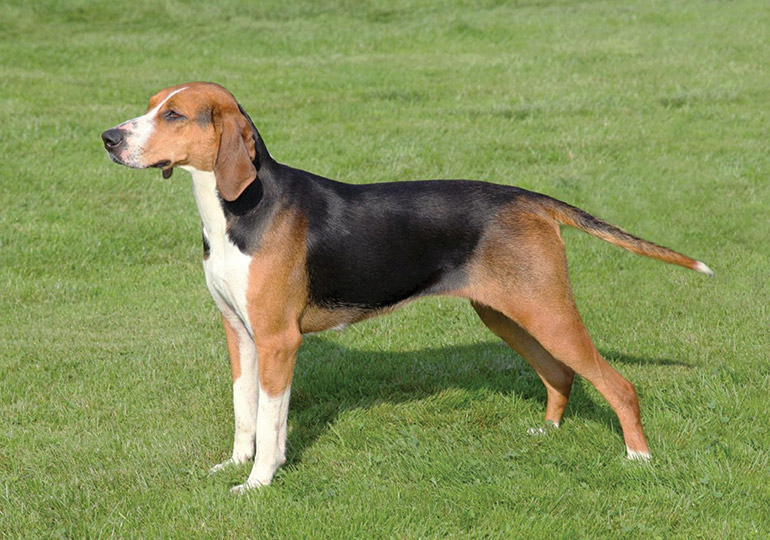
An elegant Swedish tricolour hound: level-headed, hardy, friendly and reliable. The Hamilton Hound is Sweden's national tracker, bred by Baron Hamilton; calm and devoted at home, it works brilliantly by scent in the forest and needs exercise and space.
Apartment · not suitableKidsCats · with caveatsOther dogsBeginners · with caveats
The Hamiltonstovare, or Hamilton Hound, is not merely an elegant hunting dog; it’s a true national treasure of Sweden. Bred for persistent fox and hare hunting in the harsh Scandinavian climate, this breed combines an aristocratic appearance, incredible stamina, and a surprisingly gentle nature. Thanks to its balanced temperament and loyalty, it easily becomes a cherished family member, though its hunting instincts never fully fade. This is a dog with a dual nature: an energetic and relentless tracker in the field, and a calm, loving companion at home. We’ll delve into all the nuances of this unique breed’s character, care, and history further on Tvaryny.
Hamilton Hound: Key Breed Information
Hamilton Hound: Key Breed Information · 13
Breed Name
Hamilton Hound (Hamiltonstovare)
Country of Origin
Sweden
Time of Origin
Late 19th Century
FCI Classification
Group 6 (Scent Hounds and Related Breeds), Section 1.2 (Medium-sized Hounds).
Height (at Withers)
Males: 53–61 cm Females: 49–57 cm
Weight
23–27 kg
Lifespan
12–14 years
Primary Purpose
Hunting fox and hare (solitary)
Character
Friendly, balanced, energetic, loyal
Care
Minimal, requires regular brushing
Activity Level
Very high
Compatibility with Children
High
Compatibility with Other Animals
Gets along well with other dogs. Requires early socialisation for living with cats and other small animals due to strong hunting instinct.
What to Feed a Hamilton Hound?
Hamiltonstovares are known for their excellent appetite and lack of fussiness with food. This is both a plus and a minus. On one hand, you won't have problems with feeding. On the other, there's a high risk of overfeeding and obesity. It's important to strictly control portion sizes and not give in to the dog's pleading look when it begs for an extra helping.
The basis of the diet can be either high-quality dry food of premium or super-premium class for active medium-sized dogs, or a natural diet. When choosing dry food, pay attention to the ingredients: the first ingredient should be meat. A natural diet should be balanced and include lean meat (beef, turkey, chicken), offal, grains (rice, buckwheat), vegetables, and fermented dairy products. It is recommended to feed an adult dog twice a day to reduce the risk of bloat.
The Hamilton Hound as a Hunter
Despite many Hamiltonstovares living as companion dogs today, their primary purpose should not be forgotten. They are first-class hunters, and their instincts never disappear. Their specialisation is hunting fox and hare. Unlike many hounds, they work alone rather than in a pack, which demands considerable intelligence and independence from them.
The Hamiltonstovare's working style is impressive. Using its phenomenal sense of smell, it finds a trail and then persistently pursues the quarry, covering kilometres across varied terrain. Throughout the chase, it maintains vocal contact with the hunter using its characteristic, melodious bay. This trait is common to many Scandinavian hounds, such as the Schiller Hound or the Finnish Hound, each with their unique working characteristics. Even if you are not a hunter, it's important to provide the dog with opportunities to fulfil its instincts through long walks, scent-finding games, or activities like nosework.
Interesting Facts about the Breed
Named Breed: The Hamiltonstovare is one of the few breeds named after its creator, Count Adolf Hamilton.
National Pride: In Sweden, this breed is considered a national heritage and is one of the symbols of Swedish cynology.
Solo Hunter: Unlike British Foxhounds, which hunt in large packs, the Hamiltonstovare was bred for independent work, which developed high intelligence and independence in it.
"Singing" Hound: The Hamiltonstovare's voice is very clear and melodious. Hunters can determine the stage of the chase (tracking, pursuit) by the tonality of its bark.
Not for Guarding: Despite its significant size, the Hamiltonstovare is a very friendly dog, completely devoid of aggression towards people, which makes it a poor guard dog.
History of the Hamilton Hound Breed
The breed's history is inextricably linked with the name of Count Adolf Patrick Hamilton – the founder of the Swedish Kennel Club and a true dog breeding enthusiast. In the second half of the 19th century, Count Hamilton set out to create an ideal Swedish hound that would possess not only excellent working qualities but also an attractive appearance. He aimed to produce a dog capable of independently, without a pack, tracking and pursuing game, primarily foxes and hares, in the dense and often snow-covered forests of Sweden.
To achieve this goal, Count Hamilton employed a meticulous approach to selective breeding. The foundation for the new breed comprised the best German hounds of that era, particularly the Hanoverian, Holstein, and Courland Hounds, renowned for their outstanding scenting ability and endurance. To add speed, elegance, and athleticism, he crossed them with English Foxhounds. The result of this painstaking work was a dog that combined the finest traits of its ancestors: German methodicalness and scenting prowess, and English speed and power.
The breed, named "Hamiltonstovare," was first presented at an exhibition in Sweden in 1886. These dogs quickly gained popularity among Swedish hunters due to their versatility and reliability. Unlike many other hounds that work in packs, the Hamilton Hound is a soloist. It tracks the animal, flushes it out, and pursues it, alerting the hunter to its location with a loud, melodious bay. This trait made it an indispensable aid for individual hunting.
Despite its popularity in its homeland, as well as in Great Britain and the USA, the breed remains relatively rare outside Scandinavia. This makes each Hamiltonstovare truly unique. The breed standard was officially recognised by the Fédération Cynologique Internationale (FCI), solidifying its status on the global stage.
What the Hamilton Hound Looks Like: Breed Standard
The Hamilton Hound is a noble-looking dog, exuding strength and elegance. Its appearance harmoniously combines the functionality of a hunter and the beauty of a show dog. Every detail of its exterior speaks of its readiness for prolonged and strenuous work.
General Appearance: Proportionally built, strong dog with clearly defined musculature, but without excessive massiveness. Appears hardy and athletic.
Head: Long, rectangular in shape, slightly convex in the cranial region. The stop is smooth but noticeable. The muzzle is long, powerful, not pointed.
Eyes: Dark brown, almond-shaped. The expression is calm, intelligent, and friendly.
Ears: Set fairly high. When the dog is relaxed, they hang alongside the cheeks, with the front edge not lying tightly. When the dog is alert, the ears lift slightly at the cartilages. They are soft, with thin skin and rounded tips.
Nose: The nose leather is always black, large, with well-developed nostrils.
Bite: Scissor bite, with a full set of teeth.
Neck: Long, muscular, without dewlap.
Body: Back is straight and strong. Loin is muscular. Chest is deep, well-developed, with well-sprung ribs.
Tail: Set level with the back. Thick at the base, gradually tapering to the tip. The dog carries it straight or slightly scimitar-shaped, but never curled over the back.
Limbs: Straight, parallel, with strong bone and well-developed musculature. Paws are oval, with tightly knit toes and strong pads.
Coat: Very dense, double-layered. The topcoat is short, harsh, lying close to the body. The undercoat is short, soft, and dense, especially in winter. This coat structure reliably protects the dog from cold and moisture.
Colour: The characteristic tricolour coat is the breed's hallmark. The main background is tan (from golden to rich brown). A black "saddle" (mantle) is located on the back, neck, and upper part of the tail. White markings are obligatory on the muzzle (blaze), neck, chest, lower part of the limbs, and on the tip of the tail.
Parameter
Male
Female
Ideal Height at Withers
57 cm
53 cm
Permissible Height Range
53–61 cm
49–57 cm
Average Weight
23–27 kg
23–27 kg
Character and Temperament of the Hamilton Hound
The Hamiltonstovare's character is a unique blend of hunting ardour and domestic comfort. At home, this is a calm, gentle, and well-balanced dog who adores its family. It is very people-oriented and strives to be at the centre of activity. The Hamilton Hound gets along wonderfully with children, showing astonishing patience towards them. It is loyal to its owner and ready to follow them to the ends of the earth.
However, take him into the woods or a field, and he transforms instantly. His calm demeanour gives way to a passionate hunting drive. Once he picks up a scent, this dog becomes incredibly persistent and independent. This self-reliance in decision-making is a trait developed over years of solitary hunting, and it must be considered during training. Due to this instinct, he should not be let off the lead in unfenced areas, as, captivated by a scent, he might run off a considerable distance.
The Hamiltonstovare is friendly towards strangers, without aggression. He might announce the arrival of guests with a loud bark, but nothing more. Therefore, he is not suitable as a guard dog. This distinguishes him from breeds specifically bred for protection, such as the powerful Estrela Mountain Dog. With other dogs, especially other hounds, he usually finds common ground. However, coexisting with cats and other small household pets can be problematic due to his strong hunting instinct. Early and proper socialisation can help, but there's no guarantee of complete safety for smaller pets.
Pros and Cons of the Hamilton Hound Breed
Before getting such an active and distinctive dog, it's important to weigh all the pros and cons.
Pros and Cons of the Hamilton Hound Breed · 6
✅ Pros
❌ Cons
Friendly and gentle nature. Ideal family companion, tender with children.
Very high energy level. Requires daily intensive physical exercise.
Loyalty to family. Forms strong bonds with its owner.
Strong hunting instinct. Prone to running off, cannot be let off the lead in unsafe areas.
Robust health. Health is generally robust, but no breed-wide list of hereditary diseases has been compiled — “not described” means “not studied”, not “not there”.
Needs space. Absolutely unsuitable for living in a small flat.
Striking appearance. Elegant dog with a beautiful tricolour coat.
Loud voice. Often barks melodically, especially when excited or bored.
Low maintenance grooming. Short coat does not require complex grooming.
Tendency towards independence and stubbornness. Can be challenging to train for beginners.
High intelligence. Learns well if the right approach is found.
Does not get along with small animals. May perceive cats, rabbits, rodents as prey.
Training and Socialisation
Training a Hamilton Hound is an interesting, yet challenging task. On one hand, it's an intelligent dog that values its owner's praise. On the other, its inherent independence and hunting instincts demand patience and consistency from the owner. The foundation of successful training is positive reinforcement: praise, treats, and games. Harsh methods and punishment do not work with this breed and can lead to stubbornness and a refusal to cooperate.
The most crucial command for the Hamiltonstovare is the "Come!" command. Practising it should begin at an early age and be constantly reinforced. However, even a perfectly trained dog might ignore the command if it picks up an interesting scent. Therefore, safety is paramount – off-lead walks only in well-fenced areas.
Early socialisation is critically important. From puppyhood, introduce your dog to various people, sounds, places, and other animals. This will help raise a confident and well-balanced dog that reacts appropriately to the surrounding world.
Care and Maintenance
Caring for a Hamiltonstovare cannot be called difficult, but it has its specifics related to this dog's active lifestyle.
Housing: The most important requirement is space and movement. This dog is absolutely unsuitable for living in a small flat. An ideal option would be a private house with a large, securely fenced area. The fence must be high enough so the dog cannot jump over it, and without any digging opportunities underneath. Remember that chaining this free-spirited dog is cruel and can lead to psychological problems.
Grooming: The Hamiltonstovare's coat does not require professional grooming services. It is sufficient to brush it 1–2 times a week with a special brush or rubber glove to remove dead hairs. During seasonal shedding (spring and autumn), the procedure should be carried out more frequently. Bathe the dog only when absolutely necessary, as frequent washing can damage the protective oily layer of the skin. After walks in muddy weather, it is enough to wipe the paws and belly with a damp towel.
Ear and Claw Care: Regularly check the condition of the ears for redness or unpleasant odour. Clean them with a special lotion as needed. Claws usually wear down naturally during walks on hard surfaces, but if this doesn't happen, they need to be trimmed with clippers once a month.
NutritionHealth and risks
Health and Typical Diseases
Frequently Asked Questions about the Hamilton Hound Breed (FAQ) · 4
Is the Hamilton Hound suitable for flat living?
No, absolutely not. This is a very energetic breed that requires a lot of space for movement. The confined space of a flat, even with long walks, can lead to destructive behaviour, constant barking, and other issues.
How much physical exercise does a Hamiltonstovare need?
A great deal. This dog needs at least 2 hours of intensive activity every day. This can include long walks, runs with the owner, or games. Ideally, the dog should have the opportunity to run off-lead regularly in a safe, fenced area.
Will a Hamilton Hound get along with a cat?
It's challenging, but possible under certain conditions. If the dog and cat grow up together from a young age, the chances of peaceful coexistence are high. However, an adult Hamiltonstovare unfamiliar with cats will most likely perceive them as prey. Introducing a cat into a home where an adult hound already lives is risky.
Does this breed shed a lot?
Shedding is moderate throughout the year and intensifies twice a year, in spring and autumn, when the dog changes its undercoat. Regular brushing during these periods will help keep the amount of hair in the home under control.
Video about the Breed
FAQ
Who bred the Hamilton Hound?
The breed was created by the Swedish count (baron) Adolf Patrik Hamilton in the late 19th century by crossing German and English hounds; it is Sweden's national tracker.
Is the Hamilton Hound good for a family?
Yes — at home a level-headed, friendly dog, good with children; it only needs plenty of exercise and dislikes being alone.
Is the breed suited to a flat?
No — a hardy working tracker that needs space and prolonged exercise.