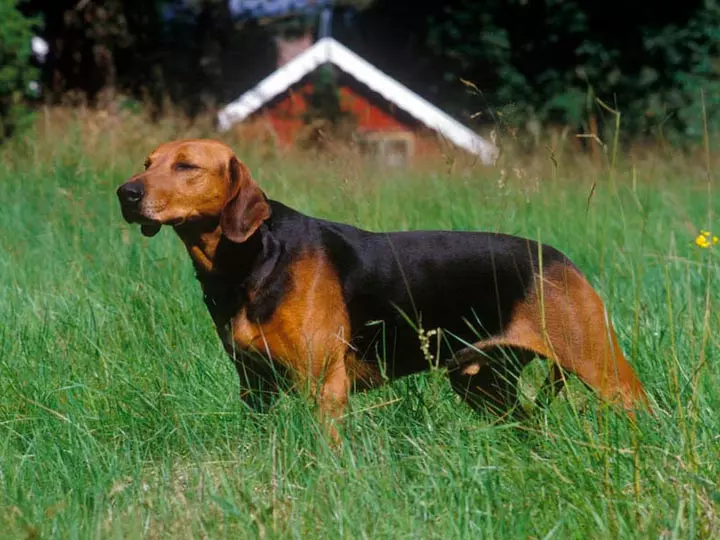
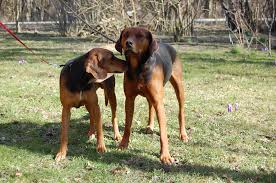
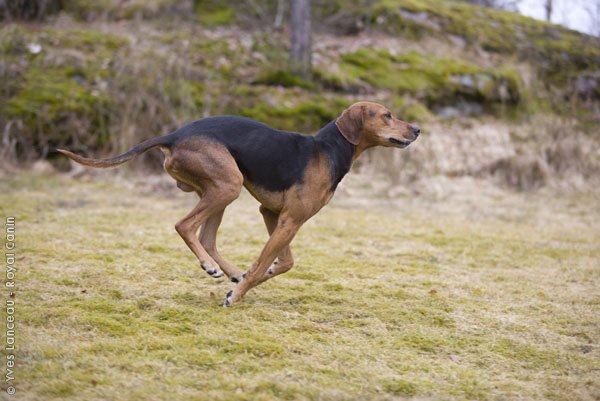
A swift tan-and-black hound of the Swedish snows — hardy and devoted: fast, clever, independent and attached to one owner. The Schillerstövare (Schiller Hound) is an elegant Swedish breed bred for fast hunting of fox and hare in harsh Scandinavian conditions; a pride of Swedish hunters, it is devoted to its handler but reserved with strangers.
Apartment · not suitableKidsCats · not suitableOther dogsBeginners · with caveats
The Schillerstövare, also known as the Schiller Hound, is more than just a dog; it's a true embodiment of the Swedish hunting spirit. This elegant, fast, and resilient hound was specifically bred for hunting in the harsh conditions of Scandinavia, where snow and cold are commonplace. The breed stands out not only for its exceptional working qualities but also for its devoted character and striking appearance. It is the pride of Swedish hunters, although it remains quite rare outside its homeland. For those interested in unique hunting breeds, the Schiller Hound will be a real discovery, which we will discuss in detail further on Tvaryny.
The primary purpose of this dog is to hunt hare and fox. When pursuing prey, the Schillerstövare uses its clear, melodious voice to alert the hunter to its location, but it never harms the game itself. This makes it an ideal partner for sporting hunts. Despite its hunting passion, at home it transforms into a loyal and obedient companion, although its independent nature can create certain difficulties in training. One of the breed's unique traits is its metabolism: unlike many other dogs, the Schiller Hound is absolutely not prone to gaining excess weight.
Comparison with Other Scandinavian Hounds
To better understand the uniqueness of the Schiller Hound, it's worth comparing it with other Swedish hounds. The most well-known are the Hamiltonstövare and the Smålandsstövare. The Hamiltonstövare is more popular and widespread, has a characteristic tricolour coat, and a somewhat calmer temperament. The Smålandsstövare is the oldest Swedish breed, usually black and tan, and has a naturally short tail. In contrast, the Schiller Hound stands out with its vibrant red coat and black "mantle" and is considered the fastest among them. Similar traits can also be found in hounds from other regions, for example, the Bosnian Coarse-Haired Hound Barak, which is also a resilient hunter. However, in terms of speed and elegance, the Schillerstövare can even compete with breeds like the Beagle-Harrier.
Interesting Facts about the Schiller Hound
The breed name "Schillerstövare" literally translates from Swedish as "Schiller's Hound" ("stövare" – a general term for hunting hounds in Sweden).
It is one of the fastest Scandinavian hounds, capable of developing high speeds across varied terrain while pursuing prey.
Despite its effectiveness, the Schiller Hound is a solitary hunter. It is not intended for pack hunting and may show intolerance towards other dogs during work.
The coat colour of the Schiller Hound is unique and strictly defined by the standard: rich red with a clear black saddle. Any other variations are a disqualifying fault.
The first representative of the breed was shown at an exhibition as early as 1886, making it one of Sweden's older established breeds.
History and Origin of the Schiller Hound
The history of the breed is inextricably linked with the name of the Swedish farmer and keen hunter Per Schiller, who lived in the 19th century. It was he who laid the foundations for creating this unique Scandinavian hound. Schiller dreamed of breeding an ideal hunting dog that would combine speed, endurance, an excellent sense of smell, and the ability to work in the challenging weather conditions of the Swedish winter. To achieve his goal, he began meticulous selective breeding.
The breed is based on dogs of South German origin, which likely arrived in Sweden with soldiers. Per Schiller crossed these dogs with the best representatives of Swiss and Austrian hounds, and also added the blood of English Beagle-Harriers to improve speed. He paid particular attention to working qualities, selecting only those individuals for breeding who demonstrated the best results in hunting. The first dogs resembling modern Schiller Hounds were presented at an exhibition in Sweden in 1886. These were two dogs named Rask I and Rask II.
After Per Schiller's death, his work was continued by breed enthusiasts. The Swedish Kennel Club officially recognised the breed under the name Schillerstövare in 1907. The standard was established, and the breed began to gain popularity among Swedish hunters. The Fédération Cynologique Internationale (FCI) recognised the Schiller Hound in 1951. Despite its recognition and excellent working characteristics, the breed never gained widespread popularity outside the Scandinavian Peninsula, remaining primarily a national treasure of Sweden and Norway.
Breed Standard and Appearance of the Schiller Hound
The Schiller Hound is a medium-sized, well-proportioned dog that combines strength and elegance. Its appearance speaks of speed and endurance. It is a muscular, but not heavy dog, with noble features and an intelligent, attentive gaze.
Breed Standard and Appearance of the Schiller Hound · 12
Characteristic
Description according to FCI Standard No. 131
General Appearance
Proportionally built, noble, muscular dog, giving an impression of speed and strength.
Set high, pendulous, soft to the touch. When pulled forward, they barely reach the middle of the muzzle.
Nose
Nose large, black, with well-developed nostrils.
Body
Rectangular format. Back straight and strong. Loins muscular. Chest deep, well-developed, reaching the elbows.
Tail
Set on a line with the back. Straight or slightly sabre-shaped. Reaches the hocks. Thick at the base, gradually tapering towards the tip.
Limbs
Strong, well-boned, with well-developed musculature. Paws compact, with tightly knit toes and strong pads.
Coat
Short, dense, harsh to the touch. On the head, ears, and forelegs, the coat is shorter and softer. Undercoat well-developed, especially in winter.
Colour
Fawn-red (from golden to rich reddish-brown) with a distinct black saddle (mantle) on the back. Small white markings on the chest and toes are permissible but undesirable.
Height at Withers
Dogs: 53–61 cm. Bitches: 49–57 cm.
Weight
18–25 kg.
Character and Temperament of the Schillerstövare
The character of the Schiller Hound is a harmonious blend of hunting passion and calm devotion to its family. This is a very energetic and lively dog, always ready for action. Its temperament can be described as stable and balanced; it is not prone to unprovoked aggression or nervousness. The main traits of its character are:
Devotion to its owner: The Schillerstövare forms a very strong bond with its handler. It is obedient and eager to please, but only if it perceives the human as a consistent and fair leader.
High Energy: This is not a couch potato dog. It requires daily, intensive physical exercise to remain happy and healthy. Without sufficient activity, it can become restless and even destructive.
Friendliness: Towards people, it is usually welcoming and open. It gets along well with children, especially if raised with them. However, due to its energy, it might accidentally knock over a small child.
Hunting Instinct: This is the strongest trait of its character. When out for a walk, it constantly "scans" the area with its nose. Upon spotting potential prey (a squirrel, cat, or bird), it may bolt after it, ignoring commands. Therefore, a reliable lead is essential in public places.
Independence: Like most hounds, it was bred to work independently, at a distance from the hunter. This independence can manifest as stubbornness during training.
Attitude towards other animals: It usually gets along well with other dogs, as it doesn't have a dominant nature. However, due to its strong hunting instinct, it's not recommended to keep it in the same home with small animals (cats, rodents, rabbits) unless it has been socialised with them from an early age.
Pros and Cons of the Breed
Before getting such a serious dog as the Schiller Hound, it's important to weigh all the pros and cons. This breed is not suitable for every family.
Pros and Cons of the Breed · 7
Pros
Cons
✅ Exceptional health and strong immunity.
❌ Very high demands for physical exercise.
✅ Devotion and love for the family.
❌ Not suitable for apartment living.
✅ Low-maintenance coat care.
❌ Strong hunting instinct, requires control.
✅ No predisposition to obesity.
❌ Tendency to bark, especially when something catches its interest.
✅ Striking and noble appearance.
❌ Difficulty in training due to independence and stubbornness.
✅ Excellent scenting and working qualities for hunters.
❌ Does not tolerate loneliness well.
✅ Gets along well with school-aged children.
❌ Rare breed, puppies are hard to find outside Sweden.
Training and Education
Training a Schiller Hound is a challenge that requires patience, consistency, and an understanding of the hunting dog's psychology. Despite its obedience and desire to please its owner, its inherent independence often prevails. It was bred to make decisions independently, far from the hunter, so blind obedience to commands is not its strong suit.
The key to success is early socialisation and starting training from a young age. Sessions should be short, engaging, and based on positive reinforcement (treats, praise). Monotonous repetitions will quickly bore the dog, and it will lose interest. Special attention should be paid to the "Come!" command, as this is the most important command for the hound's safety. Never punish the dog for not returning immediately – this will only make it avoid you in the future.
Care and Maintenance of the Schiller Hound
Keeping a Schiller Hound requires a responsible approach from the owner, primarily in ensuring an adequate level of activity. Ideal conditions for this dog are a country house with a large, securely fenced area where it can run freely. The fence must be high enough, as the Schillerstövare may try to jump it if it catches an interesting scent.
Grooming: Care for this hound's short coat is minimal. It's enough to wipe it once a week with a damp cloth or a special rubber glove to remove dead hairs. Shedding is seasonal and moderate. Bathe the dog only when absolutely necessary. It's important to regularly check and clean its ears, as their pendulous shape promotes the accumulation of dirt and the development of infections. Also, don't forget about nail trimming and dental care.
Physical Exercise: This is a key aspect of keeping the breed. The Schillerstövare needs at least 1.5–2 hours of intensive exercise daily. This can include long runs, hikes in the woods, cycling (with the dog running alongside), or specific activities such as coursing or nose work. A simple walk on a lead will not satisfy its need for movement.
Nutrition
Nutrition and Diet
Health and risks
Health and Lifespan
Frequently Asked Questions about the Breed (FAQ) · 5
Is the Schiller Hound suitable for a family with children? Yes, it can be a wonderful family dog for an active family with school-aged children. It is patient and friendly. However, due to its high energy level, its games might be too rough for very young children, so interaction should always be supervised.
Does the Schiller Hound shed much? Its shedding is moderate and seasonal (spring and autumn). Regular brushing with a rubber brush during this period will help keep the amount of hair in the home under control.
Can a Schillerstövare be kept in an apartment? This is highly inadvisable. This dog needs space to move. Confined within four walls, it will suffer from a lack of activity, which can lead to destructive behaviour and constant barking.
Is it difficult to care for? No, in terms of grooming, it is very simple. The main difficulty lies in meeting its needs for physical and mental exercise.
Can it be left alone for long periods? Schiller Hounds bond strongly with their family and do not tolerate prolonged solitude well. If the dog is left alone all day, it may suffer from separation anxiety, which will manifest as howling and destruction of property.
Video about the Breed
FAQ
What was the Schiller Hound bred for?
For fast hunting of fox and hare in harsh Scandinavian conditions — with snow and cold; an elegant, fast and hardy hound, a pride of Swedish hunters.
What is the Schiller Hound's character?
A “one-person dog”: very devoted to its handler, clever and independent at work, but reserved and wary of strangers; with enough exercise it is calm at home.
Is the breed suited to a flat?
Poorly — a fast working hound with high exercise needs; in a flat without a job and scent work it grows bored.