

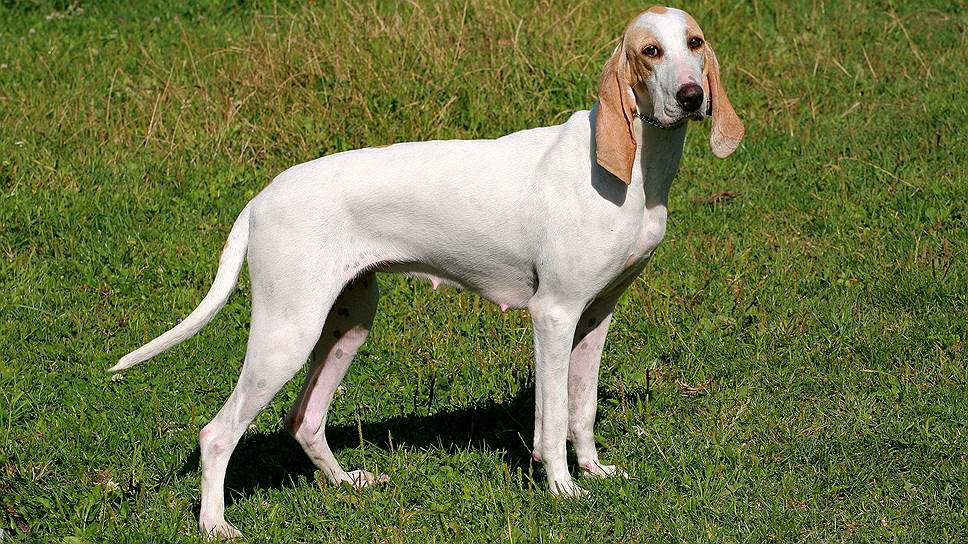
| Height | 53–60 cm |
| Weight | 25–28 kg |
| Lifespan | 12–13 years |
| FCI group | 6 · scenthounds |
| Origin | France |
Exact ratings
- Generally a robust working breed
- Ear infections (long pendulous ears)
- Hip dysplasia
- Obesity with insufficient exercise
- Sunburn on the pale skin
Balanced food for an active scenthound, with weight control. Check the long pendulous ears regularly; provide plenty of exercise, scent work and company — the breed dislikes being alone.
The Porcelaine is a dog that embodies elegance and a hunter’s passion all in one. Its name is a giveaway: this breed’s graceful build, aristocratic head, and unique, lustrous white coat with striking orange patches bring to mind a precious porcelain figurine. But don’t let its refined looks fool you; behind that exquisite exterior is an energetic, tireless, and incredibly devoted hunter who has served the French aristocracy for centuries. This dog is a true all-rounder: fierce and indefatigable in the field, yet gentle, calm, and affectionate with its family. It thrives on human companionship and struggles with being left alone, while showering its loved ones with boundless affection. To learn more about this unique breed, its temperament, history, and care requirements, you can read more about it on Tvaryny.
Today, the Porcelaine remains a relatively rare breed outside of its native France, but its popularity is slowly growing thanks to the perfect blend of working ability and a wonderful companion nature. They are obedient and sensitive pets who, after a long day of hunting, transform into calm and gentle family members. Their grooming isn’t as complicated as it might seem, but this breed does require significant physical exercise and mental stimulation for a happy and healthy life.
General Breed Characteristics
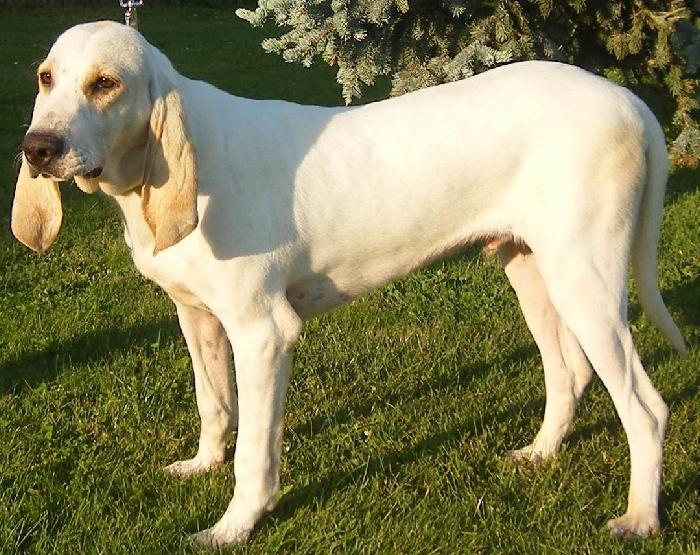
To better understand this breed, it’s worth looking at its key parameters. The Porcelaine is a well-proportioned, medium-sized dog that combines strength, speed, and elegance.
| Characteristic | Description |
| Origin | France, Franche-Comté region |
| FCI Classification | Group 6 (Scent Hounds and Related Breeds), Section 1.2 (Medium-Sized Hounds). Standard No. 30. |
| Size | Medium |
| Height at Withers | Males: 55-58 cm; Females: 53-56 cm |
| Weight | 25-28 kg |
| Lifespan | 12-13 years |
| Coat | Short, fine, dense and shiny |
| Colour | Pure white with round orange patches. The patches should never form a “mantle”. |
| Temperament | Energetic, brave, gentle, loyal, sociable |
| Use | Hunting small game (hares, roe deer), companion dog |
A Brief History of the Porcelaine
The Porcelaine, also known as the “Franche-Comté Hound” (Chien de Franche-Comté), is one of the oldest and most distinguished French hound breeds. Its history stretches back to the 17th century, closely tied to the aristocratic hunting grounds of Eastern France, particularly the Franche-Comté region bordering Switzerland. It’s believed the breed was developed by carefully crossing local white St. Hubert hounds (descendants of the White Bloodhound) with the powerful, now extinct, Montaimboeuf hounds. English Harriers and scent hounds from Switzerland, like the Lucerne Hound, also played a part, giving the breed its speed and endurance. Similar traits can be found in other European hounds, such as the Tyrolean Hound.
The name “Porcelaine” comes from the French word for “porcelain”. The breed was given this name because of its unique, gleaming white coat with a slight sheen, which resembles the glazed surface of fine porcelain. Through the thin coat, dark spots on the skin are often visible, creating a distinctive marbled effect.
The French Revolution in 1789 was catastrophic for many aristocratic dog breeds, and the Porcelaine was no exception. With the fall of the nobility, the breed was pushed to the brink of extinction. However, thanks to the efforts of enthusiasts and Swiss breeders, the breed was saved. They crossed the surviving specimens with local Swiss hounds, which helped to restore the population, although it slightly altered the original appearance. Today’s Porcelaine is a result of this careful rebuilding work. The breed was officially revived in 1844 and once again became popular among French hunters. The first breed club was founded in 1971. Despite its rich history and outstanding qualities, the Porcelaine remains a rare breed outside of France today.
Breed Standard and Appearance
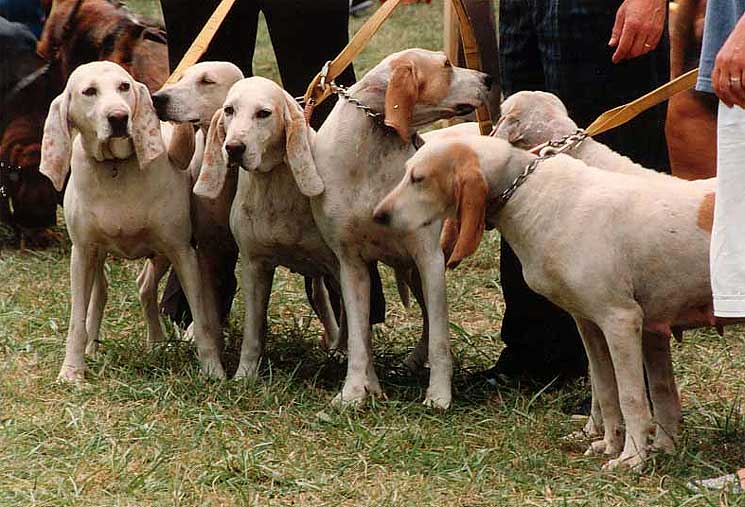
The Porcelaine is a dog where every feature speaks of its noble heritage and purpose. Its appearance combines power and elegance, creating the image of an ideal hunter.
The head of the Porcelaine is very refined and “sculpted,” with clean lines. The skull is broad between the ears, and the occipital protuberance is barely noticeable. The stop is well-defined but not abrupt. The muzzle is of a normal length, and the nose is black and well-developed.
The eyes are dark, very expressive, with an intelligent and gentle look.
The ears are one of the breed’s most characteristic features. They are thin, curled at the tip, set low at eye level, and hang down to the tip of the nose. The ears typically have prominent orange patches.
The body is well-proportioned, with a straight back and a broad, muscular loin. The chest is of medium width but deep, which provides plenty of room for the lungs—crucial for an enduring hound. The belly is slightly tucked up.
The tail is thick at the base, gradually tapering to the tip, and is carried with a slight curve.
The coat and colour are the breed’s hallmark. The coat is very short, fine, yet dense and close-lying, with a distinctive sheen. The colour is exclusively white, with clearly defined, irregularly shaped orange patches. Importantly, these patches should not merge to form a continuous “mantle.” The colouring is more intense on the ears. Black pigment spots on the skin often show through the white coat, creating that unique “porcelain” effect.
Porcelaine Character and Temperament
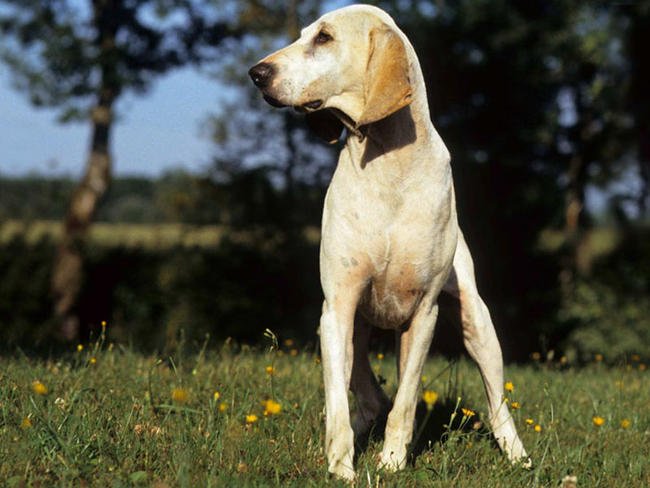
The Porcelaine has a dual character that makes it truly unique. When hunting, it is a relentless, passionate, and brave tracker, while at home, it is a well-balanced, gentle, and deeply loyal companion. This breed has a strong pack instinct, so it is very family-oriented. Porcelaines love being the centre of attention, participating in all family activities, and they cope poorly with long periods of solitude. If left alone for too long, they can suffer from separation anxiety, which may lead to destructive behaviour and incessant barking.
They get along wonderfully with children, showing astonishing patience and sensitivity. However, as with any dog, interactions with small children should be supervised. Porcelaines generally get on well with other dogs, as they were bred for centuries to work in large packs. However, problems can arise with small pets (cats, rodents, rabbits) due to their strong hunting instinct. Early and proper socialisation can help temper this trait, but the drive to chase can emerge at any moment. The Porcelaine’s hunting qualities are similar to those of French breeds like the Billy or the Ariegeois, which are also known for their passion for the hunt.
One of the breed’s most famous traits is its voice. Porcelaines are very “talkative.” They have a melodic, clear bark that they use during the hunt to alert the handler when they’ve found a trail. At home, they can also be noisy, reacting to unfamiliar sounds, which is why this breed might not be the best choice for apartment living with thin walls. Similar to the Porcelaine, a Griffon Vendéen Moyen is an excellent hunting companion.
Pros and Cons of the Breed
Before getting a Porcelaine, it’s important to weigh up all the pros and cons of this breed to understand if it fits your lifestyle.
| Pros | Cons |
|---|---|
| Exquisite Appearance: An elegant and aristocratic look. | High Energy Needs: Requires at least 1.5-2 hours of intense exercise every day. |
| Dual Character: An energetic hunter and a calm companion at home. | Prone to Barking: Has a loud and clear voice that it often uses. |
| Family Devotion: Forms a strong bond with its owners and is a wonderful friend. | Strong Hunting Instinct: May chase small animals; not suitable for off-leash walks in unsecured areas. |
| Gets on well with children and other dogs: Patient and non-confrontational. | Hates Solitude: Can suffer from separation anxiety. |
| Easy Grooming: Doesn’t require complex grooming. | Needs an Experienced Owner: Can be stubborn during training and requires a firm but fair hand. |
| High Intelligence: Capable of learning if the right approach is found. | Rare Breed: It can be difficult to find a puppy from a responsible breeder. |
Porcelaine Care and Maintenance
Caring for a Porcelaine isn’t particularly difficult, but it does have specific requirements related to its activity level and physiological features.
Grooming. The “porcelain” coat is self-cleaning and repels dirt, so the dog doesn’t need to be bathed often. Bathing 2-3 times a year or as needed is enough. However, regular brushing (1-2 times a week) with a soft brush or a rubber grooming mitt is a must. This helps remove dead hair, stimulates blood circulation, and keeps the coat looking shiny. You should pay special attention to their ears. Their long, hanging shape restricts air circulation, creating ideal conditions for bacteria and fungi to thrive. Regularly check their ear canals (once a week) for redness, dirt, or a foul odour, and clean them gently with a special lotion. Don’t forget to trim their claws (every 3-4 weeks) and clean their teeth.
Physical Activity. This is a crucial aspect of owning a Porcelaine. This dog was bred for long runs and therefore needs daily, intense physical exercise. A simple walk on the lead won’t satisfy its needs. The ideal options are long runs, hikes in the countryside, or jogging alongside a bike. A minimum of 1.5-2 hours of active exercise per day is required. The best place to keep a Porcelaine is a house with a large, securely fenced garden where it can run freely. The fence should be high, as these dogs can be prone to escaping if they catch an interesting scent. Keeping one in a flat is only possible if the owner is prepared to dedicate a lot of time to long, active daily walks.
Diet: What to Feed a Porcelaine
Proper nutrition is the key to a healthy and long life for an active dog. A Porcelaine’s diet should be balanced and meet its high energy needs. You can choose either high-quality dry food from a premium or super-premium brand designed for active medium-sized dogs, or you can opt for a natural diet.
If you choose a natural diet, the basis of their meals (around 50-60%) should be lean meat and offal (beef, turkey, chicken, tripe, heart). The rest of the diet is made up of:
- Grains (20-25%): Buckwheat, rice, oatmeal.
- Vegetables (15-20%): Carrots, pumpkin, courgettes, beetroot (with caution), and greens.
- Fermented dairy products: Low-fat cottage cheese, kefir (1-2 times a week).
- Eggs: 1-2 boiled eggs per week.
It’s important not to overfeed your dog, as excess weight puts extra strain on their joints. The daily portion should be divided into two meals. Always ensure they have access to fresh, clean water.
| Product Type | Approximate Daily Portion for an Adult Dog (25 kg) | Notes |
|---|---|---|
| Meat and Offal | 400-500 g | Lean cuts, raw or slightly cooked. |
| Porridge | 200-250 g (cooked) | A source of carbohydrates and energy. |
| Vegetables | 150-200 g | A source of fibre and vitamins. Can be given raw or steamed. |
| Vegetable Oil | 1 tablespoon | Flaxseed or olive oil for coat health. |
Training and Socialisation
Porcelaines are intelligent and clever dogs, but their training has its peculiarities. Like many hounds, they can be quite independent and stubborn. They were bred to make decisions far away from the handler, so blind obedience is not their strong suit. The key to success lies in patience, consistency, and positive reinforcement. Harshness and physical punishment are unacceptable, as they can permanently destroy the trust between the dog and its owner.
Training should start from an early age. Early socialisation is very important: introduce your puppy to different people, sounds, places, and other animals. Special attention should be paid to the “Come!” command. Due to their strong hunting instinct, a Porcelaine, upon catching a scent, might forget about everything else in the world. Therefore, the recall command must be practised until it’s perfect. For hounds like the Porcelaine or the Griffon Vendéen Moyen, this is one of the most important and difficult commands.
The owner of a Porcelaine must be its leader—calm, confident, and consistent. Training sessions should be short, interesting, and varied so that the dog doesn’t lose interest. Use treats and praise as motivation.
Health and Typical Breed Diseases
The Porcelaine is generally a healthy and robust breed with a strong immune system. However, like any breed, it is predisposed to certain genetic and acquired diseases:
- Hip Dysplasia: A common problem among active medium- and large-sized dogs. This is a hereditary disease that leads to arthritis and pain. It’s important to choose a puppy from breeders who test their dogs for dysplasia.
- Ear Infections (Otitis): Due to the anatomical structure of their ears (long and hanging), Porcelaines are prone to ear infections. Regular ear hygiene is the best prevention.
- Bloat (Gastric Torsion): A life-threatening condition typical of dogs with deep chests. To prevent it, feed your dog smaller portions twice a day and avoid active games immediately after eating.
- Anaesthesia Sensitivity: Some members of the breed may have an increased sensitivity to certain types of anaesthesia. Always inform your vet about this before any surgical procedures.
- Hunting Injuries: As an active hunting dog, the Porcelaine is prone to cuts, sprains, and other injuries while working in the field. Carefully inspect your dog after every hunt.
The Porcelaine as a Hunting Dog
While the Porcelaine can be a wonderful companion, its true calling is hunting. It is a classic scent hound that primarily works on small game: hare, rabbit, fox, and roe deer. It can work both alone and in a pack. Its main hunting qualities are its phenomenal sense of smell, incredible endurance, speed, and clear, melodic voice. Once it picks up a trail, the Porcelaine alerts the hunter with its characteristic, ringing bark and can tirelessly pursue the quarry for hours. Its passion for pack work and endurance is reminiscent of a hound like the Tyrolean Hound, although it has a more elegant physique. The Porcelaine also shares hunting prowess with the Billy and the Ariegeois.
Interesting Facts about the Porcelaine
- A Name That Fits: This is one of the few breeds whose name so accurately describes its appearance—the shiny white coat that resembles porcelain.
- Almost Extinct: The Porcelaine was on the verge of extinction after the French Revolution and was only saved thanks to the efforts of Swiss dog breeders.
- “Transparent” Coat: A unique feature is that the dark pigment spots on the skin are often visible through the thin white coat, creating a marbled effect.
- Melodic Voice: Hunters value Porcelaines for their special, clear voice, which can be heard over great distances in the woods.
Frequently Asked Questions
- Is the Porcelaine suitable for apartment living?
It’s not the best option. The breed needs a lot of space and intense physical activity. Keeping it in a flat is only possible if the owner can provide 2-3 long, active walks every day. Their tendency to bark should also be taken into account. - Does the Porcelaine shed a lot?
They shed moderately. Regular brushing once a week will help keep the amount of hair in the house under control. - Can this dog be kept on a chain or in a kennel?
Categorically no. They are social dogs who suffer without human contact. Keeping them in a kennel is only acceptable for short periods, not as a permanent residence. - Are they aggressive towards people?
No, aggression towards people is absolutely uncharacteristic of this breed. They are friendly and gentle dogs.
Videos about the Breed
- Elegant, with an excellent nose
- Gentle, calm, good with children
- Friendly to other dogs
- Hardy, all-round hunter
- Vocal — “gives tongue” on the trail
- Strong hunting instinct (risky with cats)
- Cannot bear being alone
- High exercise needs — not for a flat
| Harrier | Small Blue Gascony Hound | Anglo-Français de petite vénerie | |
|---|---|---|---|
| Height | 48–53 cm | 50–60 cm | 48–56 cm |
| Energy | 4.5 | 4.5 | 4.5 |
| Apartment | 2 | 2 | 2 |
| Beginners | 3 | 2.5 | 2.5 |
Where does the name “porcelain hound” come from?
Is the Porcelaine good for a family?
Is the breed suited to a flat?
FCI Standard No. 30 · Société Centrale Canine
For apartments · For kids · For beginners · Active · Smartest · Hypoallergenic · All rankings →