Group 3 · terriers · United Kingdom (Scotland, Isle of Skye)
Skye Terrier
An aristocrat under a curtain of sumptuous coat: devoted, reserved, brave and deeply attached to one person. The Skye Terrier is an ancient Scottish terrier twice as long as it is tall, with a long silky coat; a rare, dignified breed with a faithful "one-person" heart.
ApartmentKids · with caveatsCats · with caveatsOther dogs · with caveatsBeginners · with caveats
The Skye Terrier is a truly wonderful and rare dog breed with an aristocratic appearance and a rich history. Be prepared to turn heads on your daily walks — their elegant gait, long flowing coat, and dignified expression captivate everyone who sees them. However, to maintain that true Scottish lord look, their magnificent "fur coat" requires meticulous and regular grooming. This isn't just a sofa-loving lapdog; they're a true terrier at heart — brave, active, and occasionally stubborn. They require moderate but regular exercise to burn off their energy. To learn more about all aspects of the care, character, and history of this unique breed, read more on Tvaryny.
At home, Skye Terriers are quite calm and reserved. They are independent dogs who, at the same time, form deep bonds with their owners, often choosing one person as the centre of their universe. They are wary and aloof with strangers, which makes them excellent watchdogs. It's important to note that they aren't always patient with small children, so for families with toddlers, it's worth considering a more easy-going breed.
Skye Terrier: A Brief Breed Overview
Skye Terrier: A Brief Breed Overview · 8
Origin
United Kingdom (Scotland, Isle of Skye)
FCI Classification
Group 3 (Terriers), Section 2 (Small Terriers). Without a working trial.
Year of Breed Recognition
1879 (first breed club)
Lifespan
12–15 years
Ideal Height at Withers
25–26 cm
Weight
8–11 kg (depending on sex and build)
Temperament
Loyal, brave, reserved, intelligent, stubborn
Other Names
Skye Terrier, Terrier from the Isle of Skye
Interesting Facts About the Breed
Royal Favourites: In addition to Queen Victoria, another fan of the breed was Mary, Queen of Scots. Legend says her favourite Skye Terrier hid under her skirt during her execution and died of grief a few days later.
"Dog from the Heavens": The name of the island "Skye" comes from the Old Norse for "cloud island," which is why the breed is sometimes poetically called the "terrier from the cloud island."
One of the Rarest Breeds: The Skye Terrier is on the list of Vulnerable Native Breeds in the UK. Extremely few puppies are registered annually, which puts the breed at risk of extinction.
Two Ear Types: Unlike many other breeds where the standard allows for only one ear type, both prick ears and drop ears are officially recognised in Skyes. Prick ears became more popular in the late 19th century.
Bred for Hunting in Burrows: Their long, harsh coat served as armour, protecting them from the bites of their prey, and their short, powerful legs allowed them to dig effectively.
History of the Skye Terrier Breed
The history of the Skye Terrier is inextricably linked to the misty and rugged Isle of Skye in western Scotland, which gave the breed its name. It is one of the oldest terrier breeds, with roots dating back to at least the 16th century. It's believed that the ancestors of modern Skyes were local Scottish terriers used for hunting otters, badgers, and foxes in the rocky terrain. Their long, low-slung body and short legs were perfect for entering burrows.
There is a legend that in the 16th century, a ship of the Spanish Armada was wrecked off the Isle of Skye. The surviving dogs, believed to be Maltese, interbred with the local terriers, giving their descendants the luxurious long coat. While it's a lovely story, there is no documentary evidence to support it. It's more likely that the long coat is the result of selective breeding for protection against harsh weather and the bites of prey animals.
True popularity came to the Skye Terrier in the 19th century when they became favourites of the British aristocracy. Queen Victoria was a passionate admirer of the breed, which instantly made them fashionable among the gentry. She owned both prick-eared and drop-eared Skyes. This royal patronage secured the breed an honoured place at the first dog shows.
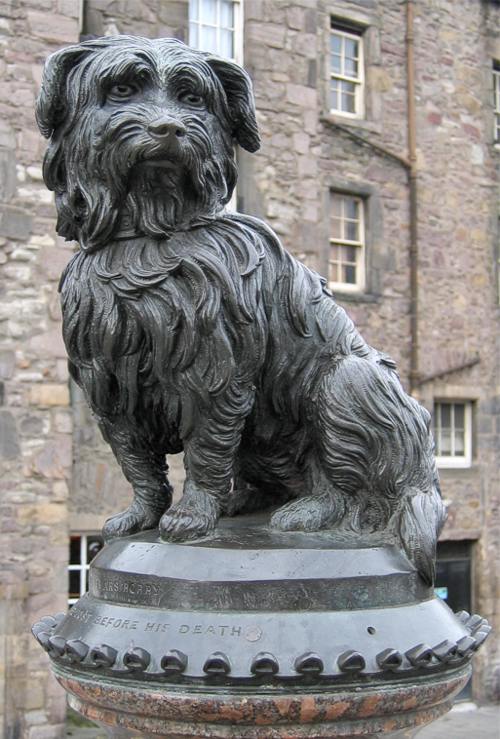
The most famous Skye Terrier in history is, without a doubt, Greyfriars Bobby. This dog became a symbol of canine loyalty. After the death of his owner, John Gray, in 1858, Bobby spent the next 14 years, until his own death, on his master's grave at Greyfriars Kirkyard in Edinburgh. His story touched the entire world, and a statue was erected in his honour in the Scottish capital. This story forever cemented the Skye Terrier's reputation as an incredibly loyal dog. Unfortunately, today the Skye Terrier is one of the rarest and most vulnerable breeds in the UK, making the efforts of enthusiasts to preserve it particularly valuable.
What the Skye Terrier Looks Like: Standard and Appearance
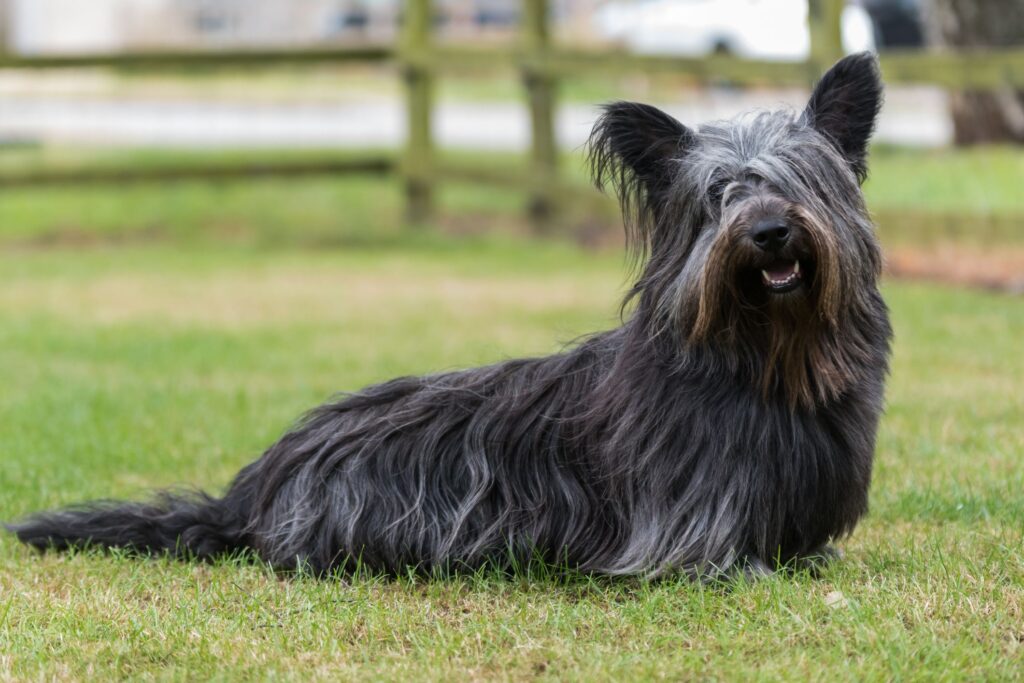
The Skye Terrier is a dog whose appearance combines elegance with strength. Its body is long, low-set, and powerful, with well-developed muscles. The ratio of body length to height at the withers is approximately 2:1. Despite its short legs, it is very agile and sprightly.
Head: Long and powerful, but in proportion to the body. The stop is gentle. The muzzle is strong, not pointed, with powerful jaws.
Nose: The nose is always black.
Eyes: Medium-sized, dark brown, set close together. The expression is intelligent and piercing.
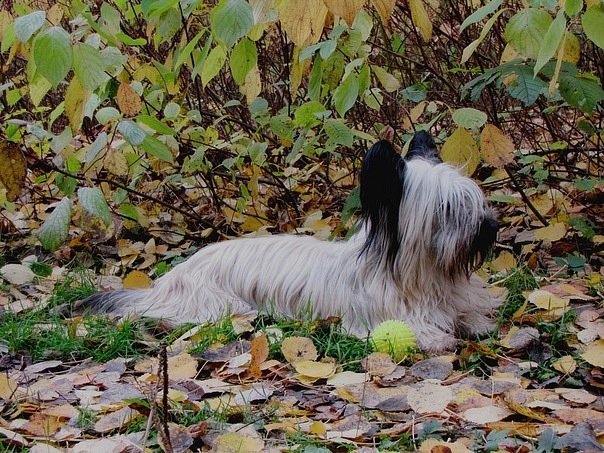
Ears: There are two variations — prick ears and drop ears. Prick ears are of medium size, set high, and covered with long hair that forms beautiful "fringes." Drop ears are slightly larger, set lower, and lie close to the head. Both types are standard.
Body: The back is straight and long. The chest is deep and oval-shaped.
Tail: Covered with a thick coat. When at rest, it hangs down and may be slightly curved. When excited, it rises but not above the level of the back.
Limbs: Short, straight, and muscular. The feet are large, pointing forward, with thick pads and strong, preferably black, nails.
Skye Terrier Coat and Colour
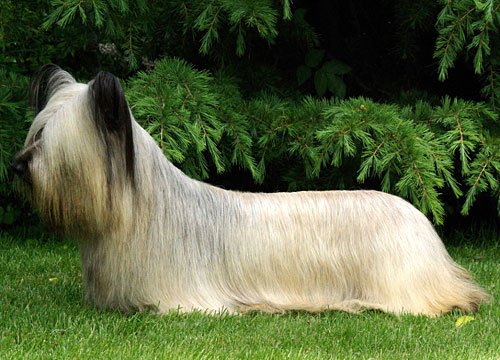
The main attraction of the Skye Terrier is its double coat. The undercoat is short, soft, and dense, like down. The topcoat is long (about 14 cm), harsh to the touch, straight and flowing, without curls. It forms a natural parting from the head to the tail, falling down both sides of the body. The hair on the head is shorter, forming a "fringe" that covers the eyes, and a beard. It is important that the coat does not obstruct the dog's vision.
Permissible colours are varied:
Black.
Dark grey or light grey.
Fawn.
Cream.
Regardless of the colour, the tips of the ears, the muzzle, and the tail must be black. A small white spot on the chest (no more than 2 cm) is acceptable. An interesting feature: the final colour in Skye Terriers develops quite slowly, sometimes not until they are 18 months old. Puppies are often born much darker than they become in adulthood.
Character: Temperament and Behaviour
Underneath the aristocratic exterior of the Skye Terrier lies the brave heart of a true hunter. This is a "one-person dog." They are immensely devoted to their family but usually choose one person to whom they bond most strongly. With their own people, they are affectionate and playful, but not needy. This isn't the kind of dog that will follow you around all day; they value personal space, both theirs and yours. Many mistakenly believe they are aggressive, but this is not the case. Their behaviour is more about reserve and mistrust of strangers, rather than unprovoked aggression. If a person earns a Skye's trust, they will have a loyal friend for life.
Like most terriers, they have a strong and independent character. A Skye Terrier can be stubborn and try to make decisions on their own. This isn't a fault, but a peculiarity of the breed that must be taken into account during training. They are very intelligent and learn quickly, but will only follow a command when they see the point of it and respect their owner. Shouting and physical punishment don't work with them — you'll only get a complete refusal to cooperate. Unlike some hounds, such as the Swiss Hound (Schwyz Hound), which are accustomed to working in packs, the Skye Terrier is an individualist.
Pros and Cons of the Skye Terrier Breed
Before getting such an unusual dog, it's important to weigh up all the pros and cons. A Skye Terrier is not for everyone, and a potential owner must be prepared for their peculiarities.
Pros and Cons of the Skye Terrier Breed · 6
Pros
Cons
Incredible loyalty. This is a dog that will be faithful to its owner until the end.
Stubbornness and independence. Requires patient and consistent training.
Good watchdog. Will always warn of strangers' arrival, but is not prone to barking without reason.
Complex coat care. Requires daily brushing and regular washing.
Adaptability. Can live in both an apartment and a house (but not outdoors).
Mistrust of strangers. Requires early and extensive socialisation.
Doesn't require excessive exercise. Daily walks are sufficient.
Not the best choice for families with small children. Can be impatient with children's antics.
Striking and rare breed. Your pet will always be the centre of attention.
High cost and rarity. Finding a puppy from a good breeder can be difficult.
Robust health and longevity.
Prone to back problems due to a long spine.
Training and Socialisation
Raising a Skye Terrier is an intellectual battle in which you'll need steadfastness, patience, and a sense of humour. They are very intelligent dogs, but their intelligence is combined with considerable stubbornness. They will not blindly obey commands. The owner must become an authoritative leader and partner for the Skye, whom they respect. Training should be consistent, fair, and based on positive reinforcement — praise and treats. Shouting and harshness will only cause the dog to retreat into itself. The breed is more suitable for an experienced dog owner than a novice. Just like the Dandie Dinmont Terrier and the West Highland White Terrier, Skyes are very clever dogs who won't just blindly obey.
Early socialisation is critically important. From a very young age, introduce the puppy to different people, sounds, places, and other animals. This will help to raise a confident and well-balanced dog, rather than one that is timid or aggressive towards strangers. Due to their strong hunting instinct, it's best to keep a Skye on a lead in unenclosed areas — they may bolt after a cat or a squirrel, ignoring all commands. You can introduce them to other terriers, such as the Montenegrin Mountain Hound or the Swiss Hound (Schwyz Hound), at specialised dog parks.
Skye Terriers are tireless and love to run, despite their short legs. They happily participate in sports like mini-agility or nosework, where they can show off their cleverness and energy.
How to Groom a Skye Terrier's Coat
Grooming the Skye Terrier's magnificent coat is the most important aspect of looking after the breed. It requires time and patience.
Brushing: This is a daily or at least 2–3 times a week procedure. You need to use a long-bristled brush and a metal comb with widely spaced teeth. You must brush thoroughly, strand by strand, from the roots to the tips, to prevent mats from forming. Pay special attention to the areas behind the ears, under the legs, and on the belly.
Washing: A Skye should be bathed as needed, usually once every 3–4 weeks. Use only quality shampoos for long-haired dogs, and also be sure to use a conditioner or balsam. This will help make the coat smooth and prevent it from tangling. After washing, the coat must be thoroughly dried with a hairdryer, while simultaneously brushing.
Trimming: Skye Terriers are not trimmed! Their coat is their protection and their pride. The only thing that needs to be done is a hygienic trim. Carefully trim the hair between the paw pads and around the anus. The "skirt" can be slightly tidied up so that it doesn't drag on the ground.
Eyes and Ears: Regularly check the eyes and ears. The hair growing near the eyes can be tied back or carefully trimmed if it obstructs the dog's vision. Ears should be cleaned as needed with a special lotion.
Nutrition
Skye Terrier Nutrition: Key Recommendations
Health and risks
Skye Terrier Health: Typical Diseases and Prevention
Frequently Asked Questions About the Skye Terrier Breed (FAQ) · 4
Does the Skye Terrier shed a lot?
Despite their long coat, Skye Terriers shed moderately. Their double coat sheds the undercoat seasonally, but with regular brushing, most of the dead hair remains on the brush, not on your furniture and clothes.
Is the Skye Terrier suitable for apartment living?
Yes, absolutely. They are not hyperactive dogs and are calm at home. They don't need a large space as long as they get enough daily walks for physical and mental stimulation.
Do Skye Terriers get along well with other animals?
This depends on socialisation. If the puppy grew up with other dogs or cats, it will likely be tolerant of them. However, their strong hunting instinct can pose a threat to small animals such as rodents or birds. With unfamiliar dogs on the street, they can be wary and even scrappy, especially with members of the same sex.
Can you leave a Skye Terrier alone for a long time?
They form strong bonds with their family but are also quite independent. A well-behaved adult Skye can handle being alone during the working day. However, like any dog, they should not be left alone for an entire day.
Video about the Breed
FAQ
Why is the Skye Terrier so devoted?
It is a hallmark of the breed — a deep attachment to its person (the legend of Greyfriars Bobby); at the same time it is reserved and distrustful of strangers.
Is the Skye Terrier prone to back problems?
Yes — the body is twice as long as it is tall, so there is a risk of disc disease; puppies should avoid stairs and jumps up to 8–10 months.
Does the coat need a lot of care?
Yes — the long silky coat that covers the body and eyes needs regular combing so it does not mat.