EN
Tvaryny › Dogs › Cairn Terrier
Group 3 · terriers · Great Britain (Scotland)

Cairn Terrier

A shaggy daredevil of the Scottish Highlands — small, hardy and fearless: lively, clever, devoted and people-oriented. The Cairn Terrier is one of the oldest Scottish terriers, once a tireless hunter of small quarry among the stone cairns; today it is an energetic companion involved in every family affair, unable to imagine life without human company.
Height
28–31 cm
Weight
6–8 kg
Lifespan
12–15 years
FCI group
3 · terriers
Cairn Terrier
Photos: 2

Breed ratings

Family Kids Beginners Training Energy Health Shedding Drooling Barking Apartment Weather Prey drive
Exact ratings · 12
Family 5.0 Kids 4.5 Beginners 4.0 Training 3.5 Energy 4.0 Health 4.0 Shedding 2.0 Drooling 1.0 Barking 3.5 Apartment 4.0 Weather 4.0 Prey drive 4.0
Pros
Lively, devoted, good with children
Hardy, undemanding, healthy
Compact, suits a flat
Clever, involved in everything
Cons
Keeps a hunting instinct (earthdog drive)
Cannot bear being alone
Prone to digging and barking
Wiry coat needs stripping
Size
Compatibility
Apartment Kids Cats · with caveats Other dogs Beginners

The Cairn Terrier is a small, yet sturdy and courageous dog that hails from the rugged Scottish Highlands. Once an indispensable hunter of small game, this breed has now won the hearts of millions as an energetic and loyal companion. Cairn Terriers make excellent friends for active families who prefer a lively lifestyle. They cannot imagine their existence without human interaction and therefore require constant attention and involvement in family affairs. A Cairn will become not just a friend, but a full-fledged family member who will want to participate in everything that happens. You can read more about this wonderful dog on Tvaryny.

They are fantastic dogs for families with children, as they are always ready to join in all the fun and games. However, it is important to remember that you should never be rough or disrespectful with Cairn Terriers, as they can become unruly and stubborn. If you want to achieve something with a Cairn Terrier, always use positive reinforcement, especially treats, which they absolutely adore. This small ‘key’ will help unlock their big and loving heart.

Cairn Terrier: Key Breed Characteristics

Cairn Terrier: Key Breed Characteristics · 9
CharacteristicDescription
OriginGreat Britain (Scotland)
Year of Recognition1909
Life Expectancy12–15 years, sometimes up to 18
Height at Withers28–31 cm
Weight6–8 kg
TemperamentBrave, active, playful, independent, loyal
UseCompanion dog, hunter of small rodents
Grooming NeedsMedium (regular brushing, stripping)
Activity LevelHigh

What a Cairn Terrier Looks Like: A Detailed Description
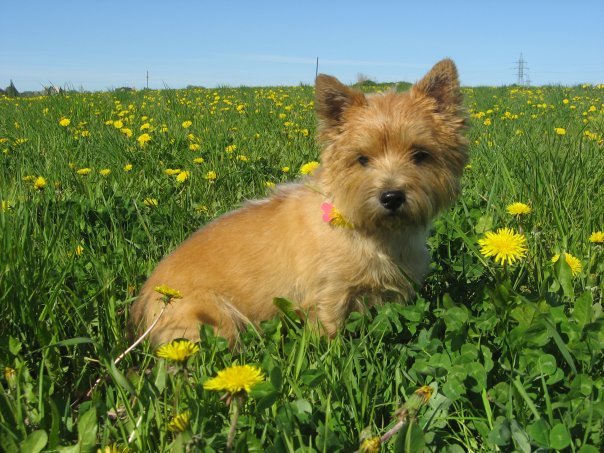
A Cairn Terrier

The Cairn Terrier is a small but strong and well-balanced dog with a "cheeky" yet intelligent expression. Its appearance completely matches its working past: it is durable, agile, and ready for any adventure.

  • Head: Small, proportional to the body, with a broad skull. The forehead has a pronounced but smooth stop to the muzzle. The muzzle is strong but not heavy, tapering towards the nose.
  • Eyes: Medium-sized, set wide apart, usually dark brown. The gaze is very expressive, lively, and piercing, hidden under shaggy eyebrows.
  • Ears: Small, triangular, erect and pointed. They are set high and give the dog an alert appearance.
  • Body: Compact, with a straight back, flexible loin, and a deep chest. The neck is strong and of medium length. The Cairn's body is muscular and powerful, allowing it to be extremely agile.
  • Limbs and Paws: The front paws are larger than the hind ones, strong, with thick pads, which helped them dig into the ground. The limbs are short but very muscular.
  • Tail: Short, proportional to the body, set high. The dog holds it cheerfully, almost vertically, but never curls it over its back.
  • Coat: Double-layered, which is a key feature of the breed. The outer layer is a harsh, coarse, and weather-resistant coat that protects against rain and dirt. The undercoat is soft, short, and dense, providing warmth in cold weather. On the muzzle, the fur forms a small moustache and beard.
  • Colour: Various colours are allowed: cream, wheaten, red, grey, or almost black. Brindle colouring of any of these is also very common. A characteristic feature is darker shades on the ears, muzzle, and the tip of the tail.

Interesting Facts About the Cairn Terrier

  • A Hollywood Star: The most famous Cairn Terrier in the world is the dog named Terry, who played Toto in the classic 1939 film "The Wizard of Oz." For that role she was paid more than many of the human actors on set.
  • Colour Change: Many Cairn Terriers, especially those with brindle colouring, can significantly change their coat colour throughout their lives. A puppy born light can darken with age, and vice versa.
  • Royal Favourites: The British Royal Family is known for its love of Corgis, but King Edward VIII and his wife Wallis Simpson were great fans of Cairn Terriers and kept several dogs of this breed.
  • Natural-born Hunters: Cairn Terriers worked in "teams" of several dogs. Their task was to drive the animal into a burrow or a crevice in the rocks and then fearlessly follow it underground.

The History of the Cairn Terrier

The history of the Cairn Terrier is closely intertwined with the rocky and harsh landscapes of the Scottish Highlands and the Isle of Skye. The breed is considered one of the oldest among terriers. Its name comes from the Gaelic word "cairn," which means a 'pile of stones' or 'rocky hill'. This directly indicates the working purpose of these dogs: they were bred to hunt small pests such as foxes, badgers, and otters that hid among these very stone mounds.

For centuries, all working terriers in Scotland were simply called "Scottish Terriers." They were valued exclusively for their working qualities—courage, endurance, and hunting drive—while their appearance, coat colour, or type of fur was largely ignored. It was only at the end of the 19th century that canine enthusiasts began to classify and standardise different types of terriers. Thus, from one large group of "earth dogs," well-known representatives such as the West Highland White Terrier and the Scottish Terrier (Scotch Terrier) were gradually singled out. Initially, Cairn Terriers were called "short-haired Skye Terriers," which caused confusion. Under its modern name, the breed first appeared at a show in London in 1909 and was officially recognised by the Kennel Club in 1910. From 1928, these charming and energetic dogs began to gain popularity throughout Europe and beyond.

The Cairn Terrier Character: A Big Dog in a Small Body

Cairn Terriers are the epitome of the classic terrier spirit: they are brave, fearless, independent, and a little bit stubborn. They have a very well-developed protector instinct. Despite their modest size, this dog can fearlessly challenge a much larger opponent if it senses a threat to itself or its family. They are very sociable, playful, and love being the centre of attention. A Cairn will be unhappy if it is ignored or left alone for too long. It needs mental and physical stimulation, otherwise, out of boredom, its behaviour can become destructive: it might chew on things, bark incessantly, or dig up your garden.

They are exceptionally intelligent, which makes the learning process potentially easy, but their independence requires patience and consistency from the owner. Cairns love to make their own decisions and are not always ready to blindly obey. However, they are very food-oriented, so treats will be your best assistant in training. This breed gets along wonderfully with children, especially if they grow up together. A Cairn will become a tireless playmate. However, it is important to teach children to respect the dog and not to be rough with it. As for other animals, Cairns can live with other dogs, especially with early socialisation. But with small household pets (hamsters, rabbits, cats), problems may arise due to their strong hunting instinct. Any small, fast-moving creature can be perceived as prey. This is a trait they share with the Dandie Dinmont Terrier, which also has a strong prey drive.

Pros and Cons of the Cairn Terrier Breed

Pros and Cons of the Cairn Terrier Breed · 6
ProsCons
Compact size: Ideal for living in both a flat and a house.Tendency to bark: Can be noisy, reacting to any sound or movement.
High intelligence: Learn quickly if you find the right approach.Stubbornness and independence: Require consistent and patient training.
Loyalty to the family: Get very attached to their owners and make wonderful companions.Strong hunting instinct: May chase cats and other small animals. Should not be let off the lead in dangerous areas.
Robust health: Considered one of the healthiest breeds with a small number of genetic diseases.Need for activity: Require regular and long walks and mental stimulation.
Low shedding: With proper care (stripping), they hardly shed at all.Love to dig: Instinct forces them to dig holes in the garden or flowerbeds.
Fun and playful nature: Always ready for fun, which makes them great dogs for active people.Require specific grooming: The coat needs manual plucking (stripping), not clipping.

Cairn Terrier Care: Coat, Activity, and Upkeep

Cairn Terriers adapt well to various living conditions. Thanks to their compact size, they are easy to keep in a city flat, provided they get enough exercise. However, they will feel ideal in a private house with a well-fenced garden where they can expend their energy. But be prepared that your garden might become a digging site—it's an instinct that is difficult to fight. Caring for a Cairn is not complicated, but it requires regularity.

Coat Care: Stripping, not Clipping

A key aspect of care is the coat. It must be brushed several times a week with a metal comb to prevent matting and remove dead hairs. It is not recommended to wash a Cairn too often, only as it gets dirty, so as not to wash away the natural protective oily layer.

Most importantly: a Cairn Terrier's coat should not be clipped with clippers. Clipping damages the structure of the harsh outer coat, making the fur soft, dull, and unable to protect against moisture and dirt. The correct care consists of stripping (manually plucking) the dead hair 2–3 times a year. This procedure can be done independently after learning from a groomer or by contacting a professional. Stripping stimulates the growth of a new, healthy, and harsh coat.

Physical Activity

A Cairn Terrier is an energiser. It needs at least 45–60 minutes of active walks daily. This can be more than just walking on a lead, but also running, playing with a ball, or frisbee. They also love hiking and exploring new places. Insufficient activity is a direct path to obesity and behavioural problems. It is important to remember that due to their hunting instincts, they should not be let off the lead near roads or in places where they might chase a cat or a squirrel. This is a trait they share with other terriers, such as the West Highland White Terrier, the Scottish Terrier, and the Norwich Terrier.

Cairn Terrier Training and Socialisation

Cairn Terrier photo

Cairn Terriers are very intelligent dogs, capable of instantly memorising commands. However, their intelligence is combined with terrier stubbornness. They were bred for independent work, so do not expect slavish obedience from them. The main things in training are consistency, patience, and positive reinforcement. Rudeness and punishment will only lead to the dog withdrawing or starting to resist. Sessions should be short, dynamic, and interesting so as not to bore the dog. Use treats and praise—a Cairn is willing to do a lot for a tasty morsel.

Early socialisation is critically important. From puppyhood, introduce the Cairn to various people, sounds, places, and other animals. This will help raise a confident and well-balanced dog that will not show aggression or fear. Remember that the Cairn Terrier, like its relatives, has a strong character, so the owner must be a leader for it—calm, fair, and confident.

Nutrition

Cairn Terrier Nutrition: Key Recommendations

Health and risks

Cairn Terrier Health: Typical Illnesses and Prevention

Frequently Asked Questions About the Cairn Terrier Breed (FAQ) · 5

Do Cairn Terriers shed a lot?
With proper care, which includes regular stripping, Cairns hardly shed at all. If they are clipped, the structure of the coat is damaged, and they may start to shed more heavily.

Are Cairn Terriers suitable for inexperienced owners?
They can be a good choice, but only if the owner is prepared for their stubbornness and the need for consistent training. This is not a dog that will obey unquestionably. You need to be ready to show patience and leadership qualities.

How much does a Cairn Terrier puppy cost?
The price of a puppy depends on its pedigree, the reputation of the kennel, and the parents' titles. Keeping the animal for its whole life always outweighs what you pay at the start, and that is the figure worth thinking about first.

Can Cairn Terriers live in a flat?
Yes, they adapt well to living in a flat, but only if they get enough daily physical and mental activity. Without long walks, they will get bored and can become destructive.

Do Cairns get along well with cats?
This depends on the individual dog's temperament and whether they grew up together. If a Cairn is introduced to a cat at an early age, they can become friends. However, its hunting instinct may be triggered by an unfamiliar cat on the street, so constant supervision is required.

Video about the breed

FAQ

Where does the name “Cairn Terrier” come from?
A cairn is a heap of stones; the breed was named for bolting small quarry (foxes, rodents) out of such heaps and burrows in the Scottish Highlands.
Is the Cairn Terrier good for a family?
Very — a lively, devoted, people-oriented dog, good with children, that wants to join in every family affair; the key is not to leave it alone for long.
Is the Cairn Terrier suited to a flat?
Yes — a compact, adaptable dog; the keys are daily walks, activity and company, as it has energy and curiosity in abundance.

Similar breeds

Show all 13 breeds
Sources

FCI Standard No. 4 · The Kennel Club