

| Height | 44–56 cm |
| Weight | 20–25 kg |
| Lifespan | 12–13 years |
| FCI group | 6 · scenthounds |
| Origin | Serbia / Balkans |
Exact ratings
- Hip dysplasia
- Ear infections (pendulous ears)
- Eye disease
- Generally a healthy Balkan breed
- Injuries while hunting
Quality food for an active breed, with weight control. Plenty of exercise is a must; clean the pendulous ears; the short coat is easy to care for.
The Serbian Tricolour Hound, also known as the Yugoslavian Tricolour Hound, is a rare but exceptionally talented hunting breed originating from the Balkan Peninsula. These dogs are the embodiment of endurance, loyalty, and hunting drive. They are close relatives of breeds such as the Serbian Hound and the Montenegrin Mountain Hound, but stand out due to their unique tricolour coat. Members of the breed are low-maintenance animals with robust health and excellent working qualities. While hunting, they display incredible energy and passion, yet at home, they transform into calm and obedient companions. Serbian Tricolour Hounds serve their owner and their family with unwavering devotion, which makes them wonderful pets, provided they receive proper training and sufficient exercise. To discover all the nuances of their care, character, and history, read more on Tvaryny.
Serbian Tricolour Hound: Key Information About the Breed
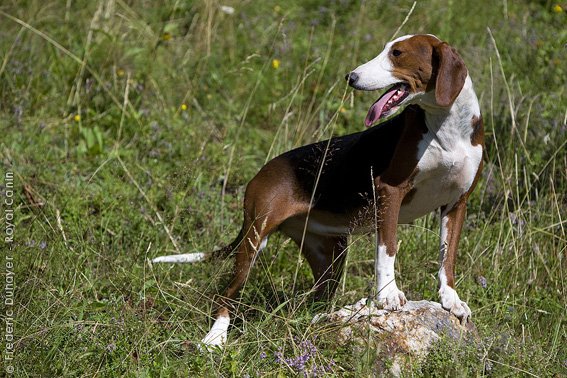
| Breed Name | Serbian Tricolour Hound (Serbian Tricolour Hound, Srpski Trobojni Gonič) |
| Country of Origin | Serbia |
| FCI Classification | Group 6 (Scenthounds and Related Breeds), Section 1.2 (Medium-sized Hounds). Standard No. 229. |
| Lifespan | 11-14 years |
| Height at Withers | Males: 45-56 cm, Females: 44-54 cm |
| Weight | 20-25 kg |
| Temperament | Loyal, lively, reliable, calm at home, energetic when hunting |
| Use | Hunting small to medium-sized game (hare, fox, wild boar, deer) |
| Physical Exercise Needs | Very high |
| Coat Care | Minimal |
History and Origin of the Breed
The history of the Serbian Tricolour Hound is closely intertwined with that of other Balkan hounds. Essentially, this breed is a variation of the Serbian Hound, which was previously known as the Balkan Hound. For centuries, hounds predominantly with reddish or red-and-black coats existed in the territory of the former Yugoslavia. However, from time to time, puppies with three colours—red, black, and white—would appear in litters. Initially, such dogs were considered non-standard and were culled, but over time, hunters noticed that tricolour individuals often had the same outstanding working qualities as their bicolour relatives.
Deliberate work on the breed began in the mid-20th century. Yugoslavian cynologists decided to preserve and standardise this tricolour variation. The breed, under the name “Yugoslavian Tricolour Hound,” was first officially shown at an international dog show in Belgrade on 7-8 June 1950. However, official recognition by the Fédération Cynologique Internationale (FCI) came later. The first breed standard was published on 25 July 1961. After the dissolution of Yugoslavia, the breed’s name was changed to “Serbian Tricolour Hound.”
Despite its outstanding hunting abilities, the breed never gained widespread popularity outside its homeland. Today, Serbian Tricolour Hounds are bred mainly in Serbia and neighbouring Balkan countries, where they are highly valued for their hard work, stamina, and loyalty.
Breed Standard and Appearance
The Serbian Tricolour Hound is a medium-sized dog with a strong but not heavy build. Its appearance conveys the impression of a robust and energetic animal, bred for long pursuits of game across difficult terrain. The body is slightly elongated, with its length exceeding the height at the withers by approximately 10%.
The dog’s head is wedge-shaped, with the length of the skull and muzzle being roughly equal. The forehead is slightly convex with a pronounced longitudinal furrow. The stop (the transition from forehead to muzzle) is moderate. The muzzle is strong and gradually tapers towards the nose, but is not pointed. The nose is always black and well-developed. The lips are tight-fitting and not pendulous. A scissor bite is desired, and a full dental formula is preferred.
The ears are set high, of medium length, pendulous, and lie close to the cheeks. They are thin and rounded at the tips. The eyes are almond-shaped, of medium size, and preferably as dark brown as possible. The gaze is calm and intelligent.
The body is strong, with a straight top line. The withers are well-defined. The back is muscular and straight. The loin is powerful. The chest is deep (making up 45-50% of the height at the withers) but not overly wide. The belly is slightly tucked up.
The tail is a continuation of the croup line, thick at the base and gradually tapering to the tip. The dog carries it like a sabre, slightly below the back line. It is covered with dense hair.
The coat is short, dense, and shiny, with a well-developed undercoat. It feels quite harsh to the touch. The most important feature of the breed is its tricolour coat. The main colour is a rich reddish or fox-red. A black mantle or “saddle” is located on the back and sides. White markings are mandatory and are located on the head (in the form of a blaze on the muzzle), on the neck (as a full or partial “collar”), on the chest, on the limbs, and on the tip of the tail. The white colour should not occupy more than one-third of the total body surface.
Character and Temperament
The character of the Serbian Tricolour Hound is a marvellous combination of two opposites. When hunting, it is an unstoppable, passionate, and persistent pursuer, while at home, it is a gentle, calm, and loyal family member. This duality makes it unique.
- Loyalty: This dog becomes very attached to its owner and family. It loves to spend time with people and does not handle long periods of solitude well. Its loyalty knows no bounds, and it is always ready to protect its loved ones.
- Energy: Like any hound, it has an enormous amount of energy. This dog requires daily, long, and intense physical activity. A simple walk on a lead around the house is just a warm-up for it.
- Independence: The breed was created for independent work, where the dog pursues game at a great distance from the hunter. This has developed its ability to make its own decisions. Therefore, during training, the owner may encounter a certain stubbornness.
- Voice: The Serbian Tricolour Hound has a loud and clear voice (known as ‘gon’), which it actively uses during the hunt to inform the hunter of its movements. In urban environments, this can become a problem if the dog is not taught not to bark without cause.
- Relationships with children and other animals: They usually get along well with children, especially if they grow up together. However, due to their strong hunting instinct, they may perceive small domestic animals (cats, rodents, birds) as prey. Early socialisation is extremely important.
Application in Hunting
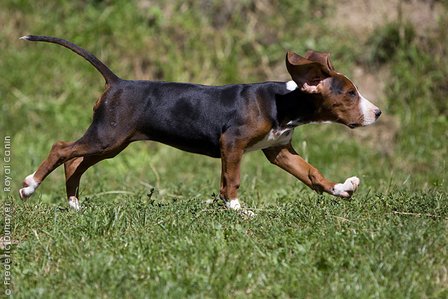
The Serbian Tricolour Hound is first and foremost a working hunting dog. Its main purpose is scent hunting. It possesses an exceptional sense of smell, incredible stamina, and persistence, allowing it to pursue game for hours.
The main targets for hunting with this breed are:
- Hare and Fox: These are classic game for hounds. The dog finds a fresh trail, flushes the animal, and with a loud bark, chases it, often in a circle, bringing it back to the hunter.
- Wild Boar and Deer: Thanks to their courage and tenacity (the ability to stay on a trail for a long time), these hounds are also successfully used for hunting larger game. They do not attack the animal, but only hold it in place by barking until the hunter arrives.
The voice (‘gon’) of this dog is high, clear, and very resonant, easily heard over long distances. Experienced hunters can determine which animal the dog is pursuing and how close it is by the change in the tone and frequency of its bark. This breed, like many other European hounds, for example, the Griffon Fauve de Bretagne, is a true specialist in its field, refined through centuries of selective breeding.
Care and Maintenance
The Serbian Tricolour Hound is a low-maintenance breed, but certain aspects of care require attention. The most important condition for its happy life is the opportunity to fulfil its need for movement.
The ideal living conditions for this dog are a house with a large, securely fenced garden. Apartment living is only possible if the owner is willing to dedicate at least 2-3 hours a day to active walks, runs, or training sessions. Without sufficient physical exercise, the dog becomes restless, may start to damage things in the house, and exhibit other forms of destructive behaviour.
| Procedure | Frequency | Recommendations |
|---|---|---|
| Brushing the coat | Once a week | Use a rubber brush or glove to remove dead hair. During shedding season (twice a year), this should be done more often. |
| Bathing | As needed, no more than 2-3 times a year | Frequent washing with shampoo can damage the skin’s protective layer. After a hunt, it’s enough to rinse its paws and belly with clean water. |
| Checking and cleaning the ears | Once a week | Because the ears are pendulous, they are poorly ventilated, which creates a risk of infections. Check them regularly and clean them with a special lotion. |
| Trimming claws | 1-2 times a month | If the claws don’t wear down naturally during walks, they need to be trimmed with a clipper. |
| Checking teeth | Several times a week | It is recommended to brush their teeth with a special toothpaste for dogs to prevent tartar buildup. |
Training and Socialisation
Training the Serbian Tricolour Hound has its peculiarities. It is an intelligent dog that learns quickly, but its innate independence requires patience and consistency from the owner. Harshness, shouting, and physical punishment are unacceptable—they will only lead to a loss of trust and stubbornness on the dog’s part. The method of positive reinforcement works best: praise, treats, and toys.
The basic commands that every hound should know are “Come!”, “Heel!”, “Sit!”, and “Leave!”. Special attention should be paid to the “Come!” command, as a strong hunting instinct can cause the dog to ignore the owner if it picks up an interesting scent. You should start practising this command from an early age in a safe location.
Early socialisation is critically important. From puppyhood, introduce the dog to different people, sounds, places, and other animals. This will help to raise a balanced and confident dog that will react appropriately to new situations. Socialisation with other dogs is particularly important, as hounds often work in packs.
Health and Common Ailments
The Serbian Tricolour Hound, like many other landraces that have not undergone extensive breeder intervention, boasts robust health and longevity. Health is generally robust, but no breed-wide list of hereditary diseases has been compiled — “not described” means “not studied”, not “not there”. However, like all dogs, they are not immune to certain problems.
- Ear infections (otitis): Due to the pendulous shape of their ears and poor ventilation of the ear canal, hounds are prone to otitis. Regular checks and cleaning of the ears are the best prevention.
- Hunting injuries: While pursuing game in the forest or mountains, the dog can get cuts, scratches, or more serious injuries. It is important to always have a first-aid kit with you.
- Hip dysplasia: Although this disease is not widespread in the breed, it can occur, as it does in most medium to large dogs. It is important to choose a puppy from a reputable breeder with health-tested parents.
- Urinary stones: Some sources indicate that the breed is susceptible to this problem, especially in old age. A properly balanced diet and sufficient water intake can significantly reduce the risks.
Regular visits to the vet, timely vaccinations, and treatments for parasites (fleas, ticks, worms) are the key to a long and healthy life for your pet.
Feeding Recommendations
The diet of a working dog must be balanced and meet its high energy needs. There are two main approaches to feeding: ready-made dry food and a natural diet (BARF).
When choosing a dry food, you should opt for premium or super-premium products designed for active dogs of medium breeds. Meat should be the primary ingredient, not cereals. During periods of intense hunting or training, you can switch the dog to more calorie-dense rations for working dogs.
For a natural diet, the basis of the ration (about 50-70%) should be lean meat and offal (beef, turkey, chicken, tripe, heart). The diet should also include:
- Grains: buckwheat, rice, oatmeal (no more than 20-30%).
- Vegetables and greens: carrots, pumpkin, courgettes, apples (a source of fibre and vitamins).
- Fermented dairy products: low-fat kefir, yoghurt, cottage cheese (a source of calcium).
- Vegetable oils: linseed, olive (1 teaspoon per day for a healthy coat).
Important: Do not feed the dog directly before or immediately after intense physical activity to avoid the risk of gastric torsion. The daily food allowance should ideally be divided into two meals. And, of course, the dog should always have access to fresh, clean water.
Pros and Cons of the Breed
| Pros | Cons |
|---|---|
| ✅ Outstanding hunting qualities | ❌ Requires very high physical activity |
| ✅ Robust health and low-maintenance | ❌ Unsuitable for apartment living without proper exercise |
| ✅ Loyalty to the family and calm nature at home | ❌ Can be stubborn and independent during training |
| ✅ Minimal coat care | ❌ Strong hunting instinct, may chase small animals |
| ✅ No tendency towards aggression towards humans | ❌ Prone to loud barking |
Interesting Facts About the Serbian Tricolour Hound
- One breed – three names. Throughout its history, the breed was officially called the “Yugoslavian Hound,” then the “Yugoslavian Tricolour Hound,” and only after the dissolution of Yugoslavia did it receive its current name, “Serbian Tricolour Hound.”
- A sibling, not a twin. Although the Tricolour Hound originated from the Serbian (bicolour) Hound and was long considered merely a variation of it, today they are two separate FCI-recognised breeds, and cross-breeding between them is not permitted.
- A rare gem. In contrast to its relatives, the Serbian Hound and the Montenegrin Mountain Hound, the tricolour variety is significantly rarer and is almost never found outside the Balkans. Owning such a dog is truly exclusive.
- A musical voice. Hunters say that the ‘gon’ of the Serbian Tricolour Hound is particularly melodic and resonant, making it easy to distinguish its work from that of other dogs in the forest.
Frequently Asked Questions about the Breed (FAQ)
Is the Serbian Tricolour Hound suitable as a first dog for a novice?
Probably not. This breed requires an experienced owner who understands the psychology of a hunting dog, is willing to dedicate a lot of time to training and physical activity, and can show patience and consistency in training.
Can the Serbian Tricolour Hound live in a city flat?
Theoretically yes, but it is highly undesirable. For a comfortable life in a flat, the owner will have to provide the dog with at least 2-3 hours of active walks per day (runs, games, training in a dog park). Ideally, this dog should live in a private house with access to a large garden.
How much do they shed?
Their shedding is moderate and seasonal (in spring and autumn). Regular brushing during this period will help to significantly reduce the amount of hair in the home. At other times, coat care is minimal.
Is the Serbian Tricolour Hound a good guard dog?
It can announce the arrival of strangers with a loud bark, but it does not have an innate aggression towards people. It is more of a “doorbell” than a guard dog. It will not show aggression towards guests if the owner makes it clear that everything is alright.
Video about the Breed
- Lively, hardy, level-headed
- Generally robust health
- Withstands bad weather
- Devoted to its handler
- Keen nose — follows a scent
- Loud, ringing bark
- Needs plenty of exercise
- Independent hunting character
| Serbian Hound | Bosnian Coarse-haired Hound | Istrian Hound | |
|---|---|---|---|
| Height | 44–56 cm | 46–56 cm | 44–56 cm |
| Energy | 4.5 | 4.5 | 4.5 |
| Apartment | 2.5 | 2.5 | 2.5 |
| Beginners | 3 | 3 | 3 |
How does the Serbian Tricolour Hound differ from the Serbian Hound?
Is the breed suited to a flat?
Is the Serbian Hound good with children?
FCI Standard No. 229 · The Kennel Club
For apartments · For kids · For beginners · Active · Smartest · Hypoallergenic · All rankings →