

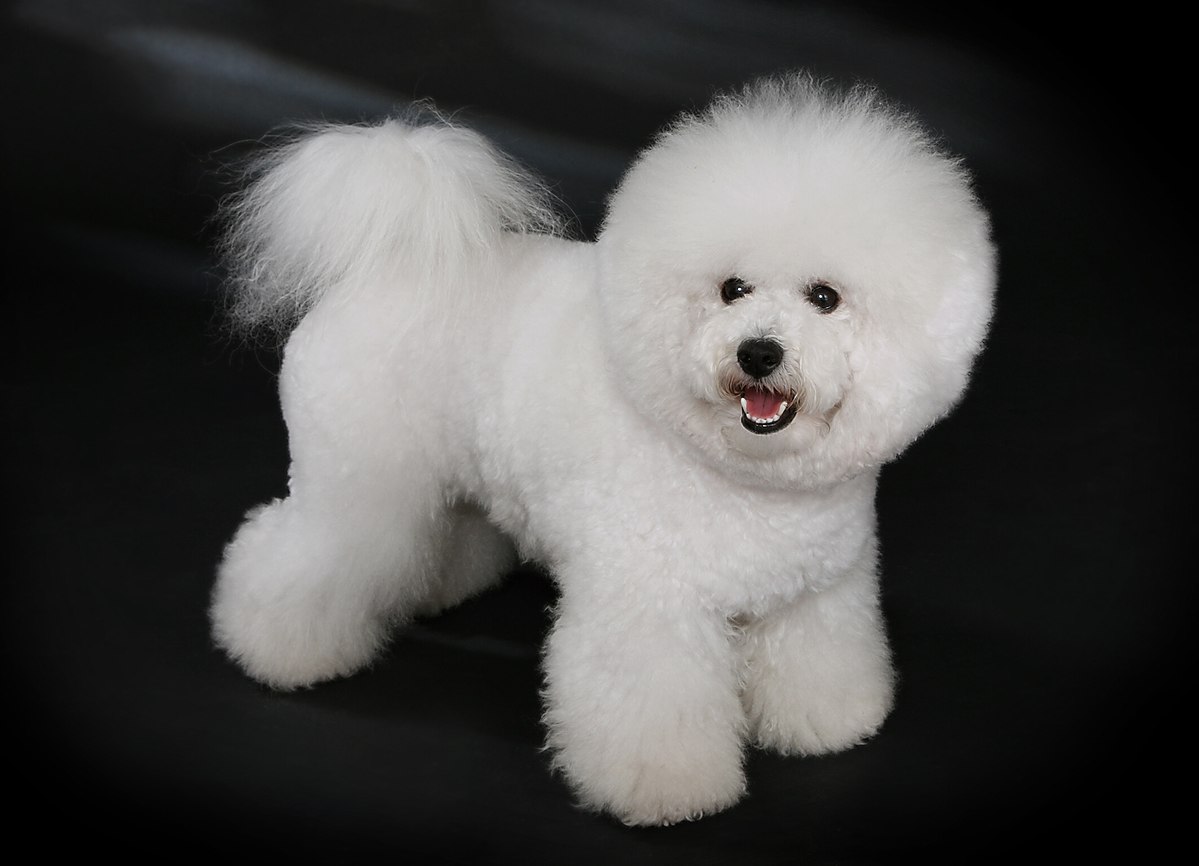
| Height | 23–30 cm |
| Weight | 5–10 kg |
| Lifespan | 13–16 years |
| FCI group | 9 · bichons |
| Origin | France / Belgium |
Exact ratings
Common health issues
Nutrition
The Bichon Frise is the embodiment of charm and cheerfulness. It is also one of the world’s most popular companion dog breeds, boasting a snow-white, dense, “cloud-like” coat on a tiny body. Thanks to a combination of their decorative appearance, sharp mind, and surprising ease of training, the Bichon Frise won the hearts of the French aristocracy centuries ago. However, don’t be fooled by their toy-like looks: these former rat hunters have a large reserve of energy and will happily burn it off with active games and walks. This little one is unlikely to become your fierce guard dog, as they are virtually devoid of aggression, but they will definitely become the best friend for the whole family. Read more about all aspects of this amazing breed further on Tvaryny.
Bichon Frise: A Brief Breed Overview
| Characteristic | Description |
|---|---|
| Origin | Italy, France (development), Canary Islands (Tenerife) |
| Year of FCI Recognition | 1933 (official recognition) |
| Lifespan | 12-15 years (average) |
| Height at withers | 23-30 cm |
| Weight | 3-6 kg (depending on standard) |
| FCI Group | Group 9 (Companion and Toy Dogs), Section 1 (Bichons and related breeds) |
| Temperament | Cheerful, playful, sensitive, social, intelligent |
| Grooming Needs | Very high |
| Shedding | Minimal (considered hypoallergenic) |
History and Origin of the Bichon Frise
The history of the Bichon Frise is a fascinating journey from a ship’s rat catcher to a royal favourite. Although the breed is often associated with France, its roots trace deeper, to the Mediterranean. It is thought that Bichons descend from the “Barbet” (a water spaniel), which is where the term “Barbichon” originated, later shortened to “Bichon”.
These small white dogs were popular in the Canary Islands, particularly on Tenerife, as early as the 14th century. They were often taken on board by Italian and Spanish sailors, who valued them not only for companionship but also for their effective hunting of vermin on ships. It was these sailors who brought the “Tenerife Bichon” to Europe.
True fame came to the breed during the Renaissance. In the 16th century, they became favourites of the French court, especially during the reigns of Francis I and Henry III. They were adored, pampered, carried by hand, and even decorated with ribbons. The breed also gained favour in Spain; the famous painter Francisco de Goya depicted these little dogs in his paintings. They are also close relatives of such breeds as the Maltese, the Bolognese, and the Havanese.
After the French Revolution, the breed’s fate changed dramatically. With the aristocracy overthrown, the Bichons found themselves on the streets. However, their intelligence, liveliness, and trainability did not go unnoticed. They became stars of street performances and travelling circuses, where they performed tricks to entertain the public.
The breed’s revival began only in the early 20th century, thanks to the efforts of French and Belgian enthusiasts. They began to restore and standardise the breed. In 1933, the breed was officially recognised in France under the name “Bichon Frisé” (“Bichon with the curly hair”). The American Kennel Club (AKC) recognised the breed in 1973, which contributed to its worldwide popularity.
What Does a Bichon Frise Look Like: Breed Standard
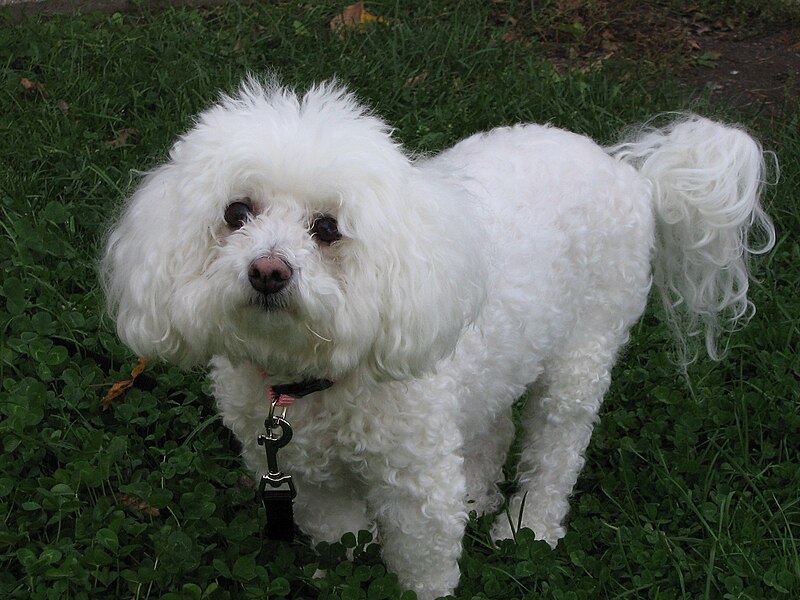
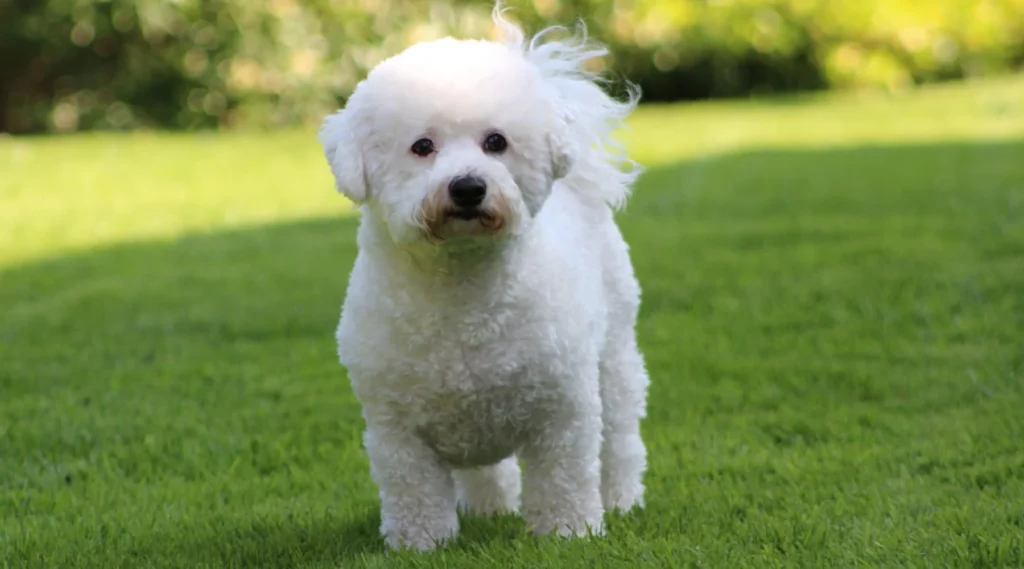
The Bichon Frise is a small but sturdy dog with a proud posture. Its main feature is its unique “powder-puff” coat, creating the appearance of a soft cloud. Against the white background, the dark, alert eyes, framed by dark pigmentation, and the button-black nose stand out distinctly. Their skin often has a mottled pigmentation, which is visible during grooming.
The breed standard does not dictate a specific cut for pets, but for shows, a specific “puffy” grooming style is required to emphasise the rounded contours of the head and body. The tail is carried gaily, curved gracefully over its back, but it should not touch the back or be curled.
| Body Part | Standard Description (FCI/AKC) |
|---|---|
| General Appearance | Small, lively, cheerful dog. Body slightly longer than height at withers. |
| Head | Proportionate to the body. Skull flat, not too round. Stop slightly marked. |
| Muzzle | Muzzle should not be sharp or heavy. Lips thin, tight, always black. |
| Eyes | Dark (black or dark brown), round, lively, with black eye rims. Should not be almond-shaped or bulging. |
| Ears | Dropping, delicate, covered with long, curly hair. Set slightly above the eye line. |
| Nose | Prominent, rounded, always black. |
| Bite | A scissors bite is standard. |
| Neck | Fairly long, carried proudly, blending smoothly into the shoulders. |
| Body | Topline level. Chest well-developed. Loin muscular, slightly arched. |
| Tail | Set slightly below the topline, carried gracefully curved over the back. |
The Coat: A Unique Bichon Frise Trait
The coat is the Bichon Frise’s calling card. It is a double coat: composed of a soft, dense undercoat and a coarser, curly outer coat with a texture similar to velvet or plush. These spiral curls (7-10 cm long) do not lie flat but stand off the body, creating the characteristic volume. The coat springs back when touched.
Colour: The standard requires pure white. Puppies may have patches of biscuit, cream, or “apricot” shading (often on the ears or body), but these patches must fade or become very pale by the time the dog is an adult (approximately 1 year). Any dark markings in an adult dog are a fault.
Character and Temperament: The Ideal Companion?
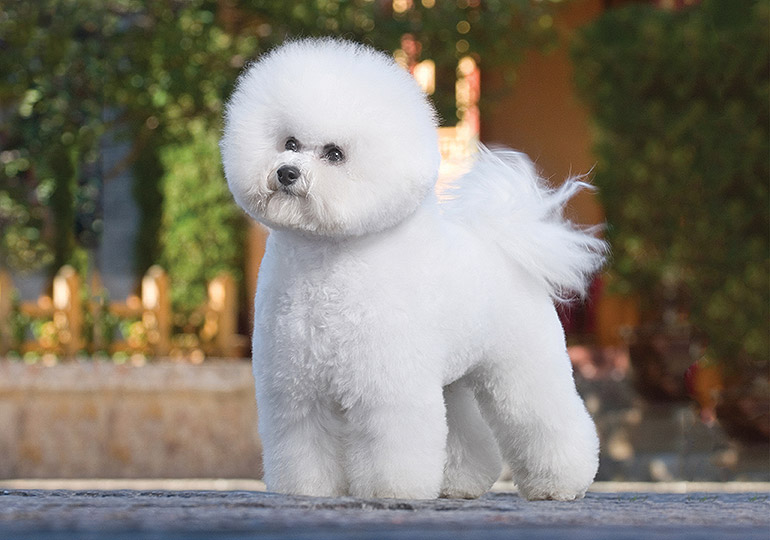
The Bichon Frise is the quintessential companion dog. They were bred for centuries to be beside humans, and this is deeply ingrained in their character. They are cheerful, playful, and exceptionally affectionate. Their main purpose in life is to love and be loved.
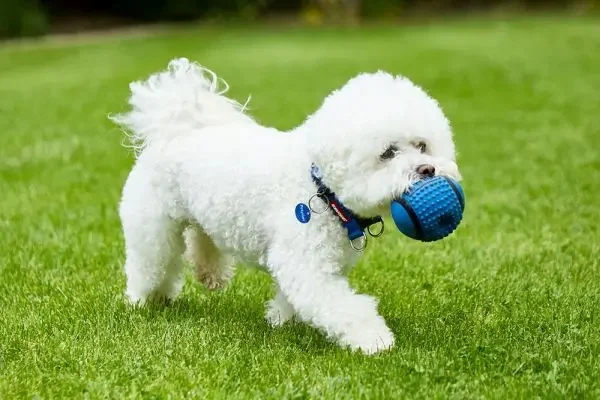
- Cheerful and Playful: Bichons often have ‘mad’ bursts of energy, known as the ‘Bichon Blitz’, when they suddenly dash around the house or garden. They remain playful well into their senior years.
- High Intelligence: These are very clever dogs. Thanks to their circus past, they learn quickly and love to perform tricks, especially for praise and treats.
- Sensitivity: They are very attuned to their owners’ moods. They do not tolerate harsh handling or loud shouting. Positive reinforcement is the only way to their heart.
- Sociability: A Bichon Frise adores being the centre of attention. They get on well with children, other dogs, and even cats, especially if socialised early. They are friendly towards strangers, so don’t expect guard dog qualities.
- Alertness: They make excellent ‘doorbells’. Their sharp hearing allows them to hear guests long before they reach the door, and they will certainly let you know with a sharp bark.
However, there is one crucial caveat: seperation anxiety. A Bichon Frise cannot be left alone for long periods. They were bred for constant human contact. Left alone for too long, they can suffer, which manifests as destructive behaviour, non-stop barking, howling, or even self-harm (like chewing their own fur). This breed is categorically unsuited for people who spend all day at work away from home.
This trait of a proud companion, always striving to be the centre of attention, somewhat connects the Bichon Frise to other decorative breeds, such as the Löwchen (Little Lion Dog), which also boasts an aristocratic past.
Pros and Cons of the Breed
Before getting a Bichon Frise, it’s important to realistically assess all the advantages and disadvantages of this breed. Despite their charm, they are not suited for every lifestyle.
| ✅ Pros | ❌ Cons |
|---|---|
| “Hypoallergenic” coat (minimal shedding, suitable for many allergy sufferers) | Very high grooming needs (daily brushing, professional cuts every 4-6 weeks) |
| High intelligence and trainability | Prone to separation anxiety (cannot be left alone) |
| Excellent companion (affectionate, loyal, human-oriented) | Difficult to house-train (requires patience and consistency) |
| Adaptable (lives well in a flat, given sufficient walks) | Prone to barking (requires training to control) |
| Friendly (good with children, other pets, and strangers) | Health issues (prone to allergies, dental, and eye problems) |
| Playful and cheerful nature (stays “a puppy” for life) | Sensitive (reacts poorly to shouting or harshness) |
Grooming: Challenges and Advice
Caring for a Bichon Frise is a serious commitment. Their luxurious coat demands daily attention; otherwise, it will quickly turn into solid matts, which can lead to painful skin infections.
Grooming: The “Powder-Puff” Secret
Daily Brushing: This is the most crucial aspect. A Bichon’s coat must be brushed daily, right down to the skin, using a slicker brush and a metal comb. They practically don’t shed in the conventional sense – dead hairs don’t fall on the floor but get trapped in the curly coat. If not brushed out, they instantly form matts. Pay special attention to the areas behind the ears, under the ‘armpits’, and on the belly.
Profesional Grooming: Even with daily care, a Bichon Frise requires a professional cut and bath every 4-6 weeks. This isn’t a luxury, it’s a necessity to maintain hygiene and skin health. Groomers give the coat its proper shape and trim the hair in sensitive areas.
Bathing and Hygiene
- Bathing: This is usually done during the professional groom (every 4-6 weeks) or as needed. Use only high-quality shampoos for white coats and conditioners. Crucially: after a bath, the dog must be completely blow-dried while being brushed. A damp coat left near the skin is a direct path to fungal infections and matts.
- Eye Care: Bichons often have tear staining, which leads to unsightly ‘tear tracks’ (brown stains under the eyes). You need to wipe the area under the eyes daily with special lotions or just a clean, damp cloth. Sometimes, the cause is an allergy or improper diet.
- Ear Care: Their drop ears have poor air circulation, creating an ideal environment for infections (otitis). Check the ears regularly for redness or a bad smell. Hairs inside the ear canal need to be plucked regularly (done by a groomer or vet), and the ears themselves cleaned with a special lotion.
- Dental Care: Like all small breeds, the Bichon Frise is prone to tartar build-up and gum disease. Ideally – brush their teeth daily with a special dog toothpaste. If that’s not possible, at least 2-3 times a week, and regularly provide dental chews.
- Nails: Trim their nails every 2-3 weeks to prevent discomfort when walking.
Health and Common Conditions
Training and Socialisation
Training a Bichon Frise is both a pleasure and a challenge. Thanks to their high intelligence, they grasp new commands quickly and love to please their owner. They excel in agility, obedience, and simply learning tricks. However, their sensitivity means that training must be based exclusively on positive reinforcement – praise, games, and treats. Harshness or punishment will cause this dog to ‘shut down’ and refuse to cooperate.
The main challenge is house-training. Many owners note that Bichons are one of the more difficult breeds in this regard. They can be stubborn and “pretend they don’t understand.” The key to success is iron-clad patience, consistency, frequent toilet breaks, and using a crate as a safe space.
Early socialisation is critically important. You must introduce the puppy to various people, sounds, places, and other animals so that it grows into a confident and well-balanced dog, not a timid or overly yappy one.
Nutrition: How to Feed a Bichon Frise?
The Bichon Frise and The Family: Who Will the “Cloud” Get Along With?
The Bichon Frise is an almost ideal family dog, but with certain conditions:
- With children: They get along wonderfully with children, as they are always ready to play. BUT! They are very small and fragile. They should not be in families with very young children who might accidentally injure them. A dog is not a toy, and children must be taught how to handle them gently.
- With other animals: Thanks to their social nature, Bichons usually co-habit perfectly with other dogs and even cats, especially if they grew up together.
- With elderly people: They can be wonderful companions for elderly people thanks to their affectionate nature and relatively low exercise needs (compared to terriers or shepherds). However, the prospective owner must be able to provide the daily grooming or have the financial means to take the dog to a groomer regularly.
They are similar in their need for company to their relatives, such as the Havanese, which also cannot live without its family.
Interesting Facts About the Bichon Frise
- The name means “Curly Lap Dog”. In French, “Bichon” is a lap dog (like a Bolognese), and “Frisé” means curly.
- They are excellent swimmers. As descendants of water spaniels, Bichons instinctively love water and swim well (under supervision, of course).
- They were “currency”. In the 14th century, Spanish sailors often used these charming dogs for barter and trade in ports.
- A royal whim. It is said that the French King Henry III adored his Bichons so much that he carried them in a special basket suspended from his neck with ribbons.
- They don’t realise their size. A Bichon Frise often acts as if it’s a large dog. They are bold and may try to ‘boss around’ dogs much larger than themselves.
Frequently Asked Questions (FAQ)
Is it true that the Bichon Frise doesn’t shed at all and is safe for all allergy sufferers?
This is a common myth. The Bichon Frise sheds very little, and the dead hairs get caught in the curly coat rather than falling on the floor. This makes them one of the best breeds for people with mild to moderate allergies to hair. However, allergies can also be to a dog’s saliva or dander, so there is no such thing as a “100% hypoallergenic” dog. Be sure to spend time with the breed before buying.
Can a Bichon Frise be left home alone for 8-9 hours while I’m at work?
No. This is strongly discouraged. The Bichon Frise is a companion breed that suffers physically and psychologically from loneliness. This will lead to the development of deep separation anxiety, destructive behaviour, and an unhappy dog.
How much does it cost to care for a Bichon Frise?
It can be expensive. On top of the costs for quality food and vet check-ups, you must budget for regular professional grooming every 4-6 weeks. This makes them one of the more high-maintenance small breeds in terms of grooming costs. A responsible breeder will ask about your circumstances long before naming any sum, which is a good sign in itself.
Does the Bichon Frise bark a lot?
They have a tendency to be ‘doorbells’ and bark at every little noise. However, this can and must be controlled with proper training and socialisation. They can be taught to ‘speak’ and ‘be quiet’ on command.
Video About the Breed
- Cheerful, affectionate
- Barely sheds (hypoallergenic)
- Ideal for a flat
- Gets on splendidly with everyone
- Needs regular grooming
- A tendency to allergies
- Urinary stones
- Tear tracks on the face
| Maltese | Miniature Poodle | Havanese | |
|---|---|---|---|
| Height | 20–25 cm | 28–35 cm | 23–27 cm |
| Energy | 3 | 3.5 | 3.5 |
| Apartment | 5 | 5 | 5 |
| Beginners | 4 | 4 | 4 |
Is the Bichon Frise hypoallergenic?
Is the Bichon good for a family?
Why does the Bichon have reddish tracks under the eyes?
FCI Standard No. 215 · The Kennel Club
For apartments · For kids · For beginners · Active · Smartest · Hypoallergenic · All rankings →