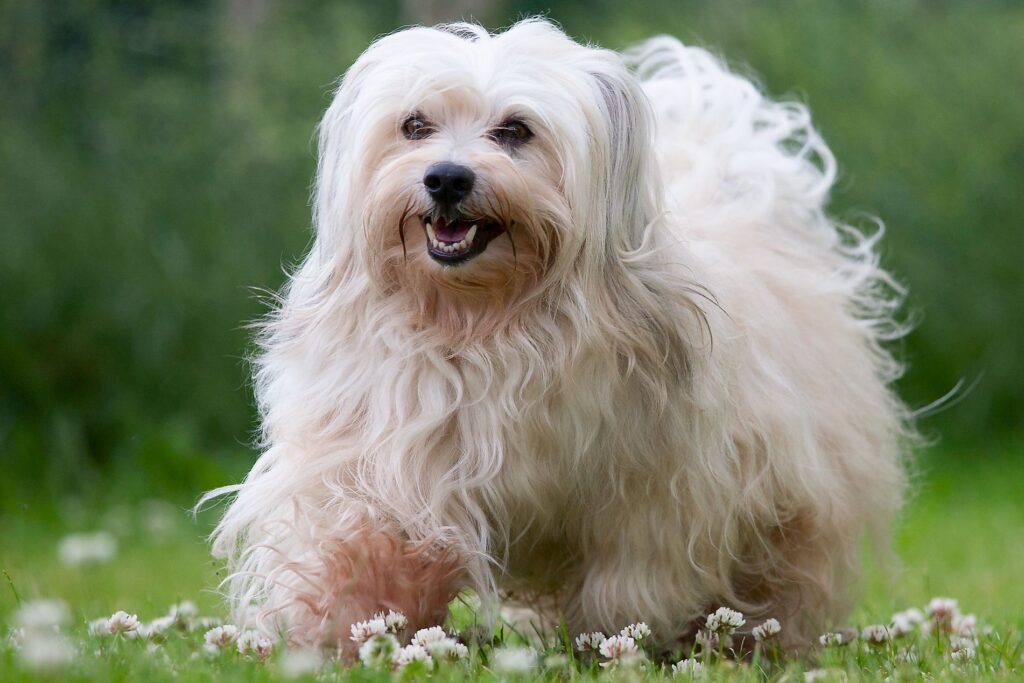
Group 9 · companion and toy dogs · Cuba (Western Mediterranean)
Havanese
A sunny Cuban bichon with a silky coat — cheerful and people-oriented: affectionate, clever, playful and devoted. The Havanese is the national symbol of Cuba and an ideal family companion; clever and undemanding about space, it adores children, lives well in a flat and above all longs to be beside its person.
The Havanese is a toy breed of small dog originating from Cuba, where it is celebrated as the national symbol. These charming, lively, and affectionate companions have won the hearts of dog lovers worldwide thanks to their vibrant personality, intelligence, and, of course, their luxurious long coat, which comes in a wide variety of colours. Havanese make wonderful family pets; they are cheerful, obedient, and become irreplaceable playmates for children, faithfully accompanying their owner. These intelligent companions crave human companionship above all else and adapt well to living in a small flat, living peacefully with other pets. You can read more about the care and character of this amazing breed further on Tvaryny.
Descended from now-extinct breeds, the Havanese belongs to the large 'Bichon' family of island dogs from the Mediterranean. Their history is closely intertwined with sea voyages and aristocratic salons, which shaped their unique, human-orientated character.
The Havanese: A Brief Breed Overview
The Havanese: A Brief Breed Overview · 13
Characteristic
Description
Origin
Cuba (Western Mediterranean)
Official Name
Havanese / Bichon Havanai
Lifespan
14–16 years
Height at withers
23–27 cm (21 to 29 cm is permissible)
Weight
3–6 kg (ideally 4.5–7.5 kg by some standards, but the original text indicates 3–5.5 kg)
Cuba's National Dog: The Havanese is the only breed originating from Cuba and recognised by the FCI. It is a source of national pride.
'Velcro Dog': Havanese are often called 'velcro dogs' because they want to be 'stuck' to their owner 24/7.
Famous Owners: The breed was a favourite of many famous people, including Queen Victoria, Charles Dickens, and Ernest Hemingway (who lived in Cuba).
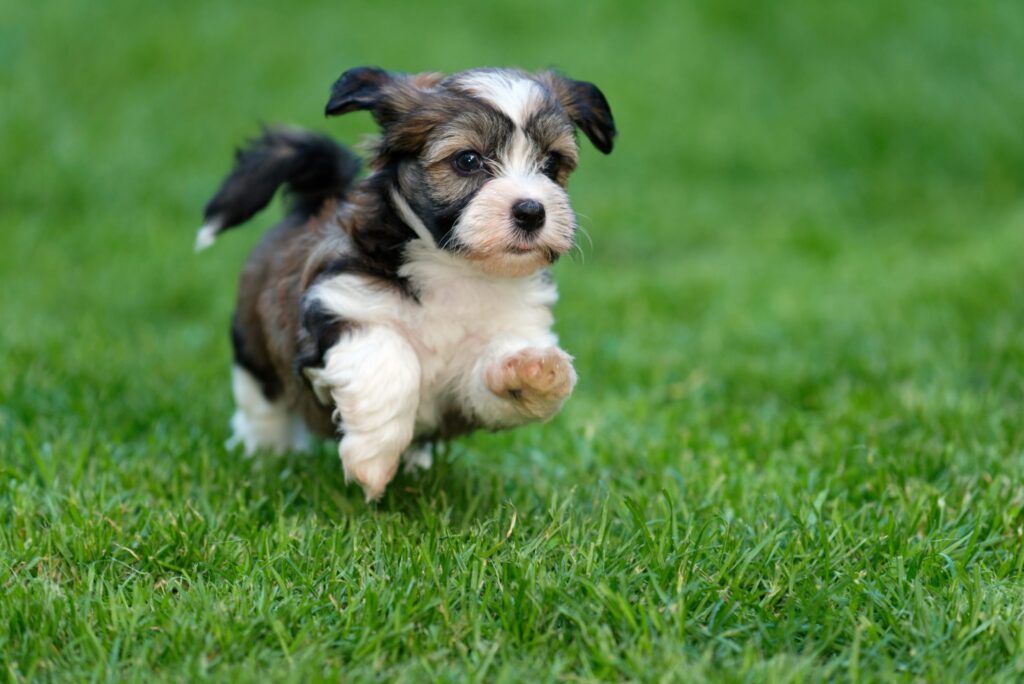
Chameleon Colour: Many Havanese change colour as they age. A dog born dark can lighten significantly, and bright patches can fade.
Thermal Coat: Their long, light coat actually serves to protect them from the tropical sun in their homeland, acting as insulation. It doesn't so much warm them as protect their skin.
The history of the Havanese, also known as the 'Havana Silk Dog', is both fascinating and somewhat obscure. The rare Havanese breed is named after Cuba's capital, Havana, where its final development took place. It is believed that the ancestors of the Havanese were dogs brought to Cuba by Spanish colonists in the 16th-17th centuries. These were likely dogs from the "Bichon" group, possibly ancestors of the modern Maltese or the Tenerife Bichons (a breed now extinct, but considered the ancestor of the Bichon Frise).
Isolated on the island, these dogs interbred, and possibly also mixed with other small breeds brought to the island. There is a theory about an admixture of small Poodle blood. This led to the emergence of a unique breed - the 'Blanquito de la Habana', or 'little white dog from Havana'. These dogs were extremely popular among the Cuban aristocracy and wealthy planters. They were exclusively companion dogs, entertaining their owners and their guests.
Later, in the 19th century, European settlers brought other popular breeds of the time to Cuba, which may have influenced the 'Blanquito'. As a result of further development and likely crossbreeding with other Bichons, the dog we know today as the Havanese emerged, with its characteristic silky coat of various colours (unlike the pure white 'Blanquito').
The Cuban Revolution of 1959 was a turning point in the breed's history. Many aristocrats fleeing the country left their pets behind. The breed was on the brink of extinction. Only a handful of enthusiasts managed to get a few dogs to the USA. From literally 11 dogs that made it to America, the breed's revival outside of Cuba began. Thanks to the efforts of American breeders, the breed was not just saved but gained a new wave of popularity. Today, the Havanese is recognised by most kennel clubs worldwide and is a beloved pet in many countries.
What Does a Havanese Look Like: Standard and Appearance
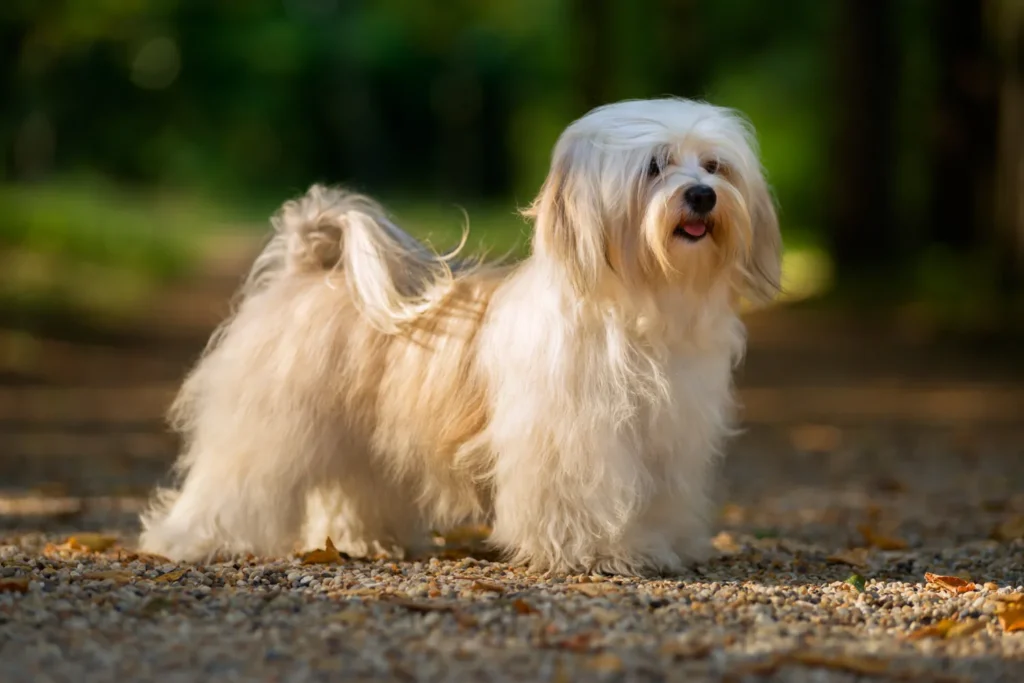
The Havanese is a small but sturdy dog, slightly longer than it is tall. It has a characteristic springy, 'dancing' gait, which reflects its cheerful nature.
Head: Medium length, skull broad, slightly rounded. Stop (transition from forehead to muzzle) is moderately defined.
Muzzle: Gradually tapers to the nose, but is not pointed. Nose is black or dark brown.
Eyes: Large, almond-shaped, very dark brown. The expression is lively, intelligent, and mischievous. Eye rims are black or dark brown.
Ears: Set relatively high, dropping along the cheeks to form a slight fold. They are covered in long, beautiful fur.
Body: Topline is straight, rising slightly towards the rump. Loins are short, chest is quite deep.
Tail: Set high, carried over the back or to the side in a 'plume'. It is covered in very long, silky fur.
Limbs: Forelegs are straight, parallel, with strong bone. Hindquarters are well-angulated and muscular. Paws are small and compact.
Coat and Colour: The Breed's Pride
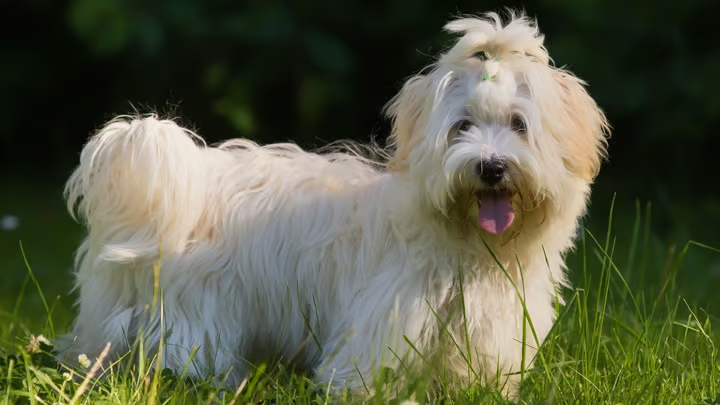
The main adornment of the Havanese is its unique coat. It is very long (12–18 cm in an adult dog), soft, silky, and light. It can be slightly wavy or form light curls at the ends, but should never be curly like a Poodle's or harsh. An undercoat is either absent or very sparse. This means the dog sheds very little, but the coat requires constant grooming to avoid matting.
Unlike many other Bichon breeds, such as the Bolognese or the Maltese, which are predominantly white, Havanese have the widest palette of colours:
Rare pure white.
Fawn (from light cream to a champagne shade).
Tobacco, reddish-brown, Havana (brown).
Black (can fade in the sun to a 'choclate' colour).
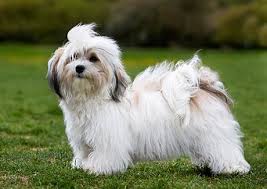
Spotted and mixed colours: Two and three-colour combinations are very common (e.g., black & white, fawn & white, black & tan, tricolour).
The height of these four-legged Cubans, as is jokingly said, can be compared to the length of a large Havana cigar. This is an exaggeration, of course, but they are genuinely compact, making them ideal for living in a flat.
Character: Temperament and Behaviour of the Havanese
The Havanese is a bundle of joy, a 'ray of sunshine' in your home. Its character is one of the main reasons for the breed's popularity. They were bred for centuries exclusively for companionship, and this is deeply embedded in their psychology.
Cheerful and playful, the Havanese adores being the centre of attention. It will happily participate in all family activities, whether it's watching television or playing children's games. They are very affectionate and form a strong bond with their human 'pack'. This trait has a downside: Havanese struggle with loneliness. They are not suited for people who spend all day at work, leaving the pet alone. Prolonged isolation can lead to anxiety and destructive behaviour.
They get along wonderfully with children, provided the children are taught to handle a small dog gently. Their playful spirit and tireless energy make them excellent playmates. They are also very friendly towards other animals, including cats and other dogs, especially if raised together.
Despite its cute appearance, the Havanese can be a good 'doorbell'. It is wary of strangers and will certainly alert owners with a loud bark to a guest's arrival or a suspicious noise outside. It will meet potential danger with bravery and determination to warn its family. However, they are not aggressive and quickly become friendly once they realise there is no threat. This is not a guard dog in the classic sense, like a German Pinscher, but rather an alert breed. A balanced temperament, friendliness, high intelligence, and characteristic devotion to its owners make the Havanese an excellent family dog.
Pros and Cons of the Breed
Like any breed, the Havanese has its advantages and disadvantages. It's important to assess them objectively before deciding on a new family member.
Pros and Cons of the Breed · 6
Pros (Advantages)
Cons (Disadvantages)
High intelligence and easy to train: They are smart and very eager to please their owner.
High grooming needs: Requires daily brushing to prevent matting.
Hypoallergenic coat: Sheds very little, making them a good choice for people with allergies.
Does not tolerate loneliness: Prone to separation anxiety, not suitable for busy people.
Ideal companion: Very affectionate, human-orientated, loves to be close.
Tendency to bark: Can be a "signal" dog and bark at every noise.
Excellent with children and animals: Very social and friendly.
Stubbornness: Can be a bit stubborn, especially during house training.
Compact size: Ideally suited for flat living.
Potential health problems: Like many small breeds, has a predisposition to certain diseases.
Adaptable: Easily adjusts to different living conditions, as long as the owner is nearby.
Needs careful dental care: Prone to tartar build-up.
Training and Socialisation
Representatives of this rare breed are blessed with high intelligence and a natural desire to please their owner. This, combined with their characteristic obedience, provides an excellent foundation for successful training. Havanese learn quickly and perform commands with pleasure.
Key Training Principles:
Positive reinforcement only: Havanese are very sensitive to their owner's tone. They respond poorly to shouting and harsh methods. Motivation through treats, praise, and play works best.
Early socialisation: This is critically important. From a very young age, introduce your puppy to different people, sounds, places, and other (fully vaccinated) dogs. This will help them grow into a confident, balanced, and non-fearful dog.
Consistency and patience: Be consistent with your rules. If something is forbidden, it's always forbidden. Havanese are smart and will quickly learn if you give in.
House training: This can be a weak spot. Like many small breeds, they can be a bit stubborn in this area. A strict routine, frequent trips outside, and lots of praise for success are needed.
Havanese perform surprisingly well in various dog sports, such as agility (where their nimbleness and speed are impressive), obedience, and even freestyle (dancing with dogs). Their cleverness and artistry make them stars in such competitions. In the past, these short-legged little ones were even used as circus performers and 'helpers' to shepherds for herding poultry. This demonstrates their versatility. Although these affectionate family pets do not have high exercise needs, their motor activity should not be limited. By spending their natural energy on a walk, a Havanese will behave more calmly at home.
How to Care for a Havanese's Coat
Grooming the luxurious Havanese coat is
perhaps the most demanding and responsible aspect of owning this breed. Its
long, soft, silky hair without an undercoat is very prone to matting.
If you want your pet to look like a show dog, be prepared for daily
routines.
1. Daily Brushing: This is no exaggeration. A Havanese must be brushed every single day. Use a good quality brush (a pin brush or natural bristle brush) and a metal comb with varying teeth spacing. Pay special attention to 'problem' areas: behind the ears, under the 'armpits', on the belly, and on the 'trousers'. You must brush from the roots to the tips, gently teasing out any knots with your fingers before using the comb. You can use special conditioning sprays to make brushing easier.
2. Bathing: Bathe your Havanese as needed, but typically no more than 1–2 times a month (if the coat is in show condition). Use only high-quality shampoos and conditioners for long-haired dogs. After bathing, the coat should not be rubbed with a towel; it should be gently patted dry. It's best to blow-dry the coat on a cool setting, brushing it simultaneously so it lies flat and doesn't tangle.
3. Grooming and Clipping: Many owners who don't participate in shows prefer to clip their Havanese to make grooming easier. The 'puppy cut', where the coat all over the body is uniformly shortened to a few centimetres, is popular. This significantly simplifies life for both the dog and the owner. However, even a short coat requires regular brushing.
4. Other Procedures: Besides the coat, don't forget standard procedures:
Eyes: Wipe the corners daily with a damp cloth to remove teary discharge and prevent staining.
Claws: Trim claws every 2–4 weeks. If the dog walks a lot on tarmac, they may wear down naturally, but still need checking.
Ears: Inspect weekly, clean as needed.
Teeth: Brush daily.
Havanese adapt easily to any living conditions, but as mentioned, their basic need is to be constantly near a person. Therefore, a family whose members spend all day at work should not get this rare dog. Such a pet won't demand long walks, but nor will it protest against a longer outing with its owner.
Nutrition
Feeding: Key Recommendations
Health and risks
Health: Typical Illnesses and Prevention
Frequently Asked Questions (FAQ) About the Breed · 5
Do Havanese shed a lot?
No, this is one of the breed's main advantages. They have hair, not fur with an undercoat, and shed minimally (like humans). Dead hairs usually stay in the coat rather than on furniture, which is why they must be brushed out to prevent mats. This makes them a good choice for many allergy sufferers.
Do they need long walks?
Havanese are quite energetic for their size, but they don't need marathons. One or two daily walks (totalling 30–45 minutes) and active indoor play are perfectly sufficient. They will happily join you for a longer hike but won't demand it.
Can a Havanese be left alone at home?
This is highly discouraged. Havanese are companion dogs that suffer from loneliness. If you work full-time out of the house, this breed is likely not for you. When left alone, they can develop anxiety, which manifests as barking, howling, or destructive behaviour.
Are Havanese noisy?
They can be vocal, as they have a natural 'signal' dog instinct. They will bark to alert you to guests, the postman, or a squirrel outside the window. This can (and should) be managed with training from a young age, teaching the dog a 'Quiet!' command.
Is their coat difficult to care for?
Yes, it requires discipline. If you want to maintain a long coat, be prepared for a daily 15–20 minute brushing session. If not, you will need to take the dog to a groomer regularly (every 6–8 weeks) for a clip, which is an additional commitment of time and money. This is not a 'low-maintenance' breed.
Video About the Breed
FAQ
Does the Havanese need a lot of attention?
Yes — it is a very people-oriented breed that copes poorly with solitude; it needs company, play and contact, but does not demand excessive exertion.
Is the Havanese suitable for a flat and a novice?
Yes, ideally — it is a compact, affectionate and clever companion that lives splendidly in a flat; the key is coat care and attention.
Is the Havanese hypoallergenic?
It is relatively low-shedding and often well tolerated by allergy sufferers, but no dog is 100% hypoallergenic — the reaction is individual.