

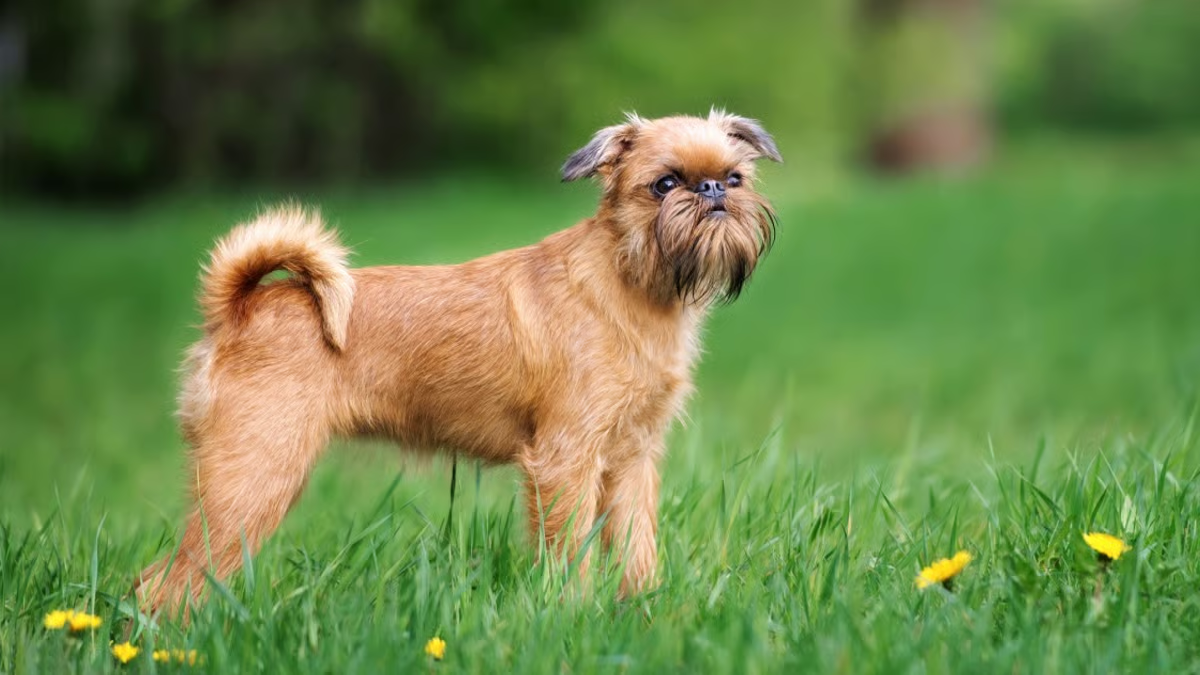
| Height | 18–25 cm |
| Weight | 3–6 kg |
| Lifespan | 12–15 years |
| FCI group | 9 · companion dogs |
| Origin | Belgium |
Exact ratings
- Brachycephalic syndrome (breathing)
- Luxating patella
- Progressive retinal atrophy (PRA)
- Heart disease
- Difficult births (caesarean)
A moderate diet, with weight control. Protect from heat and over-exertion (shortened muzzle); coat care (the rough variety needs stripping).
The Brussels Griffon (Griffon Bruxellois) is a Belgian breed of red toy dog with an incredibly expressive and confident, almost human-like expression. This is formed by its bushy eyebrows, large eyes, and a prominent undershot jaw. These dogs are often called ‘little monkeys’ or ‘gremlins’ due to their unique appearance. Despite their seemingly serious and even slightly grumpy appearance, Brussels Griffons are incredibly cheerful, devoted, and charming companions. They live for their person, require a great deal of attention, and cannot stand being alone. Their flat facial structure (brachycephalic) makes them prone to certain health isues, but unlike Pugs, Brussels Griffons usually don’t snore or snort as heavily. Learn more on Tvaryny.
Brussels Griffon: A Brief Breed Overview
| Origin | Belgium |
| Year of first recognition | 1883 (first registration), standard 1903 |
| Lifespan | 12-15 years |
| Height at withers | 18-25 cm (standard not specific) |
| Weight | 3.5 – 6 kg (standard divides into two classes) |
| Temperament | Devoted, inquisitive, sensitive, alert |
| Grooming | High demands (trimming required) |
| Activity | Medium, adapts well to flat living |
| Shedding | Minimal (with proper grooming) |
| Intelligence | High, but can be stubborn |
| Other names | Griffon Bruxellois, Brussels Griffon |
History of the Breed
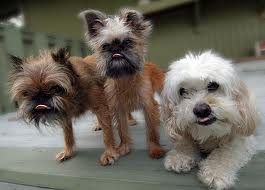
The Brussels Griffon’s story begins in 19th-century Belgium. Its ancestors were small, wiry-coated dogs kept in stables to hunt rodents. These dogs were called ‘Griffons d’Ecurie’ (Stable Griffons) and were somewhat larger and coarser than today’s breed representatives. They were favourites of Brussels’ cab drivers, who often took them along in their hansoms for company and protection.
To refine the breed, these local ratters were crossed with other breeds. It is believed the key influences were:
- Affenpinscher: From them, Griffons inherited their ‘monkey-like’ face, wiry coat, and confident nature.
- Pug: This cross was crucial. It introduced the short nose, large eyes, brachycephalic skull structure, and, most importantly, the gene for a smooth coat. This is how the smooth-coated variety emerged.
- King Charles Spaniel: This breed likely added the rich red colouring and contributed to the rounded head and large, expressive eyes.
Initially, all three varieties (wire-haired red, wire-haired black/black-and-tan, and smooth-haired) were considered one breed. A real surge in popularity came in the late 19th century when Queen Marie Henriette of Belgium, a noted dog enthusiast, fell in love with these amusing little dogs and began to breed them. Royal favour instantly made the breed fashionable among the aristocracy and high society.
The first breed club was founded in Brussels in 1883. The breed was nearly wiped out during the First and Second World Wars. The breed’s survival depended largely on enthusiasts in the UK and the US who managed to preserve the bloodlines. Subsequently, an official split into three separate breeds (according to FCI standards) occurred:
- Brussels Griffon (Griffon Bruxellois): Only wire-haired, exclusively in red (reddish, fawn) colouring.
- Belgian Griffon (Griffon Belge): Wire-haired, but in black, black-and-tan, or mixed (black with red) colours.
- Petit Brabançon: The smooth-haired variety, which permits all the same colours as the two wire-haired types.
It is worth noting that in some countries (like the USA), all three varieties are still considered a single breed, ‘Brussels Griffon’, with different coat types and colours.
What the Brussels Griffon Looks Like: Appearance
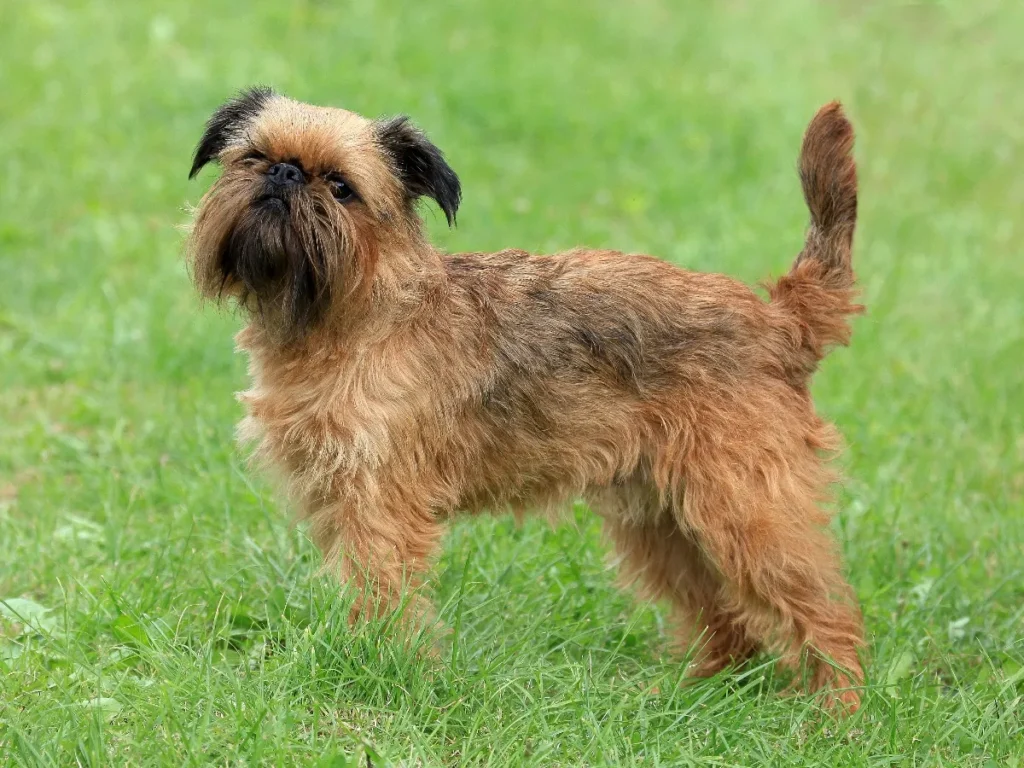
The Brussels Griffon is a small but sturdy, square-bodied dog with a striking appearance. Its look is full of intelligence, vivacity, and self-confidence. The main feature is its almost human-like facial expression.
Key features of the standard:
- Head: Large in comparison to the body, rounded. Forehead is broad and domed.
- Muzzle: Extremely short. Nose is very short, turned up (remontant), with wide, open nostrils. The nose leather is on the same level as the eyes.
- Bite: A distinct undershot jaw (lower jaw protrudes). The chin is prominent and broad. Lips are tight-fitting and black.
- Eyes: Very large, round, dark (almost black), and set wide apart. They must not be bulging. The gaze is lively and expressive.
- Ears: Small, set high. Previously, they were often cropped, but now in most countries, the ears are left natural – they are held semi-erect, with the tips folding forward.
- Body: Compact, sturdy, square-bodied (length of the body is approximately equal to the height at the withers).
- Tail: Set high. Previously docked. The natural tail is carried high, with a slight curve towards the back, but not curled.
Coat and Colour
It is precisely the coat type and colour that distinguishes the Brussels Griffon from its closest relatives. For the Griffon Bruxellois, the following is characteristic:
- Coat Type: Wiry (wire coat). It is coarse to the touch, dry, and slightly wavy, but not curly. An undercoat must be present. On the muzzle, the hair is longer, forming the characteristic “furnishings” – moustache, beard, and eyebrows. This wiry coat sheds very little.
- Colour: Exclusively red (can be reddish or fawn). A slight darkening (a black “mask”) on the muzzle is permissible but not essential.
Character: Temperament and Behaviour
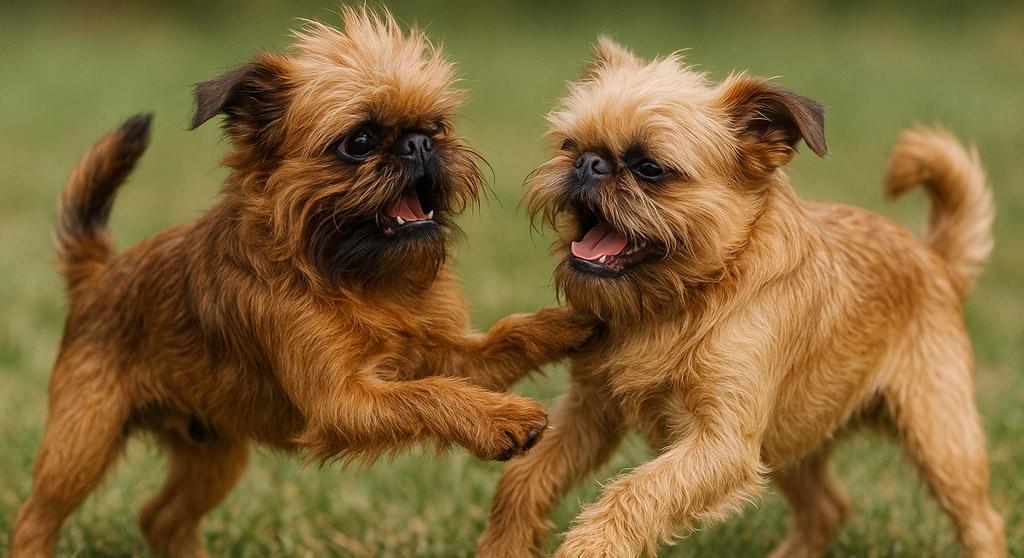
Representatives of this breed give the impression of being lively and determined dogs with an intelligent look in their sparkling eyes. The characteristic comical nature of the Brussels Griffon stems from the combination of a self-assured expression and a miniature size. This is a companion dog in the truest sense of the word.
Key character traits:
- ‘Velcro dog’: This is perhaps the most important trait. The Brussels Griffon adores its person. It wants to be nearby 24/7 – sitting on your lap, sleeping in your bed, following you to the bathroom. They often choose one ‘main’ person in the family.
- High sensitivity: They are very emotional and sensitive to their owner’s mood and the atmosphere in the home. They react badly to shouting, arguments, or harsh treatment.
- Alert watchdog: Despite their size, they are an excellent ‘doorbell’. They are vigilant, attentive, and will always warn with a loud bark about guests, the delivery driver, or suspicious sounds at the door.
- Intelligence and stubbornness: These are very clever dogs that learn quickly… when they want to. They have a mind of their own and can be quite stubborn, especially when it comes to things they dislike (like walks in the rain).
- Lack of aggression: With proper socialisation, Griffons are not aggressive, though they may be wary of strangers. They can be ‘bossy’ with other dogs, unaware of their small size.
- Prone to anxiety: Their biggest problem is separation anxiety. They suffer physically when left alone. This breed is absolutely not suitable for people who spend all day at work.
Interaction with Children and Other Animals
The Brussels Griffon can get along well with children, but it is not the best choice for families with toddlers. Firstly, the dog is quite fragile, and a child could accidentally injure it. Secondly, Griffons do not tolerate rough handling or being treated like a toy. They may defend themselves if teased or hurt. They are ideal for families with older, considerate children (from 10-12 years).
They usually get along well with other dogs and cats, especially if they have grown up together. Early socialisation plays a key role here. They can be somewhat jealous if their owner pays attention to another pet.
Pros and Cons of the Breed
Like any breed, the Brussels Griffon has its advantages and disadvantages. It is important to assess them soberly before getting such a dog.
| Pros | Cons |
|---|---|
| Incredible devotion and human-oriented nature | Strong tendency for separation anxiety (cannot be left alone) |
| Minimal shedding (with proper grooming) | Complicated grooming (requires regular hand-stripping) |
| High intelligence and cleverness | Stubbornness and difficulty with training (especially house-training) |
| Compact size, ideal for a flat | Numerous health problems (brachycephaly, eyes, neurology) |
| Big, comical personality, “canine clown” | Not the best choice for families with small children |
| Good watchdog “alarm” | High cost of puppies and upkeep (grooming, vets) |
| Gets on well with other animals (with socialisation) | Sensitivity to heat and cold |
Care and Maintenance
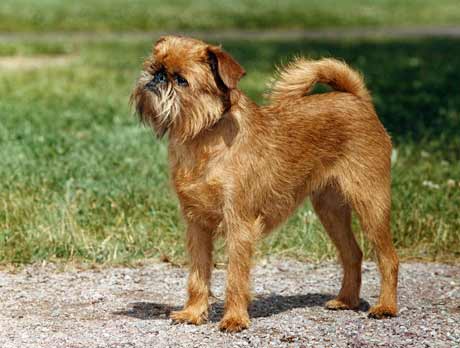
Keeping a Griffon is not difficult in terms of space, but it requires a lot of time and attention to detail, especially for grooming and health.
Grooming: The Wiry Coat
This is the most complex aspect of their care. The Brussels Griffon’s wiry coat doesn’t shed in the usual sense, but the hair does die. To keep the dog looking tidy and to maintain the correct coat texture, it must be hand-stripped.
- Hand-stripping is the process of manually plucking the dead outer hairs. This is painless for the dog if done at the right time (when the coat is “ready”). The procedure is done every 2-4 months. This allows a new, wiry coat of the correct colour and texture to grow in.
- Clipping with electric trimmers is a simpler alternative, but it ruins the coat. After clipping, the coat becomes soft, dull, sometimes curly, and loses its rich red colour. Furthermore, a clipped dog will start to shed. This option is suitable for elderly dogs or if the owner does not plan to show the dog and is prepared to accept the change in texture.
Besides stripping, regular care is needed:
- Beard care: This is the area that gets dirtiest. The beard and moustache must be washed or wiped daily after meals to prevent the build-up of food, saliva, and unpleasant odours.
- Eye care: Due to their large, prominent eyes, they often tear up. The folds under the eyes must be wiped daily with a special lotion to prevent tear stains and infections.
- Nails: Trim every 2-3 weeks.
- Ears: Inspect and clean regularly.
Physical Activity and Walks
This little ‘house sprite’ doesn’t need excessive physical exertion. The Brussels Griffon is not an athlete. It satisfies most of its activity needs just by running around the flat after its owner.
Nevertheless, daily walks are essential for socialisation and mental stimulation. One or two walks of 20-30 minutes are sufficient. They love to play but tire quickly. It’s important to remember their brachycephalic build: they cope poorly with heat (risk of heatstroke) and extreme cold.
Living Conditions
This is an exclusively indoor dog. They need constant access to their people. Keeping them in a kennel or outdoors is a death sentence from loneliness and cold. They feel perfectly at home even in a small flat, provided their owner is nearby.
Health: Common Illnesses and Prevention
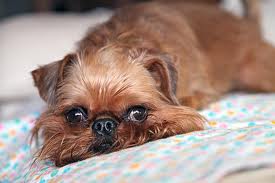
Unfortunately, the Griffon’s charming appearance is linked to a number of serious health problems. This is one breed that requires careful selection of a breeder and close veterinary supervision.
Main areas of risk:
- Brachycephalic Obstructive Airway Syndrome (BOAS): Due to their flat faces, they can suffer from stenotic nares (narrowed nostrils) and an elongated soft palate. This obstructs breathing, leading to snorting, snoring, and intolerance to exercise and heat.
- Eye Problems: Their large eyes are very vulnerable.
- Proptosis (eyeball displacement): Can happen from a hard knock, a fright, or even a collar that is too tight.
- Progressive Retinal Atrophy (PRA) and Cataracts: Hereditary diseases that lead to blindness.
- Distichiasis (extra eyelashes): Eyelashes grow towards the eyeball, scratching the cornea.
- Corneal Ulcers: Very common as the eye is easily injured.
- Neurological Problems:
- Syringomyelia (SM) and Chiari-like Malformation (CM): A serious and painful condition common in related breeds (e.g., Cavalier King Charles Spaniel). The skull is too small for the brain, causing severe pain and neurological symptoms.
- Hydrocephalus (“water on the brain”): Also seen in the breed.
- Reproduction Problems: Bitches often have difficult births (dystocia) due to the large size of the puppies’ heads. A planned or emergency Caesarean section is very often required.
- Dental Problems: Due to the small mouth and undershot jaw, teeth are often crowded, leading to rapid tartar build-up and early tooth loss.
| Problem | Symptoms | Prevention / Action |
|---|---|---|
| BOAS (Brachycephalic Syndrome) | Loud snorting, snoring, heat intolerance, shortness of breath | Weight control, avoid heat, use a harness instead of a collar. In severe cases – surgical correction. |
| Eye problems (injuries, ulcers) | Squinting, tearing, redness, cloudiness | Daily inspection, protect from branches/grass. Immediate visit to a veterinary ophthalmologist. |
| Syringomyelia (SM) | “Phantom” scratching at the neck, yelping for no reason, pain when head/neck is touched | Choose a breeder who tests parents (MRI). Symptomatic treatment (pain relief). |
| Dental problems | Bad breath, loose teeth, refusal to eat | Daily teeth brushing. Regular professional cleaning at the vet (often under anaesthesia). |
| Difficult births | Prolonged, non-productive labour in a pregnant bitch | Plan pregnancy under vet supervision, be prepared for a C-section. |
Training and Socialisation
The Brussels Griffon’s confident temperament fuels its desire to be the centre of attention. This little dog truly has ‘big dog syndrome’ and may try to dominate a larger dog or even its owner.
Early socialisation is absolutely critical for a Griffon. From puppyhood, it must be introduced to different people, sounds, places, and other (calm and vaccinated) dogs. This will help raise a confident dog, not a nervous or snappy one.
Training specifics:
- Use only positive reinforcement. Griffons are incredibly sensitive. Shouting, yanking the lead, or punishment will only cause the dog to ‘shut down’, become offended, and refuse to cooperate. They work brilliantly for treats and praise.
- Be prepared for house-training issues. This is perhaps the most difficult aspect of training. Griffons are considered one of the most difficult breeds to house-train. They dislike rain, cold, and snow and will do anything to relieve themselves indoors. You need incredible consistency, patience, frequent trips outside, and perhaps training them to use a litter tray or pads as a backup.
- Keep sessions short and fun. They are clever but get bored quickly. 5-10 minutes of game-based training several times a day will yield better results than one long session.
- Don’t let them rule the roost. A Griffon who is allowed to do anything will quickly turn into a little household tyrant. Establish clear rules and boundaries from day one.
Feeding: Key Recommendations
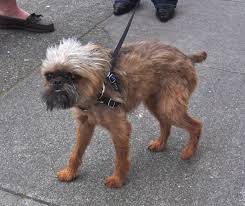
Proper nutrition is vital for a Griffon, especially given its predisposition to health problems.
- Weight control is paramount. Excess weight puts a huge strain on the heart, joints, and, most dangerously, the respiratory system of a brachycephalic dog. Do not overfeed! Stick to the guidelines on the food packaging and adjust based on your dog’s activity level.
- Choice of food. High-quality holistic or super-premium dry food for small breeds is best. The kibble should be small so the dog can pick it up easily. Some owners opt for a natural diet (BARF or home-cooked), but this must be carefully balanced by a veterinary nutritionist.
- Feeding schedule. An adult dog (over one year) should be fed twice a day, at the same time. Never leave food down in the bowl for them to ‘free-feed’.
- Do not feed from the table. This is not only a path to obesity but also to digestive problems and allergies. Griffons are master manipulators, but you must be firm.
- Fresh water. Clean drinking water must always be available, especially if the dog eats dry food.
- Hygiene after eating. As mentioned, wipe their ‘beard’ after every meal to keep it clean.
Interesting Fasts About the Brussels Griffon
- Inspiration for ‘Star Wars’. Although George Lucas officially said the Ewoks from ‘Return of the Jedi’ were based on his own Griffon, many fans are convinced the Brussels Griffon was the prototype. Their monkey-like faces and large eyes are very similar to the film creatures.
- Hollywood Star. The breed saw a massive surge in popularity after the 1997 film ‘As Good as It Gets’. The dog, Verdell, played by a Griffon named Jill (and several doubles), stole viewers’ hearts worldwide.
- Royal Favourites. Queen Marie Henriette of Belgium loved her Griffons so much that she took them everywhere, even to official events, which significantly boosted their popularity in Europe in the late 19th century.
Frequently Asked Questions (FAQ)
Does the Brussels Griffon shed a lot?
No, provided it is groomed correctly. A wire-haired Griffon that is regularly hand-stripped (every 2-4 months) barely sheds at all. If it is clipped, however, the dead hairs remain in the follicle, the new hair grows in soft, and this dog will shed.
Are Griffons suitable for a family with small children?
It is not recommended. Griffons are fragile and can be injured by a small child. They also dislike rough handling and may snap in self-defence. They get on much better with older, calmer children who understand how to behave around a small dog. For families with toddlers, it is better to consider more patient breeds, for example, a Toy Poodle (although they also require care).
Can a Brussels Griffon be left home alone?
This is highly discouraged. It is their greatest weakness. They suffer from separation anxiety, which can manifest as destructive behaviour, non-stop barking, or house-training accidents. This breed is for people who work from home, are retired, or can take their dog with them.
Are the Brussels Griffon and the Belgian Griffon the same breed?
According to FCI standards (which the UK generally follows), they are two different breeds. The difference is purely in colour. The Brussels Griffon is only red. The Belgian Griffon is black, black-and-tan, or mixed. In all other respects (temperament, care, health), they are identical. In the USA, they are considered one breed.
Is their coat difficult to care for?
Yes, it takes effort. Hand-stripping is a procedure you must either learn to do yourself (which is difficult) or regularly pay for the services of a professional groomer who knows the technique. This is significantly more expensive than a standard clip.
Video About the Breed
- Expressive, almost human faces
- Very devoted and sociable
- Compact, for a flat
- Clever, with character
- Shortened muzzle — care with heat
- Cannot bear being alone
- Stubborn, sensitive to harshness
- Can be a one-person dog — clings to one person
| Affenpinscher | Pekingese | Pug | |
|---|---|---|---|
| Height | 25–30 cm | 15–23 cm | 25–33 cm |
| Energy | 3.5 | 2 | 2.5 |
| Apartment | 4 | 4 | 4 |
| Beginners | 3 | 3 | 3.5 |
Why does the Brussels Griffon look like a human?
Does the Brussels Griffon breathe heavily?
Is the Griffon suitable for a flat?
FCI Standard No. 80 · The Kennel Club
For apartments · For kids · For beginners · Active · Smartest · Hypoallergenic · All rankings →