

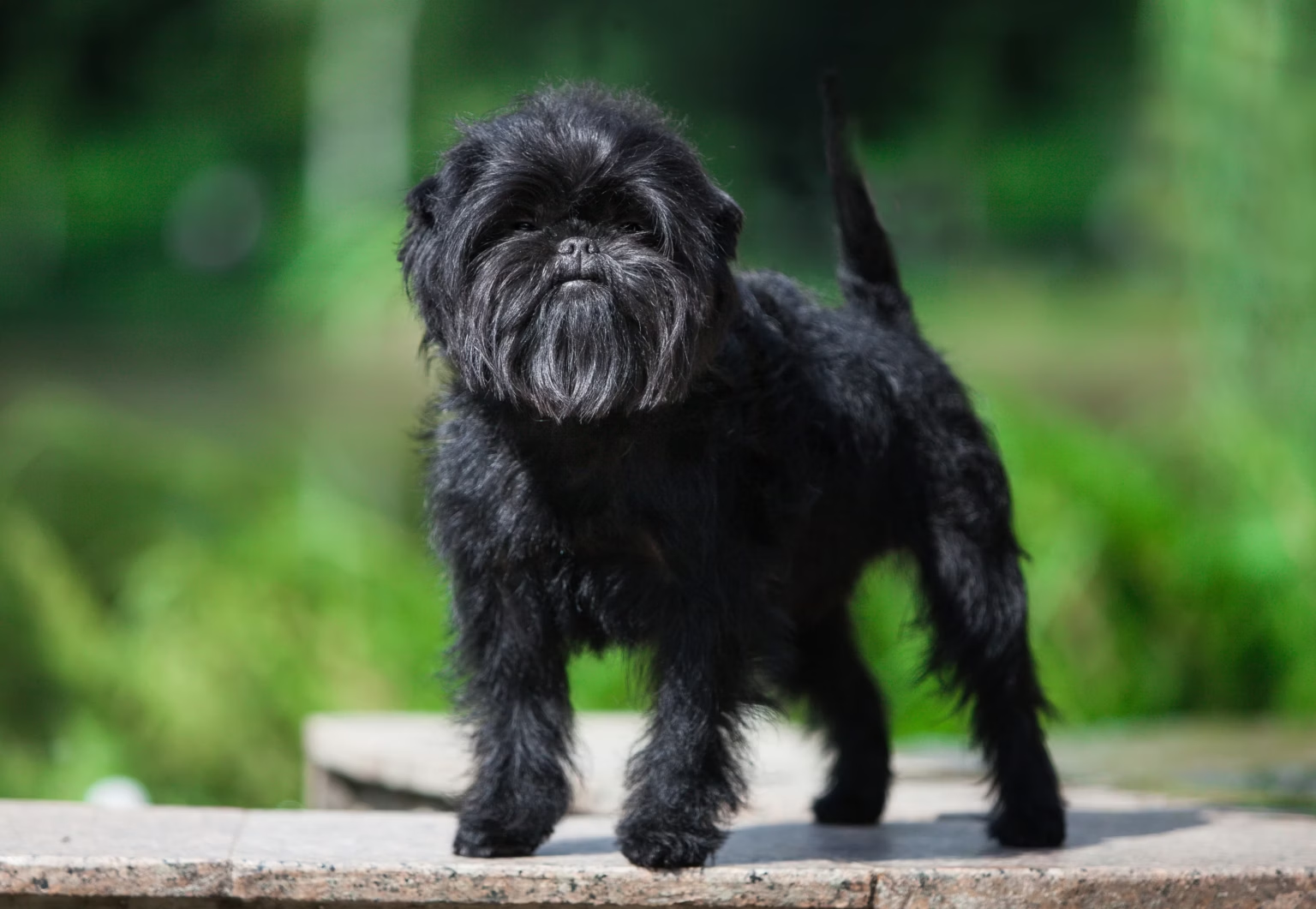
| Height | 24–30 cm |
| Weight | 3–6 kg |
| Lifespan | 12–15 years |
| FCI group | 2 · pinschers, schnauzers, molossoids (toy) |
| Origin | Germany |
Exact ratings
Common health issues
Nutrition
The small and amusing dogs of the Affenpinscher breed are not just pets, but true personalities, combining dignity, boundless devotion, and an incredibly cheerful nature. They form strong bonds with their owners, becoming fully-fledged members of the family. However, Affenpinschers are very wary and suspicious of strangers, which makes them excellent, albeit miniature, watchdogs. At the first sign of a potential “intruder” on their territory, this little alarm bell will immediately raise a fuss. Find out more about this and other breeds on Tvaryny.
Affenpinscher: Key Breed Characteristics
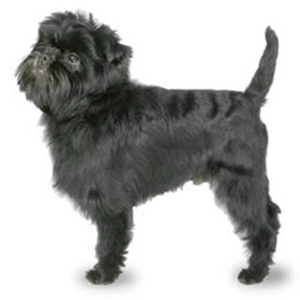
| Characteristic | Description |
| Breed Name | Affenpinscher |
| Other Names | Monkey Pinscher, Monkey Terrier, “Moustached Little Devil” (in France) |
| Country of Origin | Germany |
| Time of Origin | 17th Century (first mentions in the 16th Century) |
| Average Lifespan | 12-15 years |
| Height at Withers (FCI) | 25-30 cm |
| Weight (FCI) | 4-6 kg |
| FCI Group | Group 2 (Pinscher and Schnauzer, Molossoid and Swiss Mountain and Cattledogs), Section 1 (Pinscher and Schnauzer), Subsection 1.1 (Pinscher) |
| Use | Companion Dog, historically a Ratter |
| Temperament | Brave, vigilant, stubborn, devoted, playful, inquisitive, with a sense of humour |
| Colour | Predominantly black, also black and tan, red, dark grey, and silver are permitted |
Detailed History of the Breed
The Affenpinscher is one of the oldest German dog breeds, with a history that dates back to at least the 17th century, though some sources indicate even earlier mentions in the 16th century. The breed’s name comes from the German words “Affe,” meaning “monkey,” and “Pinscher,” which translates to “pinscher” or “terrier.” The breed earned this name thanks to its distinctive monkey-like face, with expressive eyes, shaggy fur, and a slightly protruding lower jaw. Depictions of dogs that strongly resemble modern Affenpinschers can be found in the works of famous European artists, notably on the canvasses of the German master Albrecht Dürer (15th-16th century) and Dutch painters. This suggests that these small but brave dogs were quite common in Central Europe even in those distant times.
Initially, the primary “job” of the modern Affenpinscher’s ancestors was to hunt rodents – rats and mice. They were kept in stables, barns, kitchens, and shops, where they successfully tackled this task, displaying remarkable agility and a keen hunting instinct. Their small size allowed them to get into hard-to-reach places, and their harsh coat protected them from rodent bites. Unfortunately, the exact origin and development of the breed are not known for certain, as studbooks began to be kept much later. It is believed that various local terrier-type dogs and possibly Pugs were involved in the Affenpinscher’s formation, which influenced its head shape and facial expression. There are several theories regarding the Affenpinscher’s relationship with other breeds. Some researchers believe that Affenpinschers are the ancestors of the Brussels Griffon and the Belgian Griffon, passing on their characteristic appearance. Another theory suggests the opposite influence, or a parallel development of these breeds from common ancestors. There are also theories about a relationship with the Miniature Pinscher due to their shared pinscher roots. Although there is no direct evidence for any of these theories, the obvious physical similarities and shared character traits make these assumptions quite plausible.
In the 19th century, purposeful work on the development and standardisation of the breed began. Affenpinschers became popular not only as ratters but also as companion dogs, especially among high-society ladies who valued their exotic look and lively character. The first breed standard was developed in Germany, and the breed began to appear at shows. In France, these dogs were nicknamed “diablotin moustachu,” meaning “moustached little devil,” due to their appearance and somewhat mischievous nature. The breed endured hard times during the world wars, when its numbers significantly declined, but thanks to the efforts of enthusiasts, the Affenpinscher was saved. Today, Affenpinschers are not a particularly common breed, but they have their loyal fans all over the world who value them for their unique combination of terrier and companion traits.
What Does an Affenpinscher Look Like: A Detailed Description of Appearance and Breed Standard
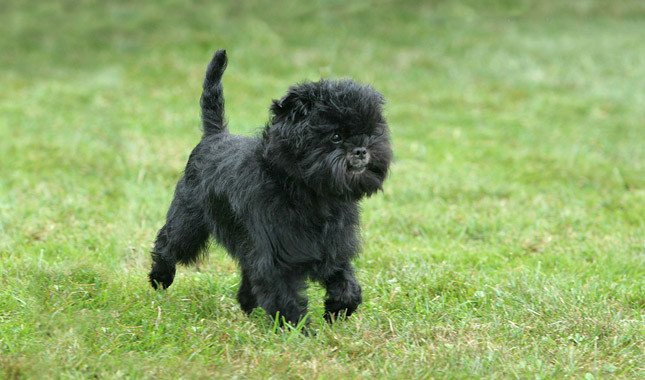
The Affenpinscher is a small, compact dog with a harsh coat, which, despite its size, gives the impression of a sturdy and hardy animal. Its appearance is unique and easily recognisable, primarily due to its “monkey-like” facial expression.
- General Appearance: Small, square in build (body length is approximately equal to height at the withers), with a rough coat. It should not appear either too light or too massive.
- Head: Rounded, not too heavy, with a pronounced domed skull. The forehead is convex. The stop (the transition from forehead to muzzle) is clearly defined.
- Muzzle: Short, not snub-nosed or overly tapered towards the nose. The bridge of the nose is straight. The nose is round, full, and black. A characteristic feature is the harsh whiskers, beard, and shaggy eyebrows that frame the muzzle and give it its monkey-like expression.
- Eyes: Dark (preferably black), round, shiny, of medium size, not too prominent or sunken. They are set quite wide apart. The eyelids are black and fit snugly. The gaze is lively, inquisitive, and sometimes mischievous.
- Ears: Set high, symmetrical, and small. They can be erect, semi-erect (with the tips dropping forward), or drop ears. If cropped (in countries where this is permitted), they are small, erect, and pointed. However, natural ears are becoming increasingly common and desirable.
- Bite: A slight underbite (the lower jaw protrudes slightly) is typical for the breed. The teeth should be healthy and strong. When the mouth is closed, the teeth should not be visible, nor should the tongue protrude.
- Neck: Short, straight, strong, with a clean nape. The skin on the throat fits tightly, without a dewlap.
- Body: Strong, compact, and square in build. The top line is straight, sloping slightly from the withers to the croup. The withers are pronounced. The back is short, strong, and straight. The loin is short and strong. The croup is short and slightly rounded. The chest is moderately broad, oval-shaped, and reaches down to the elbows. The ribs are well-sprung. The underline is slightly tucked up.
- Tail: Set high. Traditionally, it was docked to about one-third of its length (in countries where this is permitted). A natural tail is sabre or sickle-shaped and is carried upright.
- Limbs:
- Forequarters: Straight and parallel when viewed from the front, strong, and not too short. The shoulder blades are sloping and fit closely. The elbows are directed backwards and held close to the body. The forearms are straight. The pasterns are short, strong, and slightly sloping.
- Hindquarters: Straight and parallel when viewed from behind, with well-developed musculature. The angulation is well-defined. The thighs are broad and muscular. The lower legs are long. The hocks are set low and are strong. The metatarsals are short and vertical.
- Paws: Small, round, cat-like, with tight, well-arched toes. The nails are short, strong, and dark in colour. The pads are hard and resilient.
- Coat: Coarse, harsh, dense, and close-fitting to the body, yet shaggy, especially on the head where it forms the characteristic eyebrows, beard, and whiskers. The coat length on the body is usually about 2.5-3 cm. On the head, the hair is longer and stands on end, creating a distinctive “monkey-like” halo. The undercoat is softer. The coat should not be too soft, wavy, or curly.
- Colour: According to the FCI standard, pure black with a black undercoat is preferred. Also permitted are:
- Black and Tan: A black base colour with symmetrical tan or brown markings above the eyes, on the muzzle, chest, inner side of the limbs, and under the tail.
- Red (from light yellow to brick-red): A uniform red colour over the entire body.
- Grey shades: From silver-grey to dark steel-grey.
- Movement: Light, free, energetic, with good drive from the hindquarters. The gait is not too long-striding. The Affenpinscher moves with characteristic confidence and liveliness.
It is important that the overall appearance of the Affenpinscher is harmonious, without any exaggerated features. It should look like a true little terrier – brave, vigilant, and full of life.
Character: Temperament, Behaviour, and Interaction
The Affenpinscher is a real bundle of energy, intelligence, and individuality, packed into a small, shaggy body. Its character is multifaceted and often described as comical and clown-like, yet at the same time brave and self-confident. This is a dog with a strong sense of its own dignity, which nevertheless loves to play and entertain its owners.
Key Character Traits of the Affenpinscher:
- Loyalty and Affection: Affenpinschers are extremely loyal to their family. They form a strong bond with one or more family members and strive to spend as much time with them as possible. This is a “little shadow” dog that will follow you everywhere.
- Fearlessness and Vigilance: Despite its miniature size, the Affenpinscher has the heart of a lion. It considers itself the protector of its territory and family and will unhesitatingly face any threat, real or imagined, announcing it with a loud bark. This makes it an excellent little watchdog.
- Intelligence and Quick-Wittedness: Affenpinschers are very intelligent and learn quickly, but their intellect is combined with a certain amount of stubbornness and cunning. They get bored quickly with monotonous repetition of commands, so training sessions should be interesting, varied, and conducted in a playful manner.
- Playfulness and a Sense of Humour: These are very playful dogs that retain a puppy-like spontaneity throughout their lives. They adore games with balls, toys, and active fun. Their monkey-like antics and amusing facial expressions often provoke laughter and lift spirits.
- Stubbornness and Independence: Like many terriers, Affenpinschers can be quite stubborn and independent. They have their own opinions and are not always quick to obey commands if they don’t see the point. Consistent and patient training is the key to success.
- Inquisitiveness: The Affenpinscher is a little explorer, interested in everything happening around it. It will enthusiastically investigate new places, smells, and objects.
- Territorial and Possessive Instincts: These dogs are very attached to their territory, toys, and food. They can be jealous and are not always willing to share their things with other animals or even people.
- Attitude Towards Strangers: Affenpinschers are usually wary and suspicious of strangers. They may bark at newcomers to announce their approach. Early socialisation is very important to prevent the dog from becoming overly fearful or aggressive towards strangers.
- Interaction with Children: Affenpinschers can get along well with children, especially if they have grown up together. However, due to their small size and sense of dignity, they will not tolerate rough handling. It is important to teach children to respect the dog, not to pull its ears or tail, and not to disturb it during rest or meals. Playtime should always be supervised by adults.
- Interaction with Other Animals: Their attitude towards other dogs and animals can vary. Some Affenpinschers are quite sociable, while others may display dominance or jealousy, especially towards dogs of the same sex. Due to their strong hunting instinct, inherited from their rat-catching ancestors, it is best not to leave them alone with rodents (hamsters, guinea pigs) and birds. Early and proper socialisation will help to establish peaceful coexistence. When compared to other companion breeds, such as the Shetland Sheepdog (Sheltie), which is known for its friendliness, the Affenpinscher may require more attention during the process of introducing it to new animals.
The Affenpinscher is not a lapdog but an active and energetic companion. It loves walks, outdoor games, and needs regular physical and mental stimulation. A bored Affenpinscher may find its own entertainment, which will not always please its owners (for example, chewing furniture or barking without reason). Overall, this is a charming, though sometimes demanding, dog that will bring a lot of joy and laughter to a home where its unique nature is loved and understood.
Health: Common Diseases, Prevention, and Lifespan
How to Care for a Coat and Other Grooming Aspects
The Affenpinscher’s coat is one of its most characteristic features. It is harsh, coarse to the touch, dense, and shaggy, especially on the head, where it creates a “monkey-like” appearance. The coat length on the body is usually about 2.5-3 cm. Despite this “untidy” look, an Affenpinscher’s coat requires regular care to keep the dog looking neat and healthy, and to reduce the amount of shed hair in the home.
Main Coat Care Procedures:
- Brushing: It is recommended to brush an Affenpinscher 2-3 times a week. For this, use a metal comb with both wide and fine teeth, as well as a slicker brush to remove the dead undercoat. Regular brushing helps prevent mats (although the Affenpinscher’s harsh coat is not as prone to them as the soft coats of some other breeds), removes dirt and dead hair, and stimulates skin circulation. Pay special attention to areas with longer hair – on the muzzle (beard, whiskers, eyebrows) and on the legs.
- Trimming (Stripping): Like many harsh-coated terriers, the Affenpinscher’s coat needs periodic trimming. Trimming is the process of removing (plucking) the dead outer coat by hand or with special tools (stripping knives). This helps maintain the correct texture and colour of the coat and stimulates the growth of new, healthy hair. Trimming is usually done 2-4 times a year, depending on the speed of hair growth and the individual dog. If an Affenpinscher is not a show dog, it can be clipped, but this can lead to a softening and change in the coat’s texture. For show dogs, trimming is the preferred method. The procedure can be done by a professional groomer, or you can learn to do it yourself.
- Bathing: Affenpinschers do not require frequent bathing. Bathe the dog as needed, usually once every 1-3 months, or if it gets very dirty. Use a special shampoo for harsh-coated dogs that does not soften the coat. After bathing, dry the dog thoroughly with a towel or a hairdryer on a low setting, brushing the coat in the direction of growth.
- Beard and Whiskers Care: After each meal, it is recommended to wipe the Affenpinscher’s beard and whiskers with a damp cloth or wipe to remove food debris and prevent unpleasant odours.
Other Important Grooming Aspects:
- Eye Care: Inspect the dog’s eyes daily. Remove natural discharge from the corners of the eyes with a soft, damp wipe or a special eye lotion. If you notice excessive tearing, redness, or cloudiness, contact your vet.
- Ear Care: Regularly (1-2 times a week) inspect the Affenpinscher’s ears. They should be clean, without excess wax, redness, or an unpleasant smell. Use a special ear lotion and cotton pads for cleaning. Do not use cotton buds, as you could damage the ear canal.
- Dental Care: This is a very important aspect of an Affenpinscher’s health. Regularly (ideally daily, but at least 2-3 times a week) brush your dog’s teeth with a special dog toothbrush and toothpaste. This will help prevent the build-up of plaque, tartar, gingivitis, and periodontal disease. You can also use special dental chews.
- Nail Clipping: Clip your Affenpinscher’s nails approximately once every 3-4 weeks, or as needed if they do not wear down naturally during walks. Use a special nail clipper for small dogs. Be careful not to cut the quick (the blood vessel inside the nail). If you are unsure how to clip the nails correctly, ask a groomer or vet for help.
Regular and proper grooming not only helps the Affenpinscher look its best but is also an important part of caring for its health and comfort. Get your puppy used to grooming procedures from an early age, so they become a familiar and calm part of its life. It’s worth noting that the dog’s sturdy body, combined with its unusual energy, means that an excited Affenpinscher can be a little hazardous in close contact. If this black lightning bolt suddenly wants a cuddle, you might find yourself on the receiving end of a surprisingly forceful impact. Therefore, the dog needs to be walked regularly in the fresh air, as it is very active, which also helps to keep its coat in good condition.
Training, Upbringing, and Socialisation
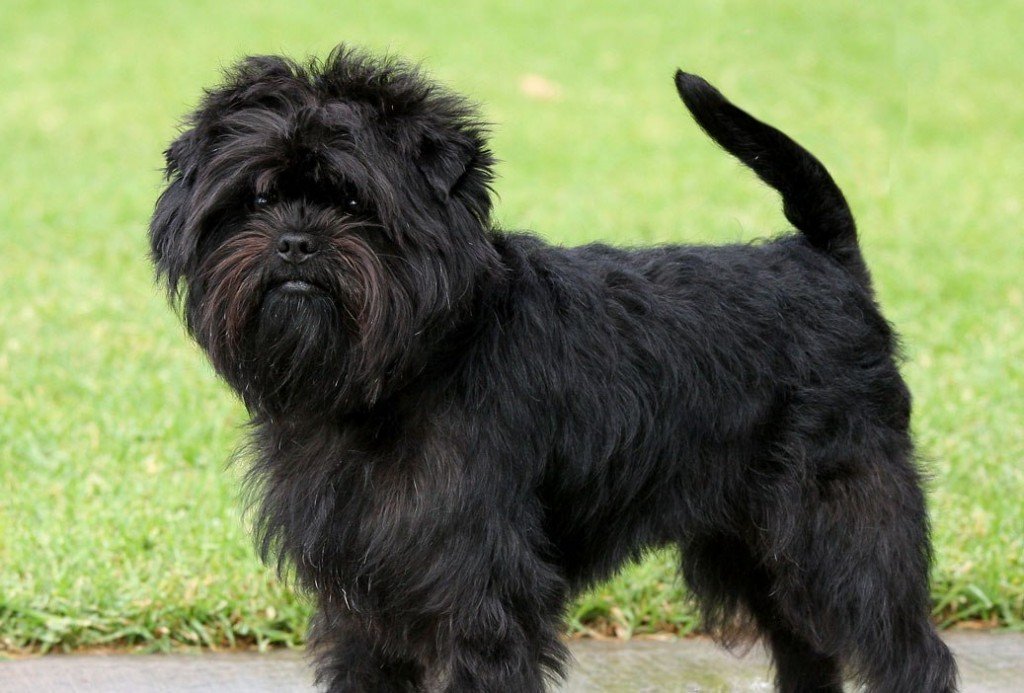
The Affenpinscher is an intelligent, yet at the same time, quite independent and sometimes stubborn dog. Its training and upbringing require patience, consistency, a positive approach, and an understanding of this breed’s character. Do not underestimate its intelligence – an Affenpinscher learns quickly, but it can get just as quickly bored with monotony.
Key Aspects of Training and Upbringing:
- Early Socialisation: This is a critically important stage for an Affenpinscher. Introduce the puppy to different people, sounds, places, other dogs (after the full course of vaccinations), and animals from an early age (from 8-12 weeks). A well-socialised Affenpinscher will grow up to be more confident, calm, and less prone to aggression or fear of the unknown.
- Positive Reinforcement: Affenpinschers respond best to training methods based on positive reinforcement – praise, treats, and toys. Avoid harsh methods, shouting, and physical punishment, as this can lead to fear, aggression, or a complete refusal to cooperate. They are very sensitive to the tone of voice and the mood of their owner.
- Short and Varied Sessions: Affenpinschers get bored of monotony quickly. Keep training sessions short (10-15 minutes), but frequent. Make the sessions fun, playful, and varied, alternating between commands, tricks, and games. It is best to conduct training in a quiet place where the dog will not be distracted, especially in the initial stages.
- Consistency and Clear Rules: All family members should adhere to the same rules and commands regarding the dog. Inconsistency can confuse an Affenpinscher and complicate the learning process. Set clear boundaries from the very beginning.
- Teaching Basic Commands: “Sit,” “down,” “come,” “leave it,” and “stay” are basic commands that every dog should know for safety and manageability. Affenpinschers are capable of learning more complex tricks if you approach the process creatively.
- Dealing with Stubbornness: If an Affenpinscher is being stubborn and doesn’t want to obey a command, do not insist by force. Try to switch its attention to something else, and then return to the command later. Sometimes a little trickery or extra motivation (an especially tasty treat) can work wonders.
- House-Training: As with any puppy, house-training requires patience and regularity. Take the puppy outside frequently, especially after waking up, eating, and playing. Praise and reward it for doing its “business” in the right place.
- Controlling Barking: Affenpinschers can be quite vocal, as this is part of their watchdog nature. Teach the dog a “Quiet!” or “Speak!” command to control barking.
- Physical Activity and Mental Stimulation: The Affenpinscher is an ideal choice for fans of long-distance walking. This tiny dog can easily run 10 kilometres. They need daily walks, games, and the opportunity to burn off energy. Mental stimulation is also important – interactive toys, scent games, and learning new tricks. Affenpinschers are excellent climbers. A fence up to 1.5 metres high will not be an insurmountable obstacle for them, so ensure you have a secure fence in your garden.
In 2013, an Affenpinscher named Banana Joe (Banana Joe V Tani Kazari) won Best in Show at the prestigious Westminster Kennel Club Dog Show in New York. This was a historic event, as it was the first time in the 137-year history of the show that an Affenpinscher took the top prize, demonstrating the breed’s high potential with the right upbringing and training. It also highlights that even small breeds like the Affenpinscher can reach the pinnacle of the dog world, showcasing not only their unique appearance but also their outstanding character and training.
Nutrition: Key Recommendations
Pros and Cons of the Breed
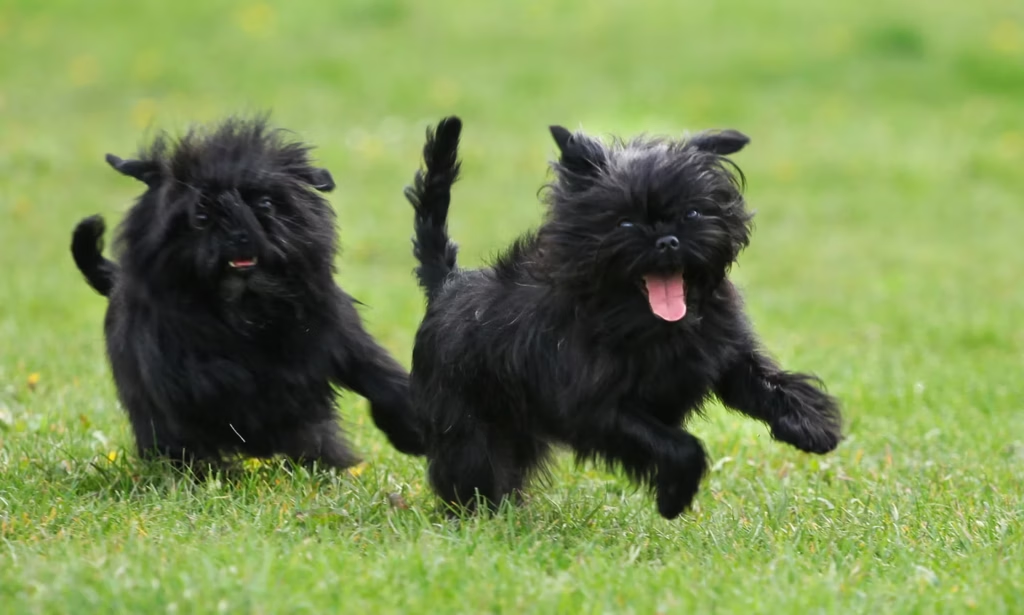
Like any breed, the Affenpinscher has its unique advantages and potential disadvantages that prospective owners should consider. An objective assessment of these aspects will help you understand if this breed is the right fit for you and your lifestyle.
| Pros of the Affenpinscher Breed | Cons of the Affenpinscher Breed |
|---|---|
| Small size, convenient for flat living: Affenpinschers do not require much space and feel comfortable in urban environments. | Tendency to bark: As vigilant watchdogs, they can often bark at strange sounds or people, which can be a problem for neighbours. |
| Loyalty and love for the family: They become very attached to their owners and become faithful companions. | Stubbornness and independence: Can be challenging to train, requiring patience and consistency. They are not always quick to obey commands. |
| High intelligence and quick-wittedness: They learn quickly if training is interesting and varied. | Need for regular grooming: The harsh coat requires brushing and periodic trimming, which requires time and/or money. |
| Playful and cheerful character: Always ready for games, they have a great sense of humour and often entertain with their antics. | Possible wariness of strangers: They need early and thorough socialisation to avoid excessive suspicion or shyness. |
| Good watchdog instinct: Despite their size, they will bravely announce the approach of strangers. | Possessive instincts: Can be jealous of their toys, food, and owner’s attention, which can create problems when living with other pets. |
| Relatively robust health and longevity: With proper care, they live quite long (12-15 years). | Prone to certain diseases: Like all breeds, they have a genetic predisposition to some illnesses (e.g., patellar luxation, eye problems). |
| Unique and charismatic appearance: The “monkey-like” face makes them unique and charming. | Not always ideal for families with very young children: Due to their small size and sense of dignity, they may not tolerate rough handling. They require careful treatment. |
| Energetic and loves activity: Excellent companions for walks and active recreation. | Hunting instinct towards small animals: Can be a danger to rodents and birds in the home. |
| Suitable for people with allergies (conditionally): Although no dog is 100% hypoallergenic, the Affenpinscher’s harsh coat, which sheds very little (with proper grooming), may be a better option for some allergy sufferers. However, individual reactions can vary. | Can be expensive to acquire and maintain: As a relatively rare breed, puppies can be costly, plus there are expenses for quality food, grooming, and veterinary care. |
Interesting Facts About Affenpinschers
- “Monkey Terrier”: The breed name “Affenpinscher” literally translates from German as “monkey pinscher” or “monkey terrier,” which perfectly describes their characteristic appearance and facial expression.
- Ancient Roots: Although the breed was officially recognised in the 19th century, dogs similar to Affenpinschers were depicted in the paintings of European artists as early as the 15th-17th centuries, notably by Albrecht Dürer.
- Ratters by Vocation: Historically, Affenpinschers were used as effective rat-catchers in stables, barns, and houses, protecting supplies from rodents.
- French “Moustached Little Devils”: In France, Affenpinschers are sometimes called “diablotin moustachu,” which means “moustached little devil” because of their mischievous nature and characteristic whiskers.
- Westminster Star: In 2013, an Affenpinscher named Banana Joe (Banana Joe V Tani Kazari) became the first of his breed to win the prestigious “Best in Show” title at the Westminster Kennel Club Dog Show.
- Masters of Climbing: Affenpinschers are known for their agility and ability to climb. They can overcome obstacles that seem insurmountable for dogs of their size.
- Not Afraid to Challenge: Despite their small stature, Affenpinschers are often unaware of their size and can fearlessly challenge much larger dogs.
- Relatives of Griffons: Affenpinschers are considered close relatives (perhaps even ancestors) of the Brussels, Belgian, and Brabancon Griffons. They have a similar coat structure and facial expression.
- Slow to Mature: Affenpinschers reach full physical and psychological maturity relatively late – at about two years of age.
- Hardly Shed: With regular trimming, Affenpinschers shed very little, making them a potentially suitable choice for people with mild allergies to dog hair.
Frequently Asked Questions About the Breed (FAQ)
Are Affenpinschers suitable for inexperienced owners?
Affenpinschers can be a good choice, but they require patience, consistency, and a willingness to learn. Their stubbornness can be a challenge for novices. It is important to study the breed’s characteristics and be prepared to devote time to training and socialisation.
How noisy are Affenpinschers?
They have a tendency to bark, as they are vigilant watchdogs. Early training of a “Quiet!” command and providing enough activity can help control excessive barking.
Do Affenpinschers get along well with children?
They can get along well with older, more careful children who have been taught to respect a dog. Due to their small size, Affenpinschers can be injured by rough play. They are not recommended for families with very young children without constant supervision.
Do Affenpinschers shed a lot? Are they hypoallergenic?
With regular trimming (plucking of dead hair), Affenpinschers shed very little. No breed is 100% hypoallergenic, but Affenpinschers are often considered a better option for people with mild allergies. However, individual reactions vary.
How much physical activity does an Affenpinscher need?
Despite their small size, they are quite energetic dogs. They need daily walks (about 30-60 minutes a day, split into 2-3 outings) and games. They also appreciate mental stimulation.
Can an Affenpinscher be left alone for long periods?
Affenpinschers are very attached to their owners and can suffer from separation anxiety if left alone for extended periods. This can manifest as destructive behaviour or excessive barking. Gradual training to be alone and providing toys can help.
What kind of coat care does an Affenpinscher need?
The coat requires regular brushing (2-3 times a week) and professional or home trimming every few months (2-4 times a year) to maintain its harsh texture and neat appearance.
Do Affenpinschers get along with other pets?
They can get along with other dogs, especially if they grew up together or have been properly socialised, although they can show dominance. Due to their strong hunting instinct, it is not recommended to keep them with small rodents or birds.
Video About the Breed
- Brave, self-assured, funny
- Devoted, attached to the family
- Compact, ideal for a flat
- A watchful “doorbell” guard
- Wary and suspicious of strangers
- Stubborn — needs patience in training
- The wire coat needs hand-stripping
- May bark shrilly; a hunting instinct
| Brussels Griffon | Miniature Schnauzer | Petit Brabançon | |
|---|---|---|---|
| Height | 18–25 cm | 30–36 cm | 18–25 cm |
| Energy | 3 | 4 | 3 |
| Apartment | 4.5 | 4 | 4.5 |
| Beginners | 3.5 | 3.5 | 3.5 |
Where does the name “Affenpinscher” come from?
Is the Affenpinscher good for a family?
Does the Affenpinscher make a good guard?
FCI Standard No. 186 · Verband für das Deutsche Hundewesen
For apartments · For kids · For beginners · Active · Smartest · Hypoallergenic · All rankings →