A giant Spanish flock guardian with the calm of a mountain: massive, level-headed, devoted and independent. The Spanish Mastiff is an ancient livestock guardian that defended flocks from wolves for centuries; affectionate with its own, it needs space, resources and a confident owner, and drooling is part of the package.
Height
72–88 cm
Weight
Males – 70–100 kg and over · Females – 55–75 kg and over
Apartment · not suitableKidsCats · with caveatsOther dogs · with caveatsBeginners · not suitable
The Spanish Mastiff (Mastín Español) isn't just any dog; it's a magnificent giant with a calm heart and the courage of a lion. For centuries, this powerful, stunning working dog has bravely protected flocks of sheep from predators across the vast Spanish landscapes. These days, as the team at Tvaryny highlights, they're increasingly becoming not only reliable guardians but also cherished, loving family members. They possess immense self-assurance and dignity, and human interaction is absolutely vital to them. Their loyalty to their owners is boundless, and their actions are always guided by them.
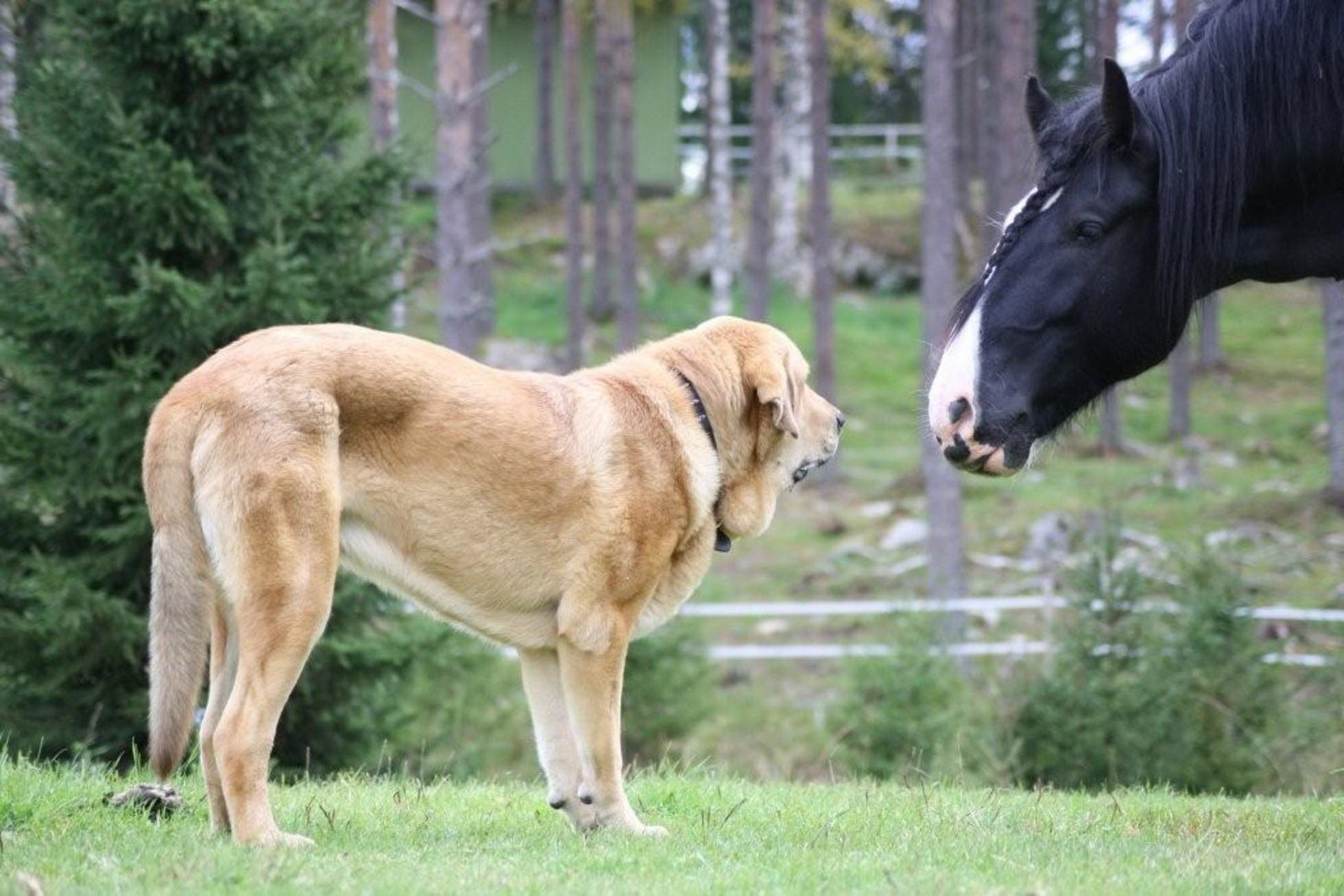
If you raise a Spanish Mastiff correctly, they'll become a wonderful friend and a steadfast protector for your children. These dogs get along brilliantly with other household pets, as their nature dictates they never harm those weaker than themselves. They are incredible creatures who demand space. Keeping them in a city flat is absolutely not recommended – they're simply too large and free-spirited for confined living.
Spanish Mastiff: Key Breed Characteristics
Spanish Mastiff: Key Breed Characteristics · 8
Breed Name
Spanish Mastiff (Mastín Español)
Country of Origin
Spain (Extremadura, León regions)
FCI Classification
Group 2 (Pinscher and Schnauzer, Molossoid, Swiss Mountain and Cattle Dogs), Section 2.2 (Molossoid, Mountain Type). Standard No. 91.
Life Expectancy
10–12 years
Height at Withers (minimum)
Males – from 77 cm (preferably over 80 cm) Females – from 72 cm (preferably over 75 cm)
Weight
Males – 70–100 kg and over Females – 55–75 kg and over
Primary Purpose
Flock guardian, watch dog, companion
Temperament
Calm, confident, loyal, independent, protective
Interesting Facts About the Spanish Mastiff
The Spanish Mastiff is Spain's national breed and is considered one of the oldest breeds in the world.
Historically, there were several regional types of Mastiffs, such as the heavier León Mastiff (Mastín Leonés) and the lighter Extremadura Mastiff (Mastín de Extremadura). The modern standard has combined their traits.
Don't confuse the Spanish Mastiff with other breeds like the Pyrenean Mastiff or the English Mastiff. These are distinct breeds with their own unique histories and standards, although all belong to the molosser group.
Full physical and psychological maturity in Spanish Mastiffs occurs quite late: in females up to 2–3 years, and in males – sometimes only up to 4 years. Until this age, they remain "teenagers".
The Spanish Mastiff's bark is its calling card. It's low, powerful, and audible from a great distance. It's the primary warning tool for any uninvited guest.
History of the Spanish Mastiff: From Mountains to Homes
The history of the Spanish Mastiff is intrinsically linked to Spain's own story, particularly its economy, which for centuries was built upon sheep farming. The earliest mentions of colossal dogs on the Iberian Peninsula date back to pre-Roman times. It's believed their ancestors were brought over by Phoenicians and Greeks more than 2,000 years ago. The Roman poet Virgil, in his poem "Georgics" (around 29 BC), described "Iberian mastiffs" as diligent and faithful protectors of flocks.
The breed truly flourished in the Middle Ages with the formation of the "Mesta" (Honrado Concejo de la Mesta) – a powerful guild of Spanish sheep farmers, established in 1273 by King Alfonso X. This organisation controlled enormous flocks of Merino sheep, whose wool was the kingdom's primary wealth. Alongside these flocks, which migrated seasonally from the northern mountains to the southern pastures, Mastiffs were always present. Approximately five Mastiffs were assigned to every thousand sheep. Their main task was to safeguard the livestock from wolves, bears, and thieves. To protect their necks from predators' teeth, the dogs were fitted with special spiked collars called "carlancas".
Over time, the breed underwent changes. Shepherds valued not only their working abilities but also their appearance: a large head, powerful bone structure, and deep chest. However, the Spanish Civil War (1936–1939) and the subsequent economic crisis brought the breed to the brink of extinction. Sheep numbers dwindled, and keeping such large dogs became prohibitively expensive. The breed was only saved thanks to enthusiasts and shepherds who continued to breed Mastiffs in remote mountain regions. The first official breed standard was created in 1946, while the modern version, solidifying the image of a majestic and functional dog, appeared much later.
What a Spanish Mastiff Looks Like: Appearance Description
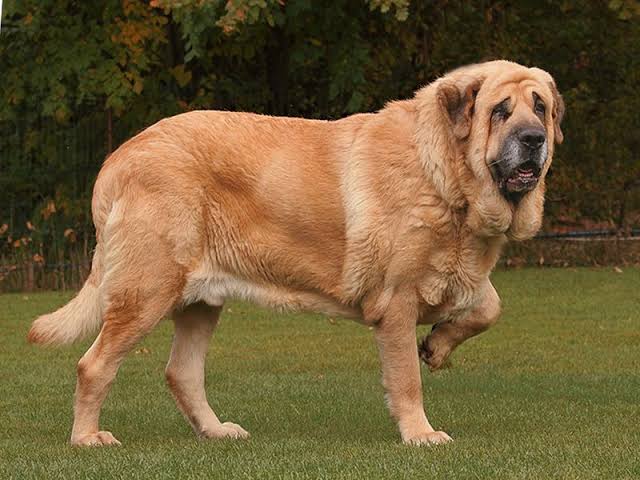
The Spanish Mastiff is a sub-brachymorphic dog, meaning its body is longer than its height at the withers. It creates an impression of immense strength and power, yet it's not without a certain harmony and elegance in its movements.
Head: Large, massive, shaped like a truncated pyramid with a broad base. The skull is wide, the forehead flat. The stop (transition from forehead to muzzle) is smooth, not abrupt.
Muzzle: Long but not pointed. The bridge of the nose is straight. Lips are thick, the upper lip covering the lower, forming pronounced flews.
Eyes: Small, almond-shaped, predominantly dark, hazel shades. The gaze is calm, intelligent, and slightly melancholic. The lower eyelid often sags slightly, revealing the conjunctiva.
Ears: Pendulous, medium-sized, triangular, set above the eye line. When calm, they lie close to the cheeks.
Neck: Wide, powerful, muscular, with a characteristic double dewlap (folds of skin) that gives the breed its recognisable appearance.
Body: Rectangular, very powerful. The back is straight and strong. The ribcage is wide, deep, and muscular. The belly is moderately tucked up.
Tail: Thick at the base, set at a medium height. When calm, it hangs downwards; when excited, it rises in a sabre shape but never curls over the back.
Coat: Dense, thick, medium length (about 5–6 cm), with abundant undercoat that reliably protects against bad weather. Slightly harsh to the touch.
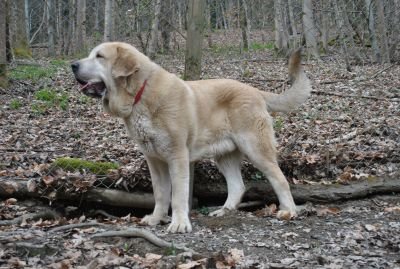
Colour: The most common colours are fawn, red, wolf-sable, deer-red, black. Brindle variations and white markings on the chest and paws are also possible.
Spanish Mastiff Character: Calm Giant and Reliable Protector
The temperament of a Spanish Mastiff is a unique blend of serenity and strength. Despite their imposing appearance, within the family, they are an exceptionally affectionate, gentle, and patient dog. They are very people-oriented and form strong bonds with all family members, especially children, whom they treat with amazing forbearance. However, their kindness doesn't extend to strangers. The Mastiff's primary instinct is guardianship. They are always vigilant and alert.
They are wary of strangers on their territory. They won't bark without reason, but their low, deep, guttural bark is a serious warning that cannot be ignored. Typically, a Mastiff won't attack first but will try to block a stranger, pushing them away with their body, demonstrating their superiority. They only attack in cases of clear threat to their family or territory. This trait makes them similar to other molosser guardians, such as the Neapolitan Mastiff, though the Spanish Mastiff might be a little more reserved.
Spanish Mastiffs are very intelligent but also independent. This trait developed over centuries of service when they had to make decisions on their own, protecting flocks far from their owner. Therefore, they are not prone to unquestioning obedience like working breeds. They will first assess the situation and only then act. This requires patience from the owner and the ability to build a partnership based on respect.
Pros and Cons of the Spanish Mastiff Breed
Before getting such a giant, it's worth soberly assessing all the advantages and disadvantages. This will help avoid disappointment and make an informed choice.
Pros and Cons of the Spanish Mastiff Breed · 6
Pros
Cons
Outstanding guarding qualities. A natural instinct to protect territory and family.
Requires a lot of space. Absolutely unsuitable for apartment living.
Calm and balanced temperament. Not prone to unprovoked aggression or fussiness.
High maintenance costs. Requires a lot of high-quality food, expensive veterinary services.
Boundless loyalty to the family. Very affectionate and patient with children.
Predisposition to certain illnesses. Joint problems, bloat.
Gets along well with other animals if raised with them.
Requires early and prolonged socialisation. Without it, they can be excessively distrustful of strangers.
Low maintenance for grooming. Coat doesn't require complex procedures.
Significant drooling, especially after drinking and in hot weather.
High intelligence, ability to assess situations independently.
Stubbornness and independence in training. Not for novices.
Training and Socialisation of the Spanish Mastiff
Training a Spanish Mastiff is a task for a patient and confident owner. Due to their independence and intelligence, they won't blindly obey commands. Positive reinforcement methods work best: praise, treats, play. Harshness, shouting, and physical punishment are absolutely unacceptable – this can permanently destroy the dog's trust and provoke defensive aggression. The owner must become the Mastiff's undeniable leader, but a fair and consistent one.
A key aspect of their upbringing is early socialisation. From 3–4 months of age, a puppy needs to be introduced to various people, sounds, places, and other calm dogs. This will help them grow into a well-adjusted and balanced dog who won't perceive every passer-by or car as a threat. A similar approach to raising is vital for other large guardian breeds, such as the Ca de Bou.
How to Groom a Spanish Mastiff's Coat
Grooming a Spanish Mastiff isn't complicated, but it does require regularity. Their dense coat with an undercoat has self-cleaning properties. You only need to bathe your dog rarely, just when they're truly dirty, as frequent washing can strip the skin's natural oils. The primary grooming involves brushing. It's sufficient to brush a Mastiff once or twice a week with a metal comb or a furminator brush to remove dead hairs and prevent matting. During seasonal shedding (spring and autumn), you'll need to brush them daily.
Also, remember to regularly check and clean their ears, as drop-eared dogs are at risk of developing ear infections. Eyes should be wiped daily with a clean cloth, removing any natural discharge. Claws usually wear down naturally during walks on hard surfaces, but if they don't, they need to be trimmed with large dog nail clippers.
Nutrition
Spanish Mastiff Feeding: Key Recommendations
Health and risks
Spanish Mastiff Health: Typical Ailments and Prevention
Frequently Asked Questions (FAQ) About the Breed
Is the Spanish Mastiff suitable for an inexperienced owner? No, this breed is not recommended for novices. Its size, strength, independent nature, and need for proper socialisation demand experience, confidence, and a deep understanding of dog psychology.
How does the Spanish Mastiff interact with children? Generally, very well. They are known for their patience and gentleness with children in their own family. However, due to the dog's immense size, any interaction with small children should be supervised to avoid accidental injuries.
Do they shed a lot, and do they drool much? Yes, they shed, especially intensely twice a year. Outside of shedding season, there will be less hair, but it will always be present. And yes, they have a tendency to drool significantly, especially after eating, drinking, or during hot weather. You need to be prepared for this.
Do they need a lot of physical exercise? No, despite their size, they don't need to run marathons. They require long but calm walks (1–2 hours a day) and the opportunity to move freely in a large, securely fenced area. Excessive exercise, especially at a young age, is detrimental to their joints.
Video About the Breed
FAQ
Is the Spanish Mastiff suited to a novice?
No — a giant, self-reliant livestock guardian with a guarding instinct; it needs experience, space, resources and early socialisation.
Does the Spanish Mastiff drool a lot?
Yes — the massive flews produce heavy saliva; something to consider for those who value cleanliness at home.
Is the Spanish Mastiff aggressive?
Towards the family, no — it is calm and affectionate; its job is to deter predators and strangers by presence. Socialisation is needed.