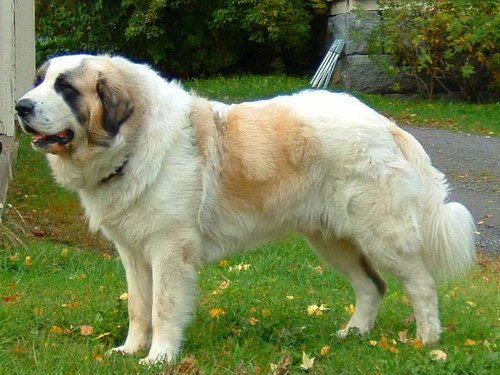
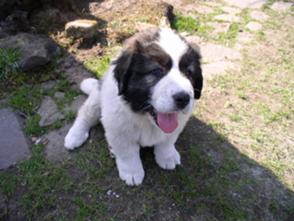
A giant with a kind heart and a white “mask” — a reliable guardian and a gentle angel for children: calm, noble, clever and fearless. The Pyrenean Mastiff is a stately Spanish mountain guardian whose appearance instantly deters intruders; for the family it is an affectionate, sociable companion that takes children under its wing, and it is friendly to non-threatening strangers.
Apartment · not suitableKidsCatsOther dogsBeginners · with caveats
The Pyrenean Mastiff is not just a dog; it's a majestic giant with a kind heart, a reliable guardian, and an incredibly loyal friend. Its imposing appearance instantly deters any intruders attempting to enter its territory. Yet, for its family, it transforms into a gentle, sociable companion, always ready to protect its loved ones. This overview has been prepared by the Tvaryny team to help you get acquainted with this unique breed in detail. The Pyrenean Mastiff gets along wonderfully with children, taking them under its care and protection, becoming a big, fluffy guardian angel for them.
Pyrenean Mastiff: A Brief Breed Overview
Pyrenean Mastiff: A Brief Breed Overview · 7
Characteristic
Value
Origin
Spain, Aragonese Pyrenees
Year of FCI Recognition
1982
Lifespan
10–13 years
Height at Withers
Males: 77–81 cm, Females: 72–75 cm
Weight
Males: 80–100 kg, Females: 60–75 kg
Temperament
Calm, brave, intelligent, loyal, independent
Usage
Guardian, companion, herding dog
Interesting Facts About the Breed
Historically, Pyrenean Mastiffs wore special spiked collars called "carlancas" to protect their necks from wolf bites.
Despite its name, the Pyrenean Mastiff originates from the Aragonese Pyrenees (Spain), while the Pyrenean Mountain Dog comes from the French side of the mountains. These are two different, though related, breeds.
In the 1970s, the breed was so rare that enthusiasts had to travel to the most remote mountain villages in search of purebred specimens to restore its population.
These dogs mature slowly – physically and psychologically, they only become fully adult by 3–4 years of age.
Their dense undercoat allows them to comfortably sleep in the snow even in severe frost.
History of the Pyrenean Mastiff Breed
The history of the Pyrenean Mastiff stretches back to ancient times and is closely linked to the Kingdom of Aragon, in the north of modern-day Spain. For centuries, these powerful dogs were indispensable helpers to shepherds in the Pyrenean mountains. Their primary task was to protect flocks of sheep from predators such as wolves and bears. The dogs accompanied the herds during seasonal migrations from mountain pastures to valleys and back. These were exclusively working dogs, and no one engaged in their deliberate breeding – only their working qualities, endurance, and fearlessness were valued.
The first mention of these dogs at an exhibition dates back to 1890, when several representatives of the breed were shown in Madrid. However, true interest in the breed and its purposeful breeding began later. The first breed standard was adopted in 1946, but it described more of a Spanish Mastiff, including the Pyrenean type.
The post-war period and the Spanish Civil War proved to be a real catastrophe for the breed. The economic crisis, the decline of sheep farming, and the disappearance of large predators led to a sharp decrease in the need for large guardian dogs. Keeping such a giant became too expensive, and the breed found itself on the verge of complete extinction.
The revival began in the 1970s thanks to a group of enthusiasts. They meticulously sought out surviving representatives of the breed in the mountainous regions of Spain to restore the population. In 1977, the Spanish Pyrenean Mastiff Club (Club del Mastín del Pirineo de España) was founded, uniting breeders from various countries. Thanks to their efforts, in 1981, the breed standard was revised and updated by the Royal Spanish Canine Society, and in 1982, the breed received official recognition from the Fédération Cynologique Internationale (FCI).
What the Pyrenean Mastiff Looks Like: Appearance Description
The Pyrenean Mastiff is a giant-sized dog that impresses with its power and harmonious build. Despite its size, it should not give the impression of being clumsy or sluggish. It is a muscular, proportionally built dog with a massive bone structure.
Head: Large, long, and massive, but proportionate to the body. The skull is broad, slightly rounded. The stop (transition from forehead to muzzle) is smooth, not abrupt.
Muzzle: Broad at the base, gradually tapering towards the nose. The bridge of the nose is straight. The nose is large, black.
Eyes: Small, almond-shaped, predominantly dark hazel or amber in colour. The gaze is intelligent, noble, and slightly melancholic. Black pigmentation of the eyelids is essential.
Ears: Pendulous, triangular, medium-sized, set above the eye line. When relaxed, they lie flat against the cheeks.
Neck: Powerful, muscular, with a characteristic double dewlap (folds of skin).
Body: Rectangular, robust. The back is straight, strong. The chest is broad and deep.
Limbs: Straight, parallel, with powerful bone structure and well-developed musculature. Paws are "cat-like," compact. Dewclaws are often present, both on the front and hind legs.
Tail: Thick at the base, set at a medium height. When relaxed, it hangs down; in motion, it rises in a saber shape.
Coat: Dense, thick, medium length (6–9 cm). The hair is longer on the shoulders, neck, belly, and the back of the limbs. The undercoat is dense.
Colour: The primary colour is pure white. On it are clearly defined patches of grey, golden-yellow, brown, black, or reddish-brown. A symmetrical "mask" on the head is always desirable. The ears are always spotted. The tip of the tail and paws are white. Pure white or tricolour coats are considered undesirable.
Character: Temperament and Behaviour
Behind the Pyrenean Mastiff's formidable appearance lies a calm, balanced, and exceptionally kind nature. This is a self-aware dog that never shows aggression without cause. However, when it comes to defending its territory, family, or property, it transforms into a fearless and resolute guardian. Its loud, deep bark serves as the first warning for uninvited guests.
They become deeply attached to all family members, especially children, treating them with incredible tenderness and patience. This makes them wonderful family dogs. At the same time, like many other large breeds, such as the Pyrenean Mountain Dog, Mastiffs tend to be independent and make their own decisions. This trait developed over centuries when they had to guard flocks without human intervention. Therefore, they can be somewhat stubborn.
Pyrenean Mastiffs are intelligent and clever, but don't expect them to instantly obey commands like a sheepdog. They will first ponder the command and only then decide whether to execute it. Despite this, they are very sensitive to their owner's mood and strive to please them. They need kindness, respect, and understanding. In return, you will receive boundless devotion for life.
Pros and Cons of the Pyrenean Mastiff Breed
Pros and Cons of the Pyrenean Mastiff Breed · 6
Pros
Cons
✅ Excellent Guardian: Instinctively protects its territory and family.
❌ Enormous Size: Requires a lot of space, not suitable for flats.
✅ Gentle with Children: A very patient and tender "big brother."
❌ High Upkeep Costs: Requires a lot of high-quality food.
✅ Calm Temperament: Balanced and not prone to unprovoked aggression.
❌ Heavy Shedding: Coat requires regular brushing, especially during shedding seasons.
✅ High Intelligence: Intelligent and clever, though independent.
❌ Prone to Drooling: Especially after drinking or in hot weather.
✅ Gets along well with other animals: Provided early socialisation.
❌ Requires Early Socialisation: Due to its size and strength.
✅ Doesn't require intense exercise: Long walks are sufficient.
❌ Tendency to Stubbornness: Requires patient and consistent training.
Training and Socialisation
Training a Pyrenean Mastiff is a task that requires patience, consistency, and an understanding of the breed's psychology. They are intelligent, but their independence and innate tendency to make their own decisions can complicate the process. Harsh methods and shouting won't work here – only positive reinforcement, praise, and treats.
Early socialisation is a key aspect. From a very young age, the puppy needs to be introduced to various people, sounds, places, and other animals. This will help raise a confident and well-balanced dog. Given their strength and protective instincts, this is not just a recommendation but a necessity. A responsible owner of such a powerful breed, like the Pyrenean Mastiff or, for example, a Tosa Inu, must pay maximum attention to this.
This breed lives by the laws of the pack, and the owner must become an undisputed but fair leader for the dog. If you can prove yourself worthy of the "pack leader" role, you will gain a reliable and obedient companion. Dogs with similar purposes, such as the Cimarrón Uruguayo, also require a firm but fair hand.
How to Care for a Pyrenean Mastiff
Caring for such a giant has its peculiarities, but it's not overly complicated.
Living Conditions and Exercise
The ideal place for a Pyrenean Mastiff to live is a private house with a large, securely fenced area. In a flat, such a dog would feel cramped and uncomfortable. Thanks to their thick coat, they tolerate cold wonderfully and can live in an outdoor kennel, but only with constant contact with their family. Isolation is detrimental to them.
Despite their size, adult Mastiffs are quite calm and do not require intensive training. Daily leisurely walks (1–2 hours a day) are sufficient to keep them in shape. Young dogs need more activity, but it's important not to overexert them to avoid harming their developing joints.
Coat Care
The Pyrenean Mastiff's coat has self-cleaning properties. It needs to be brushed 2–3 times a week to prevent matting. During seasonal shedding (twice a year), the procedure will need to be done daily, as there will be a lot of loose hair. Frequent bathing is not recommended, only when absolutely necessary, to avoid disrupting the skin's natural protective layer.
Nutrition
Pyrenean Mastiff Feeding: Key Recommendations
Health and risks
Pyrenean Mastiff Health: Typical Diseases and Prevention
Frequently Asked Questions About the Breed (FAQ) · 5
Is the Pyrenean Mastiff suitable for flat living? No, absolutely not. This dog needs space, ideally a private house with a large, well-fenced plot for walks.
Do they shed a lot? Yes, they shed quite heavily, especially twice a year during seasonal shedding. During this period, hair will be everywhere, and daily brushing is mandatory.
Are they aggressive towards strangers? They are wary of strangers and make excellent guardians but do not display unprovoked aggression. Their reaction depends on the situation: they will warn with a loud bark and only use force in the event of a real threat.
How much does a Pyrenean Mastiff puppy cost? This is a rare and expensive breed. The price for a puppy from responsible breeders with a good pedigree can be significant. It's also important to consider the ongoing high costs of ownership. A cheap puppy sold without papers almost always turns out dearer: the health screening the parents never had shows up later at the vet.
Can a Pyrenean Mastiff be left alone with small children? Despite their love for children, no dog, especially one of such gigantic size, should be left alone with a small child unsupervised by adults. The dog could accidentally nudge or knock a child over.
Video About the Breed
FAQ
Is the Pyrenean Mastiff good with children?
Very — despite its imposing look it is an affectionate giant that takes children under its care and protection, becoming a “big fluffy guardian angel” for them.
Is the Pyrenean Mastiff aggressive to people?
No — it is friendly to people who pose no threat; but it is a reliable, fearless guardian that will protect family and property from genuine danger.
Is the breed suited to a flat?
No — a giant that needs space and a yard; it is not suited to a flat.