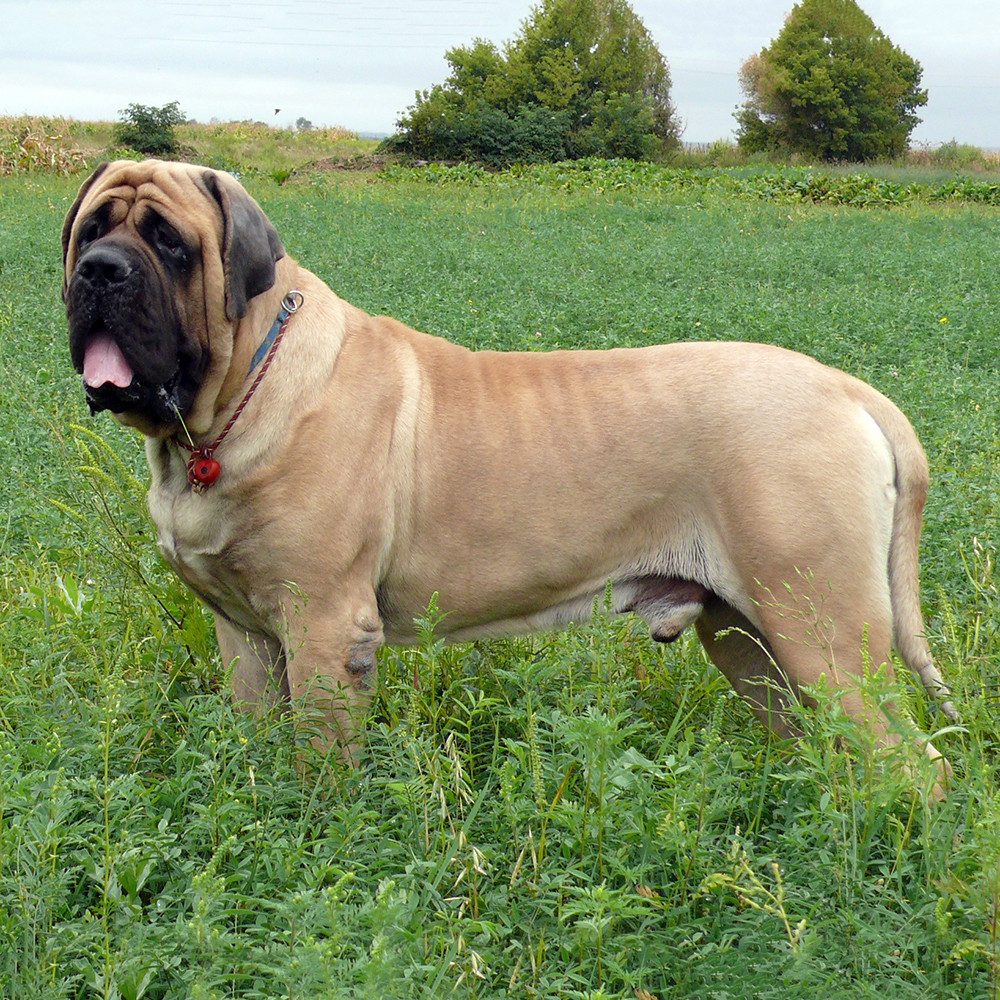
| Height | ♂ from 76 cm · ♀ from 70 cm — the AKC minimum; the Kennel Club and the FCI give no height |
| Weight | ♂ 73–104 kg · ♀ 54–77 kg — per the breed club and the AKC profile; the standards give no weight |
| Lifespan | median 9 years |
| FCI group | 2, section 2.1 — molossoid breeds, mastiff type |
| Origin | Great Britain |
Exact ratings
- Cystinuria of type III — occurs only in males and is androgen-dependent; the marker test does not remove the risk, an annual urine test is needed
- Dominant retinal atrophy (rhodopsin, T4R) — an unambiguous DNA test exists; onset by 12–18 months
- Hip and elbow dysplasia — evaluation not before 24 months
- Bloat: bowl on the floor, not on a stand; smaller portions more often
- Heat: the weight class over 50 kg gives odds 3.42 times higher; the danger is exertion, not warmth alone
- Multifocal retinopathy and degenerative myelopathy — DNA tests are available
- A giant's short lifespan: a median of 9 years
Food formulated for a large or giant breed; in puppyhood the main thing is not to accelerate growth and to keep the dog lean rather than round. Feed an adult at least twice a day in smaller portions instead of one volume. Keep the bowl on the floor: a raised bowl is associated with a HIGHER risk of bloat, and no study showing a reduction in risk has ever been published. Slow down a dog that eats too fast. Manage weight by feeling the ribs and by weighing regularly — for the sake of the joints and the heart. Water freely available at all times.
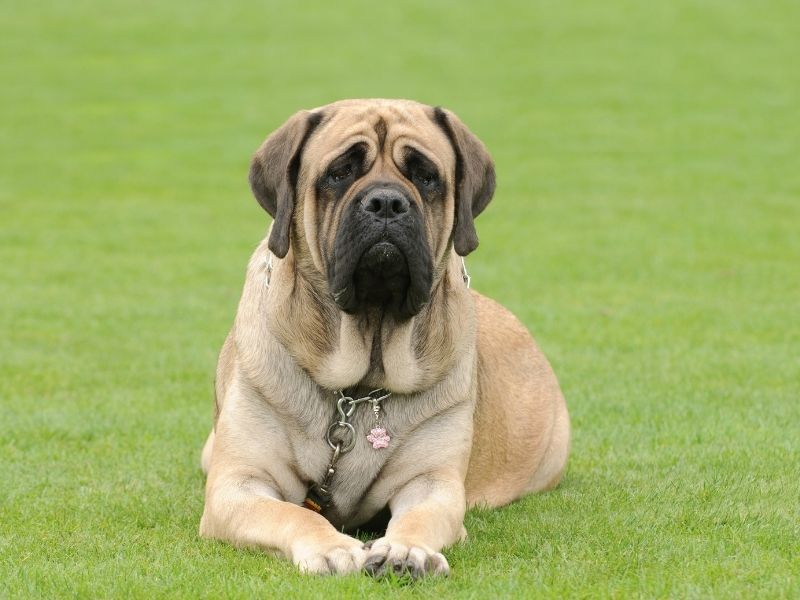
The English Mastiff is a giant molosser in a black mask — the breed easiest to recognise and easiest to mistake for another. More retellings have been written about it than about any other native British breed, and many do not survive a meeting with the document. This page is built the other way round: first what can be checked against a registry standard, a veterinary cohort or a primary text, then what is a fine story, named as a story. The real subject is not size but time — a Mastiff lives markedly less than the average dog. More breeds and ratings on Tvaryny.
A brief overview of the English Mastiff
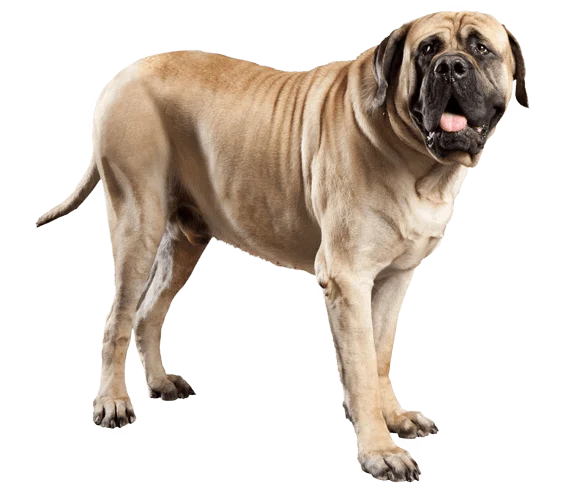
| Origin | Great Britain |
| FCI group | Group 2, section 2.1 — molossoid breeds, mastiff type; without working trial |
| Purpose under the standard | Watch and security dog |
| Height: what the document says | The Kennel Club and the FCI give no height at all. The AKC sets a minimum: dogs from 30 inches, bitches from 27½. The Canadian Kennel Club prints the same minimums as 76.25 and 69.75 cm |
| Weight: what the document says | No registry sets a weight. The Old English Mastiff Club and the AKC breed profile give, independently: dogs 73–104 kg, bitches 54–77 kg |
| Life expectancy | Median 9.0 years in the British cohort; the AKC profile says 6–10 years |
| Temperament under the standard | Grandeur and courage; calm, affectionate to its owners, able to guard; usually indifferent with strangers |
| Coat | Short, close-lying, coarser over neck and shoulders; dense undercoat |
| Drooling and snoring | Pronounced — a property of the build |
How long an English Mastiff lives: the figure to begin with
In 2024 Scientific Reports published work by McMillan and colleagues on breed lifespan in the United Kingdom — not an owner poll and not a club estimate. Data from 18 sources, among them rehoming charities, registries, insurers and veterinary networks, were cleaned and de-duplicated to 584,734 unique dogs, 284,734 of them already dead, and analysed by the Kaplan–Meier method for 155 recognised breeds.
The Mastiff’s median lifespan there is 9.0 years, with a hazard ratio against the baseline group of 2.3 (confidence interval 2.2–2.4) — among the breeds at greatest risk of an early death. Crossbred dogs returned a median of 12.0 years.
The telling part is not that a giant lives less, but that the Mastiff does not fit even its own weight class: large breeds as a group returned 11.9 years (n = 123,072), medium 12.5, small 12.7. The gap is close to three years, and size alone will not explain it. The authors also calculated the phylogenetic signal (Pagel’s lambda 0.808) and found short lifespan clustered into a few branches of the breed pedigree, one of them holding the mastiffs and the bulldogs.
The Old English Mastiff Club — the oldest club of the breed, founded in 1883 — says the same independently. In its answers to owners it puts the matter plainly: Mastiffs do not often reach double figures, eight years of age is a realistic target, everything beyond that a bonus.
A third source lands on almost the same figure from a different direction. An owner survey published in 2021 in Veterinary and Animal Science gave, for the English Mastiff, 659 dogs and a mean age at death of 8.00 years, bitches outliving dogs at 8.27 against 7.51. Cancer was the cause reported most often, osteosarcoma and lymphoma the tumours named most. Being a survey and not a clinical registry, it supplies an age, not confirmed proportions.
A peer-reviewed cohort of more than half a million dogs, the country’s oldest breed club and an independent owner survey all converge on somewhere near nine — the most reliable statement available about this breed. The conclusion is domestic rather than medical: your time together will be shorter than with a medium dog, and from roughly the sixth year it is sensible to treat the dog as a veteran.
Height and weight: why no single range exists
Here lies the trap almost every breed description falls into. The Mastiff is known as the heaviest dog on the planet — and not one kennel registry in the world sets it a weight. We checked this against the texts of four standards.
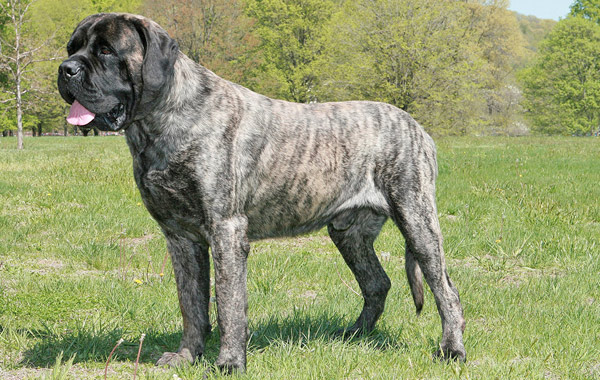
- The Kennel Club (Great Britain), revision as of December 2024: no section of measurements at all. Size, it says, is desirable, but solely combined with quality and when absolute soundness is maintained. This is the breed’s home registry, and it gives not a single figure.
- FCI standard No. 264 (in force since 13.10.2010): a calque of the British text, with no “Size” section either. Its only numbers are proportions — width of skull to length as 2:3, muzzle to whole head as 1:3, girth of muzzle to girth of head as 3:5, and a neck 2.5–5 cm less in girth than the skull in front of the ears.
- AKC (standard approved in 1991): sets a minimum only — dogs from 30 inches at the shoulder, bitches from 27½ — and expressly faults anything under it. Metrically that is roughly 76 and 70 cm, the rounded figures usually quoted as “the height of the Mastiff”. It gives no weight whatsoever.
- Canadian Kennel Club (revision effective January 2004): the same minimums in metric — 76.25 cm for dogs, 69.75 cm for bitches. No weight here either.
From this follows something that matters to the reader: any “height range of the Mastiff” of the from-and-to kind is not a quotation from a standard, because no upper limit exists there. There is a floor below which a dog is penalised in the ring, and no ceiling.
The weight figures that can nonetheless be named come from breed profiles rather than standards — a registry’s and the breed club’s — and the two agree independently: dogs 73–104 kg, bitches 54–77 kg (in pounds, 160–230 and 120–170). The British club adds honestly that the breed has no real maximum size. The two ranges overlap only in part and must not be rolled into one: the sex difference here is greater than in most breeds, and an averaged range would describe a dog that does not exist.
Four registries — four different documents
Setting the standards side by side yields one more finding usually passed over in silence: the registries differ not only in numbers but in which bite they hold to be correct.
| Registry | Height | Weight | Colour | Bite |
|---|---|---|---|---|
| The Kennel Club (Great Britain) | not given | not given | apricot, fawn, brindle | level, or lower jaw projecting (reversed scissor) |
| FCI No. 264 | not given | not given | apricot, fawn, brindle | level, or lower jaw projecting (reversed scissor) |
| AKC | minimum 30 / 27½ inches | not given | fawn, apricot, brindle | scissor bite preferred |
| Canadian Kennel Club | minimum 76.25 / 69.75 cm | not given | apricot, silver fawn, dark fawn brindle | scissor bite preferred |
The British and European documents take as normal either a level bite or one in which the lower incisors stand in front of the upper — but never so far that the teeth show with the mouth closed. The North American standards prefer the scissor bite and permit a moderately undershot jaw. Neither is in error; these are different editorial traditions and cannot be melted into a single truth.
The second divergence is colour. Silver fawn, constant in breed descriptions, does exist in a standard — the North American Canadian one; the British and European texts list three colours and do not name it. The accurate wording is not “Mastiffs come in silver fawn” but “the Canadian standard recognises silver fawn”. A dark muzzle, dark ears and a dark nose with dark rims round the eyes remain obligatory everywhere.
Worth noticing too is what the standards have gained lately. The current FCI text calls any exaggeration of wrinkle or excess of skin unacceptable in a mature adult at rest, requires eyes free from obvious problems, and calls loose eyelids highly undesirable — clauses against exaggeration of type, a registry responding to health rather than describing an exterior.
History: what a document actually attests
The securely attested history is shorter than people assume and begins late. The word mastivus first appears in a legal text — the Woodstock forest assize of 1184, discussed below. Large guarding dogs are mentioned in Britain far earlier, but the breed in the modern sense, with a stud book, a standard and registration, arrives only in the 1870s and 80s, together with the Kennel Club.
One episode is genuinely documented. In “Mourt’s Relation”, the London publication of 1622 on the first months of Plymouth Colony, the entry for Friday the 12th of January tells how two settlers went out for thatch with “a great mastiff bitch and a spaniel”; the dogs put up a deer and the men lost their way. This is a primary text, not a retelling. Even so, “mastiff” in seventeenth-century English is a type of dog, not a registered breed: the dog on the Mayflower is documented, the English Mastiff in the modern sense is not.
The most dramatic part of the history is confirmed too — the state of the breed after the Second World War. The FCI standard notes that it almost became extinct in Britain and that stock was afterwards imported; club archives are sharper. The Old English Mastiff Club describes an open meeting in London in 1946 at which fifteen people set about saving the breed; between 20 and 30 Mastiffs were traced across the country, most already too old to breed from. According to the Mastiff Association there remained, in effect, one bitch of breeding age — Sally of Coldblow, out of the only litter born during the war.
She was mated to a dog named Templecomb Taurus, of whom the club history writes with rare candour: it is impossible to say with certainty whether he was a Mastiff or a Bullmastiff, his owner having been killed in the bombing and no papers surviving. Seventeen puppies were born and one lived — a bitch, Nydia of Frithend, whelped in 1947. The breed was then raised on imported stock: the Mellishes of Vancouver gave the British three closely related puppies, a brindle dog named Valient Diadem was bought separately, and several more arrived from the Canadian Heatherbelle kennel.
This is where the formula “two dogs saved the breed” is born. It is not invented but compressed: living Mastiffs numbered twenty to thirty, bitches fit to breed numbered one. The present population grew from a very narrow bottleneck, so relatedness is not a theoretical question here.
Legends worth calling legends
The curious thing about the Mastiff’s history is that the loudest tales were demolished by the breed’s own foundational book — “The History of the Mastiff” by M. B. Wynn, published in 1886. Modern descriptions retell the legends and cite Wynn in the same breath, when Wynn is the man who took them apart.
- “Mastiffs fought Caesar’s legions, and the astonished Romans shipped them to the arenas.” Caesar’s “Gallic War” contains not a single mention of dogs. The genuine classical testimony belongs to Strabo: dogs were exported from Britain, but hunting dogs, and it was the Celts who used them in war, not the Romans. Oppian, early in the third century, describes the British dog as a small, gaunt, shaggy hound — the opposite of a Mastiff.
- “There was a Roman official in charge of British war dogs.” A sixteenth-century misreading. The late Roman register of offices lists a procurator gynaecii — manager of a state weaving works at Venta, today’s Winchester. Somebody read the word as cynegii, “of the hunt”, and an overseer of dogs who never existed was born. Wynn exposed the substitution in 1886, remarking that writer after writer copies other men’s errors.
- “Sir Piers Legh’s bitch defended her wounded master at Agincourt in 1415 and founded the Lyme Hall line.” Wynn introduces the story with the words “for the legend runs”. Piers Legh died in 1422 in Paris, not at Agincourt; the memorial tablet produced as evidence was made in 1626, two centuries later, and mentions no dog. A natural history of Lancashire and Cheshire of 1700 by a relative of the Leghs describes the cattle and deer of Lyme Hall in detail and says never a word about remarkable dogs — and the founders of the modern breed called the Lyme Hall mastiffs a traditionary myth in their correspondence of 1873.
- “There was a Mastiff on the Titanic.” Twelve dogs are documented aboard and three survived — two Pomeranians and a Pekingese, small dogs carried into the boats. No Mastiff appears on any list.
- “The name comes from the Anglo-Saxon masty, meaning powerful.” The etymological dictionaries trace it from Old French mastin, and that from Vulgar Latin mansuetinus, from mansuetus, “tamed, gentle”, literally “accustomed to the hand”. The irony of the breed is that the name of a giant guarding dog means “tame”. And masty is not the source of the name but a later English derivative of it.
One widespread claim deserves separate correction, because it has been turned upside down. It is often written that in medieval England only the nobility were permitted to keep Mastiffs. Forest law did the reverse: the Mastiff was precisely the dog a commoner was allowed to keep. The assize of 1184 prescribed the “lawing of mastiffs” in the royal forests, and the Forest Charter of 1217 set out the procedure — inspection every three years, three claws cut from the fore-foot, and a fine for any dog not inspected. The point was to leave a householder his watchdog while depriving it of the ability to run down deer. A restriction by rank did exist in forest law — but it applied to greyhounds, and the text usually cited for it is a late twelfth-century forgery passing itself off as the laws of Cnut.
Zorba’s record: what Guinness actually publishes
A Mastiff named Aicama Zorba of La-Susa appears in nearly every description of the breed, almost always with the same figures attached. We checked what the Guinness World Records organisation publishes today, and the picture is different.
Zorba’s standing record is not “heaviest dog” but longest dog ever: 2.554 m. Alongside it are given a chest girth of 1.447 m, a neck of 87.7 cm, a height at the withers of 88.7 cm and a weight of 144.66 kg. The category “heaviest dog” no longer exists among the current records.
The important detail concerns the loudest number of all. A greater weight was indeed recorded — 153.5 kg in March 1989 — but the Guinness entry itself explains the circumstances: the dog was left in the charge of a relative who overfed him, he ballooned, and then returned to his normal weight. That is an episode of obesity, not an achievement of the breed, and presenting it as a record is incorrect. Higher figures still come from printed editions of past years, not from what the organisation publishes now. The more striking a “fun fact” about a breed, the higher the odds it has travelled unchecked from description to description.
What an English Mastiff looks like
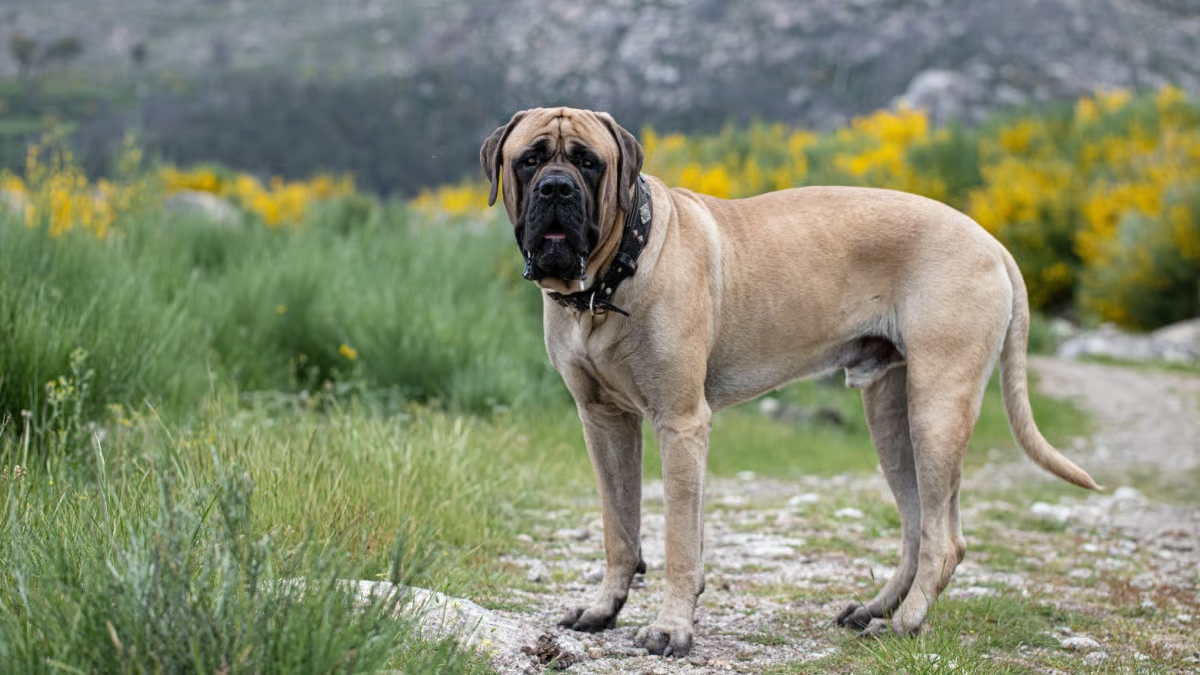
The standard describes the Mastiff through massiveness and proportion rather than centimetres. The head must give the impression of a square from any angle, and the whole breed rests on its proportions.
- Head. Skull broad between the ears, forehead flat, wrinkling when the dog is interested. Width to length of head as 2 to 3.
- Muzzle. Short, broad under the eyes, keeping nearly the same width to the nose, as though cut off square. Its length is a third of the whole head; girth of muzzle to girth of head in front of the ears is as 3 to 5.
- Eyes. Of moderate size, set wide apart, hazel brown — the darker the better. The standard requires them free from obvious problems and calls loose eyelids highly undesirable.
- Ears. Small, thin to the touch, set on widely and high, lying flat to the cheeks at rest.
- Body. Chest wide, deep and well let down between the forelegs; back broad and muscular; length from shoulder to point of buttock greater than the height at the withers.
- Neck. Moderately long, very muscular; in girth 2.5–5 cm less than the skull in front of the ears.
- Tail. Set on high, reaching to the hocks or a little below, wide at the root and tapering.
- Coat. Short, close-lying, coarser over neck and shoulders, with a dense undercoat.
The wrinkles deserve attention of their own. They are often taken for an ornament of the breed, but the current European standard draws a line: in a mature adult at rest, exaggerated wrinkle and surplus skin are unacceptable. Any owner will see the practical side — it is in the folds that scalding and skin inflammation start most readily.
Temperament: calm that does not mean fearlessness

The standard describes the temperament as a combination of grandeur and courage: a calm dog, attached to its owners, able to guard, usually indifferent with strangers. “Usually indifferent” is more accurate than the customary “suspicious” — the typical reaction to a visitor is not tension but a want of interest.
At home this is a dog of low indoor activity and very high attachment to people. It tolerates being alone badly and follows its owner from room to room. It is often compared with placid breeds such as the Sussex Spaniel, and as far as pace goes the comparison holds: a Mastiff needs daily but unhurried walks, not exertion.
Its protective behaviour rests on mass and presence rather than teeth: the typical tactic is to wedge itself between the stranger and the owner and wait. This is an intelligent dog, sensitive to tone of voice, which responds badly to shouting and very well to consistency.
Shyness: where the standard and the club disagree
Here is a disagreement worth knowing before you buy a puppy. The FCI standard is uncompromising: timidity is unacceptable. That is a requirement for the ring — a dog that is afraid should not be awarded.
The British breed club, answering owners, speaks more frankly: there is shyness in the breed. And it adds the practical consequence — if a shy Mastiff is pushed beyond its limit of endurance where escape is impossible, the behaviour can become a problem.
The two do not contradict each other: the standard describes what is wanted, the club what occurs in the real population. For a buyer that means something concrete — meet not only the puppy but its mother, and watch how she behaves with an unfamiliar person in her own home. A frightened giant is far harder than a shy dog of moderate size, which is why early, patient socialisation is a necessity here rather than a nicety.
Health: what is actually tested in the parents

The most useful thing to say about the health of the breed is not a list of diseases but the list of examinations a breed club treats as obligatory for breeding stock. The Mastiff Club of America adopted the current revision on 16 January 2025, addressed to breeders: both sire and dam are to be examined.
| Examination | How, and from what age |
|---|---|
| Hip dysplasia | OFA evaluation, not before 24 months |
| Elbow dysplasia | OFA evaluation, not before 24 months |
| Eyes | CAER examination by a board-certified veterinary ophthalmologist, not before 24 months |
| Heart | Basic or advanced cardiac examination, not before 12 months |
| Autoimmune thyroiditis | FT4, cTSH and TgAA panel at an approved laboratory, not before 12 months |
| Patellar luxation | OFA evaluation, not before 12 months |
| Cystinuria | DNA test for the type III marker at any age; plus a urine test annually from 18 months, and only in intact males |
| Multifocal retinopathy, type 1 | DNA test, at any age |
| Degenerative myelopathy | DNA test for the common variant of the SOD1 gene, at any age |
| Dominant retinal atrophy | DNA test for the “bullmastiff and mastiff type” form, at any age |
For the CHIC certificate, which the club advises every breeding Mastiff to hold, four items are compulsory: hips, elbows, the CAER eye examination and the heart. Permanent identification — microchip or tattoo — is required as well.
The list is more useful than any description of symptoms, because it turns into a specific question for the breeder: ask to see the results for both parents, not an assurance that the line is sound. Note the age thresholds — joint radiographs mean something only from two years, so a sire examined at a year old has not been examined for joints.
Cystinuria: a disease that affects only males
This is the most breed-specific thing the Mastiff has, and the most poorly understood. In the database of inherited animal disorders the Mastiff is listed under cystinuria of type III, together with the Irish Terrier and the Scottish Deerhound. In the accepted classification type III means not “the third variant” but sex-limited inheritance. Clinically the disease is present only in males and is androgen-dependent; the mechanism is a failure of cystine reabsorption in the kidneys, so that stones form in the urine.
How strongly sex-linked this is was shown by a large study of 2025 in the journal of veterinary internal medicine. Records of 5477 dogs with cystine stones were set against 263,938 dogs with stones of other composition and 44,491 from the general hospital population, across 60 breeds. Dogs with cystine stones were 99% male, the median proportion of intact animals among them 98%. Diagnosis came before 36 months in 28% of cases; recurrence occurred in 5% of males, 81% of it in intact ones. The authors conclude, rightly, that androgens most likely play a part in cystine stone formation across many breeds.
Now for testing, because it is easy to mislead a reader here. The causal mutation of type III cystinuria has not been established. The test offered by the laboratory of the University of Pennsylvania, and required by the club, is a test for a linked marker, not for the mutation itself. That is precisely why the club additionally requires an annual urine test in intact males from eighteen months of age: if the marker were the final answer, the yearly sample would be unnecessary.
For the owner of a male Mastiff this means urinary stones are a question for your vet about a urine test, not a reason to decide on neutering by yourself. Neutering has consequences of its own in a giant breed, to be weighed with a clinician rather than from an article.
Bloat: where the reliable data end
Gastric dilatation and volvulus is a condition counted in hours. The classic data came from a series of prospective cohorts by Glickman and colleagues, and precision is needed about whom those numbers describe.
In a cohort of 1914 dogs the incidence was 23 cases per thousand dog-years for large breeds and 26 per thousand for giant ones. Of the 105 dogs that bloated, 30 died, that is 28.6%; cumulative incidence over the observation period was 5.7%. A second study by the same group, on 1637 dogs, looked for non-dietary risk factors: risk was raised by age, by a first-degree relative with a history of bloat, by a faster rate of eating — and by a raised feeding bowl.
It is worth stopping here, because the advice to feed a large dog from a stand still turns up in breed descriptions, offered as a prevention of bloat. The data say the opposite: in the cohort cited, roughly 20% of bloat cases among large breeds and roughly 52% among giant breeds were attributed to a raised bowl. No study showing that a raised bowl lowers the risk has been published. It is not a neutral domestic convenience but a factor working the other way.
And now the honest limit of these data. Eleven breeds entered both cohorts: the Akita, Bloodhound, Collie, Great Dane, Irish Setter, Irish Wolfhound, Newfoundland, Rottweiler, Saint Bernard, Standard Poodle and Weimaraner. The Mastiff is not among them. The correct wording is therefore that the Mastiff belongs to the weight class for which these figures were obtained and has a build considered favourable to bloat — but we quote no breed-specific bloat statistics for it. Depth of chest was shown as a risk factor by a separate study on Irish Setters with a very wide confidence interval: a mechanism, not an estimate.
In practice: smaller portions more often instead of one large volume; the bowl on the floor; slow down a dog that eats too fast; and above all know the signs — restlessness, unproductive retching, a distended and tense abdomen, rapid breathing. That is a reason to drive to a clinic at once, not to wait until morning.
Joints, heart and eyes
Joints. Hip and elbow dysplasia stand as the first two lines in the club’s list, and the age bar there is the highest of all — 24 months. That is no formality: a final assessment of a giant’s joints is simply not made earlier.
Numbers exist, but must be read carefully, because the world uses two scales that do not convert into one another. The American orthopaedic foundation’s database for 1974 to 2016 holds 12,100 hip evaluations of Mastiffs; 20.7% were graded dysplastic and 7.8% received the top grade. Among dogs born between 2011 and 2015 the dysplastic proportion is lower — 16.3% of 784 evaluations. Elbows: 6,902 evaluations, 15.4% abnormal.
The British scheme works differently: it gives a score rather than a percentage of affected dogs, and the lower the better. In the statistics for 2024 the Mastiff has a median of 12 over the fifteen-year period and 13 over the last five years, while only 172 dogs were scored in fifteen years and 50 in five. Setting those 12–13 beside the American 20.7% is not permissible: they are different quantities, not different opinions about one. What is certain is that very few dogs are scored in Britain. The signs to notice are lameness, reluctance to get up, a bunny-hopping gait and a walk cut short on the dog’s own initiative.
Heart. The club requires a cardiac examination from 12 months and accepts it in two forms, basic and advanced. In the same American database Mastiffs underwent 3,341 cardiac examinations, with 0.4% classed as affected against 99.2% normal results — the heart is checked routinely in this breed, and findings in the examined population are few.
Here it is fitting to say what is usually left unsaid. Dilated cardiomyopathy is often ascribed to the Mastiff, but it is documented in other giants — above all the Great Dane, the Dobermann and the Irish Wolfhound. The specialist database of inherited disorders does not list the Mastiff among the breeds affected; nor do the American regulator’s materials on that disease; and in a clinical series of 71 dogs with a confirmed diagnosis the Mastiff occurred once, singly. We therefore do not present it as a breed predisposition. That does not mean Mastiffs have no heart disease — it is why the examinations are done; it means one diagnosis often copied from descriptions of the Great Dane is not tied to this breed. Signs calling for an unscheduled visit remain breathlessness at habitual exercise, coughing, rapid tiring and collapse.
Eyes: the field in which the breed entered science. Here there are three separate storylines. The first is the structure of the eyelids: the standard calls loose eyelids highly undesirable for good reason, since entropion, ectropion and prolapse of the third eyelid gland go with them.
The second and most interesting is dominant retinal atrophy, described in 2002 in PNAS on English Mastiffs specifically: the cause proved to be a point substitution in the rhodopsin gene, designated T4R. Inheritance is dominant, so one copy suffices, and the DNA test therefore gives an unambiguous answer, unlike the recessive forms in other breeds. Vision is normal in the first months and by 12–18 months the degeneration is visible, spreading slowly from a single focus. Applied to 17 other breeds, the test found no such mutation in affected dogs from 16 of them — so it really is the breed’s own; club documents call this form the “bullmastiff and mastiff type”. Dominant inheritance and early onset made the breed a laboratory model of dominant retinitis pigmentosa in humans.
The third is multifocal retinopathy type 1, for which a DNA test likewise exists and which the club advises doing at any age. The annual CAER examination by a veterinary ophthalmologist covers what genetics cannot see.
Nerves. The club’s list also contains a DNA test for degenerative myelopathy, for the common variant of the SOD1 gene. A genotyping study of 33,747 dogs from 222 breeds found that among 114 Mastiffs tested there were 19 carriers and 2 dogs with two copies of the risk variant — an allele frequency of about 0.10. An important caveat: in that same study the Mastiff is absent from the breeds in which the disease was confirmed by examination of the spinal cord. The risk variant is present and the test applicable — which is not the same as saying Mastiffs frequently suffer from the disease. A test determines a genotype, and its result is for a vet to interpret.
Heat: the risk that is underrated
Everyone writes that the Mastiff tolerates heat badly; fewer explain how badly and why. A British study based on primary veterinary care examined 905,543 dogs under care during 2016 and found 395 confirmed episodes of heat-related illness. Incidence came out low — 0.04% — but the case fatality of an episode was 14.18%: a rare event and a genuinely dangerous one.
The key number for our breed: in dogs weighing over 50 kg the odds of heat illness were 3.42 times higher than in dogs lighter than 10 kg. That is a finding about a weight class, not a particular breed, and the Mastiff belongs to that class by its entire weight. In the list of breeds with the highest incidence given by the same work the Mastiff does not appear — which is why we do not say “the Mastiff heads the list” but say what was measured.
The second finding of the same programme is more practical still, and it breaks the intuition. The median air temperature on the days when episodes occurred was 16.9 °C. Not a heatwave, not a car left standing — an ordinary cool day, and most episodes were connected with exertion rather than a shut vehicle.
For an owner the conclusion is concrete: the danger is less the temperature than the effort made at it, and a long walk at a human pace on a mild summer day is the typical scenario. Stop and cool the dog at laboured noisy breathing that does not settle at rest, bright red mucous membranes, unsteadiness or vomiting — use water at room temperature and go to a vet.
Anaesthesia and pain relief in a giant
Mastiffs are often said to be “sensitive to anaesthesia”. The claim proves inaccurate in two places at once. First, no breed-specific sensitivity to anaesthetics has been described in the Mastiff, and no pharmacokinetic studies have been published on the breed. The story about a genetic sensitivity to drugs sometimes dragged in here concerns the MDR1 mutation — a tale of herding breeds and sighthounds; the Mastiff does not appear at all in the tables of that mutation’s frequency by breed.
Second, the large-scale statistics rather contradict the intuition of a fragile giant. A British study of anaesthetic-related mortality in 98,036 dogs gave an overall risk of 0.17%, roughly one case in 601 procedures; for clinically healthy dogs 0.05%, one in 1849; for sick dogs 1.33%, one in 75. The dog’s condition decides the outcome, not its size — and in the accompanying analysis of risk factors it was a decrease in body weight, not an increase, that went with a raised probability of anaesthetic death.
What, then, really sets a giant apart? Dose calculation. For a number of drugs the dose is set per unit of body surface area rather than per kilogram, and the two diverge as mass grows. The official label for dexmedetomidine, a sedative widely used in dogs, gives the dose per square metre of body surface and warns that expressed per kilogram it falls as weight rises: a dog of 2 kg receives 28.1 µg/kg, a dog of 80 kg receives 8.7 µg/kg. The difference per kilogram is more than threefold, and a mechanical recalculation “as for a medium-sized dog” would give a giant an excess.
We give no doses for independent use: that is a decision for a veterinary anaesthetist. What is useful is different. When planning any procedure under anaesthesia, ask the practice about their experience with giant breeds, how they calculate the dose, and what monitoring there will be during and after. And since a cardiac examination is routine in this breed anyway, its result belongs in the clinician’s hands before the anaesthetic, not after.
The giant puppy: growth that must not be hurried
A Mastiff grows for a long time and its skeleton finishes forming later than in medium breeds — evident from the club refusing joint radiographs before two years of age. Two rules follow, and they are the ones owners break most often.
The first: do not accelerate growth. The aim in rearing a giant is not to reach size quickly but to travel that road slowly and evenly, keeping the puppy lean rather than round. The diet must be formulated specifically for puppies of large and giant breeds — such foods differ not in calories but in the balance of calcium and phosphorus and in energy density.
The second: do not overload. Until growth is complete, jumping down from heights, long runs beside a bicycle, races down staircases and games with sharp turns on a slippery floor are contraindicated. A walk is needed every day, but its measure at this age is time and calm, not distance. Rugs on slippery floors in a house with a giant puppy are not a trifle.
Caring for an English Mastiff

The Mastiff’s coat is short but double, so the breed moults all year round with seasonal peaks. There is no complicated grooming, but several places demand regularity.
- Coat. A rubber brush or mitt once or twice a week; daily during the moult. It removes dead hair and gives you a reason to look over the skin.
- Facial folds. The most important point of care in this breed. The folds must be wiped and, above all, dried — it is moisture in the fold, not dirt, that starts the inflammation. Do it daily, particularly after drinking and eating.
- Eyes. A daily look, careful removal of discharge. Redness, squinting or excessive watering are a reason to see a vet, not to reach for drops on your own.
- Ears. A weekly check; odour, redness or dark discharge mean a veterinary appointment.
- Nails. About once a month. In a dog of this mass an overgrown nail alters the set of the foot, so this is a question of joints, not neatness.
- Teeth. Regular brushing; the jaw structure of the breed is such that tartar builds up unnoticed.
- Drool. A towel in the hall is standard equipment in a house with a Mastiff — a property of the lips, not a sign of a problem.
On the dog’s place: a Mastiff needs less floor area than the ability to lie out of the traffic and in the cool. A hard floor harms a giant — a firm bed that does not flatten to the boards is required, or callused pressure sores appear on the elbows.
Training and socialisation

A Mastiff learns differently from the working breeds. It does not care for repetition and does not work on excitement: it memorises a command quickly and performs it when it can see the point. Short sessions of a few minutes work far better than long ones, and severity does not work at all — under pressure this breed shuts down rather than tries harder.
Socialisation is critical for a simple arithmetical reason: the adult dog will weigh as much as an adult person, or more. Everything a puppy fails to learn in its first year must be unlearned in an animal that cannot be restrained by force. The early months need calm, measured introductions to people, surfaces, sounds, traffic and dogs — with no attempt to toughen up a frightened puppy.
The minimum repertoire to have in place before the dog gains its weight: walking beside you on a loose lead, giving up an object calmly, allowing mouth, ears and feet to be examined, standing quietly for a stranger, and going to its place on command. The last is no decoration: a visitor in a house with a Mastiff feels at ease exactly to the degree that the dog can lie down and stay there.
Feeding

Feeding a Mastiff serves two tasks: keeping surplus weight off the joints and the heart, and reducing what can be reduced in the risk of bloat.
- Food matched to age and size. For a puppy, one formulated for large and giant breeds; for an adult, a balanced ration chosen with your vet rather than from advertising.
- Smaller portions more often. An adult dog is sensibly fed at least twice a day, the daily volume divided rather than given at once.
- The bowl on the floor. Not on a stand — for the reasons set out above.
- Slow a fast eater. Speed of eating is one of the confirmed risk factors for bloat.
- Weigh instead of judging the portion by eye. In a giant, two surplus kilograms are invisible but perceptible to the joints; go by feeling the ribs and the waist seen from above.
- Water. Always freely available, especially in warm weather.
Joint supplements and any “supportive” courses are matters to discuss with a vet rather than prescribe yourself: in a giant breed this is a question of dose and of whether it is warranted at all, and it overlaps with the ration.
Do not confuse the breed
The word “mastiff” in the names of several breeds is a permanent source of confusion, and other breeds’ facts travel with the name. The English Mastiff is a breed of British origin which the registries call simply Mastiff, with no adjective.
It should not be confused with the Bullmastiff, a separate and later breed, with the Neapolitan Mastiff of Italian origin, or with the Tibetan Mastiff, which has no bearing on British history at all. The difference is not merely formal. In the British cohort from which the median of 9.0 years for the Mastiff is taken, the Neapolitan Mastiff appears on a line of its own with a median of 9.3 years and the Cane Corso with 8.1. Joints diverge more sharply still: in the same American database where the Mastiff has 20.7% dysplastic hips, the Neapolitan Mastiff has 51.3%, the Bullmastiff 25.4% and the Tibetan Mastiff 15.9%. These are different populations with different numbers, and data cannot be carried from one to another.
Whom the Mastiff suits, and whom it does not
The Mastiff suits a person who wants a calm domestic giant, is willing to walk unhurriedly every day, and asks the dog for neither sport nor active work. It does well where somebody is nearly always at home and where its presence in a room is taken as normal rather than as an obstruction.
It does not suit in three cases. The first is when the dog would be left alone for long stretches: this breed is strongly oriented to people, and even relatively self-sufficient breeds such as the Portuguese Water Dog need company, while a Mastiff cannot do without it. The second is when there is nowhere for a giant to lie without being in the way, and no way to keep it cool in summer. The third and most important is when a person is not prepared for a short time together and for old age that begins early.
With children a Mastiff is usually patient, but what operates here is physics rather than character: a dog weighing as much as an adult can knock a child over simply by turning round. The shared space is therefore arranged so that a small child and an adult Mastiff are never left unsupervised, and so that the dog has a place of its own where children do not go.
Video about the breed
- Calm and level-headed; with strangers indifferent rather than tense
- Low need for exercise — unhurried walks, not sport
- Deeply attached to the family, patient with children
- Guards by presence and mass, not by its teeth
- Barks little — gives voice to the point
- A short life: a median of 9 years, below even the average for large breeds
- Drools and snores heavily — a property of the build, not a fault
- Tolerates being left alone badly
- The weight class over 50 kg: odds of heat illness 3.42 times higher than in small dogs
- Needs space, coolness and a firm bed; a hard floor does harm
- Strength and mass demand socialisation within the first year — relearning later is hard
| Bullmastiff | Broholmer | Great Dane | |
|---|---|---|---|
| Height | 61–69 cm | 70–75 cm | 72–90 cm |
| Energy | 2.5 | 2.5 | 3 |
| Apartment | 2.5 | 2 | 2 |
| Beginners | 2.5 | 2.5 | 2.5 |
How long does an English Mastiff live?
How heavy and how tall is an English Mastiff?
Is the English Mastiff aggressive?
Is an English Mastiff suitable for a family with children?
What health tests should a Mastiff puppy's parents have?
Can a Mastiff be fed from a raised bowl?
Is it true that Mastiffs fought the Roman legions?
Can a Mastiff be left alone for long periods?
Standards: FCI No. 264 · The Kennel Club · AKC · Canadian Kennel Club. Clubs: Old English Mastiff Club · Mastiff Club of America (Health Statement). Studies: McMillan et al., Scientific Reports · Glickman et al., JAVMA · Kijas et al., PNAS · Zeng et al., Journal of Veterinary Internal Medicine · Lulich et al., Journal of Veterinary Internal Medicine · Bell and Hesketh, Veterinary and Animal Science · VetCompass (Royal Veterinary College) · OMIA · Orthopedic Foundation for Animals · BVA/KC Hip Scheme. Historical and reference sources: M. B. Wynn, The History of the Mastiff · Mourt's Relation · Guinness World Records. Additionally: Brodbelt et al. (anaesthetic mortality) · manufacturer's data sheet for dexmedetomidine.
For apartments · For kids · For beginners · Active · Smartest · Hypoallergenic · All rankings →