Group 2, section 2.1 — molossoid, mastiff type; without working trial · Denmark
Broholmer
A Danish giant with a regal bearing and a kind heart — fearsome in looks, gentle in nature: calm, level-headed, reliable and devoted. The Broholmer is a rare Danish mastiff rebuilt from four puppies of a single 1976 litter. The FCI standard calls it calm, good-natured and friendly — and at the same time watchful, while the Danish club adds: generally friendly towards strangers too. Clear leadership is needed because of the dog's size, not because of its temperament.
Height
♂ ≈75 cm · ♀ ≈70 cm
Weight
40–70 kg
Lifespan
8–11 years
FCI group
2, section 2.1 — molossoid, mastiff type; without working trial
Closed gene pool: a waiting list for a puppy and few lines to choose from
Size
ToySmallMediumLargeGiant
Compatibility
Apartment · not suitableKidsCatsOther dogsBeginners · with caveats
The Broholmer is a Danish molosser of mastiff type that genuinely died out in the twentieth century and was then rebuilt almost from nothing: in 1976 four puppies from a single litter became the foundation of the entire modern breed. This is neither a legend nor a piece of club decoration — it is a documented history, complete with the names of the dogs, the dates of the assessments and even the attempts that failed. Today the Broholmer is a calm, self-assured giant with its own FCI standard, No. 315, and one of the smallest breeding populations among recognised breeds. To read about others, visit Tvaryny.
How the Breed Vanished: Inbreeding as the Main Cause
The first half of the twentieth century undid everything Sehested had built. Two world wars and economic crises made keeping a very large dog difficult, and it was widely swapped for a smaller one. Breeding became a matter of chance rather than of method. Against distemper there was then only one "remedy": putting the dog to sleep.
Yet when the breed club describes those years, it names neither the wars nor the epidemics as the main cause. The wording of its historical note runs like this: a rising degree of inbreeding brought a loss of type, of health and of mentality; dogs of that quality were hard to place; the spiral closed. And then comes a sentence the club addresses to itself — a course of events like this ought to go down in the history of the Broholmer as a warning. The last dogs were entered in the stud books in the 1950s, after which the breed was considered extinct for several decades.
The Reconstruction, 1974–1998: Names, Dates and Failed Attempts
This history is worth knowing in detail, because it explains every one of the breed's present-day rules. The trigger was a journalist, Jytte Weiss: in May 1974 the Danish Kennel Club magazine "HUNDEN" printed her article "In search of the Broholmer". Other publications followed, together with a release circulated nationwide by the Ritzau agency asking possible owners to contact the DKK Committee for national and forgotten breeds.
Two males were the first to be found. Bjørn of Helsinge, a yellow male whom the judges unanimously recognised as a true Broholmer, turned out to be sterile. The second was Manne, a black seven-year-old male from Asserbo who over the years had left a good deal of unregistered offspring in the district. Through 1975 owners brought their dogs before the DKK judges Ole Staunskjær and Gerhard Refsgaard; roughly five or six animals were accepted and classed as crossbreds of good type. On 2–3 June 1976, at the Roskilde show, six dogs were presented to the judges and five were declared fit for breeding.
What the Founder Bottleneck Means Today
The Broholmer's defining feature is not its looks but the state of its gene pool, and the club speaks about this openly. Along with FCI recognition, in 1998 the stud book closed: dogs without an FCI pedigree are no longer accepted. That means the whole genetic diversity of the breed has already been fixed by what the first breeding animals brought in, and it can no longer be increased — only reduced.
The scale: about 1,200 living registered Broholmers worldwide. And dogs born abroad are no help — they all descend from Danish dogs and belong to the same closed pool. Annual registrations with the DKK have moved over a decade between 89 puppies (2008) and 148 (2017). Planning a mating without inbreeding, once you look five to seven generations back, remains difficult.
Hence rules that ordinary breeds do not have:
The "popular sire" limit. No male should father more than a quarter of the average annual number of registered puppies; for the Broholmer that came to 34 puppies in 2018 and 37 in 2019. The club insists that offspring born abroad be counted in.
Inbreeding is calculated further back than the kennel club requires: not 6.25% over three generations but 6.25% over four — with the advice to look further still.
Repeat matings are barred by default. A combination may be repeated only for very weighty reasons; the breeding council always advises against a repeat and against using the same male on two littermate sisters.
Cryptorchids — cautiously back into breeding. Cryptorchid males are normally not bred from at all, but for the Broholmer the club together with the DKK launched a separate project: unilaterally cryptorchid males whom the experts judge valuable for the reconstruction may take part in breeding. The conditions are strict — a conformation description, a semen test, the absence of any other disqualifying fault, satisfactory health results and a completed mental description; the project is capped at five males, each limited to two litters. It is an openly acknowledged compromise: the breed simply cannot lose these genes as well.
The black variety is a separate task. It still lags behind in type, so a black dog finds it harder to earn at a show the grade required for breeding approval. The club recommends mating dominant blacks to typical yellows and reds — both to improve the type and to keep the black line out of inbreeding.
The logic of these rules is simple: in a closed population every dog kept out of breeding removes from the breed not only the undesirable trait but its whole unique set of genes — and it can never be brought back. So the club balances between severity towards disease and the fear of narrowing the base. The latest example is the changes in force for matings after 1 March 2026: instead of a rigid show-grade requirement, a dog may now gain approval either at a show or through a conformation description within the club, and the age limit for the mental description (previously it had to be passed by 36 months) has been dropped. The reason is stated plainly: the show requirement was depriving the breed of potential breeding animals, males above all.
The Danish Kennel Club still writes about the breed in one line: the reconstruction is not finished.
Interesting Facts About the Breed
The best-known "fact" about the breed is a myth, and the club itself owned up to it. King Frederick VII and Countess Danner did indeed always keep two dogs called Tyrk and Holger, and there are paintings of them at Jægerspris castle. But those were not Broholmers; they were "great Danish dogs". Frederick VII died 23 years before the Broholmer was recognised as a separate breed. The club explains the origin of the error plainly: during the search in 1975 there was a shortage of good old images of the breed, preferably with a king — and the choice fell on Frederick VII with Tyrk.
At Copenhagen Zoo Broholmers were not kept merely on display: their puppies were sold, and the females were used as wet nurses for the young of the big cats.
Black Broholmers guarded the grounds of the Tivoli amusement park through the winter, and in the Gribskov forest they were called "the charcoal burners' dogs".
The DKK marked the start of the reconstruction with a medal bearing a Broholmer, handed out to exhibitors at the 1976 show.
When the breed was finally allowed to leave the country, the rule was: no more than 10% of a litter. The first Broholmer went to Norway in the spring of 1999.
The numbering of the breed's dogs still carries the trace of the reconstruction: X for dogs of the X-register up to 1998, Y for litters born in Denmark, I for litters born abroad, K for dogs transferred from the Danish DRU register.
The Broholmer is one of five Danish national breeds, looked after by a dedicated kennel club committee for national and forgotten breeds.
There was a time when the owner of a Broholmer had an obligation to breed the dog — that was how the population was rebuilt. The club explains separately on its myths page that this obligation was abolished long ago, as was the notion that a puppy buyer has to be approved by the club: a sale is a matter for the breeder and the buyer alone.
History of the Breed: From the Royal Hound to the "Butcher's Dog"
The FCI standard traces the type back to the Middle Ages, when these dogs were used to hunt stag and later mainly as guards of large farms and manors. The Danish breed club (Broholmerselskabet) fills in the picture. The big Danish hunting dog served the par force hunt — a mounted chase after large game in which the pack had to stop the quarry and hold it until the nobleman arrived. When the par force hunt was banned by law in Denmark in 1770, the king's dog was no longer needed — and spent the next century as a "manor dog", a guard at castles and estates.
In the towns the same dog went by the name Slagterhunden, the "butcher's dog", because it was a familiar sight outside the meat shops. The breed even made it into the Danish dog act, listed among those that had to be kept shut in "from sunset to sunrise".
The decisive episode came in the second half of the nineteenth century, and it had a political backdrop. Otto von Bismarck decreed that the "great Danish dog" should henceforth be called Deutsche Dogge and become the German imperial hound — in other words, that it should change its country of origin from Denmark to Germany. In response the chamberlain and holder of the Broholm entail in the south of the island of Funen — Niels Frederik Bernhard Sehested (1813–1882) — set about breeding the old Danish dog as a Danish breed in its own right. He gathered his breeding stock from Danish manors and from private owners who kept dogs "of good health and correct type", and passed puppies on to owners who undertook to carry the work forward. The breed took its name from the estate: Broholmshunden, later Broholmer.
The first standard was written in 1886; among its authors was Sehested's son, Hannibal Sehested. The dogs spread quickly across Denmark, and at Copenhagen Zoo Broholmers were kept in three roles at once: as exhibits, as breeding animals whose puppies were sold, and as wet nurses for the young of the big cats. At Tivoli the black variety guarded the grounds through the winter season, and in the Gribskov forest the black dogs were known as "Kulsvierhunden", the charcoal burners' dog.
Standard and Appearance
Then comes the moment from which the whole modern breed begins. The yellow male C. Bastian, a descendant of Manne, was mated to the yellow female Muffe. The litter was born on 22 October 1976: four of the puppies — three males and a female — were judged "Broholmer-like" and entered in the DKK X-register under the numbers X-1 Bjørn, X-2 Dana, X-3 Sam and X-4 Thor. Those four are the foundation of the breed.
The scale of the early years is clear from the club's own arithmetic: in the first seven years four males and six females were used in breeding, producing 42 "Broholmer-like" puppies in 10 litters — an average of 4.2 usable puppies per litter. With a base like that, the question of bringing in blood from related molossers arose at once, and it is the failures that are most instructive. A proposal to use the Anatolian Karabash was not supported by the committee. The DKK bought a large Spanish Mastiff puppy; after a hip radiograph graded "E" the dog was taken out of the programme. It was the third option that worked: in the Netherlands a litter was found that had come from a "misunderstanding" between an English and a Spanish Mastiff; two puppies came to Denmark, the female Sif was admitted to breeding and mated to X-1 Bjørn. Her daughter Kraka entered the breeding programme, and a male out of Bjørn and Kraka — X-31 Grane — sired thirteen litters between 1985 and 1989.
The black variety fared worst of all. It had to be rescued separately: in 1996 the DKK advised the club to concentrate on preserving the black dogs, after which a nationwide search turned up a black male, Oscar (X-393) — third generation from X-7 Thor, but, as the club says plainly, with an admixture of Great Dane. In 1997 he sired the first black puppies born since May 1981.
On 20 April 1979 the owners met at Holbæk and founded the Society for the Reconstruction of the Broholmer Breed, today's Broholmerselskabet. On 26 May 1982 the FCI recognised the breed on a definitive basis: the updated 1886 standard was given the number 315. The club, for its part, regards the reconstruction as formally complete on 1 January 1998: from that date the dogs began to receive ordinary DKK/FCI pedigrees, the X-numbering gave way to Y-numbering, and Broholmerselskabet became a full breed club under the DKK. By that point 444 dogs had been registered since X-1. Only then was sale abroad permitted — with the rule that no more than 10% of a litter may leave Denmark.
Main characteristics under FCI standard No. 315 (the version in force since 3 May 2025; the official language of the standard is English):
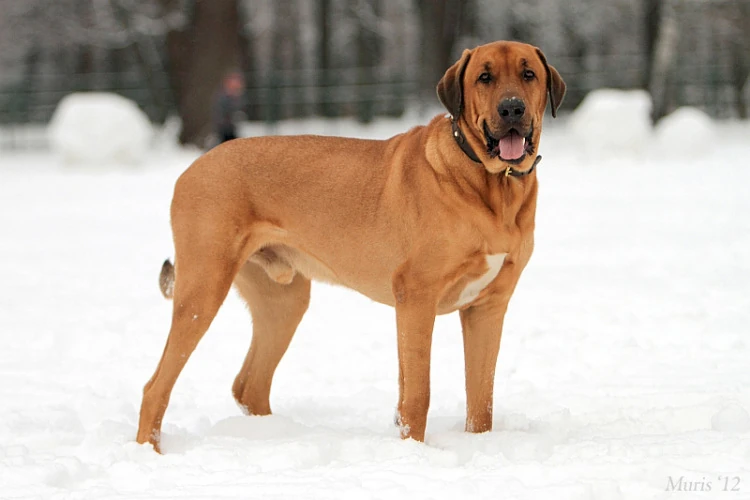
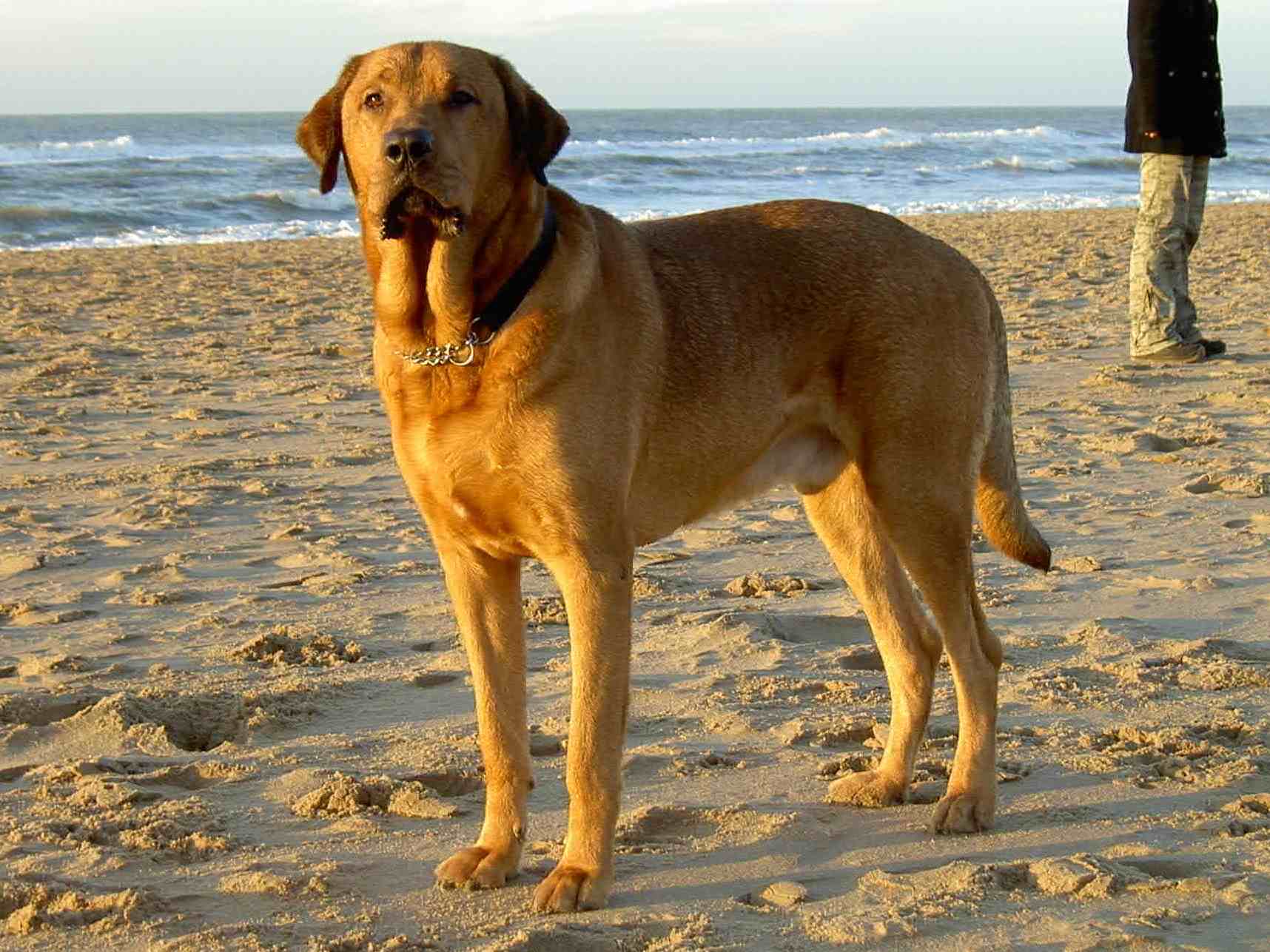
General appearance: a large mastiff-type dog of rectangular outline, powerfully built, with restrained and strong movement. The forehand defines the picture. The standard makes a specific demand for marked sexual dimorphism: a male must look distinctly male, a female distinctly female.
Proportion: the height from withers to elbow and from elbow to ground stand in a ratio of 1:1. Skull and muzzle are of equal length.
Head: fairly large and broad, giving a heavy impression. The skull is broad and rather flat; its upper line is parallel to the line of the muzzle and set slightly higher. The stop is not strongly pronounced.
Muzzle and jaws: a massive muzzle that looks short because of the heavy head; upper and lower jaws of equal length. Scissor or level bite. The nose is full and black.
Eyes: round, not too large, with close-fitting eyelids, from light to dark amber; the expression should convey great self-confidence.
Ears: medium-sized, set rather high, hanging close to the cheeks.
Body: straight topline, strong and clearly marked withers, a fairly long back, a croup of medium length and slightly sloping, a powerful, deep chest with a well-developed forechest. The neck is very strong, with some dewlap.
Tail: set on rather low, broad at the root, carried hanging and without a fringe; in movement it rises to the horizontal, preferably no higher.
Coat and skin: short and close-lying, with undercoat. The skin is well pigmented and thick, generally loose, especially on the neck.
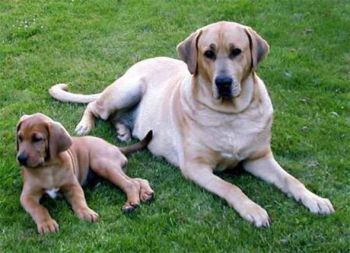
Colour: yellow with or without a black mask; red with or without a black mask; black. The mask must appear on the muzzle only. White markings on the chest, feet and tip of the tail are optional.
That last point is not a detail but a recent change. In the previous version of the standard yellow came specifically "with a black mask", and that is still how the colour paragraph looks in a great many descriptions of the breed. The reason for the change is a genetic study the club carried out itself, which we come to below.
Parameter · 6
Parameter
Value under FCI standard No. 315
Height at withers, male
about 75 cm
Height at withers, female
about 70 cm
Weight, male
50–70 kg
Weight, female
40–60 kg
FCI group
2, section 2.1 — molossoid, mastiff type; without working trial
Country of origin
Denmark
Height and weight are given in the standard separately for males and for females, and merging them into a single range is wrong — all the more so in a breed whose standard expressly demands marked sexual dimorphism. As for longevity, the FCI standard says nothing: breed standards have no such section at all. The one marker the club itself supplies is this — the owner receives the "veteran" questionnaire in the year the dog turns eight.
Among the disqualifying faults it is worth knowing the ones that actually turn up here: a nose of any colour other than black; overshot or undershot bite; eyes of different colours; erect ears; a tail curled over the back; incorrect colour; long coat; aggressive or excessively timid behaviour. Ordinary faults include, among others, rose ears, a hooked tail, a "sooty" cast to the coat, white markings anywhere other than the chest, feet and tip of the tail, and also pacing. A separate clause of the standard reminds breeders that only functionally and clinically healthy dogs of typical breed conformation should be used for breeding.
Character and Temperament
The standard describes the temperament in four words: calm, good-natured, friendly — and at the same time watchful. The order of the words matters, and the Danish Kennel Club puts it even more directly: the Broholmer is watchful and can carry itself with great self-assurance, but is generally friendly, towards strangers too. Suspicion of strangers, in other words, is not the breed norm — it is the thing to be told apart from the norm. Both aggression and excessive timidity are disqualifying in the breed.
Another widespread claim deserves to be turned on its head. The DKK does write about the need for clear leadership from the owner — and immediately gives the reason: because of the dog's size, not because of its temperament. That is a completely different instruction from "a firm hand for a dominant breed". The same passage goes on: the Broholmer co-operates willingly and can learn anything, provided the method rests on desire, kindness and trust.
The breed is attached to its own territory and is not inclined to wander without reason; it moves willingly, but usually at an unhurried pace. This is a patient companion that feels at ease when it can see the whole family at once — and therefore needs a close social life with people, not a kennel in the corner of the yard. In character it is more manageable and less given to independent decisions than the classic livestock guardians such as the Caucasian Shepherd Dog.
But here is an honest detail the club does not hide. The compulsory mental description (mentalbeskrivelse) has given the breed a profile built up over decades of observation, and comparing the average result with the ideal one shows two divergences: the breed has less curiosity than it should and more fear. The club states this outright as a breeding objective. Beyond that, certain lines are known in which related dogs behave restlessly, hyperactively and noisily and stress easily — and this is passed on to their offspring. In a dog of this weight such behaviour is unacceptable: within six months in 2017–2018 three young Broholmers were put down precisely because of behavioural problems. That is why the mental description in Denmark is not a formality but a breeding requirement: both parents must pass it after the age of 10 months.
This body of knowledge, incidentally, is thinning out, and the club regrets it. Before 2015 practically every Broholmer went through the mental description: in 2012, for instance, 125 descriptions for 140 puppies born. Since breeding was "let go", the description is mostly done by those planning a mating: 71 descriptions for 94 puppies in 2015, 66 for 148 in 2017. The compulsory health questionnaire that the dog's own vet used to fill in disappeared along with them. Today the club is trying to rebuild the picture through voluntary surveys, sent to owners who are club members three times in a dog's life: at 2 years, at 5 and at 8, when the dog is already counted a veteran.
Upbringing and Training
The Danish Kennel Club's practical instruction is short: train in varied ways, in short bursts, and reward generously. The Broholmer responds well to direction and keeps fairly close contact with its owner, so harshness is both unnecessary and harmful here — it destroys the very mechanism of trust on which everything rests. In this the Broholmer differs less from other molossers than from the myth about molossers: what it shares with the English Mastiff or the Great Dane is bulk and a slow pace of maturing, not a need for a "pack leader".
Early socialisation is critically important, and in this breed it carries a breeding significance as well. Introduce the puppy to different people, sounds, surfaces, places and calm dogs — precisely the range of situations the mental description will later test: contact, handling, play, surprise, sound, "ghosts", gunshot. The aim is not a "fearless guard" but a dog that, having been startled, has the courage to go and check what it was and can settle again quickly.
Pros and Cons of the Breed
Pros and Cons of the Breed · 6
Pros
Cons
Calm and level-headed: the standard demands exactly this temperament, and it is genuinely seen in the breed.
Needs space: not a flat dog; it needs a fenced plot.
Watchful without aggression: gives voice only when needed and is generally friendly to strangers.
Size dictates daily life: a car it fits into, a clinic prepared to work with that weight, and room in the house.
Strongly family-oriented: attached to its own territory and does not wander.
Drooling and seasonal shedding: as in most molossers.
Patient with children — provided the children are taught how to behave around a large dog.
Long maturing: up to 1.5–2 years the workload is strictly measured, and stairs are not for it.
Undemanding in grooming: short coat, regular brushing in spring and autumn.
A breed under reconstruction: a small gene pool, a limited choice of lines, a waiting list for a puppy.
Transparent health: HD, ED and cardiac statuses in this breed are public and checkable in the DKK database.
Not for those who do not check: the breed has lines with spondylosis, cryptorchidism and unsettled mentality.
Care and Maintenance
The ideal setting for a Broholmer is a house with a large, securely fenced plot. The breed likes being outdoors and copes well with the weather thanks to its dense coat with undercoat — but "outdoors" here means next to the family, not apart from it.
Coat: short and close-lying, with a thick undercoat. Shedding is noticeable in spring and autumn, so brush more often in those periods; a regular pass with a rubber brush is enough for the rest of the year.
Ears: inspect them regularly. This is not a formality: in the breed's health survey it was ear problems — redness, inflammation, fungus — that came top of owners' reports.
Eyes and eyelids: the standard requires close-fitting eyelids; any persistent watering or irritation is a reason to show the dog to a vet rather than to wipe it yourself for months on end.
Claws: trim them if they do not wear down on walks. In a heavy dog an overgrown claw quickly changes the way the foot is set down.
Exercise: a young dog is worked moderately. A very concrete piece of advice from the Danish Kennel Club: until the Broholmer has finished growing, a lot of going up and down stairs does it no good. An adult needs long daily walks at a calm pace, not sport.
Nutrition
Nutrition: Key Recommendations for a Giant
Health and risks
Colour: the Genetics the Club Worked Out for Itself
In 2013 the breeding council started a colour project to establish exactly which black lives in the Broholmer. The result was unexpected, and it has practical consequences for anyone looking at a litter.
Most of the breed is sable (Ay). That means yellow and red Broholmers are genetically identical despite looking very different: the shade is set by modifier genes, not all of which have been found. The club's practical conclusion is that two dark red dogs may perfectly well produce yellow puppies, and vice versa.
Recessive black (a) exists in the breed. This form of black is known in only a few dog breeds, so the finding came as a surprise to the club. In practice it means black puppies appear by two different routes: from a dominant black dog with any partner at all, and from a recessive black dog only if the partner also carries the allele.
The "sooty" cast is simply the tipping of sable dogs, that is, black hair tips. The standard treats it as a fault — while it follows from the basic genetics of most of the population.
Recessive red dogs produce no black pigment in the coat at all. The skin usually does produce it, so the nose and eyelid rims stay dark — but the club also records recessive red Broholmers with a red nose and light eyelids. The standard, meanwhile, disqualifies a nose of any colour other than black.
White markings have two origins: the ordinary kind, where the pigment simply "did not reach" the whole body, and the piebald gene, which behaves unpredictably — from normal markings to a white collar. Two copies of piebald give a spotted, "flowery" Broholmer.
Black-and-tan and long coat are still circulating in the breed. The last black-and-tan puppy was born in 2012. Long coat came to light in 2008, when one litter produced three long-coated puppies and a DNA test confirmed the parentage. Both traits are recessive: if both parents carry them, statistically a quarter of the litter will show them. Long coat is a disqualifying fault in the standard.
Brindle has not been detected in the Broholmer.
It was this project that produced the argument which eventually reached the standard: if yellow and red dogs are sable and take their colour from the same genetics, then the rule "only yellow may carry a mask" loses its sense. In the 2025 version the FCI made the mask optional for yellow and red alike.
Health and Common Diseases
Frequently Asked Questions (FAQ) · 6
Is the Broholmer suitable for an inexperienced owner? The real limit here is not character but mass. The Danish Kennel Club writes explicitly that clear leadership is needed because of the dog's size, not because of its temperament: the breed co-operates willingly and learns readily when the training is built on desire, kindness and trust. So the question is rather whether a person is ready to manage a dog approaching 70 kg in any situation out in the street.
Do Broholmers really have bad joints? The club sets this claim straight on its myths page. Every dog that goes into breeding is compulsorily radiographed for hips and elbows, and the club presses for whole litters to be screened, not only the breeding animals. On the ten-year cross-section: 83.6% of examined dogs had hips of grade A or B, and 92.7% elbows of grade 0 or 1. But the breed is large and heavy, so a puppy's joints need more care during growth than an average dog's.
How do Broholmers get on with other animals? With early and correct socialisation they live alongside other animals well, especially if they grew up together. Difficulties arise more often between adult males. Since the dog is strongly attached to its own territory and not inclined to roam, conflicts are usually tied to the house and the yard.
Do Broholmers shed a lot? The coat is short and dense, with a thick undercoat; noticeable shedding falls in spring and autumn, and more frequent brushing is needed in those periods. The breed requires no complicated grooming.
How hard is it to find a Broholmer puppy? Hard, and the reason is structural: there are about 1,200 living registered dogs in the world, annual registrations in Denmark stay somewhere around a hundred-odd puppies, and the stud book is closed — an influx of new blood is impossible. Every litter in Denmark receives its own number and a club certificate, so origins can be checked. The choice of lines is correspondingly limited, and the wait is usually long.
Can a Broholmer be kept on a chain? Categorically not. This is a social dog which, in the kennel club's description, needs a full social life in close contact with its family; it is at its best when it can see the whole household at once. Unlike breeds with less pronounced social needs, such as the English Bulldog, the Broholmer needs constant contact with people.
Video About the Breed
FAQ
Is the Broholmer aggressive?
No. The FCI standard describes the temperament as calm, good-natured and friendly — and at the same time watchful, while the Danish Kennel Club spells it out: generally friendly towards strangers too. Aggression and excessive timidity are disqualifying faults, and both parents must pass the compulsory mental description after the age of 10 months.
Is the Broholmer good for a family?
Very — a calm, devoted giant, patient with children who have been taught how to behave around a large dog. It needs a close social life with the family rather than a kennel in the corner of the yard: it is happiest when it can see the whole household at once. Space is still essential, so not for a flat.
How rare is the Broholmer?
Very. About 1,200 registered dogs are alive worldwide, and the studbook has been closed since 1998 — there is nowhere to take new blood from. Annual registrations in Denmark have stayed between 89 and 148 puppies, so the choice of lines is limited and the wait is usually long.