

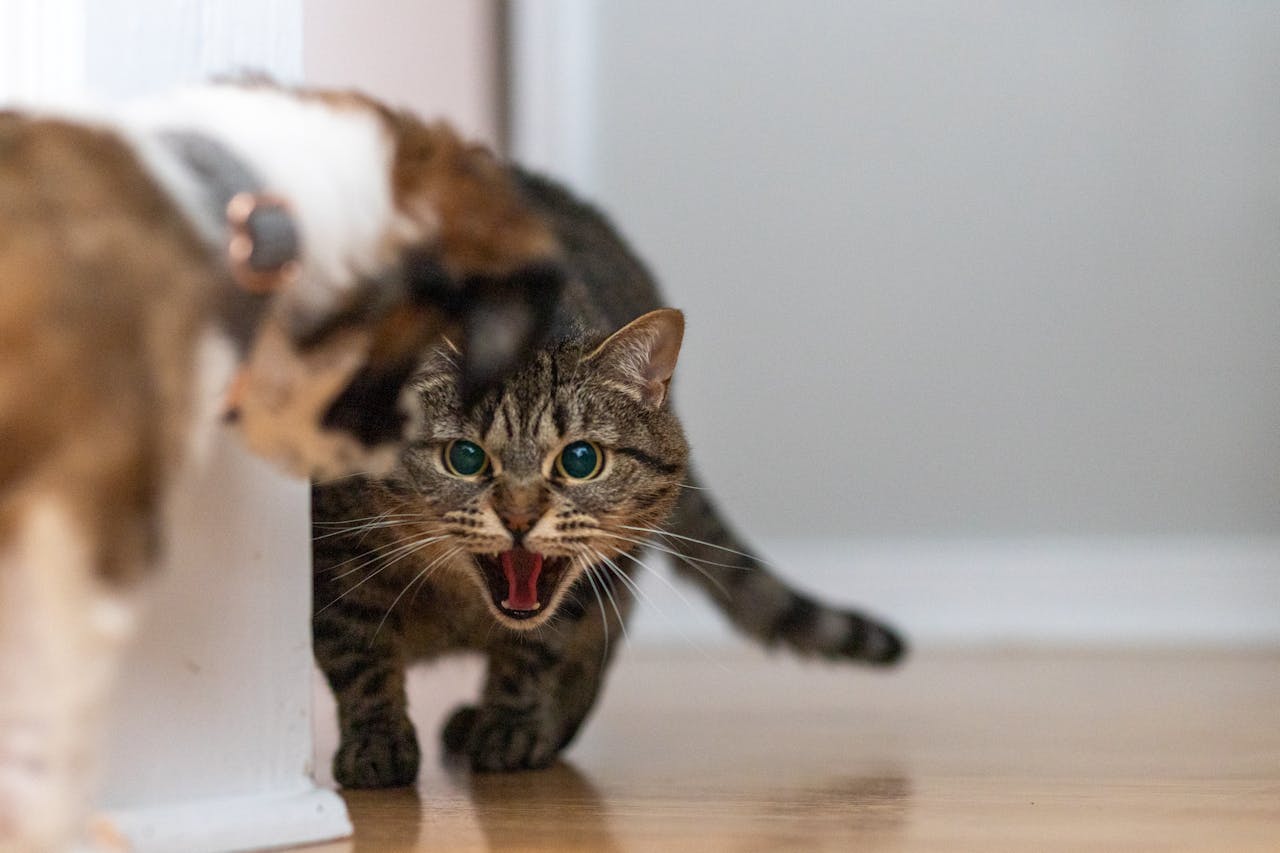
Aggressive behaviour in cats is one of the most common problems owners face; find out more on Tvaryny. Hissing, scratching, and biting can be directed towards people or other animals in the home. This not only creates a tense atmosphere but can also be dangerous. It’s important to understand that aggression isn’t a personality trait but rather a symptom indicating an underlying problem, whether it’s medical, behavioural, or environmental. Understanding the reasons for aggression is the first step towards resolving it and restoring harmony in your home.
In this article, we’ll take a closer look at the different types of feline aggression, its possible causes, and, most importantly, effective methods for correcting such behaviour. Remember, patience, consistency, and the right approach will help you understand your pet and build a trusting relationship with them.
What is Feline Aggression and Why Does It Occur?

Aggression in cats refers to any behaviour that involves a threat or attack: hissing, growling, arching the back, flattening the ears, dilated pupils, swatting (with or without claws), scratching, and biting. Cats use aggression as a form of communication, signalling fear, pain, territorial defence, frustration, or other states. To better interpret these signals, it’s helpful to explore cat body language: how to understand your pet’s mood and intentions.
It’s crucial to distinguish normal predatory behaviour (like hunting toys or insects) from problematic aggression directed at people or other pets. The key to resolving the issue is to identify the type of aggression and its root cause.
Types of Aggression in Cats
Understanding the different types of aggression will help you more accurately pinpoint the cause of your cat’s problem:
- Fear aggression (defensive): Occurs when a cat feels threatened and sees no way to escape. This can happen in unfamiliar surroundings, when meeting strangers or other animals, during a visit to the vet, or when the cat is cornered. Signs include flattened ears, dilated pupils, hissing, growling, attempts to hide, and attacking if approached.
- Territorial aggression: Cats are territorial animals. Aggression can arise when they defend their territory (home, garden) from “intruders” – other cats, dogs, or even people. It often manifests when a new pet is introduced to the home or after a move.
- Play aggression: Most common in young cats and kittens, particularly if they were separated from their mother and siblings too early, or if owners have used their hands or feet during play. The cat perceives hands/feet as prey and “hunts” them, leading to biting and scratching. This type of play can be quite painful.
- Redirected aggression: This happens when a cat is aroused by a stimulus (e.g., seeing another cat outside the window) but cannot reach it. Their frustration and aggression can then be “redirected” onto the nearest target – another animal or a person who happens to be nearby. This is one of the most unpredictable types of aggression.
- Petting-induced aggression: Some cats enjoy being stroked, but only up to a certain point. When the level of stimulation becomes excessive, the cat may suddenly bite or scratch to stop the contact. It’s important to learn to recognise your cat’s signals (skin twitching, tail lashing, flattened ears) that indicate they’ve had enough.
- Pain-induced aggression: A cat experiencing pain (from an injury, arthritis, dental issues, or internal diseases) may become aggressive, especially when the painful area is touched or when someone tries to pick them up. A sudden onset of aggression in a previously calm cat is a reason for an immediate visit to the vet.
- Maternal aggression: A mother cat may aggressively protect her kittens from any perceived threat, including people and other animals. This is instinctive behaviour.
- Idiopathic aggression: This is a diagnosis of exclusion, used when no medical or behavioural cause for the aggression can be identified. It is rare.
Main Causes of Aggressive Behaviour
As we can see, the reasons for aggression are varied:
- Medical problems: Pain (from arthritis, injuries, dental issues), hyperthyroidism, neurological disorders, cognitive dysfunction in older cats. Always rule out medical causes first!
- Fear and anxiety: New surroundings, loud noises, unfamiliar people or animals, negative past experiences.
- Resource and territory protection: Competition for food, water, resting places, litter trays, or an owner’s attention, especially in multi-pet households.
- Inadequate or improper socialisation: Kittens that haven’t had enough positive experiences with people and other animals at an early age (up to 7-9 weeks) may grow up to be fearful or aggressive.
- Frustration: The inability to carry out natural instincts (such as hunting or exploring territory), or restricted freedom.
- Inappropriate play habits: Using hands and feet to play with a kitten.
- Hormonal changes: In unneutered male cats and unspayed female cats.
How to Determine the Cause of Aggression

Before starting any corrective measures, it’s essential to understand what specifically provokes your cat’s aggression.
- Consult your vet: This is the first and most crucial step. The vet will conduct an examination and may recommend tests to rule out any medical problems that could be causing pain or behavioural changes.
- Observe your cat: Keep a diary to record episodes of aggression. Note down:
- What preceded the aggression? (Were you trying to stroke the cat? Did another animal come close? Did the cat see something outside the window?)
- Who was the aggression directed at? (You, another family member, another animal?)
- How exactly did the aggression manifest? (Hissing, scratching, biting?)
- The cat’s body language before, during, and after the incident? (Ears, tail, pupils, body posture).
- Where and when did it happen?
- Analyse the environment: Have there been any recent changes in your home? (A move, renovations, the arrival of a new person or animal, a change in your schedule).
Ways to Correct Aggressive Behaviour
After ruling out medical causes and identifying the likely type of aggression, you can begin behaviour modification. The main principles are safety, patience, and positive reinforcement.
1. Ensuring Safety and Managing the Environment
Avoid situations that provoke aggression. If your cat is aggressive towards guests, isolate them in a separate room during visits. If aggression occurs between cats, temporarily separate them, ensuring each has their own resources (bowls, litter trays, resting spots) in different parts of the house.
Create “safe zones” for your cat – places where they won’t be disturbed (high shelves, cat beds/dens, spots under the bed). Provide vertical space (shelves, cat trees) so your cat can observe their surroundings from a safe height.
Never physically punish your cat! This will only increase fear, anxiety, and aggression, and will damage the trust between you.
2. Behaviour Modification
The methods used will depend on the type of aggression:
- Play aggression:
- Never play with your cat using your hands or feet.
- Use fishing rod toys, laser pointers (always end the game with a “catch” of a physical toy or treat), balls, and toy mice.
- Provide regular, short (10-15 minute) interactive play sessions each day.
- If the cat attacks during play, make a loud noise (“Ouch!”) and immediately stop the game, ignoring the cat for a few minutes.
- Fear aggression:
- Don’t force contact with the cat. Allow them to approach you on their own terms.
- Use methods of desensitisation and counter-conditioning (DSCC). Gradually introduce the cat to the stimulus (person, other animal) at a safe distance where they remain calm. Reward calm behaviour with treats and praise. Slowly decrease the distance if the cat remains relaxed.
- Ensure the cat has escape routes and safe hiding places.
- Petting-induced aggression:
- Learn to recognise your cat’s body language (tail twitching, flattened ears, tense body, dilated pupils) and stop petting before these signs appear.
- Keep petting sessions short.
- Identify which areas your cat enjoys being petted (usually the head, neck, and back) and which to avoid (often the belly and base of the tail).
- Territorial aggression (especially between cats):
- If you’re introducing a new cat, do so gradually. Initially, keep them in separate rooms, allowing them to get used to each other’s scent (by swapping bedding or toys). Then, allow them to see each other through a glass door or a mesh screen. The next stage is short, supervised meetings in a neutral area, rewarding calm behaviour with treats.
- Ensure there are enough resources for all cats: multiple litter trays (rule of thumb: one per cat, plus one extra), food and water bowls, resting places, and scratching posts, all located in different areas.
- Use synthetic pheromone diffusers (such as Feliway Multicat), which can help reduce tension between cats.
- Redirected aggression:
- Identify and, if possible, eliminate the initial trigger (e.g., close curtains to prevent the cat from seeing a neighbour’s cat).
- Do not touch or try to calm an aroused cat – you could become the target of their aggression. Give them time to calm down in a quiet place.
3. Environmental Enrichment and Stress Reduction
Boredom and stress can contribute to aggression. Provide your cat with:
- Physical activity: Regular play sessions, access to cat trees and shelves.
- Mental stimulation: Puzzle toys, treat-dispensing toys, training simple commands using a clicker and positive reinforcement.
- A safe place to rest and observe.
- A stable daily routine: Feeding, play, and interaction at the same times each day.
- Use of pheromones: Diffusers or sprays with synthetic feline pheromones can help create a sense of calm and security.
4. Consulting a Specialist
If you cannot manage the aggression yourself, or if it is sudden, severe, or dangerous, do not hesitate to seek professional help. Your vet can refer you to a certified animal behaviourist or a veterinary behaviourist. A specialist can accurately diagnose the cause of the aggression, develop an individual correction plan, and, if necessary, recommend medication to reduce anxiety or aggression (prescribed only by a vet!).
Preventing Aggression

The best way to deal with aggression is to prevent it:
- Early socialisation: Ensure kittens have positive experiences with different people, sounds, and, if possible, friendly animals between the ages of 2 and 7-9 weeks.
- Proper handling: Teach children and adults how to interact correctly with a cat, respecting its personal space and recognising signs of discomfort.
- Appropriate play: From the beginning, use only toys for play, not hands or feet.
- Neutering/Spaying: This significantly reduces the risk of hormonally driven aggression (such as territorial or inter-male aggression).
- Meeting their needs: Provide your cat with enough physical and mental activity, and a safe, stimulating environment.
- Gradual introductions: When bringing a new animal into the home, always do so gradually and under supervision.
Conclusion
Aggression in cats is a complex issue, but in most cases, it can be resolved or significantly reduced. The key is to approach the problem with understanding, patience, and consistency. The first step should always be a visit to the vet to rule out medical causes. Observing your cat’s behaviour, identifying triggers, creating a safe and enriched environment, and using positive behaviour modification techniques will all help you improve your relationship with your pet. If you’re struggling to manage on your own, don’t be afraid to seek help from professionals. Your calm and happy cat is worth the effort.