Tvaryny ›
Dogs ›
Australian Stumpy Tail Cattle Dog
Group 1 · herding dogs · Australia
Australian Stumpy Tail Cattle Dog
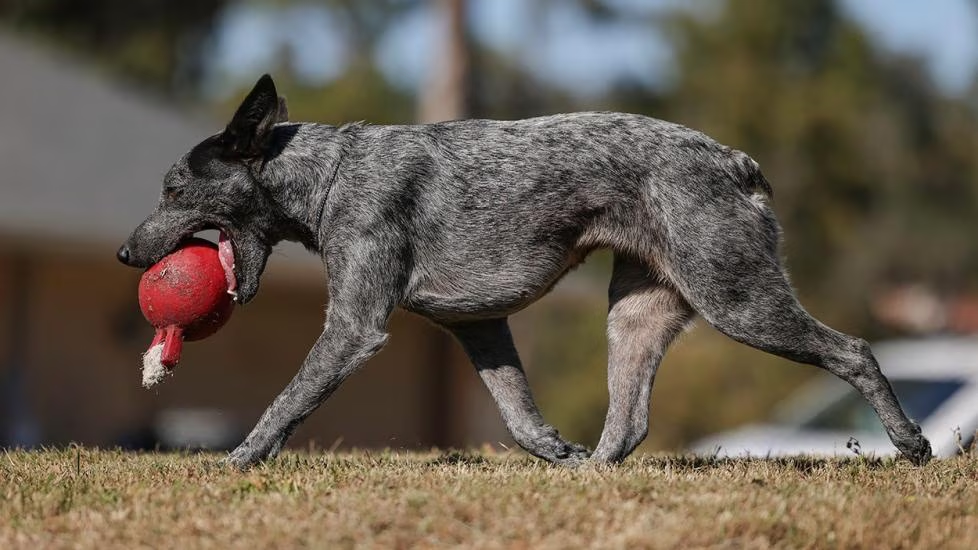
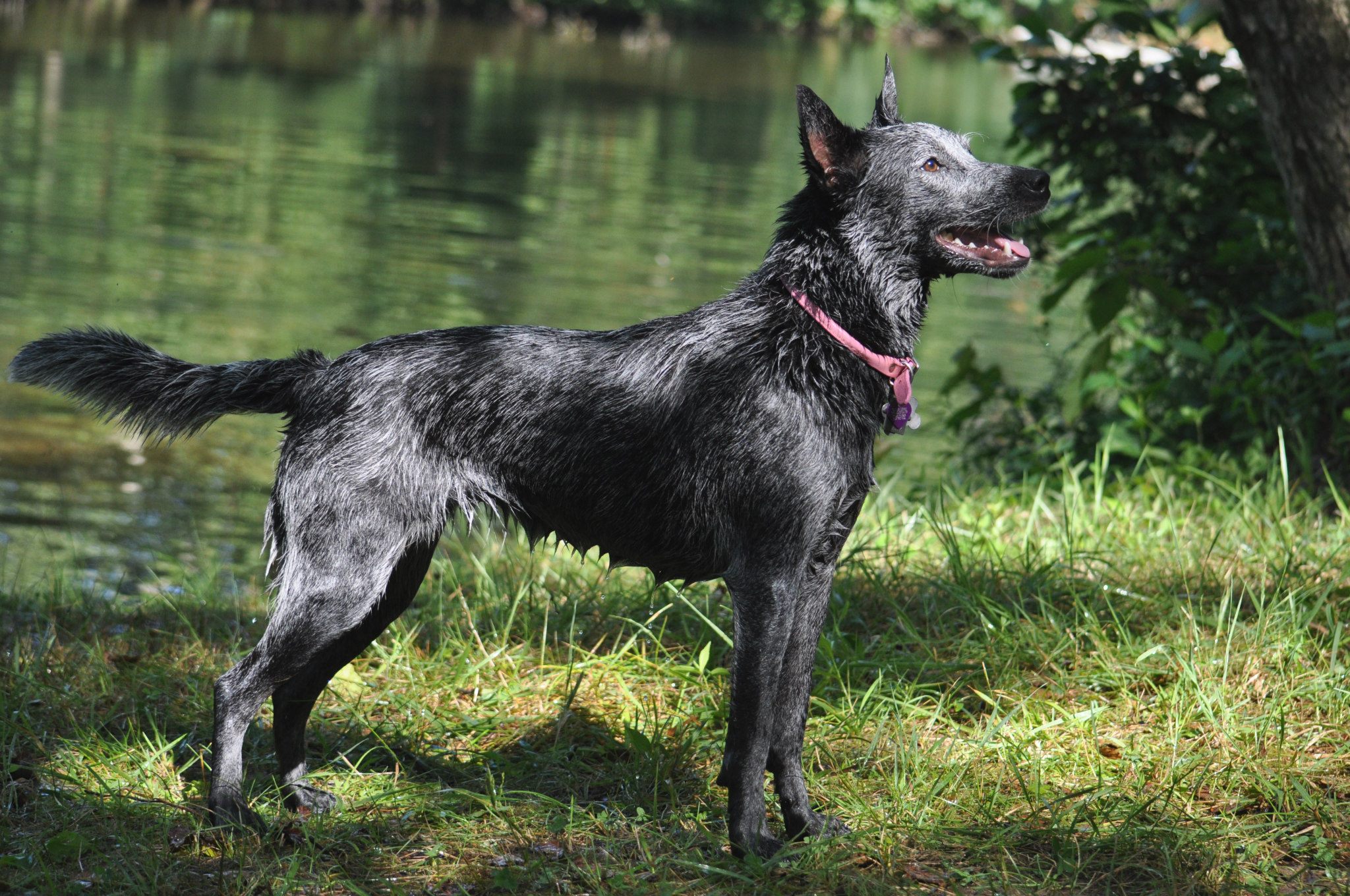
A tailless Australian pasture worker: hardy, brave, devoted and tireless. The Australian Stumpy Tail Cattle Dog is the older, "drier" relative of the Heeler with a natural bobtail; a working cattle dog for active owners that copes poorly with idleness.
Apartment · not suitableKids · with caveatsCats · with caveatsOther dogs · with caveatsBeginners · not suitable
The Australian Stumpy Tail Cattle Dog is a true unique in the canine world, a living symbol of the harsh and beautiful Australia. It is not just a dog, but a tireless "workhorse" with the blood of wild dingoes running through its veins, gifting it incredible stamina, sharp wit, and a specific temprament. The breed's main calling card is, of course, the natural absence of a long tail, which gave these animals their name. But appearance is merely the tip of the iceberg. Read more on Tvaryny.
These dogs are the embodiment of independence. They are categorically unsuitable for the role of a "sofa cushion" in a city flat. They need movement, challenges, and constant occupation. They are reliable protectors, distrustful of strangers, but limitlessly devoted to their owners. If you are looking for a partner for an active life, farming, or sport, the "Stumpy" (as they are affectionately called in their homeland) could be the ideal choice. In this article, we will break down all the nuances of the breed, from its history to creating the right diet.
Brief Overview of the Australian Stumpy Tail Cattle Dog
Brief Overview of the Australian Stumpy Tail Cattle Dog · 9
Breed Name
Australian Stumpy Tail Cattle Dog
Country of Origin
Australia
FCI Classification
Group 1 (Sheepdogs and Cattle Dogs), Section 2 (Cattle Dogs)
Year of Official Recognition
Provisional - 2001, Final - 2005
Life Span
12–15 years
Height (at withers)
Males: 46–51 cm; Females: 43–48 cm
Weight
16–23 kg
Coat Type
Short, double, harsh
Colour
Blue (solid or mottled), Red (mottled)
Interesting Facts About the Breed
This is the oldest registered dog breed developed in Australia.
Unlike many other breeds, they work silently, not barking at the cattle so as not to scare them unnecessarily, but only nipping disobedient animals.
Their stamina is legendary - they are capable of covering dozens of kilometres in heat of +40°C.
For a long time, the breed was simply called "Halls Heeler" in honour of Thomas Hall, one of the breed's creators.
History of the Breed: From "Timmins Biters" to Recognition
The history of this breed is shrouded in legend and tightly interwoven with the colonisation of Australia. In the early 19th century, farmers faced a serious problem: cattle had to be driven over huge distances through rough, wild terrain. Sheepdogs brought from England, unfortunately, could not withstand the Australian heat and the frantic workload. They were fine workers on the green pastures of Britain, but helpless in the bush. A new type of dog was needed - tough, resilient, and silent.
Timmins' Experiments
In the 1830s in New South Wales, a drover named Timmins began his experiments. He crossed imported short-haired collies (known as Smithfield dogs) with the local wild dingo. His goal was to get a dog that would work silently with the herd and possess the stamina of a wild beast. The result exceeded expectations physically but failed behaviorally. The resulting hybrids, named "Timmins Biters", were extremely hard-working but too aggressive - they often injured the cattle by biting them too hard.
Refining the Breed
To remove the excessive aggression but keep the working qualities, the blood of smooth-coated Blue Merle Collies was later added to the "Timmins Biters". This softened the character whilst preserving the unique ability to manage semi-wild cattle. It is important to understand that the Stumpy developed in parallel, but separately from the better-known Australian Cattle Dog (Australian Heeler). For a long time, these two lines were confused, but the "Stumpy" is the older lineage.
At the end of the 19th century, the breed was extremely popular, but by the 1980s it found itself on the verge of total extinction. Only thanks to an emergency programme by the Australian National Kennel Council (ANKC) was the population saved. Official international recognition from the FCI came quite late, which makes this breed still rare outside of Australia.
Appearance of the Australian Stumpy Tail Cattle Dog
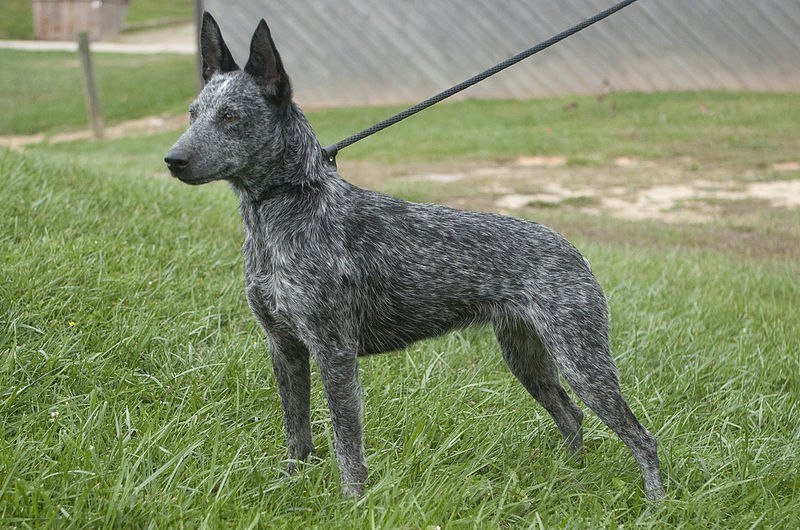
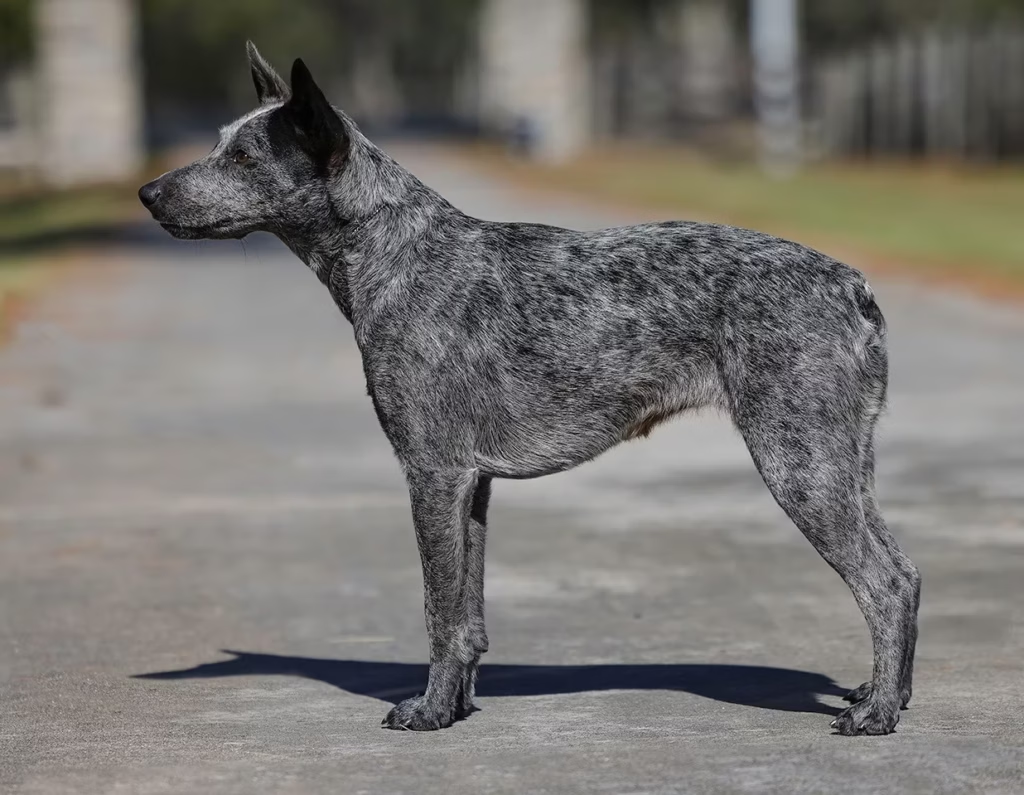
Outwardly, this is a perfectly balanced athlete. The dog has a square format - the length of the body from the point of the shoulder to the buttocks is approximately equal to the height at the withers. This distinguishes them from the ordinary Australian Cattle Dogs (Heelers), which are more rectangular and stretched.
Head and Muzzle
The skull is broad, flat between the ears, with a slight but noticeable transition to the muzzle (stop). The muzzle itself is powerful, blunt at the end, well-filled under the eyes - it is a tool with which the dog can fight back even against a bull. The jaws are strong, with a scissor bite. The ears are erect, of medium size, pointed, and set high. They are always on alert and move, catching the slightest rustle.
Body and Limbs
The neck is exceptionally strong, muscular, flowing smoothly into a deep chest. The ribs are moderately sprung. The back is straight, the loins broad and muscular, which ensures a powerful drive from the hind limbs. The paws are compact, tight ("cat's paws"), with thick pads, allowing them to run over rocks and thorns without injury.
Coat and Colour
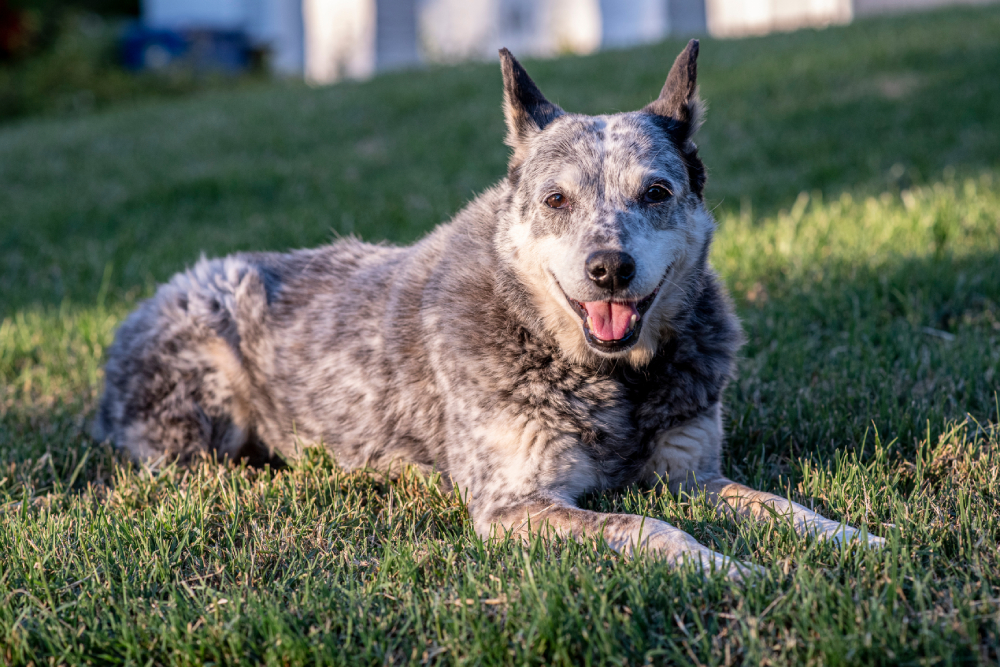
The "Stumpy's" coat is created for protection against bad weather. It is double: a short, dense, and soft undercoat is covered by a harsh, straight outer coat of medium length (2.5–4 cm). On the neck, the hair may form a small "ruff".
Colour Variants:
Blue: Solid blue or blue-mottled. There may be black markings on the head and body.
Red: Even red mottle all over the body (including the undercoat). There may be darker red patches on the head.
An important distinction from other breeds: the "Stumpy" lacks tan points. If you see reddish markings on a blue dog - it is most likely an Australian Cattle Dog (Heeler), and not a Stumpy Tail.
The Australian Stumpy Tail Cattle Dog is a creature of incredible intelligence and a complex character. It is a one-person dog. They choose "their" human and follow them everywhere like a shadow. If you go to the bathroom, the "Stumpy" will wait by the door. If you work in the field, he will be by your leg.
Working Instinct: It is so strong that the dog may try to "herd" everything that moves: children, cars, other animals, joggers. This manifests in the characteristic nipping at the heels (heeling). This behaviour needs to be corrected from childhood.
Distrust: They are natural-born guards. They will not joyfully jump onto a stranger's chest. They treat outsiders suspiciously, coldly, assessing the threat level. However, unprovoked aggression is not the norm for the breed.
Energy: This isn't just an active dog, it is a perpetual motion machine. If you don't give him a job, he will find one himself: dismantling the sofa, digging a hole in the garden, or barking at the wind.
Interestingly, in relationships with children, "Stumpys" often take on the role of a guardian. They can be patient, but it is important to remember the herding instinct - the dog might "nip" a child who runs too fast, trying to return them "to the flock".
If, however, you are interested in other types of herding dogs, less focused on the harsh control of cattle, take a look at the Finnish Lapphund or the energetic Swedish Vallhund (Västgötaspets).
Pros and Cons of the Breed
PROS (+)
CONS (-)
Incredible devotion to the owner.
Requires a huge amount of physical activity (not for the lazy).
High intelligence, learns quickly.
Tendency to "herd" children and vehicles (heel nipping).
Robust health, stamina.
Can be aggressive towards other dogs (dominance).
Easy coat care (requires almost no grooming).
Heavy shedding 1–2 times a year.
Excellent territory guard.
Does not tolerate loneliness and boredom (can destroy the house).
Training and Upbringing: Who Wins?
Training a "Stumpy" is a challenge. They are incredibly clever and often try to outsmart the owner. If you show weakness, the dog will instantly walk all over you. One can safely say that this is a battle of wits.
Early Socialisation: Critically important. From 2–3 months, the puppy needs to be introduced to different people, sounds, and dogs to reduce natural distrust.
Positive Reinforcement: Harsh methods do not work - the dog will shut down or become aggressive. Use food and play as motivation.
"Nipping" Control: As soon as the puppy tries to grab your heel - stop the game. He must understand that "herding" people is forbidden.
Maintenance and Care
Physical Activity
This is the most important aspect. A simple walk on a lead around the block is nothing for a Stumpy Tail Cattle Dog. They need running, frisbee, agility, coursing, or real work with livestock. Minimum 2–3 hours of active engagement daily. If you live in a flat, be prepared to spend all your free time in the park.
Hygiene
Everything is simple here. The coat is "self-cleaning" - mud dries and falls off by itself.
Recommendations:
Bathing: Only when absolutely necessary. Frequent washing strips away the protective oily layer.
Brushing: Once a week with a stiff brush. During moulting periods (spring/autumn) - daily, using a furminator or slicker brush.
Claws: Due to high activity, they often wear down themselves, but check them once a month.
Teeth: Cleaning 2–3 times a week with special dog toothpaste.
Nutrition
Diet: Fuel for an Energetic Machine
Health and risks
Genetics of the Stumpy Tail: Why Do They Have No Tail?
The breed's name points directly to its main anatomical feature. Most puppies are born with a natural short tail (bobtail), the length of which does not exceed 10 cm. This is not the result of docking, but the work of the dominant gene T-box mutation (C189G). However, genetics is a delicate matter:
Some puppies in a litter may be born with long tails (if they did not inherit the mutation gene). Such dogs are not admitted to shows but make wonderful pets.
The stumpy-tail gene in a homozygous state (when the embryo receives the gene from both parents) is lethal - such embryos die in the womb. Therefore, all living stumpy-tailed dogs are heterozygous for this trait.
Health and Typical Diseases
Frequently Asked Questions (FAQ) · 4
Is this breed suitable for a family with children? Yes, if the dog grew up with children. But due to the herding instinct, the dog may knock little ones over or nip them. Supervision is required.
Do they shed a lot? Yes, especially during seasonal moulting. The rest of the time - moderately. The coat is harsh and can get stuck in furniture.
Can they live outside in winter? They have a dense undercoat and tolerate moderate cold well, but in severe frosts, it is better to take the dog into a warm room or provide an insulated kennel. However, the best place for them is beside the owner.
How to distinguish a docked puppy from a naturally stumpy one? Only by touch (a docked tail has a scar) or via an X-ray. A natural stumpy tail has a specific structure of the vertebrae.
Video About the Breed
FAQ
How does the Stumpy Tail differ from the Australian Heeler?
It is an older, lighter and "drier" breed with a NATURAL bobtail (not docked); the temperament is just as workmanlike and hardy, but it is rarer.
Is the breed suitable for a novice?
No — it is an intense cattle dog with a great need for exercise and work; it takes experience and an active lifestyle.
Why does the breed have a short tail?
It is a natural breed trait — puppies are born with a bobtail; it is not docking.