Group 1 · sheepdogs and cattle dogs · Slovakia (mountainous regions)
Slovak Cuvac
A snow-white Slovak mountain guardian — stately and fearless: devoted, calm, strong and a reliable protector of its “pack”. The Slovak Cuvac is a powerful white pastoral guardian that watched over flocks and homesteads in the mountains of Slovakia for centuries; it is equally warm to all family members but distrustful of strangers, and because of its strength and independence it needs space and firm training.
Apartment · not suitableKidsCats · with caveatsOther dogs · with caveatsBeginners · not suitable
The Slovak Cuvac (Slovenský čuvač) is a majestic, snow-white pastoral working dog that has guarded flocks and homesteads in the mountainous regions of Slovakia for centuries. This superb guard dog makes an ideal companion for life in a country house with a spacious garden. The Slovak Cuvac is a very large and powerful dog, wonderfully suited to family life and accepting of all its members with equal warmth. However, due to its independent nature and physical strength, its upbringing and training must be handled by an experienced owner who can establish authority and provide consistent instruction. The Cuvac will become an unparalleled guardian, vigilantly protecting its territory and family around the clock. Read more on Tvaryny.
Slovak Cuvac: A Brief Breed Overview
Slovak Cuvac: A Brief Breed Overview · 8
Characteristic
Details
Original Name
Slovenský čuvač
Origin
Slovakia (mountainous regions)
Year of FCI Recognition
1965 (Standard No. 142)
Lifespan
11–13 years
Height at withers
Dogs: 62–70 cm, Bitches: 59–65 cm
Weight
Dogs: 36–44 kg, Bitches: 31–37 kg
Colour
Pure white (a yellowish tinge on the ears is permissible, but not desirable)
Use
Shepherd, Guard Dog, Companion
Interesting Facts About the Slovak Cuvac
White for Visibility: Traditionally, Slovak Cuvacs were bred only in white so that shepherds could easily distinguish them from wolves and other predators, especially at night or at dusk.
A Near-Extinct Breed: After the Second World War, the Slovak Cuvac population declined significantly, and the breed was on the verge of extinction. Its revival was made possible by the efforts of Slovak and Czech cynologists.
Mountain Rescue: Thanks to their endurance, strength, and sense of smell, Slovak Cuvacs were sometimes used in mountain search and rescue operations.
National Treasure: In Slovakia, this breed is considered a national treasure and part of the country's cultural heritage.
"Čuvač" Means "to Hear" or "to Guard": The breed's name, "čuvač," comes from a Slovak word meaning "to hear" or "to watch over," "to guard," which perfectly describes their vigilance and guarding qualities.
Relatives from Other Countries: The Slovak Cuvac belongs to the group of large, white, mountain pastoral dogs found in various regions of Europe. Its close relatives include the Hungarian Kuvasz, the Polish Tatra Sheepdog, the Maremma-Abruzzese Sheepdog, and the Pyrenean Mountain Dog. All these breeds share common ancestors and similar traits.
Defence Against Large Predators: Historically, these dogs were brave and strong enough to confront large predators like bears and wolves to protect their flocks.
A Detailed History of the Slovak Cuvac
The history of the Slovak Cuvac dates back centuries, to a time when unique pastoral dog breeds were being developed in the mountain pastures of modern-day Slovakia. It is believed that its ancestors were Arctic wolves, from which it inherited its thick white coat and endurance. The first written records of white mountain dogs in this region date back to the 17th century. These dogs were indispensable helpers to shepherds, guarding flocks of sheep, cattle, and even turkeys from predators such as wolves and bears. The white colouring was not accidental—it made it easy to distinguish the dog from a wild animal at dusk or during the night.
The Slovak highlanders, who were predominantly free people, also used these dogs to guard their homes and property. Their organisation, known as the "Walachian Union," highly valued the loyalty and courage of these dogs. Over the centuries, the Slovak Cuvac adapted to the harsh climatic conditions of the Slovak mountains, particularly the Tatras, which made it exceptionally hardy and unpretentious.
Unfortunately, after the First and Second World Wars, the breed was on the brink of extinction. A decline in the wolf population and changes in farming practices led to a reduced need for such large pastoral dogs. However, thanks to the efforts of enthusiasts, particularly the cynologist Dr Antonín Hrůza from the veterinary faculty in Brno, the breed was successfully revived. The date considered to be the start of registered breeding of the Slovak Cuvac in what was then Czechoslovakia is 4th June 1929. The breeders' club was established in 1933. The breeding stock came mainly from the areas of Liptovská Lúžna, Kokava, and Východná in northern Slovakia, as well as Rakhiv in the Eastern Carpathians (modern-day Ukraine). The Fédération Cynologique Internationale (FCI) officially registered the breed in 1965 under number 142.
Today, although the Slovak Cuvac is not a particularly common breed outside its homeland, it has won admirers for its striking appearance, devotion, and excellent guarding qualities. It is part of the group of white pastoral dogs, which also includes, for example, the Hungarian Kuvasz, the Maremma-Abruzzese Sheepdog, and the Polish Tatra Sheepdog, with which it is sometimes compared.
What Does a Slovak Cuvac Look Like: Appearance and Breed Standard
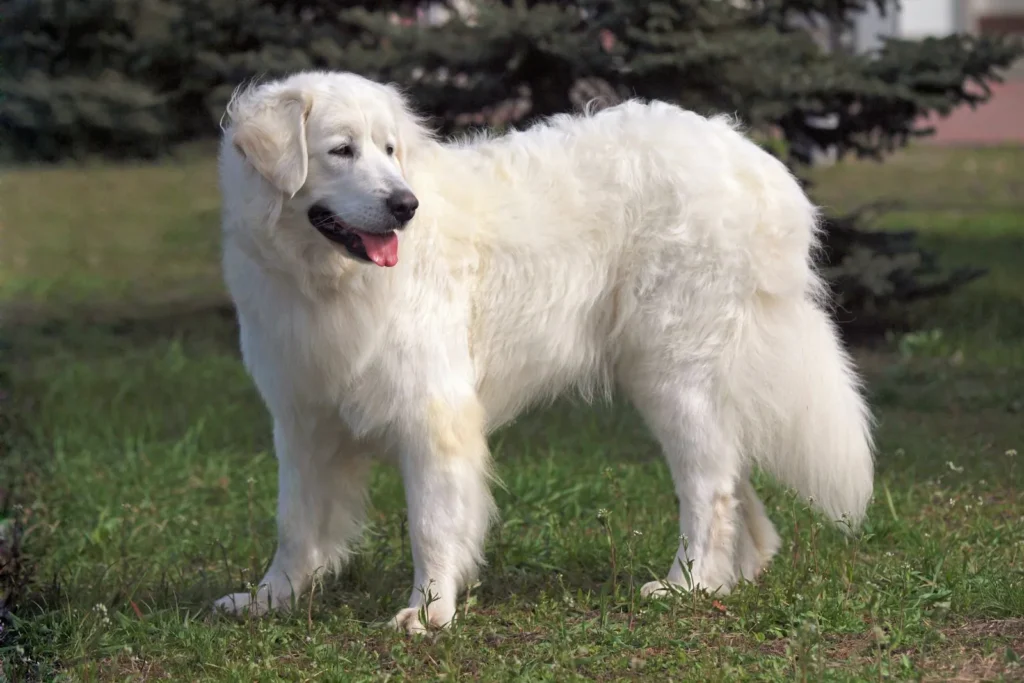
The Slovak Cuvac is a large dog of strong build, but without excessive bulk, with a striking appearance and a thick white coat. It has a rectangular body format, meaning the length of the body is slightly greater than the height at the withers.
Head: Proportional to the body, wolf-like in shape. The skull is broad between the ears, flat on top, with a shallow furrow on the forehead and a moderate stop (the transition from forehead to muzzle). The muzzle is approximately the same length as the skull, with a straight bridge, quite broad at the base, and tapering towards the nose, but not pointed. The lips are dry, tight-fitting, and black.
Eyes: Oval-shaped, dark brown, expressive, with a lively and alert gaze. The eyelids are black. Yellow eyes are a fault.
Ears: Set high, mobile at the base, hanging close to the head. They have a rounded lower edge and, when relaxed, reach the corners of the mouth.
Nose: The nose leather is black. It may lighten slightly in winter (a so-called "snow nose"), but this is not a serious fault.
Bite: A scissor bite with a full set of teeth. The teeth are strong, white, and evenly set.
Neck: Powerful and set high, especially when the dog is alert. No dewlap.
Body: The back is straight and strong. The loin is moderately long and firm. The croup is slightly sloping. The chest is broad and deep, reaching the elbows, with well-sprung ribs. The abdomen and flank are moderately tucked up.
Tail: Set low, hanging down to the hocks when relaxed, and thickly coated. When the dog is excited or moving, the tail may be carried higher, but it does not curl over the back in a ring.
Limbs: The forelegs are straight and parallel, with strong bone and well-developed musculature. The shoulder blades are long and sloping. The shoulders are muscular. The elbows are close to the chest. The pasterns are short, strong, and slightly sloping. The hind legs are strong and muscular with well-defined angles. The thighs are broad and muscular. The lower thighs are sloping and strong. The hocks are strong and set low. The metatarsus is short, strong, and vertical. The paws are compact and oval, with tightly-knit toes and strong black pads and nails.
Coat: Thick and double. The outer coat is long (5–15 cm), straight or slightly wavy, and quite coarse to the touch. It forms a distinct "mane" around the neck, especially in male dogs. The undercoat is soft, dense, and shorter than the outer coat (about half to two-thirds of its length). The coat should not form a parting on the back.
Colour: Pure white. A slight yellowish tinge on the ears is permissible but not desirable. Any patches of another colour are a disqualifying fault.
The Slovak Cuvac's Character: Temperament and Behaviour
The Slovak Cuvac is a dog with a strong, balanced, and fearless character. It is boundlessly devoted to its family and territory, always ready to defend them. This is a natural-born guardian, vigilant and attentive to everything happening around it.
Key Character Traits:
Devotion: The Cuvac becomes deeply attached to its owners and is prepared to give its life for them. It is good with all family members, including children, with whom it can be gentle and patient if properly socialised. However, due to its large size, playtime with very young children should always be supervised by an adult.
Fearlessness and Vigilance: Members of this breed are distinguished by their courage and bravery. They are capable of engaging any wild animal, even a bear or a wolf, without hesitation to protect their territory or flock. It is wary and distrustful of strangers but without unprovoked aggression. It announces its presence or the approach of strangers with a loud bark.
Independence and Intelligence: Like many pastoral breeds, the Slovak Cuvac has a degree of independence and is capable of making its own decisions, especially in extreme situations. It is an intelligent dog that learns quickly but can show stubbornness if the training methods are not suitable or if it does not see its owner as a leader.
Territorial Nature: It has a highly developed instinct to guard its territory. It is important to introduce the puppy to different people and situations from an early age to avoid excessive suspicion.
Attitude Towards Other Animals: If a Slovak Cuvac has grown up with other pets (cats, other dogs), it usually gets along well with them. However, it can be wary or even dominant towards unfamiliar dogs, especially those of the same sex. Due to its hunting instincts, small animals (rodents, birds) may be seen as prey, so keeping them together requires caution and control. Like the Austrian Pinscher, some may have a tendency to chase smaller animals.
The Slovak Cuvac is not a dog for an inexperienced owner. It needs a confident, calm, and consistent owner who can become an authority figure for it. With the right upbringing and sufficient physical exercise, the Cuvac becomes a wonderful companion and a reliable protector.
Training and Socialising Your Slovak Cuvac
Training and socialising a Slovak Cuvac are key aspects of raising an obedient, balanced, and safe companion. This breed is intelligent and capable of learning, but its independent nature and innate guarding instincts require a special approach.
Key Points for Training:
Early Start: Begin socialisation and basic training as early as possible, literally from the first few days the puppy is in your home.
Positive Reinforcement: The Slovak Cuvac responds best to training methods based on positive reinforcement – praise, treats, and toys. Harshness, shouting, or physical punishment can lead to stubbornness, mistrust, or even aggression.
Consistency and Patience: Be consistent in your demands and be patient. Members of this breed, like many other large pastoral breeds, such as the Long-Haired Pyrenean Sheepdog, they can sometimes be stubborn. Do not give up, but do not apply excessive pressure either.
Establishing Leadership: The owner must become an undisputed but fair leader for the Cuvac. This is achieved not through force, but through confidence, calmness, and consistency.
Short and Interesting Sessions: To keep the dog's interest, training sessions should be short, varied, and engaging.
Diverse Experiences: Introduce the puppy to different people (adults, children), other dogs (of various breeds and sizes), sounds, places, and situations. This will help it grow into a confident dog that reacts appropriately to new stimuli.
Controlled Interactions: All interactions, especially with other dogs, should be positive and controlled.
Avoiding Isolation: Do not keep your Slovak Cuvac in isolation. It needs interaction with its family and the outside world.
The Slovak Cuvac is not a dog that will blindly follow every command. It is a thinking, sometimes stubborn dog, but with the right approach, you will have a devoted, obedient, and brave protector. It is essential to provide it with enough space to move and regular, long walks with the opportunity to run over long distances. Physical exercise and mental stimulation are the keys to happiness and good behaviour for this dog.
Pros and Cons of the Slovak Cuvac Breed
Like any breed, the Slovak Cuvac has its advantages and disadvantages, which prospective owners should consider before getting such a dog.
Pros and Cons of the Slovak Cuvac Breed · 8
Pros
Cons
Excellent Guardian: Its natural guarding instinct makes it a reliable protector of family and property.
Requires an Experienced Owner: Not suitable for novices due to its independent nature and size.
Devoted Companion: Forms a deep bond with its family.
Prone to Dominance: May try to establish its own rules if it doesn't sense the owner's authority.
Striking Appearance: A beautiful dog with a thick white coat.
Needs a Lot of Space and Exercise: Not suitable for flat-living or for sedentary people.
Hardy and Adaptable to Climate: Tolerates various weather conditions well thanks to its coat.
Heavy Shedding: Hair will be everywhere, especially during seasonal sheds.
Intelligent and Trainable: Learns commands well with the right approach.
Can be Stubborn: Sometimes shows independence in decision-making.
Good with Children in its Family: With proper socialisation, can be a patient friend to children.
Wary of Strangers: Can be overly suspicious if not properly socialised. May bark loudly.
Generally Robust Health: Rarely gets ill with proper care and nutrition.
Potential health problems common to large breeds: (e.g., joint dysplasia).
Historically a Working Dog: Has strong pastoral and guarding instincts.
May Chase Small Animals: If not trained from a young age.
Carefully weighing all the pros and cons will help you make an informed decision and understand whether the Slovak Cuvac is the right pet for you.
Grooming Your Slovak Cuvac's Coat
The thick white coat of the Slovak Cuvac is one of its most defining features, but it requires regular grooming to stay clean and healthy. Although the breed does not need complex grooming, certain procedures are essential.
Brushing: The coat should be thoroughly brushed at least 1–2 times a week, and more frequently during shedding seasons (usually spring and autumn), possibly daily. This will help to remove the dead undercoat, prevent mats from forming, and keep the skin healthy. A comb with wide teeth and a slicker brush are suitable for the job.
Bathing: A Slovak Cuvac should only be bathed when absolutely necessary, as frequent washing can strip the skin's natural oils that protect it from adverse weather. Use special shampoos for white dogs or for dogs with sensitive skin. The coat must be dried thoroughly after a bath.
Ear Care: Regularly check the ears for dirt, redness, or an unpleasant smell. Clean the ears with special lotions as needed.
Eye Care: Check the eyes daily. Minor discharge can be gently removed with a soft cloth dampened with warm water or a special lotion. A chamomile infusion can also be used for wiping the eyes, as mentioned in the original text.
Nail Trimming: Trim the nails about once a month, or as needed if they do not wear down naturally during walks. Use nail clippers designed for large breeds.
Dental Care: Regular brushing with a special dog toothbrush and toothpaste will help prevent tartar buildup and gum disease.
The Slovak Cuvac sheds quite heavily, especially seasonally. Be prepared for white hair to be a feature in your home. Regular brushing will significantly reduce the amount of hair on furniture and clothing. Coat care not only maintains the dog's neat appearance but is also an important part of its healthcare.
Nutrition
Feeding Your Slovak Cuvac: Key Recommendations
Health and risks
Slovak Cuvac Health: Common Conditions and Prevention
Frequently Asked Questions About the Slovak Cuvac (FAQ) · 7
Is the Slovak Cuvac suitable for living in a flat? No, the Slovak Cuvac is a large and energetic dog that needs space. The ideal home for it is a private house with a large, well-fenced garden where it can move freely and perform its guarding duties.
Does the Slovak Cuvac shed a lot? Yes, the Slovak Cuvac sheds quite heavily, especially twice a year during seasonal moults. Regular brushing will help to control the amount of hair in the house.
Is the Slovak Cuvac easy to train? The Slovak Cuvac is intelligent but can be stubborn and independent. It requires an experienced owner who can establish authority and use consistent, positive reinforcement-based training methods. This breed can be challenging for novice owners to train.
How does the Slovak Cuvac get on with children? With proper socialisation and the right upbringing, the Slovak Cuvac usually gets along well with children from its own family and can be patient and gentle. However, due to the dog's large size, playtime with very young children should always be supervised by an adult.
Is the Slovak Cuvac noisy? Yes, the Slovak Cuvac can be quite vocal. It has a strong guarding instinct and is prone to barking loudly to announce the approach of strangers or any unusual sounds. This should be taken into account, especially if you have sensitive neighbours.
Does the Slovak Cuvac need a lot of physical exercise? Yes, this is an active breed that requires daily long walks, the opportunity to run freely, and physical exercise to maintain good physical and mental health. A lack of exercise can lead to behavioural problems.
What is the lifespan of a Slovak Cuvac? The average lifespan of a Slovak Cuvac is 11–13 years.
Video of the Slovak Cuvac
FAQ
What was the Slovak Cuvac bred for?
An ancient white pastoral guardian that watched over flocks and homesteads in the mountains of Slovakia against predators and thieves for centuries; the white coat helped tell it from a predator at night.
Is the Slovak Cuvac good for a family?
Yes — it is equally warm to all family members and good with children; but because of its strength, independence and distrust of strangers, space, firm training and early socialisation are needed.
Is the breed suited to a flat?
No — a large mountain guardian that needs space and a yard; ideally a country house with a spacious plot.