Group 1 · sheepdogs and cattle dogs · Poland (Tatra)
Tatra Shepherd Dog
A stately white guardian of the Tatras — calm and independent: devoted to its family, fearless against predators, level-headed and clever. The Polish Tatra Sheepdog (Podhale) is a national treasure of Poland, a white mountain flock guardian that protected herds from wolves and bears for centuries; level-headed and devoted, but self-reliant and territorial, so it needs space and an experienced owner.
Apartment · not suitableKidsCats · with caveatsOther dogs · with caveatsBeginners · not suitable
The Tatra Shepherd Dog(Polish Polski Owczarek Podhalański) is not just a stunningly beautiful large white dog, but a true national treasure of Poland. This majestic breed, hailing from the mountainous Tatra region, has for centuries served as a reliable guardian of flocks against predators and a faithful companion to shepherds. Today, thanks to its level-headed character, intelligence, and devotion to its family, the Tatra Sheepdog is gaining increasing popularity worldwide as a family dog and guardian. This detailed overview will help you gain a deeper understanding of this unique breed. Learn more on Tvaryny.
Strong, courageous, and yet remarkably gentle with their "pack," Tatra Sheepdogs are truly versatile animals. They are not only peerless guardians, capable of fearlessly confronting wolves or even bears to protect their territory, but also wonderful companions. A unique feature of the breed is its use in canistherapy (animal-assisted therapy), where interacting with these dogs has a positive therapeutic effect on children and adults, much like dolphins or horses.
Quick Breed Info
Quick Breed Info · 9
Breed Name
Polish Tatra Sheepdog (Polski Owczarek Podhalański), Tatra Shepherd Dog
Country of Origin
Poland (Tatra Mountains)
FCI Classification
Group 1 (Sheepdogs and Cattle Dogs), Section 1 (Sheepdogs). Standard No. 252.
Height (at the withers)
Dogs: 65–70 cm; Bitches: 60–65 cm
Weight
Dogs: 50–65 kg; Bitches: 45–55 kg
Lifespan
10–12 years
Colour
Exclusively pure white. Any patches or cream-coloured markings are a fault.
Temperament
Calm, level-headed, vigilant, brave, devoted to family, wary of strangers.
Therapy Dog: Thanks to their calm character and patience, Podhalans are successfully used in canistherapy for work with children with special needs and the elderly.
"White Teddy Bear": In Poland, these dogs are often affectionately called "białe misie" (white teddy bears) because of their thick white coat and large size.
Self-Cleaning Coat: The unique structure of the coat repels dirt and water, allowing the dog to stay clean for a long time, even when working outdoors.
Rescue Service: Their keen sense of smell and endurance allow these dogs to be used for finding people under snow avalanches or in rubble.
Police Service: In some countries, particularly the USA, Podhalans have been used as police dogs due to their intelligence and ability to remain calm in stressful situations.
History and Origin of the Polish Tatra Sheepdog
The history of the Polish Tatra Sheepdog is inextricably linked with the Tatra Mountains and the nomadic shepherd tribes. It is believed that the ancestors of these white giants arrived in the territory of modern-day Poland with Vlach shepherds who migrated across the Carpathians in the 14th-15th centuries. These dogs, which accompanied the flocks, were indispensable helpers: they not only protected livestock from numerous predators but also helped to manage the herds on the mountain pastures. The harsh mountain conditions, where only the strongest, most resilient, and most intelligent individuals survived, shaped the unique phenotype and character of the breed.
Isolation in the Podhale mountain region helped to preserve the purity of the breed. For centuries, the Tatra Sheepdog was known mainly to local inhabitants. The first official mention of the "mountain dog" appeared in a German journal only in 1938. The Second World War dealt a devastating blow to the population, pushing the breed to the brink of extinction. However, thanks to the efforts of Polish enthusiasts and cynologists, the breed was successfully restored. In 1973, the Fédération Cynologique Internationale (FCI) officially approved the breed standard under number 252, marking the international recognition of this unique dog.
Interestingly, the Polish Tatra Sheepdog is a close relative of other large, white pastoral dogs in Europe. They all share common ancestors and developed in similar conditions, which explains their physical resemblance. This group includes the Hungarian Kuvasz, the Slovak Cuvac, and the Italian Maremma Sheepdog, as well as the Pyrenean Mountain Dog. Despite their similarities, each of these breeds has its own unique character and appearance.
Breed Standard and Appearance: The White Giant of the Tatras
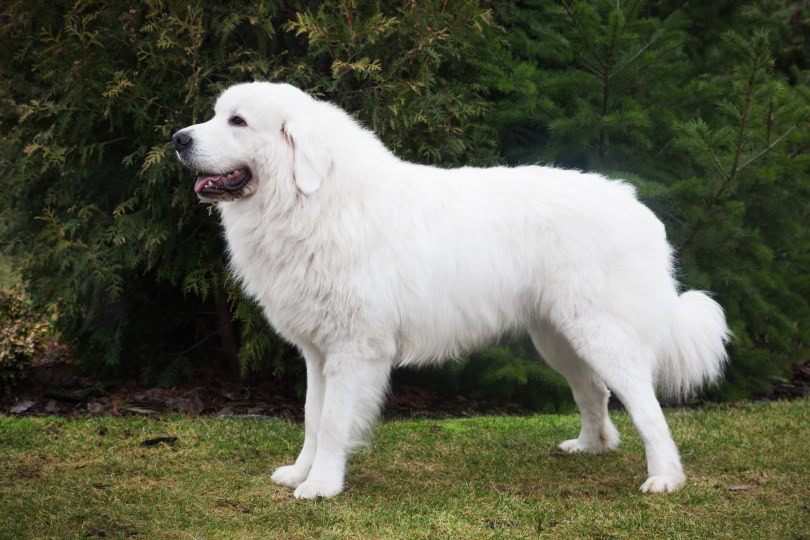
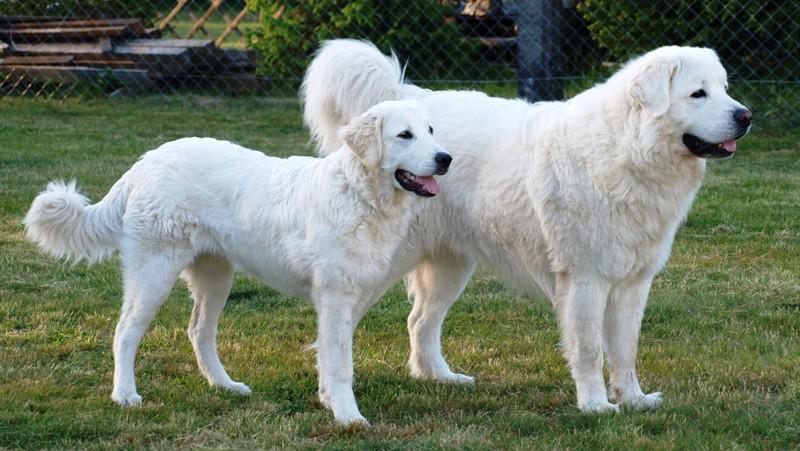
The Polish Tatra Sheepdog gives an impression of strength, endurance, and nobility. It is a large, powerful dog with a harmonious, rectangular body structure. Its appearance is perfectly adapted for work in harsh mountain conditions.
Head: Large, but in proportion to the body, with a distinct but smooth stop (the transition from forehead to muzzle). The skull is slightly convex. The muzzle is strong, gradually tapering towards the nose.
Eyes: Medium-sized, almond-shaped, and set slightly obliquely. The colour is dark brown. The gaze is intelligent, calm, and penetrating.
Nose, lips and eye rims: These must be black. This contrast with the white coat is one of the most characteristic features of the breed.
Ears: Medium length, triangular, thick, mobile, and set high. They lie close to the head with their inner edge.
Body: Powerful, with a deep chest, muscular neck, straight back, and broad croup.
Tail: Set not too high, carried low. In a state of excitement, it may be raised above the backline, but it never curls into a ring.
Coat: The dog's main adornment and protection. It is a thick, double coat. The topcoat is harsh, straight or slightly wavy, and long. The undercoat is very dense and soft, providing excellent protection from cold and moisture. On the neck and chest, the coat forms a lavish ruff, and on the hind legs, "trousers".
Table: Polish Tatra Sheepdog Breed Standard (FCI No. 252)
Body Part · 12
Body Part
Standard Description
General Appearance
A strong, compact dog, conveying an impression of stamina and mobility.
Proportions
Rectangular body, with the length of the body slightly exceeding the height at the withers.
Head and Skull
Clean-cut, strong, but not heavy. The ratio of muzzle to skull is 1:1 or the muzzle is slightly shorter.
Eyes
Expressive, medium-sized, dark brown. Eyelids are tight-fitting and black.
Ears
Thick, triangular, mobile, dropping, set close to the head.
Bite
Scissor bite, full set of teeth. A level bite is permissible.
Neck
Muscular, of medium length, without a dewlap, with a dense ruff.
Back
Straight, broad, with well-defined withers.
Chest
Deep, ribs are oblique and quite flat.
Tail
Not set too high, covered with dense hair, carried low.
Limbs
Muscular, with strong bone, straight when viewed from the front and rear. Paws are oval with black pads.
Colour
Pure white. Cream-coloured patches are undesirable.
Character and Temperament of the Tatra Sheepdog
Behind the formidable exterior of a guardian lies a surprisingly calm and level-headed character. The Polish Tatra Sheepdog is a breed with high intelligence and a strong attachment to its family, which it perceives as its "pack".
Main Character Traits:
Calm and Vigilant: This is not a fussy dog. During the day, it may seem somewhat lazy, calmly observing its surroundings. However, this calm is deceptive. The dog is always on alert and reacts instantly to any potential threat. At night, its instincts sharpen, and it becomes an even more vigilant guardian.
Territorial and Protective: The instinct to guard its territory and family is embedded at a genetic level. They do not require special training for this. The Podhalan considers its garden and home its territory and will defend them with a loud bark and, if necessary, with physical force.
Devotion to Family: The Tatra Sheepdog treats its owners and family members with immense love and gentleness. They get along well with children, showing remarkable patience. However, given the dog's large size, play with small children should always be supervised by an adult.
Independence and Intelligence: Like many other pastoral breeds, Podhalans are accustomed to making decisions independently. They are very intelligent dogs, but their intelligence is combined with a certain stubbornness. They will not blindly follow commands if they do not see the point in them. Unlike breeds geared towards constant human interaction, such as the English Springer Spaniel, the Podhalan is far more self-sufficient.
Wary of Strangers: They are cautious and distrustful of strangers. They will not show unprovoked aggression but will not allow a stranger to enter their territory freely. Proper socialisation from an early age is key to shaping an appropriate reaction to guests.
Pros and Cons of the Breed
Before getting such a majestic dog, it's important to soberly assess all the advantages and disadvantages of the breed. This will help you understand if the Polish Tatra Sheepdog is the right fit for your lifestyle.
Pros and Cons of the Breed · 6
✅ Pros
❌ Cons
A natural guardian. Needs no special training to guard its territory and family.
Needs a lot of space. Entirely unsuitable for living in a flat.
Devoted and gentle with family. Deeply loves its family and is patient with children.
Sheds heavily. An intense moult occurs twice a year, requiring thorough brushing.
Highly intelligent. Capable of independent decision-making, learns quickly with the right approach.
Prone to independence and stubbornness. Not suitable for inexperienced owners.
Majestic appearance. The beauty and power of this dog leave no one indifferent.
Loud bark. Actively uses its voice to warn of approaching strangers, which may not please neighbours.
Robust health. Rarely gets ill with proper care and nutrition.
Requires early and extensive socialisation. Without it, they can become overly wary or fearful.
Calm temperament. Does not demand constant activity and games; is level-headed.
High maintenance costs. Needs large quantities of high-quality food and veterinary care.
Training and Rearing a Polish Tatra Sheepdog
Raising a Podhalan is not a task for a novice. It requires patience, consistency, and an understanding of the psychology of an independent guardian dog. The golden rule is to build a relationship based on mutual respect, not dominance.
Key Aspects of Training:
Early Start: You must begin training and socialisation from the first day the puppy arrives in your home. Introduce it to various people, sounds, places, and other animals (under control).
Positive Reinforcement: Harshness, shouting, and physical punishment are unacceptable. Podhalans are very sensitive, and such an approach will only destroy trust and cause the dog to "shut down" or respond with aggression. Methods based on praise, treats, and play work best.
Consistency: All family members must adhere to the same rules. If something is forbidden, it is always forbidden.
Leadership Through Trust: For a Podhalan, the owner is not a dictator, but a wise and fair "pack leader" on whom it can rely. Earn its respect, and you will have the most devoted friend.
It is important to understand that the innate guarding instinct does not need to be specially developed or "set" on people. This can lead to uncontrolled aggression. The owner's task is to teach the dog to manage its instincts and react appropriately to different situations.
Care and Keeping of the Polish Tatra Sheepdog
Living Conditions
The ideal home for a Tatra Sheepdog is a house with a large, securely fenced garden. Keeping this dog in a flat is unacceptable. Firstly, because of its large size. Secondly, and most importantly, because of its innate need to patrol and guard its territory. Confined within four walls, the dog will suffer from pent-up energy and the inability to fulfil its instincts, which can lead to destructive behaviour and psychological problems.
Grooming and Coat Care
The Podhalan's luxurious white coat has a unique self-cleaning property. Dirt, once dry, simply falls off it. Therefore, the dog does not require frequent washing; once or twice a year, or if it gets very dirty, is sufficient. However, coat care is still necessary:
Brushing: Normally, it is enough to brush the dog once or twice a week to prevent mats from forming.
Moulting: Twice a year (in spring and autumn), Podhalans undergo an intense moult. During this period, the dog sheds a huge amount of undercoat and needs to be brushed daily. This will help speed up the process and make the animal more comfortable.
Clipping: Clipping or shaving a Tatra Sheepdog is strictly forbidden! Its double coat creates an air layer that protects not only from the cold in winter but also from overheating in summer. By depriving the dog of this natural protection, you can harm its health.
Also, don't forget to regularly inspect its ears and eyes, cleaning them as necessary, and to trim its claws if they don't wear down naturally.
Exercise and Activity
Despite its size, the Polish Tatra Sheepdog is not a hyperactive dog. It does not require intense training sessions or hours of running. Its main "job" is the unhurried patrolling of its territory. To maintain good physical condition, long walks on a lead once or twice a day outside its own garden are sufficient. This is also important for socialisation. It is worth understanding that their exercise needs differ from those of other large sheepdogs, such as the energetic Romanian Mioritic Shepherd Dog, which requires more dynamic activity.
Nutrition
Feeding Recommendations
Health and risks
Health and Common Breed-Specific Conditions
Frequently Asked Questions (FAQ) · 4
Is the Polish Tatra Sheepdog suitable for an inexperienced owner?
Usually, no. This breed is not recommended for novices. Its independent character, stubbornness, and large size require an experienced owner who can be an authoritative but fair leader for the dog. A novice may struggle with training, which can lead to behavioural problems.
Does the Tatra Sheepdog bark a lot?
Yes. Barking is this dog's primary working tool. It uses its loud, deep voice to warn of anyone approaching its territory. They do not bark without reason, but a reason for them could be a hedgehog in the bushes or a neighbour entering their garden. This should be taken into account if you have sensitive neighbours.
Are they aggressive towards other animals?
Tatra Sheepdogs generally get along well with animals they have grown up with and consider part of their "pack" (other dogs, cats). However, they can be aggressive towards strange dogs, especially of the same sex, that enter their territory. Their hunting instinct is weakly developed, so they rarely chase small animals.
How much does a Polish Tatra Sheepdog puppy cost?
It is vital to choose a trusted breeder who prioritises the health and socialisation of their puppies. Chasing a low price is ill-advised, as it can lead to significant veterinary bills in the future. Expect to wait: established breeders have their litters spoken for well in advance.
Video About the Breed
FAQ
What was the Tatra Sheepdog bred for?
An ancient white mountain flock guardian from the Tatra region that protected herds from wolves and bears for centuries; the white coat helped shepherds tell the dog from a predator at night.
Is the Tatra Sheepdog good with children?
Yes — despite its power, it is level-headed and gentle with its own family's children; but it is distrustful and territorial with strangers, so early socialisation matters.
Is the breed suited to a novice?
No — a self-reliant mountain guardian with a strong instinct; it needs space, an experienced owner and socialisation, not a flat.