

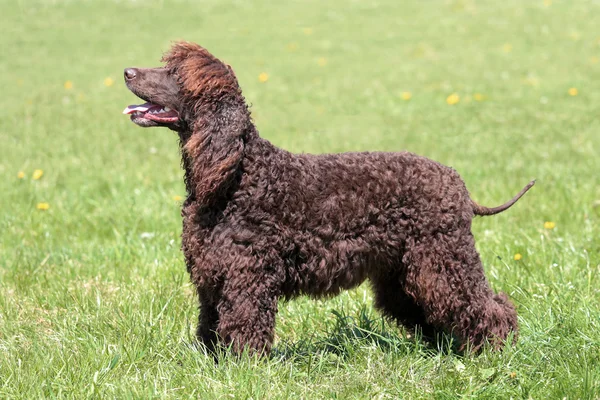
| Height | 51–61 cm |
| Weight | 20–30 kg |
| Lifespan | 10–12 years |
| FCI group | 8 · retrievers, spaniels, water dogs |
| Origin | Ireland |
Exact ratings
Common health issues
Nutrition
The Irish Water Spaniel is more than just a dog; it’s a true character, shrouded in mystery and blessed with a unique sense of humour. Bred for working in challenging conditions, hunting waterfowl, and engaging in vigorous activity, this curly-coated athlete gets carried away by the thrill of the chase and seems to forget fatigue. It can fearlessly retrieve game from icy water and swift river currents. This brave, intelligent, and incredibly loyal gundog forms a deep bond with its owner, serving with boundless love. Learn more on Tvaryny.
While long walks and active games are essential for an Irish Water Spaniel, it’s important to remember that no urban environment can replace the space and natural surroundings for which this freedom-loving dog was bred. It is the ideal companion for active people who live in the countryside and are prepared to devote plenty of time to their pet.
General Characteristics
| Characteristic | Description |
| Origin | Ireland |
| Year of first record | ~1600s, modern standard from the 1830s |
| Kennel Club / FCI Classification | Gundog / Group 8 (Retrievers, Flushing Dogs, Water Dogs), Section 3 (Water Dogs) |
| Lifespan | 10-14 years |
| Height at the withers | Dogs: 53-59 cm, Bitches: 51-56 cm |
| Weight | Dogs: 25-30 kg, Bitches: 20-26 kg |
| Temperament | Intelligent, playful, inquisitive, loyal, energetic |
| Energy Level | High |
| Grooming Needs | High |
| Moulting / Shedding | Minimal, hypoallergenic coat |
| Good with children | Good, with proper socialisation |
| Good with other animals | Requires early socialisation |
| Trainability | High, but can be stubborn |
History and Origin: The Secret of the Irish Bogs
The history of the Irish Water Spaniel is one of the most mysterious of all dog breeds. Although the modern type was formally established in Ireland in the 1830s through the efforts of Dublin enthusiast Justin McCarthy, the breed’s roots go back much further. There are written records dating back to the 1600s of “water dogs with rat-tails” that hunted ducks and other game in the Irish bogs. Its precise origins remain a matter of debate.
There are several main theories:
- Persian Heritage: One theory suggests that the breed’s ancestors came to Ireland from Persia via Spain.
- French Connection: Another popular theory points to crossbreeding Poodles with other water dogs, perhaps breeds like the Barbet or the Wetterhoun, which are also known for their curly coats and love of water.
- Portuguese Influence: A third theory links the breed to Portuguese Water Dogs, which may have been brought to Ireland by fishermen. This theory is plausible, given their working abilities and similar affinity for water, much like the Portuguese Water Dog.
Despite the uncertainty, the entire modern population of Irish Water Spaniels descends from a single dog named Boatswain, who was born in 1834 and belonged to Justin McCarthy. His genetic material became the foundation for the standardisation of the breed. By the end of the 19th century, the Irish Water Spaniel had become one of the most popular sporting breeds in the UK and North America, though today it is considered relatively rare.
What Does an Irish Water Spaniel Look Like? A Detailed Description
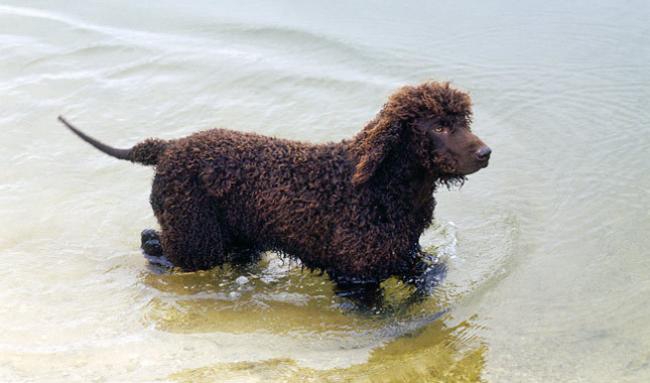
The appearance of the Irish Water Spaniel is unique and instantly recognisable. It is the tallest member of the spaniel family, a strong, muscular dog built for endurance and work in the water.
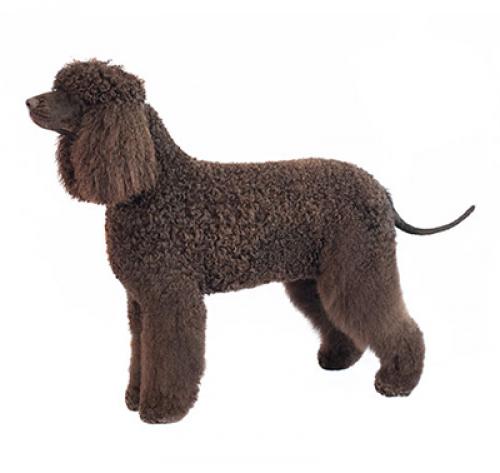
Coat and Colour: The breed’s main calling card is its coat. It consists of dense, tight curls that cover the entire body, except for the face and tail. This coat is naturally infused with oil, which makes it waterproof and protects the dog from the cold. The colour is always a consistent, rich, deep liver-brown, often with a characteristic purple hue that is particularly noticeable in the sun.
Head and Face: The head is adorned with a high “top-knot” of long curls that falls over the eyes, giving the dog a comical yet enigmatic expression. In contrast, the face, throat, and cheeks are covered with short, smooth hair. This creates a very distinctive and unique look.
Body and Tail: The body is well-proportioned, with a deep chest for powerful lungs. The back is strong and level. But the most striking feature, apart from the coat, is its ‘rat tail’. It is thick and covered in curls at the base (for about 8-10 cm), while the rest of the tail is smooth or covered in sparse, short hair, tapering to a point. This tail acts as a rudder when swimming.
Temperament: The Clown of the Spaniel Family
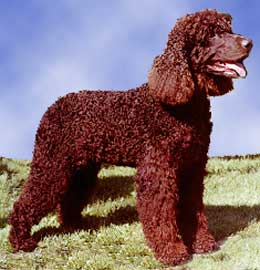
The Irish Water Spaniel is often called the “clown” of the dog world, and for good reason. It is an exceptionally intelligent, inquisitive, and playful dog with a wonderful sense of humour. They love to be the centre of attention and often resort to amusing antics to entertain their family.
They are endlessly devoted to their owners and form a strong bond with them. They get on well with children, especially if they grow up together, becoming patient and cheerful playmates. However, their energy and size require supervision during playtime with small children.
Despite their open nature within the family circle, Irish Water Spaniels can be reserved and wary of strangers. They are not aggressive, but their alertness makes them good watchdogs who will always announce the arrival of visitors with a loud bark. Early and proper socialisation is key to ensure this trait does not develop into shyness or excessive suspicion.
Pros and Cons
Like any breed, the Irish Water Spaniel has its strengths and weaknesses. It’s important to assess them objectively before deciding to get such a dog.
| Pros | Cons |
|---|---|
| Unique hypoallergenic coat. Sheds very little, making the breed a good choice for people with allergies. | High grooming requirements. The coat needs regular combing (several times a week) and professional clipping (every 2-3 months) to prevent matting. |
| High intelligence and trainability. They quickly learn commands and tricks. | A tendency to be stubborn. Their intelligence can lead to independence. They require consistent and patient training. |
| Playful and fun-loving nature. A great companion for an active family, loves games and entertainment. | Very high energy level. Needs at least 1-2 hours of vigorous physical exercise daily. Not suitable for living in a flat. |
| Loyalty to the family. Becomes strongly attached to its people and is good with children. | Wary of strangers. Needs thorough early socialisation to avoid becoming overly shy or suspicious. |
| A natural swimmer. Adores water and is an excellent dog for hunting or simply for water-based fun. | Relatively rare. Finding a good breeder and a puppy can be difficult and expensive. |
Care and Upkeep
Caring for this breed has its own specific demands, mainly related to its unique coat and high energy needs.
Grooming: How to Care for the Curly Coat
The Irish Water Spaniel’s coat is its pride and its owner’s main task. It sheds very little but requires constant care to stay healthy and beautiful. It must be thoroughly combed 2-3 times a week with a special long-toothed comb to reach the undercoat and prevent mats from forming. The dog should only be bathed when necessary, using mild shampoos to avoid stripping the natural oils that protect the skin and coat. A professional clip is needed every 8-12 weeks to maintain its shape.
Exercise and Activity
This is a very energetic breed. A simple walk on the lead will not be enough. The Irish Water Spaniel needs daily, intensive exercise that includes off-lead running, active games (like fetch and frisbee), and, of course, swimming. Access to a body of water where the dog can swim freely is the best gift you can give it. A lack of activity can lead to destructive behaviour, excessive barking, and general restlessness. Their stamina and love of work connect them with breeds like the Curly-Coated Retriever and the American Water Spaniel.
Training and Socialisation
Although Irish Water Spaniels are very intelligent and eager to please their owners, training them can be a challenge. Their intelligence is combined with independent thinking and stubbornness. Therefore, training must be consistent, fair, but firm. Positive reinforcement methods—praise, treats, and games—work best.
They get bored quickly with monotony, so training sessions should be short, varied, and interesting. Early socialisation is absolutely essential. From a very young age, a puppy needs to be introduced to different people, sounds, places, and other animals. This will help raise a confident and well-balanced dog, rather than a timid or overly suspicious one. An obedience course would be very beneficial.
Health: Common Conditions and Prevention
Feeding: How to Properly Feed an Irish Water Spaniel?
Interesting Facts About the Irish Water Spaniel
- The Oldest Spaniel: The Irish Water Spaniel is considered one of the oldest spaniel breeds, with a history stretching back at least four centuries, and possibly longer.
- Unknown Ancestors: Despite its long history, no one knows for certain how the breed came to be. Justin McCarthy, the “father” of the breed, took this secret to his grave.
- A Natural Clown: Their playful, mischievous behaviour and tendency to “perform” for an audience have earned them the nickname “the clowns of the spaniel family.”
- The ‘Rat Tail’ – A Multi-Functional Tool: The unique, smooth tail not only helps the dog steer in the water like a rudder but also avoids snagging on bushes and branches on land.
- A Rare Breed: Despite its popularity in the 19th century, the Irish Water Spaniel is a fairly rare breed today. Spotting one on the street is a real treat.
Frequently Asked Questions (FAQ)
Does the Irish Water Spaniel shed a lot?
No, it sheds very little. Its coat grows continuously, much like human hair, and dead hairs get trapped in the curls rather than falling onto the floor. This makes them an excellent choice for allergy sufferers but requires regular combing.
Is this breed suitable for living in a flat?
Absolutely not. An Irish Water Spaniel needs space to move. The ideal home would be a house with a large, securely fenced garden and, preferably, access to a body of water.
Are they easy to train?
They are very intelligent and capable of learning, but they are also independent and stubborn. Training requires patience, consistency, and the use of positive reinforcement methods. They get bored quickly with dull, repetitive tasks.
How do they get along with children and other animals?
They are generally good with children from their own family. They can get along with other dogs and animals if they have undergone early and thorough socialisation. However, their hunting instinct may surface around small animals, particularly birds.
Do they bark a lot?
They are not prone to barking without reason, but they are good watchdogs and will always give voice if they notice something suspicious or hear a stranger at the door.
Video About the Breed
- Clever, sharp-witted, easy to train
- A fearless water retriever
- The curly coat barely sheds
- Devoted, with a unique sense of humour
- A very high need for exercise and work
- Reserved with strangers
- The curly coat needs care
- Not for a flat without exercise
| Spanish Water Dog | Portuguese Water Dog | Poodle (Standard) | |
|---|---|---|---|
| Height | 40–50 cm | 43–57 cm | 45–62 cm |
| Energy | 4.5 | 4.5 | 4 |
| Apartment | 2.5 | 2.5 | 3 |
| Beginners | 3 | 3 | 4 |
Why is the Irish Water Spaniel called a “clown”?
What sets the Irish Water Spaniel apart?
Is the breed suited to a flat?
FCI Standard No. 124 · Irish Kennel Club
For apartments · For kids · For beginners · Active · Smartest · Hypoallergenic · All rankings →