

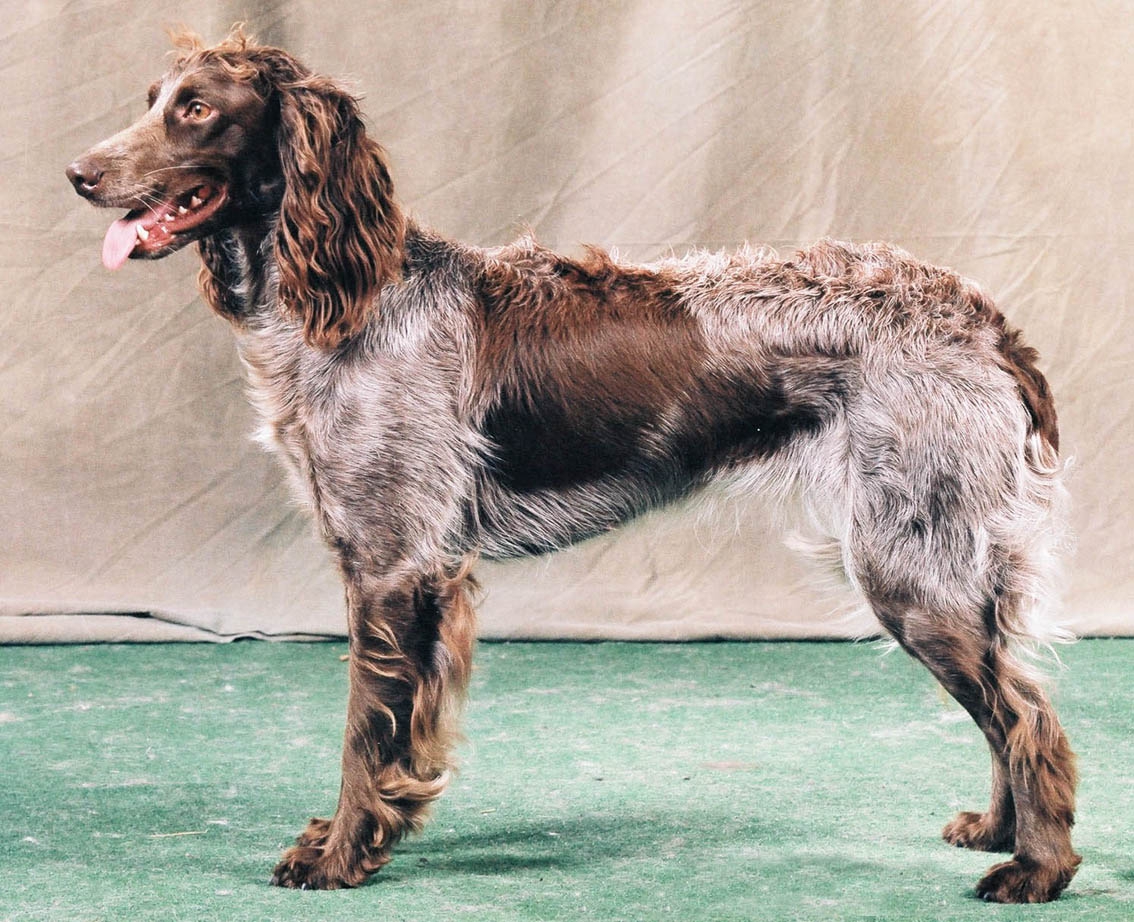
| Height | 50–58 cm |
| Weight | 18–25 kg |
| Lifespan | 12–14 years |
| FCI group | 7 · pointing dogs (spaniels) |
| Origin | France (Normandy) |
Exact ratings
Common health issues
Nutrition
The Pont-Audemer Spaniel (Épagneul Pont-Audemer) is a rare and unique gundog breed originating from the marshy regions of Normandy. Bred specifically for water hunting, this dog has a not only functional but also an incredibly striking appearance. Their coarse, wavy coat, which reliably protects them from cold and wet, and the amusing “top-knot” on their head earned them the nickname “the little marsh clown” (le petit clown des marais). Despite their somewhat comical look, Pont-Audemer Spaniels are serious, hard-working, and incredibly devoted hunters.
Today, this breed remains one of the rarest in the world, but its enthusiasts value it for its exceptional character, obedience, and people-oriented nature, which makes it an excellent family dog for active owners. Find out more on Tvaryny.
The Pont-Audemer Spaniel: A Brief Breed Overview
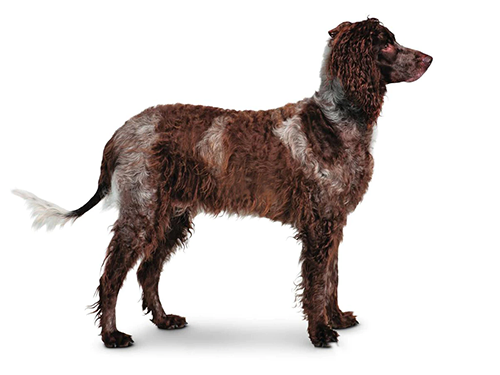
| Characteristic | Description |
|---|---|
| Origin | France (town of Pont-Audemer, Normandy) |
| FCI Recognition | 1954 (Standard No. 114) |
| FCI Group | Group 7 (Pointers), Section 1.2 (Continental Pointers, “Spaniel” type) |
| Lifespan | 12-14 years |
| Height at withers | 52-58 cm (for males and females) |
| Weight | 18-24 kg |
| Coat | Long, wavy, slightly coarse, forms a “top-knot” |
| Colour | Brown, brown roan, solid brown |
| Temperament | Cheerful, affectionate, hard-working, intelligent, a little stubborn |
| Purpose | Water retriever, companion dog |
| Activity Level | High |
History of the Breed
The history of the Pont-Audemer Spaniel is a story of survival, breeder passion, and the devastating impact of world wars. The breed was developed in the 19th century in the marshy estuaries of the Risle river, near the town of Pont-Audemer in Normandy, from which it gets its name.
The breed’s exact origin is not precisely known, but it is believed to be the result of crossing old French water dogs with local spaniels. The influence of other breeds is evident, particularly to improve hunting qualities and the waterproof coat. Most cynologists agree that among the Pont-Audemer’s ancestors were English dogs and, most likely, the Irish Water Spaniel, which may have passed on the characteristic curly “top-knot” and love of water. The influence of the Barbet, another ancient French water dog, is also possible.
The breed was extremely popular among local duck hunters. Its ability to work in cold water, dense marshy thickets, and retrieve game undamaged made it an indispensable helper.
However, the 20th century dealt the breed devastating blows. The First and Second World Wars ravaged the Normandy region, and dog breeding, which was not a primary necessity, practically ceased. By the end of the 1940s, the Pont-Audemer Spaniel was on the brink of total extinction. The breed effectively survived only through the efforts of a few enthusiasts.
A key role in saving the breed was played by a priest named Abbé Fournier. In the 1950s, seeing the catastrophic decline in numbers, he made a difficult but necessary decision: to expand the gene pool, he crossed the few remaining Pont-Audemer Spaniels with the Irish Water Spaniel. This helped save the breed from extinction, although it slightly altered its original appearance.
In 1980, due to its extremely low numbers, the French breed club (Club de l’Épagneul Pont-Audemer) was merged with the Picardy Spaniel club. Today, the Pont-Audemer Spaniel remains one of the rarest breeds in the world. Only a few dozen new puppies are registered each year, mostly in France. It is a true “relic breed,” a living part of Normandy’s hunting heritage.
What the Pont-Audemer Spaniel Looks Like: Appearance
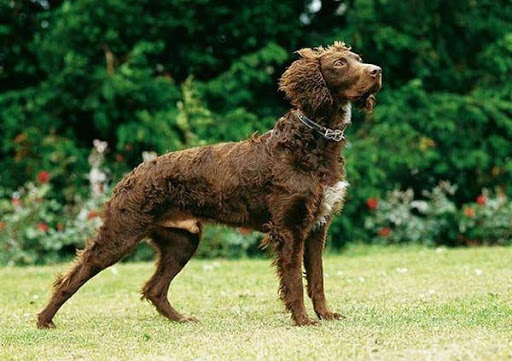
The Pont-Audemer Spaniel is a medium-sized, sturdy dog with a strong frame, but without being bulky. It gives the impression of an energetic and hardy animal, capable of working for hours in difficult conditions.
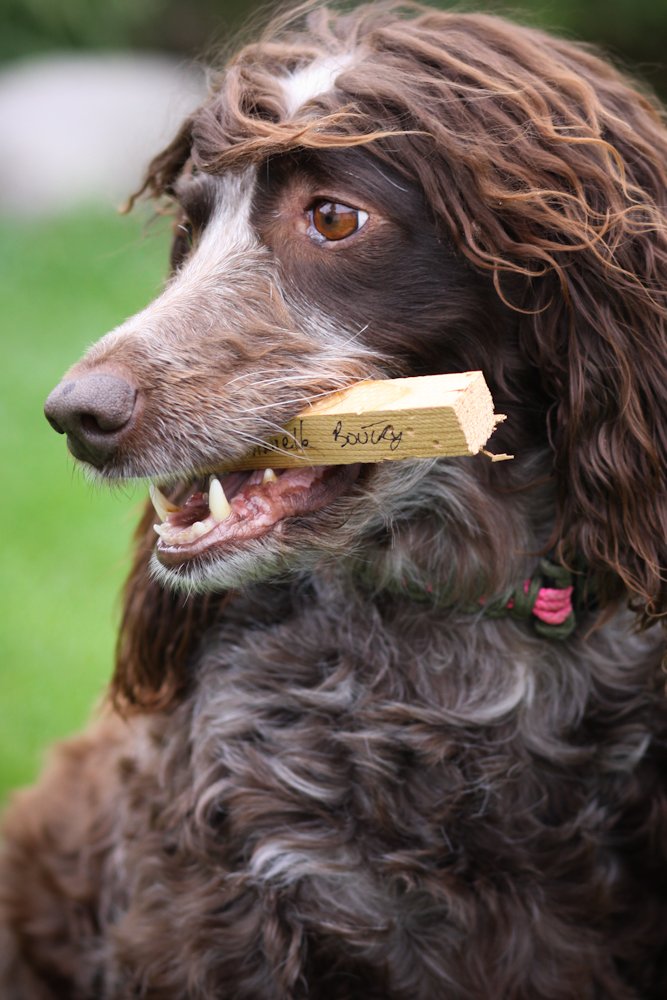
- Head: The characteristic feature is a pronounced “top-knot” of long, curly hair that falls onto the forehead. The skull is rounded, and the stop (transition from forehead to muzzle) is well-defined.
- Muzzle: Long and slightly convex (Roman-nosed), which gives it a unique profile. The nose is always brown.
- Eyes: Relatively small, amber to dark hazel in colour. The expression is intelligent, kind, and slightly mischievous.
- Ears: Low-set, flat, and hanging. They are covered in long, beautiful, curly hair that frames the head and enhances the “clownish” look.
- Body: Strong, with a deep chest that provides space for powerful lungs. The back is straight, and the loin is strong.
- Tail: Previously, it was often docked by a third. Today, where docking is banned, the tail is left long. It is thick at the base, tapering to a point, and the dog carries it fairly straight or slightly curved.
- Limbs: Powerful, muscular, with well-developed paws that may have webbing between the toes to aid in swimming.
Coat and Colour: The Natural Wetsuit
The coat is the main feature of the Pont-Audemer Spaniel. It is not just curly; it is long, slightly coarse to the touch, and somewhat ‘tousled’ (frisé et bourrue). It should not be too soft or cottony. This coat structure, often slightly oily to the touch, creates a perfect waterproof layer, allowing the dog to work in icy water without getting cold.
The coat covers the entire body but is short on the muzzle. However, the “top-knot” on the head and the long curls on the ears are mandatory breed traits.
The colour of the breed is quite strict:
- Brown roan: The most authentic and desirable colour. It is a mixture of white and brown hairs, creating a “grizzled” or “flecked” effect. Often with large brown patches.
- Solid brown (marron): Also permitted. The colour is rich, the shade of dark chocolate.
Table: Breed Standard for the Pont-Audemer Spaniel (FCI No. 114)
| Part | Standard Requirements |
|---|---|
| General Appearance | Sturdy, strong, medium-sized, hardy spaniel. |
| Head | Pronounced “top-knot” of curly hair. Skull rounded, stop defined. |
| Muzzle | Long, convex profile (Roman-nosed). Brown nose. |
| Eyes | Amber or dark hazel. Expression is lively and kind. |
| Ears | Long, flat, low-set, covered in long curly hair. |
| Neck | Strong, muscular, slightly arched. |
| Body | Deep chest, back straight or slightly convex, strong loin. |
| Tail | Set at back level. Often docked by 1/3 (where permitted) or left natural. |
| Coat | Long, curly, slightly coarse and tousled. Waterproof. Top-knot on head. |
| Colour | Brown, brown roan, brown and white. |
| Height | 52 – 58 cm at the withers. |
| Weight | 18 – 24 kg. |
Character: Temperament and Behaviour
Behind the “clown” nickname lies a deep and multifaceted character. The Pont-Audemer Spaniel is a dog with a dual nature: serious and tireless when hunting, but boundlessly cheerful, affectionate, and playful at home.
At work:
- Passion for water: This isn’t just a dog that loves water – it’s their element. They are ready to jump into any body of water in any weather.
- Excellent nose and retriever: They have a superb sense of smell and are used to find and retrieve shot birds, especially ducks, from water or dense marshy thickets.
- Stamina: This breed can work for hours without showing signs of fatigue. Their coarse coat protects them not only from water but also from thorny bushes.
At home:
- Affectionate and loyal: They bond strongly with their family and love to be the centre of attention. This is a “Velcro dog” that will follow you from room to room.
- Playful ‘clown’: They have a wonderful sense of humour, love to fool around, bring toys, and entertain their owners. Their playfulness lasts well into old age.
- High intelligence: They are smart and learn quickly… when they want to. Like many spaniels, they can have “selective hearing” and a certain amount of stubbornness.
- Sensitivity: These are very sensitive dogs that react poorly to shouting and harsh training methods. They thrive on positive reinforcement.
Socialisation: Children, Animals, and Strangers
With children: Thanks to their cheerful and affectionate nature, Pont-Audemer Spaniels usually get along wonderfully with children, especially if they grow up together. They are patient and make excellent playmates. Of course, any interaction with small children should be supervised.
With other dogs: They generally socialise well with other dogs. They were often used for hunting in a pack, so aggression towards other dogs is not in their nature. Early socialisation helps to solidify these good manners.
With other animals (cats, rodents): This is more complicated. This is a hunting dog with a strong prey drive (especially for birds). Although they can live peacefully with a cat if raised together, small animals (hamsters, rabbits) or domestic fowl will most likely be seen as prey.
Care and Maintenance
Potential owners must understand clearly: this is a breed that requires significant grooming. Their unique coat and high energy demand time and effort.
Grooming: Caring for the Curly Coat
The coat of the Pont-Audemer Spaniel doesn’t shed in the conventional sense (or sheds very little), which can be a plus for some people. However, this does not mean it is low-maintenance. Quite the opposite.
- Brushing: Their coat needs to be thoroughly brushed 2-3 times a week (or even more often if the dog spends a lot of time in the woods). The curls and undercoat easily tangle into mats, which quickly become painful. A comb with long teeth is needed to reach right down to the skin.
- Bathing: Oddly enough, the “water dog” should not be bathed too frequently with shampoo. Their coat has a natural oily layer that protects it from water and cold. Frequent washing strips this layer. Only bathe the dog when absolutely necessary or if it has got into something that won’t rinse off with plain water (e.g., after a swim in a swamp).
- Clipping: This breed does not require complex show clips like Poodles. However, the coat may need occasional trimming or professional grooming to maintain a tidy shape and prevent mats. The hair on the “top-knot” is sometimes trimmed so it doesn’t cover the eyes, although traditionally it serves as protection.
- Odour: Like many water dogs (e.g., the Irish Water Spaniel), the Pont-Audemer Spaniel can have a specific ‘doggy’ or musky odour due to teh oily coat, especially when wet.
Ear Care: A Critically Important Aspect
This is probably the most important part of their care. A combination of three factors:
- Long, hanging ears.
- Thick hair growing in the ear canal.
- Constant water entry during swimming.
This all creates a perfect warm, dark, and damp environment for bacteria and yeast to grow. Pont-Audemer Spaniels are extremely prone to ear infections (otitis).
Owners must check the ears daily, especially after walks or swimming. The ear canal must be kept dry and clean. Regularly (once a week) clean the ears with a special, vet-recommended lotion. The hair inside the ear canal may need to be plucked or trimmed.
Activity and Space Requirements
This is not a dog for the sofa and not the best choice for a small flat. The Pont-Audemer Spaniel is a high-energy working breed. It needs at least 1.5-2 hours of active physical exercise daily. And this doesn’t just mean a slow walk on a lead.
They need:
- Off-lead running: In a safe area where they can explore scents.
- Swimming: This is a vital necessity. If you do not have access to a safe body of water, this breed will be unhappy.
- Mental stimulation: Scent games, training, dog sports (agility, nosework).
The ideal home for them is a house with a large, securely fenced garden and owners who love active outdoor recreation (hiking, hunting, trips to the lake).
Training and Socialisation
Pont-Audemer Spaniels are intelligent and people-oriented, which makes them trainable. They want to please their owner. However, they have a classic “spaniel” trait – a certain amount of stubbornness and independence. If they are bored or don’t see the point of a command, they might just pretend not to hear you.
Keys to successful training:
- Positive reinforcement: They respond wonderfully to treats, praise, and games. Harshness, shouting, or punishment will cause this sensitive dog to “shut down” and refuse to cooperate.
- Early start: Socialisation and basic obedience commands must begin from puppyhood.
- Short and fun sessions: They get bored quickly with monotonous repetition. Keep training sessions short, dynamic, and game-like.
- Focus on recall: As with all hunting breeds, the “come” command is vital. Their nose can easily lead them into trouble.
They excel in various dog sports, especially those related to scent work and retrieving. Their working style differs from other continental pointers, such as the Picardy Spaniel or the German Longhaired Pointer, as the Pont-Audemer Spaniel is first and foremost a specialist in water work and dense thickets.
Health: Common Conditions
Nutrition: Key Recommendations
Pros and Cons of the Breed
This breed is certainly not for everyone. It is important to soberly assess all its advantages and disadvantages.
| Pros (Advantages) | Cons (Disadvantages) |
|---|---|
| Unique appearance: A charismatic “clown” with a top-knot that always draws attention. | Extremely rare: Finding a puppy is almost impossible. Breeder waiting lists are years long. |
| Cheerful and affectionate nature: A wonderful companion that bonds strongly with the family. | Very high grooming requirements: Needs frequent brushing, prone to mats. |
| High intelligence: Responds well to positive training. | High risk of ear infections: Requires daily checks and prevention. |
| Minimal shedding: Good for people who don’t like hair on the furniture. | Very high activity requirements: Needs 2+ hours of exercise and mandatory swimming. |
| Outstanding swimmer and hunter: The ideal dog for waterfowl hunters. | Can have a specific “doggy” odour: Due to the oily coat. |
| Good with children and other dogs. | Stubbornness: Can be independent and have “selective hearing”. |
| Limited gene pool: Higher risk of certain hereditary diseases. |
Interesting Facts About the Breed
- The ‘marsh clown’ nickname (le petit clown des marais) – is no insult. It perfectly describes their cheerful, playful nature and comical appearance, especially when they emerge from a swamp covered in mud.
- The ‘top-knot’ isn’t just for looks. It is believed the long hair on the head and ears serves a practical purpose: during swimming, it channels water away from the eyes and ear canals, and also protects the head from branches in dense thickets.
- They have webbed feet. Like most specialised water dogs, Pont-Audemer Spaniels have webbing between their toes, which makes them excellent swimmers.
- They ‘talk’. Many owners note that Pont-Audemer Spaniels are very vocal – they make various sounds (grunts, murmurs, “coos”) to express their emotions or demand something.
- They almost went extinct. At the end of the Second World War, the breed was so rare it was considered practically extinct. All modern dogs are descendants of just a few animals that were saved, litterally.
Frequently Asked Questions (FAQ) About the Breed
Does the Pont-Audemer Spaniel shed a lot? No, they shed very little, similar to Poodles. But the dead hair doesn’t fall out; it gets trapped in the curls, which leads to mats. Therefore, they require frequent brushing, even more so than some shedding breeds.
Is this breed suitable for a flat? Strongly discouraged. They need space, a garden, and most importantly, very easy access to nature and water. They will be unhappy and likely destructive in a city flat, unless the owner is a professional athlete prepared to dedicate 3-4 hours a day to walks in a park with a lake.
How hard is it to find a Pont-Audemer Spaniel puppy? Extremely difficult. It is one of the rarest breeds in the world. There are only a few active breeders in France, and very few litters are born each year. Finding a puppy outside of France is almost impossible. Be prepared for a multi-year waiting list and a trip to France.
Do they smell strongly? Yes, they can have a stronger “doggy” odour than other breeds. Their coat has a natural oily layer for waterproofing. When this coat gets wet, it can emit a rather pronounced musky scent. This is typical for many water dogs.
Can they be shaved to make grooming easier? This is strongly discouraged. Their curly coat protects them not only from cold and water but also from sunburn and heat. Shaving can disrupt their natural thermoregulation and damage the unique structure of their coat.
Video About the Breed
- Cheerful, devoted and people-oriented
- A hardy water hunter
- Obedient, easy to train
- Good with children
- A very high energy level — not for a flat
- Needs scent work and water
- The curly coat needs care
- One of the rarest breeds — hard to find
| Irish Water Spaniel | French Spaniel | Wirehaired Pointing Griffon | |
|---|---|---|---|
| Height | 51–61 cm | 54–63 cm | 50–60 cm |
| Energy | 4.5 | 4.5 | 4.5 |
| Apartment | 2 | 2 | 2 |
| Beginners | 3 | 3.5 | 3 |
Why is the Pont-Audemer Spaniel called the "marsh clown"?
Is the breed suitable for a flat?
How rare is the Pont-Audemer Spaniel?
FCI Standard No. 114 · Société Centrale Canine
For apartments · For kids · For beginners · Active · Smartest · Hypoallergenic · All rankings →