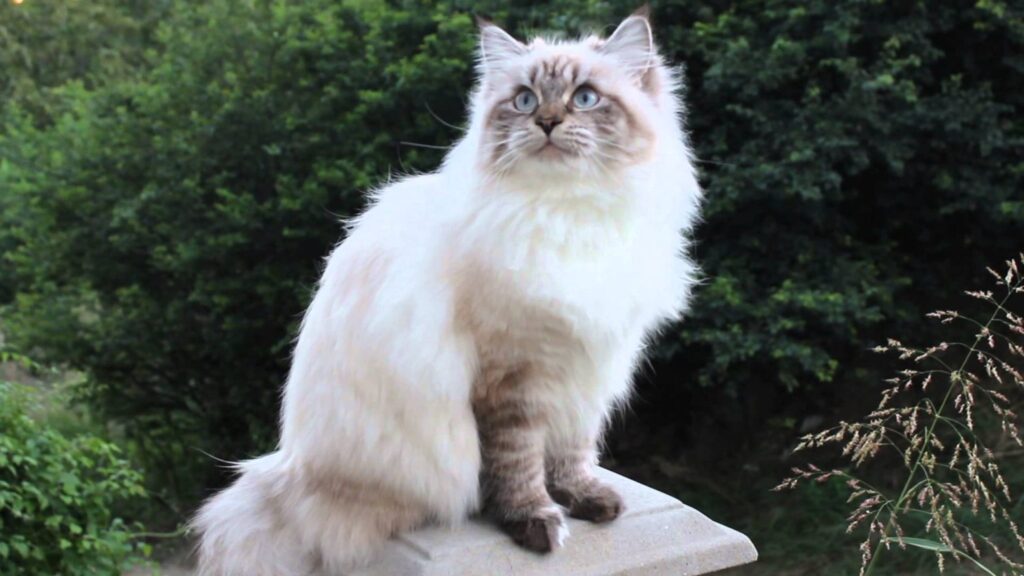
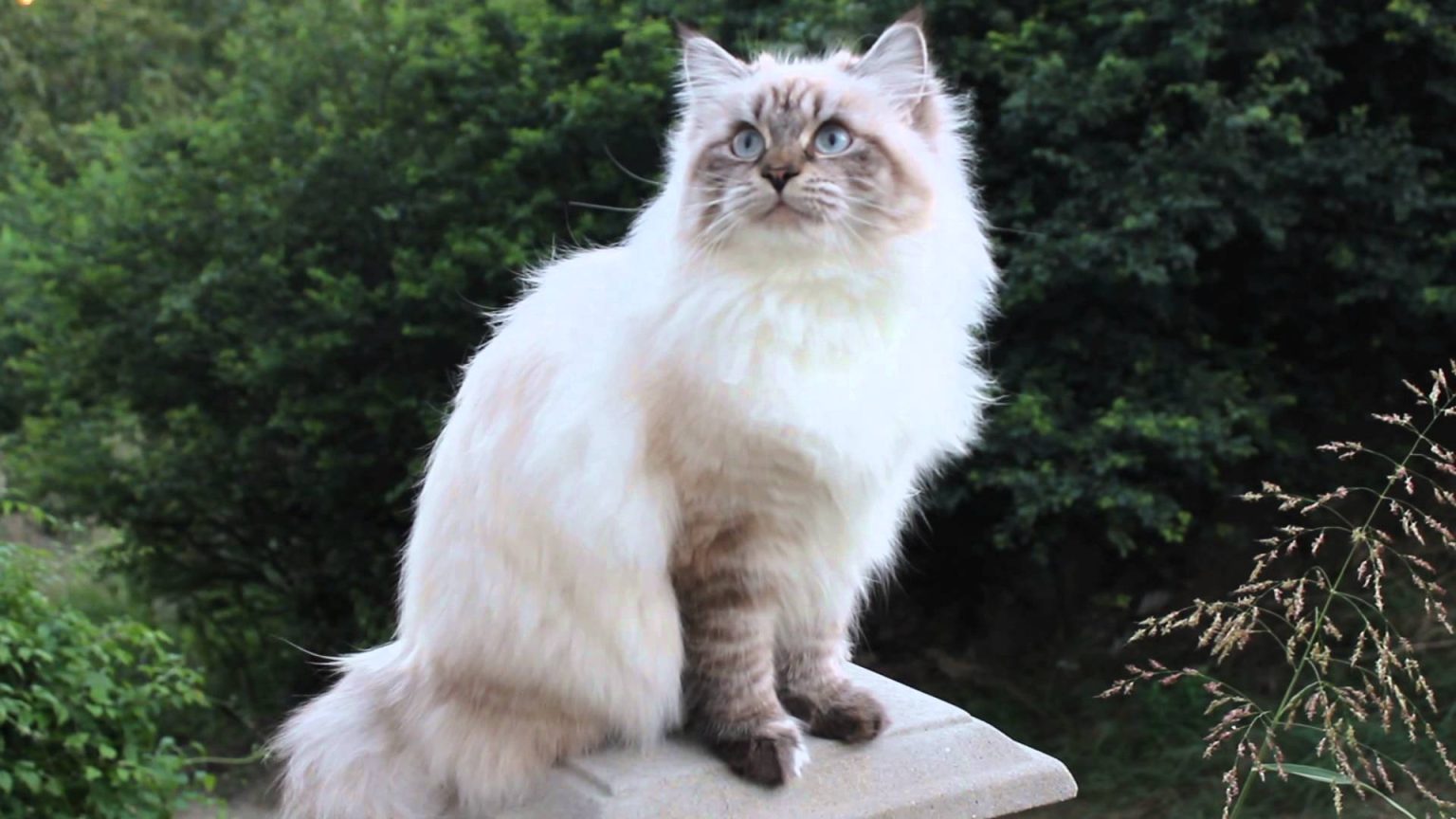
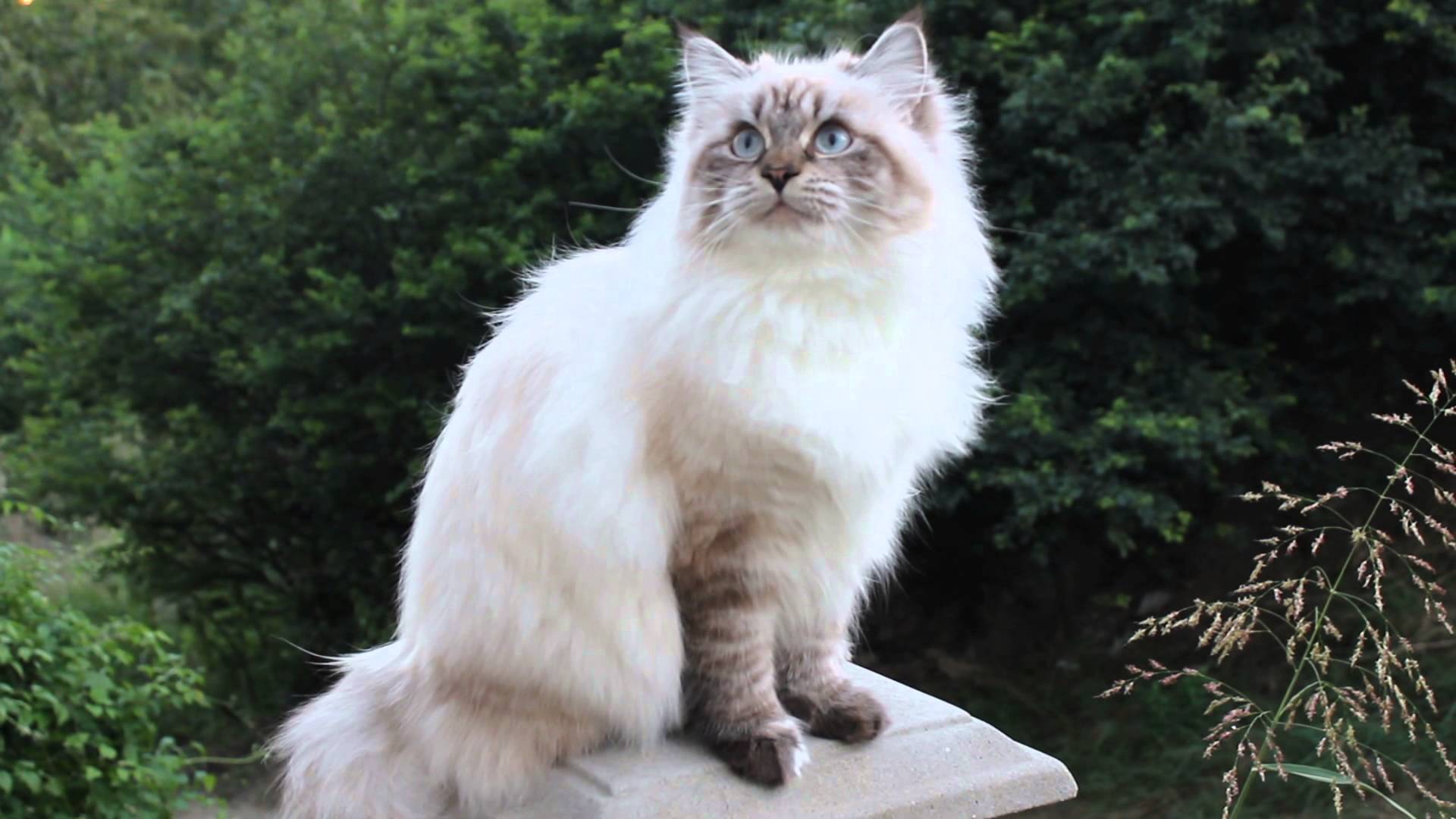
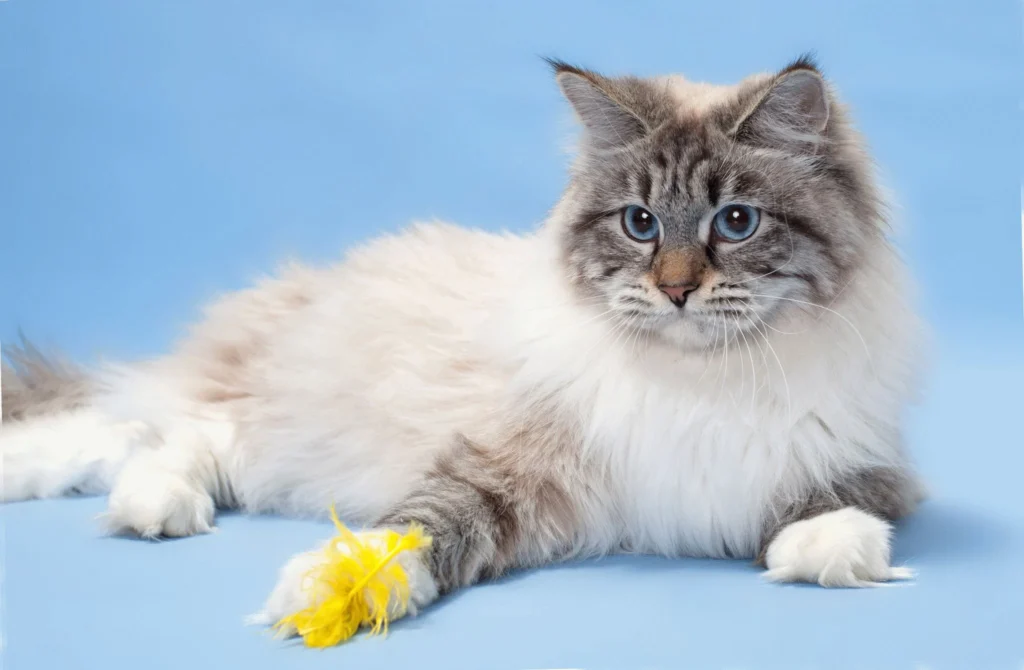
A fluffy Siberian in a “mask” — majestic and balanced: calm, affectionate, playful and dignified. The Neva Masquerade cat is the same powerful Siberian cat, but with colourpoint markings (a “mask” on the face, darkened paws, tail and ears) and blue eyes; independent, observant and slightly cautious with strangers, it is devoted to its family and, like the Siberian, is often tolerated better by allergy sufferers.
KidsDogsOther catsBeginnersTime alone · with caveats
The Neva Masquerade cat is an embodiment of calmness, affection, and playfulness, all wrapped up in one fluffy body. Essentially, it is the same majestic Siberian cat but with a unique colourpoint coat that creates a distinctive "mask" on the face and darker points on the paws, tail, and ears. These cats are always ready for a game, yet their behaviour is marked by restraint and dignity; read more about this on Tvaryny. They are independent, observant, and somewhat cautious with strangers, which adds to their special charm. Despite their luxurious, thick fur, grooming is not overly complicated. Members of this breed are renowned for their robust health and often delight their owners with long lives, reaching 15–18, and sometimes even 20 years.
The Neva Masquerade Cat: A Brief Breed Overview
The Neva Masquerade Cat: A Brief Breed Overview · 14
Characteristic
Description
Origin
Russian Federation (Saint Petersburg)
Time of emergence
Late 1980s
WCF Recognition
1992 (as a colour variation of the Siberian breed)
FIFe Recognition
2009 (as a sister breed of the Siberian)
Lifespan
15–18 years (sometimes longer)
Weight
Males: 6–10 kg, Females: 4–7 kg
Height at withers
Around 30–35 cm
Coat type
Semi-long, thick, with a double undercoat
Colouring
Colourpoint (seal-point, blue-point, red-point, cream-point, seal-tabby-point, blue-tabby-point, etc.) with or without white
The "mask" doesn't appear immediately: Kittens are born completely white, and their darker points only begin to show on the face, ears, paws, and tail after a few days or weeks. The final colour and contrast develop by 1.5–2 years of age.
Eye colour – only blue: Unlike traditionally coloured Siberian cats, whose eyes can be green, yellow, or copper, the Neva Masquerade standard only permits blue eyes of varying intensity. This is linked to the colourpoint gene.
Temperature affects colour: The colourpoint pattern is temperature-sensitive. Darker points develop on cooler areas of the body (extremities, tail, ears, face). Therefore, cats living in cooler climates or those that go outdoors in winter may have brighter, more pronounced points.
"Nevas" or "Siberians"? Although FIFe recognises them as a separate breed (NEM), many other felinological organisations (e.g., TICA, CFA - partially) register them as Siberian cats with colourpoint markings. Crossbreeding between them is permitted.
“Hypoallergenic” is a myth: The main cat allergen, Fel d 1, is produced by every cat without exception: it is made in the salivary and sebaceous glands, so it is present in saliva, on the skin and in the coat. How much allergen a cat produces varies far more from one individual animal to another than from breed to breed.
"Dog-like" personality: Many owners note dog-like traits in their character: devotion to one owner, greeting them at the door, and a desire to follow their person around and be involved in their activities.
Born hunters: Like their Siberian ancestors, Neva Masquerades have retained excellent hunting instincts. They might hunt flies, toy mice, or even real rodents if they have outdoor access.
Origin and History of the Neva Masquerade Breed
The history of the Neva Masquerade cat is closely intertwined with that of its ancestor, the Siberian cat. The appearance of the colourpoint pattern (also known as "Siamese") in Siberians was long a subject of debate. One main theory suggests this gene was introduced into the Siberian cat population through spontaneous crossbreeding with Siamese or similarly coloured cats, possibly brought to Siberia and the Far East. Another theory posits that the colourpoint gene (cs) might have existed in the native Siberian cat population as a recessive mutation.
Targeted selective breeding with Siberian-type cats displaying the characteristic dark points on the face, ears, paws, and tail against a lighter body, along with bright blue eyes, began in the late 1980s in cat fanciers' clubs in Saint Petersburg (then Leningrad). Notably, the 'Kotofey' club, under the guidance of Olga Sergeyevna Mironova, played a key role. It was thanks to their efforts that this elegant colouring was successfully established within the Siberian breed.
The name "Neva Masquerade" was given to the breed in honour of the River Neva, which flows through Saint Petersburg, and the characteristic "mask" on the animal's face. Initially, Neva Masquerades were considered a colour variation of the Siberian breed. In 1992, the World Cat Federation (WCF) recognised this colouring within the Siberian standard. However, over time, due to certain phenotypic and genotypic distinctions, as well as for breeding convenience, the Neva Masquerade began to be distinguished separately.
In 2009, the Fédération Internationale Féline (FIFe) recognised the Neva Masquerade cat as a sister breed to the Siberian, assigning it the code NEM (Neva Masquerade), whilst the Siberian cat has the code SIB. This means that crossbreeding between traditionally coloured Siberian cats and Neva Masquerades is permitted, and kittens are registered according to their phenotype (external appearance). Other felinological organisations may adopt different approaches: some continue to regard it as a colour variant of Siberians, whilst others recognise it as a distinct breed.
What the Neva Masquerade Cat Looks Like: Standard and Physical Features
The Neva Masquerade cat is a large, powerful, yet elegant animal, impressive for its harmonious blend of Siberian strength and the sophistication of its colourpoint markings.
Body: Medium to large in size, strong, muscular, with a heavy bone structure. Gives an impression of strength and power. Chest broad, back straight.
Head: Shaped like a broad, short trapezium with soft contours. Forehead broad, slightly convex. Smooth transition from forehead to nose, without a sharp stop. Cheekbones broad, set low. Chin well-developed but not protruding, forming a smooth line with the upper lip.
Ears: Medium-sized, broad at the base, slightly tilted forward, tips rounded. Ear furnishings (hairs inside the ear) and lynx tips (tufts on the ear tips) are desirable, though the latter are not always present.
Eyes: Large, oval, set slightly obliquely. The distance between the eyes is greater than the width of one eye. Eye colour must be a rich, intense blue (from light blue to sapphire). The more intense the colour, the better.
Neck: Short, strong, muscular.
Legs: Medium length, strong, powerful, forming a rectangle with the body. Paws large, round, with tufts of fur between the toes (a characteristic feature of Siberians).
Tail: Medium length, broad at the base, gradually tapering to a rounded tip. Well-furred, resembling a fox's brush.
Coat: Semi-long, very thick, with a well-developed, water-resistant double undercoat. The topcoat is coarser and glossy. The fur forms an abundant ruff around the neck, "trousers" on the hind legs, and a well-furred tail. In summer, the coat is significantly shorter and less dense than in winter. Texture can vary slightly depending on the colouring.
Colouring (Pattern): Only colourpoint. This means the main body colour is light (from white to cream or light beige), with darker markings (points) on the face ("mask"), ears, paws, and tail. The contrast between the points and the main body colour should be distinct. Permissible point variations include:
Seal-point: Dark brown (almost black) points.
Blue-point: Blue-grey points.
Red-point: Red points.
Cream-point: Cream points.
Tortie-point: Tortoiseshell points (a combination of black/blue with red/cream).
These colourings can also feature a tabby pattern (tabby-point or lynx-point) – striped points.
This elegant point pattern is also found in other breeds, such as the Seychellois cat, known for its similar markings. The presence of white "mittens" or "socks" on the paws, or a white spot on the chest or belly, is also permissible in Neva Masquerades (e.g., seal-point and white).
It is important to note that Neva Masquerade kittens are born completely white. Their points only begin to appear within the first few weeks of life, becoming fully developed by 1–2 years of age. As they get older, the contrast between the points and the body may lessen slightly, and the body fur might darken a little.
The Neva Masquerade Cat's Character: Temperament and Behaviour
The Neva Masquerade cat has inherited the finest character traits from its Siberian ancestors, complementing them with its own unique charm. These are balanced, calm, yet simultaneously playful and inquisitive animals. They are not prone to excessive fuss or destructive behaviour, but are always happy to join in a game, especially with favourite teaser toys or balls.
Loyalty and attachment to their owner are key traits of this breed. Neva Masquerades often choose one family member as "their" person, following them about, greeting them at the door, and taking part in all household activities. However, this devotion is unobtrusive. The cat will patiently wait until you are free and only then solicit attention with a quiet purr or a gentle paw-tap. They are not overly "talkative"; their voice is usually soft and melodious.
Thanks to their calm temperament and patience, Neva Masquerade cats get along wonderfully with children. They are happy to participate in children's games but are also clever enough to avoid rough handling by simply retreating elsewhere. It is important to teach children to respect the cat's personal space.
Neva Masquerades usually establish peaceful relationships with other pets, including other cats and dogs (especially if raised together). Their innate hunting instinct may surface around small rodents or birds, so keeping them together requires caution and supervision.
Towards strangers, these cats exhibit a cautious reserve. They won't hide under the sofa, nor will they immediately jump into a guest's lap. Initially, a Neva Masquerade will observe a new person from a distance, assessing the situation, and only then might it allow itself to be stroked.
These are intelligent animals that readily learn house rules and quickly take to the litter tray and scratching post. Some owners note their ability to learn simple tricks. Thanks to their Siberian heritage, they have retained a degree of independence and can happily spend time alone while their owners are at work, provided they have things to occupy them (toys, climbing structures).
Training and Socialisation of the Neva Masquerade Cat
Neva Masquerade cats are intelligent and quick-witted animals, which makes their upbringing and socialisation relatively straightforward. Their balanced temperament and natural curiosity help them learn house rules and even a few tricks.
Socialisation: Early socialisation is crucial for any kitten, and Neva Masquerades are no exception. Between 2 and 7 weeks of age, kittens are most receptive to new information and experiences. It's vital that during this time they interact with their mother and littermates (learning feline etiquette) as well as with people. When a kitten arrives in a new home (usually between 12–16 weeks old), the socialisation process continues. Gradually introduce it to all family members, other pets (under supervision), and various sounds and situations. This will help to raise a confident, calm, and sociable cat.
Litter tray and scratching post training: Kittens are usually taught to use a litter tray and scratching post by the breeder. In a new home, it's important to show the kitten where these items are located. If "accidents" occur with the litter tray, don't punish the kitten; instead, try to determine the cause (perhaps it dislikes the litter, the tray's location, or it's not clean enough). To draw attention to the scratching post, you can use catnip or demonstrate by "scratching" it with your fingernails.
Upbringing and establishing rules: Although Neva Masquerades are not prone to destructive behaviour, it's important to set clear rules from the outset: what is allowed and what is not (e.g., climbing on tables, scratching furniture). Training should be based on positive reinforcement. Praise and reward your cat with treats or affection for good behaviour. Ignore undesirable behaviour or redirect the cat's attention to a toy or scratching post. Never use physical punishment – this can lead to fear, aggression, and damage the bond of trust.
Teaching commands and tricks: Thanks to their intelligence, Neva Masquerades can learn some commands ("come," "sit") or simple tricks (giving a paw, fetching a toy). Use short training sessions (5–10 minutes), positive reinforcement (clicker training, treats), and patience. The main thing is that the learning process should be engaging and enjoyable for the cat.
Play activity: Neva Masquerades are quite active cats, especially when young. Regular play is essential for maintaining physical fitness, mental stimulation, and strengthening the bond with their owner. Use a variety of toys: "fishing rod" teasers, balls, laser pointers (always end the game by letting them "catch" the prey by pointing the beam onto a toy or treat), and interactive toys. They will also enjoy multi-level climbing frames for exploring and observing their surroundings from a height.
Walks: Many Neva Masquerade cats, like their Siberian relatives, don't mind walks outdoors. If you decide to walk your cat, be sure to use a secure harness and lead. Accustom it to the harness gradually, indoors. Walks should take place in a safe area, away from roads and aggressive dogs.
Pros and Cons of the Neva Masquerade Cat
Pros and Cons of the Neva Masquerade Cat · 7
Pros
Cons
Striking appearance: A combination of Siberian build and colourpoint markings with blue eyes.
Grooming needs: Although the coat isn't prone to severe matting, regular brushing (especially during moulting) is necessary.
Robust health and longevity: Good genetics inherited from Siberians.
Seasonal moulting: Intense shedding occurs twice a year, meaning fur will be all over the house.
Balanced and amiable temperament: Calm, affectionate, unobtrusive.
Potential tendency to gain weight: Requires dietary control and sufficient activity.
Gets on well with children and other animals: Patient and non-aggressive.
Need for space and activity: Large and active cats, they require room for play and movement.
High intelligence: Easily learns house rules, quickly adapts to the litter tray and scratching post.
Price: Kittens from reputable breeders can be quite expensive.
Devotion to owner: Forms a strong bond with their chosen person.
Wary of strangers: May not be overly sociable with guests.
Not hypoallergenic: There is no such thing as a hypoallergenic cat. The main cat allergen, Fel d 1, is produced by every cat without exception: it is made in the salivary and sebaceous glands, so it is present in saliva, on the skin and in the coat.
Needs companionship: Although independent, they require attention and interaction with their owner.
Grooming Specifics for the Neva Masquerade Cat's Coat
The Neva Masquerade cat's magnificent, often described as triple-layered, coat is its pride and hallmark. It consists of a long, somewhat coarse topcoat, dense guard hairs, and a soft, thick undercoat. This "fur coat" offers excellent protection against the cold but requires regular grooming from the owner, though it's not as demanding as it might first appear.
The primary grooming tool is a comb. It is recommended to brush your Neva Masquerade cat 1–2 times a week. The most suitable tools for this are:
A metal comb with teeth of varying lengths and densities: Helps to detangle small knots and reach the undercoat.
A slicker brush: Effectively removes dead undercoat, especially during moulting. Use gently to avoid scratching the skin.
A deshedding tool (e.g., Furminator), if desired: Efficiently removes undercoat but should be used no more than 1–2 times a month to avoid damaging the guard hairs.
Brush in the direction of hair growth, paying particular attention to areas where mats form most often: the ruff, "trousers," belly, and armpits. Due to its specific texture, the Neva Masquerade's coat is less prone to matting than that of some other long-haired breeds (like Persians), but regular grooming is still essential.
Moulting Season: Neva Masquerades, like Siberians, have a pronounced seasonal moult in spring and autumn. In spring, they shed their thick winter undercoat in preparation for summer, and in autumn, their coat is renewed for the colder months. During these periods, you'll need to brush your cat more frequently, possibly daily or every other day, to help remove dead fur and prevent ingestion leading to hairballs (trichobezoars) in the stomach. Special pastes or foods can be used to aid the passage of fur through the digestive tract.
Bathing: Neva Masquerade cats are naturally clean and usually groom themselves well. They should be bathed only when necessary: if heavily soiled, before a show, or during an intense moult (bathing helps remove more dead fur). Bathing frequency should be no more than once every 2–4 months, or even less often. Use only shampoos specifically designed for long-haired cats. It's vital to rinse all shampoo from the coat thoroughly and dry the cat carefully with a towel and, if it's not afraid, a hairdryer (on a low heat and power setting) to prevent chilling and matting of wet fur.
Other grooming aspects:
Eyes: Inspect the eyes regularly. Small, clear, or brownish discharges in the corners are normal. These can be gently wiped away with a clean, damp cloth or cotton pad moistened with a special eye lotion or boiled (and cooled) water. If discharges are heavy, purulent, or the eyes are red, consult a vet.
Ears: Check the ears weekly. Clean, pink ear flaps are a sign of health. A small amount of wax can be removed with a cotton pad moistened with a special ear cleaning solution. Do not use cotton buds to clean the ear canal! If you notice dark discharge, an unpleasant smell, redness, or if the cat is shaking its head or scratching its ears, see a vet (this could indicate ear mites or an infection).
Claws: If the cat doesn't wear down its claws sufficiently on a scratching post, they will need trimming with special claw clippers approximately every 2–4 weeks. Only trim the transparent tip of the claw, avoiding the pink part (the quick), which contains blood vessels and nerves. A good scratching post (or several of different types) is essential.
Nutrition
Feeding Your Neva Masquerade Cat: Key Recommendations
Health and risks
Neva Masquerade Cat Health: Common Ailments and Prevention
Frequently Asked Questions About the Neva Masquerade Cat (FAQ) · 7
Do Neva Masquerade cats shed a lot? Yes, like most long-haired cats, they do shed. Moulting is particularly intense twice a year – in spring and autumn. Regular brushing helps to control the amount of fur in the house and prevents mats from forming.
Are Neva Masquerade cats suitable for people with allergies? There is no such thing as a hypoallergenic cat. The main cat allergen, Fel d 1, is produced by every cat without exception: it is made in the salivary and sebaceous glands, so it is present in saliva, on the skin and in the coat. How much allergen a cat produces varies far more from one individual animal to another than from breed to breed. If you have an allergy, spend time with the particular cat you are taking home and make the decision together with an allergist — the breed guarantees nothing.
Do Neva Masquerade cats get along with children? Yes, they usually get along very well with children due to their patient and calm nature. They are playful but not aggressive. It's important to teach children to respect the cat and handle it properly.
Do they require a lot of grooming? The main grooming requirement is regular brushing of their coat (1–2 times a week, more often during moulting). Bathing is rarely needed, only when necessary. Standard care for ears, eyes, and claws is also required. Overall, their grooming needs are not overly demanding for a long-haired breed.
Can a Neva Masquerade cat be kept in a flat? Yes, they adapt well to living in a flat, provided they have enough space for movement, toys, and a climbing frame for activity. Regular play sessions with their owner are also important for them to expend energy.
What is the difference between a Neva Masquerade and a Siberian cat? The main difference is in their colouring and eye colour. The Neva Masquerade is a Siberian cat with a colourpoint pattern (dark points on a light background) and exclusively blue eyes. A Siberian cat can have various traditional colourings (solid, tabby, bicolor) and eyes that are green, yellow, or copper. In terms of temperament and build, they are very similar.
How long do Neva Masquerade cats live? This is a long-lived breed. With proper care and nutrition, their average lifespan is 15–18 years, and some individuals live to be 20 years or older.
FAQ
How does the Neva Masquerade differ from the Siberian cat?
It is the same Siberian cat, but with colourpoint markings: a characteristic dark “mask” on the face, darkened paws, tail and ears and blue eyes; size, character and health are Siberian.
Is the Neva Masquerade hypoallergenic?
There is no such thing as a hypoallergenic cat. The main cat allergen, Fel d 1, is produced by every cat without exception: it is made in the salivary and sebaceous glands, so it is present in saliva, on the skin and in the coat. How much allergen a cat produces varies far more from one individual animal to another than from breed to breed. If you have an allergy, spend time with the particular cat you are taking home and make the decision together with an allergist — the breed guarantees nothing.
Is the Neva Masquerade good for a family?
Yes — a balanced, affectionate and devoted cat, good with children and dogs; it is independent and slightly cautious with strangers, but bonds deeply with “its own”.