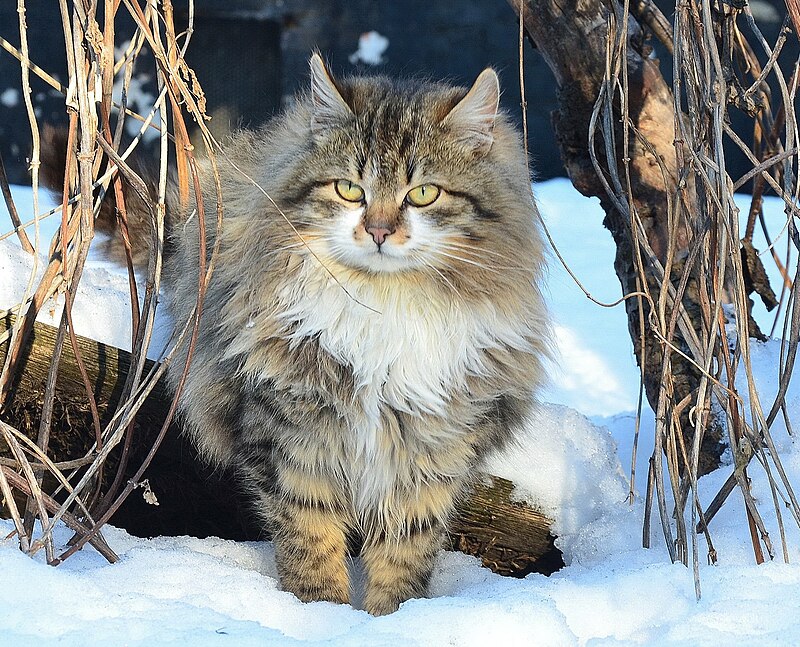
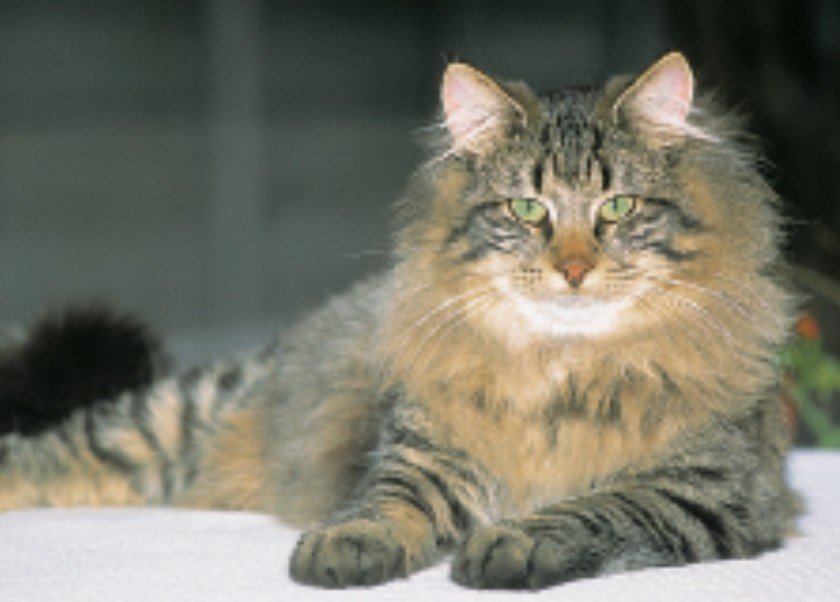
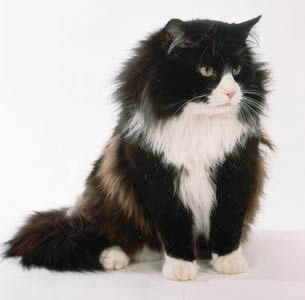
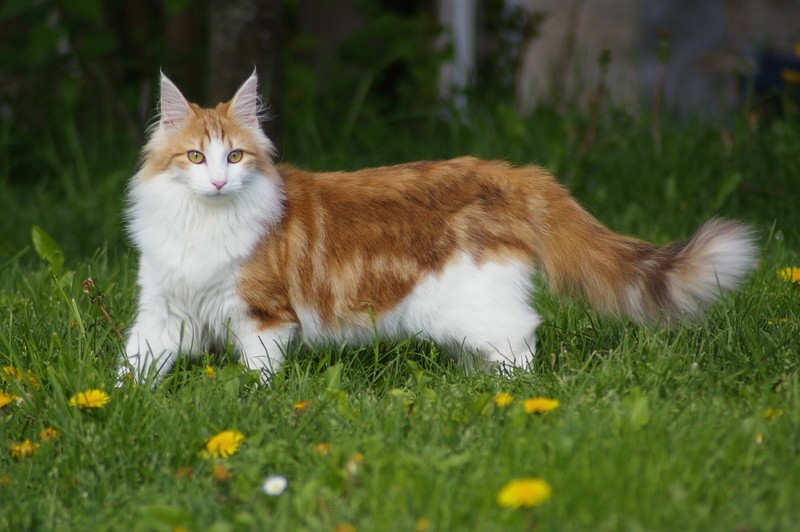
A mighty forest giant from the Scandinavian sagas — strong and independently affectionate: hardy, clever, calm and good-natured. The Norwegian Forest Cat is an aboriginal breed with a dense water-repellent double coat, adapted to the harsh winters of the North; a strong, agile climber and tireless hunter, it is balanced, good with family and animals and undemanding, but needs space, high shelves and care of its lavish coat.
The dense double coat sheds heavily and needs care
Large — needs space and high shelves
Matures slowly (up to 4–5 years)
A tendency to heart disease (HCM)
Size
ToySmallMediumLargeGiant
Compatibility
KidsDogsOther catsBeginnersTime alone · with caveats
The Norwegian Forest Cat's appearance is the epitome of strength and endurance, perfectly suited to the harsh climate of Northern Europe. Yet, beneath this wild beauty lies a surprisingly affectionate and docile nature, as delightful as its soft-to-the-touch fur. This thickly-furred domestic pet possesses a strong exploratory instinct, meaning it will try its utmost to leave the confines of a flat for an active jaunt outdoors. If it doesn't have free access to natural high spots, rest assured – it will find the tallest wardrobe or shelf from which to regally observe its owner's activities. You can find out more on Tvaryny. Caring for this magnificent creature has its own specific requirements, mainly related to the seasonal change of its luxurious, dense coat. But the effort is well worth it, as this fluffy companion is not only beautiful but also highly trainable and becomes a loyal friend. Whilst the Norwegian Forest Cat is a marvel, the feline world offers many other captivating breeds, each with unique traits, such as the American Curl with its distinctive ears, or the ruggedly handsome Pixiebob.
Norwegian Forest Cat: A Brief Breed Overview
Norwegian Forest Cat: A Brief Breed Overview · 15
Characteristic
Description
Origin
Norway
Original Name
Norsk Skogkatt
Other Names
Skogkatt, Wegie
Year of FIFe Recognition
1977
Lifespan
14–16 years (occasionally up to 20)
Size
Large
Height at Withers
Males: 30–40 cm; Females: 25–35 cm
Weight
Males: 6–9 kg; Females: 4–6 kg
Coat Type
Semi-long, double (long guard hairs and dense undercoat)
Colours
Various, except for Siamese points, chocolate, lilac, cinnamon, and fawn
Temperament
Independent, intelligent, calm, affectionate with family, playful, good hunter
Activity Level
High, requires space and climbing opportunities
Grooming
Moderate (regular brushing, especially during shedding season)
Compatibility with Children
Good (provided children are gentle and respectful)
Compatibility with Other Animals
Good (with proper socialisation)
The Norwegian Forest Cat and Other Domestic Animals
Norwegian Forest Cats usually have a friendly and tolerant nature, which allows them to get along with other pets, especially if they grew up together or were properly introduced.
With Other Cats: Skogkatts often get along well with other cats, especially if they have a similar temperament (not overly dominant or aggressive). Having a feline companion can help satisfy their need for social interaction, particularly if owners spend a lot of time away from home.
With Dogs: Many Norwegian Forest Cats can coexist peacefully with dogs, especially if the dog is calm, well-behaved, and not prone to chasing cats. It is important to conduct introductions gradually and under careful supervision.
With Small Animals: This is where great caution is needed. Norwegian Forest Cats are skilled hunters with a strong natural instinct. Therefore, keeping them in the same home with small animals such as hamsters, guinea pigs, rats, birds, or fish involves a high risk. Even if the cat seems indifferent, the instinct can kick in at any moment. If you do keep such animals, you must ensure their complete safety (secure cages, inaccessibility to the cat) and never leave them together unsupervised.
The key to successful cohabitation is a proper, gradual introduction of animals on neutral territory, under supervision, and ensuring each animal has its own safe space, food, and attention.
Comparing the Norwegian Forest Cat with Similar Breeds
The Norwegian Forest Cat is often confused with two other large, long-haired breeds – the Maine Coon and the Siberian Cat. Although they share similar features, there are also differences:
Head: The Norwegian has a triangular head with a straight profile, whilst the Maine Coon has a more square ("boxy") muzzle with a distinct break from the forehead to the nose (stop).
Ears: In the Norwegian, the ears continue the line of the triangular head; in the Maine Coon, they are set higher and more vertically.
Body: Maine Coons are often slightly larger and more massive, with a more rectangular body. The Norwegian's hind legs are noticeably longer than its front legs.
Coat: The Maine Coon's coat is more "shaggy," with a less pronounced undercoat compared to the very dense undercoat of the Norwegian.
Head: The Siberian has a more rounded head, with a shorter and rounder muzzle, and the profile has a gentle curve. The Norwegian has a triangular head and a straight profile.
Body: Siberian cats have a more "barrel-shaped," stocky body. Norwegians appear more elongated and elegant.
Coat: Both breeds have a dense double coat adapted to the cold. The Siberian's coat may be slightly softer. Siberian cats are sometimes considered less allergenic (although no breed is scientifically proven to be hypoallergenic).
Despite the differences, all three breeds are known for their friendly nature, intelligence, and impressive "wild" cat appearance.
Interesting Facts About the Norwegian Forest Cat
National Treasure: The Norwegian Forest Cat was officially recognised as Norway's national cat breed by King Olaf V.
Cats of the Goddess Freyja: As mentioned, legend has it that these cats pulled the chariot of the Norse goddess of love and beauty, Freyja.
Viking Ship Cats: There is a theory that Vikings took these cats on sea voyages to control rodents on their ships, which contributed to their spread.
"Snowshoe Paws": Dense tufts of fur between their toes not only protected them from the cold but also helped them to move across deep snow, much like snowshoes.
Waterproof Coat: The double structure of their coat, with long guard hairs and a dense undercoat, makes it virtually waterproof, allowing the cats to survive in Norway's rainy and snowy climate.
Slow Maturation: Norwegian Forest Cats grow slowly and reach full physical development and size only at the age of 3–5 years.
Natural Climbers: Thanks to their strong claws and the fact that their hind legs are longer than their front ones, they are exceptional climbers, capable of scaling trees and even rocky surfaces.
Almost Extinct: In the mid-20th century, the breed was on the verge of extinction due to interbreeding with other cats. Their survival is the result of the dedicated efforts of Norwegian enthusiasts.
History and Origin of the Norwegian Forest Cat
The history of the Norwegian Forest Cat is shrouded in legend and dates back centuries, closely intertwined with Scandinavian mythology and history. This favourite of Northern European cat owners is attributed with both local and southern origins. According to one of the most popular versions, the ancestors of modern Skogkatts were long-haired cats brought by Vikings around the 11th century. These may have been Turkish Angoras brought from the Eastern Roman Empire (Byzantium) or other long-haired breeds from the Middle East. Finding themselves in the harsh conditions of Scandinavia, these cats adapted over centuries, developing a thick, waterproof coat, a sturdy build, and excellent hunting skills to survive in the forests.
Another theory suggests that Norwegian Forest Cats descend from short-haired cats brought to Northern Europe by the Romans, which later interbred with long-haired cats, possibly Siberian cats, or developed longer fur through natural mutation and selection in the cold climate. There is also a version suggesting a connection with wild forest cats from Scotland.
These cats even found their place in Scandinavian mythology. Legends tell of "forest fairies" or "troll-cats" of enormous size with fluffy tails, capable of climbing rocks. It is believed that the goddess of love and beauty, Freyja, rode in a chariot drawn by two large grey cats, whose description strongly resembles that of Norwegian Forest Cats.
For centuries, these cats were common inhabitants of Norwegian farms and forests, valued for their hunting abilities. However, in the 20th century, especially after the Second World War, the breed found itself on the brink of extinction due to uncontrolled crossbreeding with short-haired domestic cats. It was only thanks to the efforts of enthusiasts, notably Carl-Fredrik Nordane, that work began in the 1930s to preserve and standardise the breed. In 1938, the Norwegian Forest Cat was first presented at a show in Oslo.
Systematic work was interrupted by the war but resumed in the 1960s-1970s. In 1972, the breed received a preliminary standard in Norway, and in 1977, it was officially recognised by the Fédération Internationale Féline (FIFe). Today, the Norwegian Forest Cat is Norway's national breed and enjoys great popularity worldwide, symbolising the wild beauty and resilience of Nordic nature.
What Does the Norwegian Forest Cat Look Like: Breed Standard
The Norwegian Forest Cat is a large, strong, and elegant animal, whose appearance radiates power and adaptability to harsh conditions. Its looks harmoniously combine wild grace with domestic comfort.
General Appearance: Large, strong bone structure, elongated, muscular body. Gives an impression of power and agility. Reaches full development (size and coat) only at the age of 3–5 years.
Head: Shaped like an equilateral triangle (when viewed from the front). The profile is long and straight, without a "stop" (a break between the forehead and nose). The chin is strong, giving the muzzle a determined look.
Ears: Large, broad at the base, with pointed tips. Set high and wide, continuing the line of the triangular head. Desirable features include lynx tips on the ends and dense tufts of fur inside the ear.
Eyes: Large, almond-shaped, expressive. Set slightly obliquely. Eye colour can be any (green, gold, copper), often harmonising with the coat colour. White cats may have blue eyes or heterochromia (eyes of different colours).
Body: Long, massive, with a strong bone structure and well-developed musculature. Broad chest.
Limbs and Paws: Legs are strong and tall. Hind legs are slightly longer than the front legs, giving the cat a characteristic "stance" and aiding in jumping and climbing. Paws are large, round, with dense tufts of fur between the toes (so-called "snowshoe paws," which helped them move on snow).
Tail: Long (ideally equal to the body length from the base of the neck to the base of the tail), very bushy, resembling a fox's tail. The cat often holds it high.
Coat: The breed's crowning glory – a luxurious double coat that provides ideal protection from cold and moisture. It consists of:
Long, coarse, glossy, and water-repellent guard hairs covering the back and sides.
A very dense, soft, woolly undercoat that provides thermal insulation.
The coat undergoes distinct seasonal changes: in winter, it is significantly thicker and longer, with a lavish ruff ("mane") around the neck and chest, as well as dense "knickerbockers" on the hind legs. In summer, the coat becomes shorter and less dense, though the bushy tail and "lynx tips" remain.
Colours of the Norwegian Forest Cat
Breed standards permit a wide variety of colours and patterns in the coat of Norwegian Forest Cats. The only exceptions are those that indicate hybridisation with other breeds.
Colours of the Norwegian Forest Cat · 7
Colour Category
Description and Examples
Solid
Black, blue, red, cream, white.
Tortoiseshell
Combination of black/blue with red/cream (Tortie), often with white (Calico, Bluecream & White).
Tabby – All patterns
Tabby can occur on any base colour (brown tabby, blue tabby, red tabby, cream tabby, silver tabby, etc.).
Smoke
Solid colour with a silvery-white undercoat at the base of the hairs, visible when the cat moves (black smoke, blue smoke).
Silver
Tabby pattern with a lightened, silvery-white background instead of a warm yellowish or grey (silver tabby).
With White
Any of the listed colours combined with white patches of varying size and placement (bicolours, harlequins, vans).
Forbidden Colours
Pointed patterns (as in Siamese cats), chocolate, lilac, cinnamon, and fawn, as well as their combinations with white—these colours indicate outcrossing to other breeds.
Character and Temperament of the Skogkatt
The Norwegian Forest Cat possesses a unique blend of traits: it is independent and self-sufficient, like its wild ancestors, yet at the same time very gentle, devoted, and family-oriented. These cats are not demanding but enjoy being near people, observing their activities, or quietly dozing nearby.
Intelligence and Cleverness: These are very intelligent cats that learn quickly and can solve simple problems, such as how to open cupboard doors or retrieve a favourite toy. Their intelligence requires mental stimulation through games and interactive toys.
Calmness and Composure: Skogkatts are generally quite calm and composed. They are not prone to excessive fussiness or loud vocalisations. Their voice is usually quiet and rarely used without reason.
Playfulness and Activity: Despite their calm temperament, Norwegian Forest Cats remain playful throughout their lives. They adore climbing and conquering heights, so the presence of tall cat trees, shelves, or access to wardrobes is important for them. Active games, especially those mimicking hunting, help them stay in shape.
Independence vs. Affection: Skogkatts value their independence and can quietly spend time alone, exploring their territory or resting. However, they become very attached to their owners and do not tolerate prolonged solitude well. They need attention and interaction, though they won't constantly demand it.
Attitude Towards Strangers: They typically treat strangers with reserve and caution, preferring to observe from a safe distance. They need time to get used to new people in the home.
Compatibility: Norwegian Forest Cats generally get along well with children, especially if the children are taught to handle animals gently and respectfully. They can also live with other cats and dogs, particularly if socialised from an early age. However, their strong hunting instinct can pose a threat to small pets (birds, rodents, fish).
Adaptability: They adapt quite easily to various living conditions, including living in a flat, provided there is enough space, climbing opportunities, and play activity.
Rearing, Training, and Socialisation of the Norwegian Forest Cat
Norwegian Forest Cats are intelligent and observant animals, which makes them quite trainable. Although they have an independent character, their cleverness and desire to interact with their owner open up opportunities for rearing and even training.
Training Methods:Positive reinforcement works best. Use treats, praise, and play as rewards for correct behaviour. Punishment and shouting are ineffective and can cause fear or distrust in the cat. Clicker training is a well-suited method.
What Can Be Taught: Skogkatts can be taught to use a litter tray, scratching post, and their name. Many are capable of learning simple commands ("sit," "give paw," "come here"), especially if training is conducted playfully. Some members of the breed can even be trained to walk on a harness, which will satisfy their need to explore the surrounding world.
Socialisation: This is a critically important stage for Norwegian Forest Cats, given their natural caution towards strangers. Early socialisation (from a few weeks to a few months of age) helps a kitten grow into a confident and friendly cat. Introduce the kitten to different people, sounds, situations, and other animals (under supervision). Proper socialisation will help avoid excessive shyness or fear in adulthood.
Addressing Behavioural Problems:
Climbing: Do not punish the cat for climbing on furniture. Instead, provide it with permissible alternatives – tall and stable cat trees, shelves. Make these places attractive with toys or catnip.
Scratching: Provide a sufficient number of scratching posts made of different materials (sisal, cardboard, wood) and place them in strategic locations (near sleeping areas, on the cat's travel paths).
Patience and Consistency: Remember the breed's independent nature. Do not force the cat into training if it is not in the mood. Sessions should be short, interesting, and positive. Consistency in rules and requirements is key to successful rearing.
Pros and Cons of the Norwegian Forest Cat Breed
Before getting a Norwegian Forest Cat, it is important to weigh all the advantages and potential difficulties of keeping this wonderful breed.
Pros and Cons of the Norwegian Forest Cat Breed · 8
Pros (+)
Cons (-)
Striking appearance: Large size, luxurious coat, and "wild" look make them exceptionally beautiful.
Grooming needs: Long double coat requires regular brushing (2–3 times a week, daily during shedding) to prevent mats.
Intelligent and clever: Easy to train, can learn tricks and house rules.
Heavy shedding: Especially in spring and autumn, fur will be all over the house.
Calm and balanced temperament: Not prone to excessive activity or loud noises, create a cosy atmosphere.
Need for space and activity: Require climbing facilities (tall cat trees, shelves) and regular play to maintain physical and mental fitness. Not well-suited for very small flats without additional enrichment.
Affectionate and devoted to family: Become very attached to their owners, though not overly demanding.
Wary of strangers: Can be shy or distrustful of guests, need time to adapt.
Good with children and other animals: With proper socialisation and respectful handling by children.
Not suited for long periods of solitude: Need companionship and attention, can become lonely if left alone for long stretches regularly.
Relatively robust health: Have good natural immunity, are hardy.
Predisposition to certain genetic diseases: Need to be aware of risks of HCM and Glycogen Storage Disease type IV (though the latter is now rare due to testing).
Adaptable: Can live in a private house with (safe!) outdoor access, or in a flat under the right conditions.
Strong hunting instinct: May hunt small animals, posing a risk to rodents or birds in the home.
Long lifespan: Can delight their owners with their company for 14–16 years or more.
Slow to mature: Reach full size and development only at 3–5 years of age.
Care and Upkeep of the Norwegian Forest Cat
Caring for a Norwegian Forest Cat is not overly complicated but requires regularity and attention to some specific aspects related to its luxurious coat and active character.
Grooming: Coat Care
Although the Norwegian Forest Cat's coat has water-repellent properties and is not as prone to matting as that of Persians, it still requires regular care:
Brushing: The main element of care. It is recommended to brush the cat 2–3 times a week using a metal comb with wide teeth and a slicker brush. This will help remove dead hairs and prevent mats, especially in problem areas (underarms, "knickerbockers," behind the ears).
Shedding Season: In spring and autumn, there is an intensive change of coat. During this time, the cat needs to be brushed daily to help it get rid of the old undercoat and reduce the amount of fur in the house. Insufficient brushing can lead to the cat ingesting fur during grooming, which can cause stomach problems (formation of hairballs - trichobezoars).
Bathing: Due to the coat's structure, Norwegian Forest Cats do not require frequent washing. Bathe them only when necessary (heavy soiling, preparation for a show) – perhaps 1–2 times a year. Use special shampoos for long-haired cats.
Claws: Regularly trim the tips of the claws (approximately every 2–4 weeks) with special nail clippers to prevent them from ingrowing and damaging furniture. Be sure to offer the cat several good-quality scratching posts in different places around the flat.
Ears and Eyes: Regularly inspect the ears for dirt or signs of inflammation. Clean them only when necessary with a cotton pad moistened with a special lotion. Eyes usually do not require special care, but if discharge appears, it should be gently wiped with a clean tissue or cotton pad moistened with warm, boiled water.
Environment and Activity
Norwegian Forest Cats are active and inquisitive animals that require an appropriate environment:
Vertical Space: These are the mountaineers of the cat world. Provide them with access to high places: multi-level cat trees, wall shelves, access to wardrobes (if safe). This will satisfy their natural instinct to climb and observe from a height.
Play Activity: Regularly play with your cat using wand toys, balls, and laser pointers (always ending the game with "catching" the prey). Interactive toys and puzzles will help maintain its mental activity.
Safety: If the cat lives in a flat, ensure that windows and balconies are protected with "cat-proof" netting. If there is outdoor access, it must be secure (an enclosed catio or walks on a harness under supervision). Free-roaming is not recommended due to risks of injury, infection, theft, and danger to local wildlife.
Resting Place: Set up several cosy places for sleeping and resting – soft beds, houses, preferably at different heights.
Nutrition
Feeding the Norwegian Forest Cat: Key Recommendations
Health and risks
Health and Disease Susceptibility in the Norwegian Forest Cat
Frequently Asked Questions About the Norwegian Forest Cat Breed (FAQ) · 7
Are Norwegian Forest Cats suitable for living in a flat? Yes, they can adapt to life in a flat, provided they are given enough space to move, plenty of climbing opportunities (tall cat trees, shelves), and regular play activity to burn off energy. A small flat without additional enrichment might be too confined for them.
Do Norwegian Forest Cats shed a lot? Yes, especially during seasonal moults in spring and autumn when they shed their thick winter undercoat. Daily brushing is necessary during these periods. At other times, shedding is moderate, but regular grooming (2–3 times a week) is still required.
Do Norwegian Forest Cats get along with children? Usually, yes. They are patient and calm, but it's important to teach children to handle the cat gently and respectfully, and not to disturb it during sleep or meals. As with any animal, interaction with young children should be supervised.
How long do Norwegian Forest Cats live? The average lifespan is 14–16 years, but with good care and robust health, they can live up to 18–20 years.
Are Norwegian Forest Cats hypoallergenic? No, Norwegian Forest Cats are not considered a hypoallergenic breed. They produce the allergen Fel d 1 (like all cats), although individual human reactions may vary. People with allergies are advised to spend time with representatives of the breed before getting a kitten.
Do Norwegian Forest Cats require a lot of attention? They are not excessively demanding but appreciate the company of their family. They need daily interaction, play, and affection. They do not tolerate prolonged solitude well and can become lonely if regularly left alone all day.
Can Norwegian Forest Cats be let outside? Due to numerous dangers (cars, diseases, poisoning, other animals, theft), free-roaming is not recommended. If you want to provide your cat with access to fresh air, safer options include a secure enclosed outdoor area (a "catio") or walks on a harness under close supervision.
FAQ
How does the Norwegian Forest Cat differ from the Maine Coon?
Both are large semi-long-haired aboriginal breeds, but the Norwegian has a triangular face and a dense water-repellent double coat for harsh winters, while the Maine Coon is larger, with a squarer face and a longer body; their characters are similar — both calm and “dog-like”.
Is the Norwegian Forest Cat hard to care for?
Moderately — the dense double coat is brushed 2–3 times a week, and more often during the seasonal moult so it does not mat; otherwise it is an undemanding, hardy breed.
Is the Norwegian Forest Cat good for a family?
Very — a balanced, good-natured and devoted cat that gets on with children, dogs and other animals; it is independent, loves climbing and heights, so it will appreciate high shelves and space.