

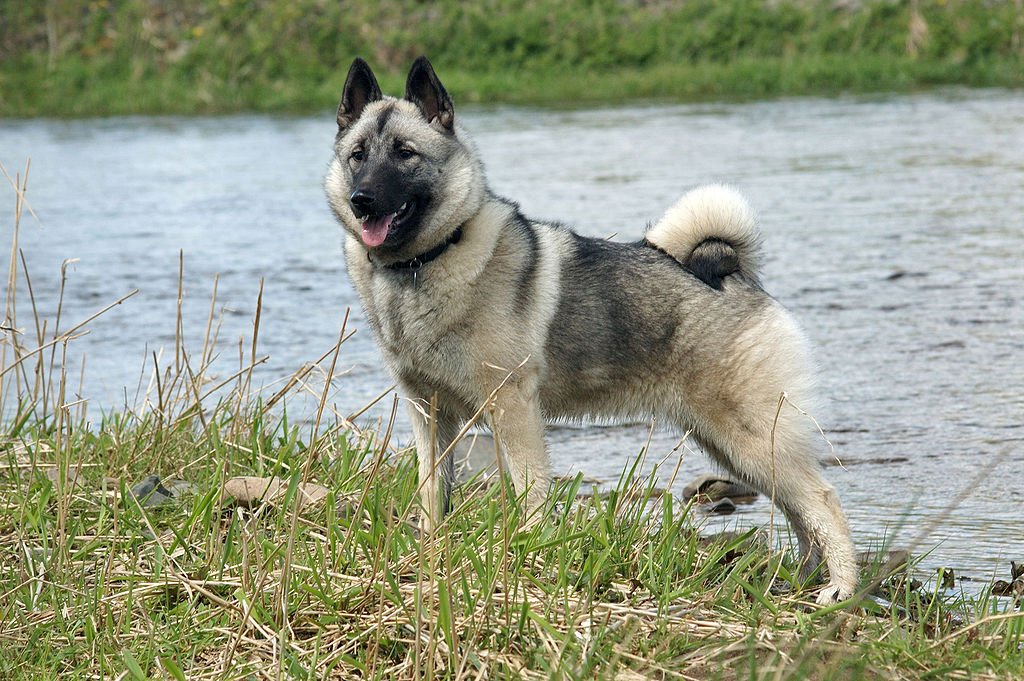
| Height | 49–53 cm |
| Weight | 20–27 kg |
| Lifespan | 10–15 years |
| FCI group | 5 · spitz |
| Origin | Norway |
Exact ratings
Common health issues
Nutrition
The Grey Norwegian Elkhound is far more than just a magnificent hunting dog; it is a national treasure of Norway and one of the oldest dog breeds in Europe. They are primarily known for their exceptional ability to hunt large game, especially the moose (or elk). This powerful animal can run at speeds of around 30 kilometres per hour for up to 12 hours, and only the Elkhound has the stamina to tirelessly pursue, corner, and hold this mighty beast until the hunter arrives. These dogs are truly versatile: they excel in many roles, possessing a high level of intelligence and outstanding trainability. For more about this amazing canine, read on here at Tvaryny.
In addition, Norwegian Elkhounds also make wonderful companions. They are superb with children, patiently and understandingly tolerating all their mischief, becomming reliable friends and protectors. Generally, Elkhounds are friendly and open towards people. However, their guarding instinct is also well-developed. Should an intruder enter their territory, this dog will fearlessly stand in its defence, alerting with a loud bark and demonstrating its courage. Norwegian Elkhounds are not always agreeable with other dogs, particularly males; a struggle for leadership is inevitable, which is why early socialisation is key to harmonious coexistence.
The Norwegian Elkhound (Grey): A Brief Breed Overview
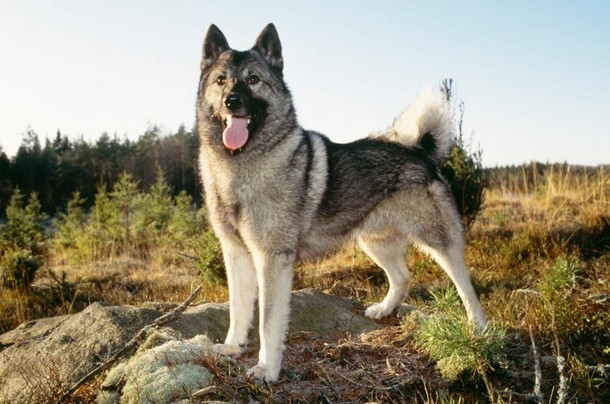
| Characteristic | Value |
| Origin | Norway |
| FCI Classification | Group 5 (Spitz and Primitive Types), Section 2 (Nordic Hunting Dogs) |
| Year of First Mention | Archaeological finds date back to 4000-5000 BC, modern standard – 1877 |
| Life Expectancy | 12-15 years |
| Height at Withers | Males: 52 cm; Females: 49 cm |
| Weight | Males: approx. 23-25 kg; Females: approx. 18-20 kg |
| Temperament | Bold, energetic, independent, loyal, friendly |
| Use | Moose hunting, guarding, companion, search and rescue |
History of the Norwegian Elkhound Breed
The history of the Grey Norwegian Elkhound stretches back to ancient times, making it one of the most venerable dog breeds in Europe. Archaeological excavations in Scandinavia, particularly Norway, have uncovered dog skeletons dating back 4000-5000 years BC, which are anatomically very similar to modern Elkhounds. The most famous discovery is the skeleton from the Viste Cave in Jæren, considered a direct ancestor of the breed. These dogs have long inhabited the Scandinavian countries, where local people used them as indispensable aids in hunting large game such as moose, bear, and wolves. Translated from Norwegian, the breed name “Norsk Elghund Grå” literally means “Norwegian Elk Dog Grey”.
Legend has it that similar dogs were loyal companions to the Vikings. They accompanied them on expeditions, guarded settlements, and helped them find food. Boldness, endurance, and loyalty – these are the qualities that were valued by the Vikings and are fully inherent in this breed. For centuries, the breed developed naturally, adapting to Norway’s harsh climatic conditions. The first dog show where the Norwegian Elkhound officially participated took place in 1877 in Oslo. This spurred standardisation and focused breeding efforts. In 1901, the breed received official recognition, marking the beginning of its pedigree breeding. Although the main purpose of Elkhounds is hunting, their versatility is striking. In Lapland, they are used as herding dogs for reindeer. Also, similar hunting traits can be found in the Russo-European Laika, while another unique Norwegian dog is the Norwegian Lundehund. Today, they are increasingly kept simply as family members, valued for their intelligence, devotion, and playful nature.
What the Norwegian Elkhound (Grey) Looks Like: Appearance Description
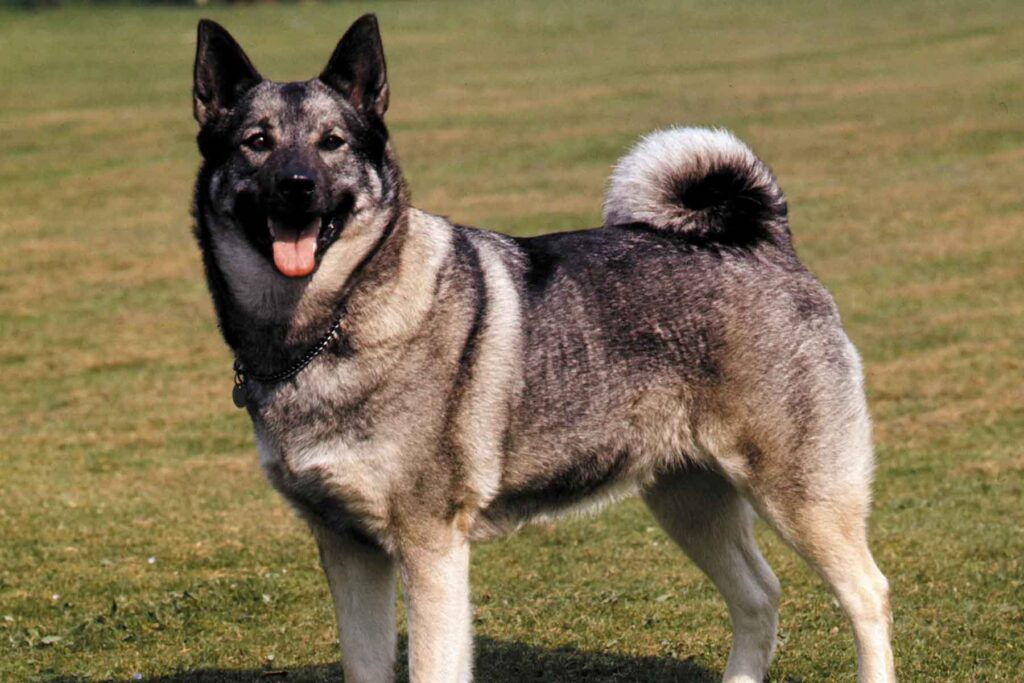
The Norwegian Elkhound is a typical representative of the Northern Spitz-type dogs. It is robust, compact, and possesses a square body format, indicating its strength and agility. Its appearance harmoniously combines power and elegance. The head is wedge-shaped with a broad skull that tapers smoothly towards the muzzle. The muzzle is conical but not pointed. The stop (transition from forehead to muzzle) is smooth, without any harshness. The bridge of the nose is straight, and the nose is black.
The eyes are medium-sized, oval-shaped, and dark brown, emitting an intelligent and confident gaze. The ears are set high, erect, pointed at the tips, and very mobile, allowing the dog to catch the slightest sounds. The neck is strong, muscular, medium-length, without loose skin, and covered with dense fur that forms a distinct ruff. The body is short and sturdy, with a straight topline. The limbs are straight, parallel, strong, and muscular, providing the dog with endurance for running. The paws are small, oval-shaped with tightly closed toes. The tail is one of the breed’s most characteristic features – set high, tightly curled into a ring, and carried over the back.
The coat is dense, harsh, and straight, with a very thick, soft, and light-coloured undercoat that reliably protects the dog from any bad weather. The coat is shorter on the head and the front of the legs, while it is longer on the neck, chest, back of the legs, and tail. The colouration features various shades of grey. The presence of black tips on the outer coat hairs is characteristic, creating a “zonary” effect. The colour is significantly lighter on the chest, belly, legs, and underside of the tail. A dark “mask” on the muzzle and a dark line from the eye to the ear are often present. The coat colour is not uniform; it changes from lighter on the lower parts of the body to darker on the back. Other Elkhound breeds exist, for example, the Norwegian Elkhound Black and the Jämthund (Swedish Elkhound), which differ in colour and some exterior features.
Character: Temperament and Behaviour of the Norwegian Elkhound
Norwegian Elkhounds are dogs with a balanced and calm character, yet at the same time, they are extremely energetic and love active games, movement, and, of course, hunting. They are fast, bold, and brave dogs that do not shy away from danger. From birth, Elkhounds have a strong passion for hunting, and even in urban settings, they will always try to pursue cats, squirrels, or other small creatures. This instinct must be controlled from an early age. And while they are independent and self-reliant at work, in everyday life, they greatly require close contact and affectionate interaction with people. They need a loving owner, to whom Elkhounds will be boundlessly devoted until the end of their days.
These dogs are strong and enduring; they can pursue game for a long time in any weather condition. They are highly intelligent and learn quickly, but they do not respond well to harsh treatment or drill. An Elkhound is a partner, not a servant, so respect, patience, and positive reinforcement are key to training. They can be a bit stubborn, which stems from their ability to make decisions independently during the hunt. They treat their family with great love and tenderness, getting along well with children, whom they perceive as part of their “pack.” They can live with other animals if raised together, but their predatory instinct may cause issues with smaller household pets. The Elkhound is also an excellent guard dog, always warning of strangers with a loud bark. Its bark is a characteristic feature – it is shrill and staccato.
Pros and Cons of the Breed
| Pros | Cons |
|---|---|
| ✅ High intelligence and trainability | ❌ Tendency towards stubbornness and independence |
| ✅ Boundless devotion to family and owner | ❌ Requires a lot of physical exercise and activity |
| ✅ Excellent companion for active people and children | ❌ Heavy shedding twice a year; coat requires maintenance |
| ✅ Robust health and stamina | ❌ Tendency to dominate other dogs |
| ✅ Excellent hunting and guarding qualities | ❌ Loud and frequent barking |
| ✅ Tolerates cold weather well | ❌ Tolerates heat poorly |
| ✅ Cleanliness and lack of a specific “doggy” smell | ❌ Strong hunting instinct; may chase other animals |
Norwegian Elkhound Health: Typical Ailments and Prevention
How to Care for the Norwegian Elkhound’s Coat
These dogs are best kept in a detached house with a spacious garden and a securely fenced area. They need room to move. They are energetic, active, and love their freedom. Keeping them in a flat is only possible on the condition of very long and intensive daily walks. However, even in a garden, you must ensure the dog has a designated space – a kennel or run that provides protection from rain, wind, and scorching sun. Norwegian Elkhounds tolerate frost wonderfully, but heat is a serious challenge for them. On summer days, the dog should not stay in the sun for too long and must always have access to cool water.
Caring for the Elkhound’s luxurious coat is not as complicated as it might seem. The main thing is regular brushing. It is recommended to brush the dog 1-2 times a week to remove dead hair and prevent mats from forming. During the seasonal shedding (spring and autumn), which is very intense, the procedure must be carried out daily. Bathing the Elkhound should only be done when absolutely necessary, as frequent washing disrupts the natural protective oily layer on the skin and coat. Don’t forget the standard hygiene routines: check and clean the ears weekly, brush the teeth with a special dog toothpaste 3-4 times a week. Also, pay attention to the animal’s eyes; for prevention, they can be rinsed with a chamomile decoction. Claws usually wear down naturally during walks on hard surfaces, but if this does not happen, they need to be trimmed once a month.
Training and Socialisation
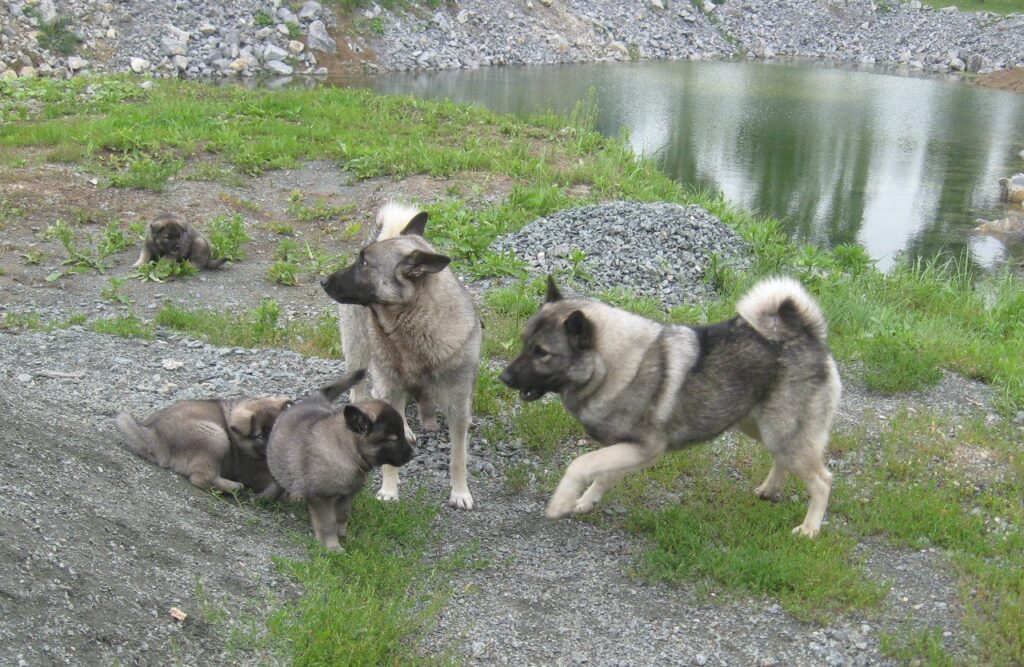
Elkhounds are versatile dogs, capable of working in various fields. It is therefore up to you what your dog will engage in. Of course, these dogs are primarily hunters, with the instinct running in their blood. Today, however, they are increasingly being kept for guarding private properties or simply as companions. They can also be search dogs, rescuers, participate in canine therapy (a rehabilitation programme for sick people and children), and various types of canine sports (agility, obedience).
Early socialisation is critically important for this breed. From the age of 3-4 months, the puppy must be introduced to various people, sounds, places, and other animals. This will help raise a confident and well-balanced dog. If you want your dog to be a guardian, it doesn’t mean it should be isolated. It must know its family and react calmly to guests you receive, but at the same time be alert to strangers.
Elkhounds are quite intelligent, but you need to put in effort for the dog to obey you. By nature, these dogs are self-reliant, somewhat stubborn, and independent. This is not the breed that will mindlessly execute commands. They require motivation and an understanding of why they are doing something. Roughness and physical punishment are unacceptable – you will only lose the dog’s trust. The method of positive reinforcement works best: praise, treats, and toys. Regardless of what your dog does, the main thing is that it moves a lot. A simple one-hour walk will not suffice. The Elkhound needs at least 2 hours of active physical exertion daily. You can confidently take it with you on long hikes, mountain trips, morning jogs, and bicycle rides. Intellectual demands are also important – teach it new commands and use puzzle toys.
Norwegian Elkhound Feeding: Key Recommendations
Interesting Facts About the Breed
- The Norwegian Elkhound is the national dog of Norway.
- This breed is mentioned in Scandinavian mythology and sagas.
- Elkhounds have a unique hunting technique: they do not attack the moose but keep it in place by barking, circling around it until the hunter arrives.
- During the Second World War, these dogs were used to transport messages and medicine to hard-to-reach areas.
- The breed has a unique ability to close its ear canals to protect them from dirt or water.
- There is another unique Norwegian breed – the Norwegian Lundehund, which has six toes on each paw.
Frequently Asked Questions About the Breed (FAQ)
| Question | Answer |
|---|---|
| Is the Norwegian Elkhound suitable for flat living? | Conditionally. It is only possible provided there are daily, very long (2-3 hours minimum) and active walks with physical and intellectual exercise. The ideal place for them is a private house with a large, securely fenced garden. |
| Do Elkhounds shed heavily? | Yes, very heavily. They have intense seasonal shedding twice a year (spring and autumn), during which they lose a huge amount of undercoat. During this period, they need to be brushed daily. |
| How do they get along with children? | Wonderfully. Elkhounds are patient, playful, and protective of the children in their family, making them excellent companions. However, as with any breed, interaction between the dog and small children should be supervised. |
| Can an Elkhound be kept with other animals? | Yes, if they grew up together. However, the strong hunting instinct may cause issues with cats and other small animals that the dog might perceive as prey. |
| Is the Norwegian Elkhound easy to train? | They are intelligent and learn quickly but can be stubborn. Training requires patience, consistency, and the use of positive reinforcement methods. It is not the best choice for a novice who has never owned a dog before. |
Video About the Breed
- Brave and hardy
- Devoted to its own family
- Resistant to hard frost
- A clever hunter and watchdog
- Independent and stubborn in training
- Inclined to bark
- Heavy seasonal shedding
- A tendency to gain weight
| Norwegian Elkhound (Black) | Finnish Spitz | Icelandic Sheepdog | |
|---|---|---|---|
| Height | 46–49 cm | 39–50 cm | 42–46 cm |
| Energy | 4.5 | 4 | 4 |
| Apartment | 2.5 | 2.5 | 3.5 |
| Beginners | 2.5 | 2.5 | 3.5 |
What does the Norwegian Elkhound hunt?
Does the Norwegian Elkhound shed a lot?
Is the Elkhound prone to excess weight?
FCI Standard No. 242 · The Kennel Club
For apartments · For kids · For beginners · Active · Smartest · Hypoallergenic · All rankings →