

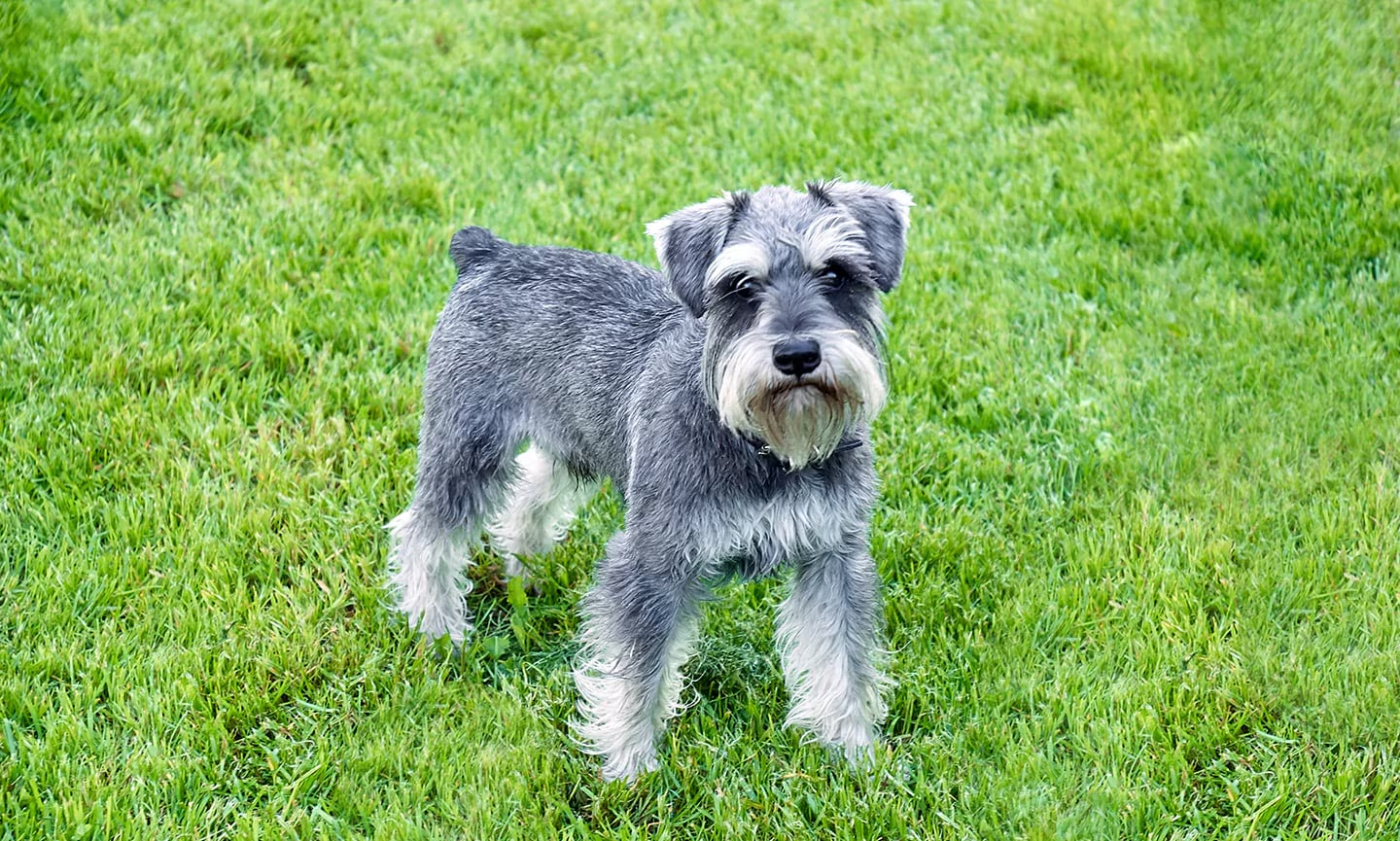
| Height | 30–35 cm (FCI) |
| Weight | 4–8 kg (FCI) |
| Lifespan | 13.3 years (Dogs Trust) · 11.6 (primary care) |
| FCI group | 2 · pinschers and schnauzers |
| Origin | Germany |
Exact ratings
Common health issues
Nutrition
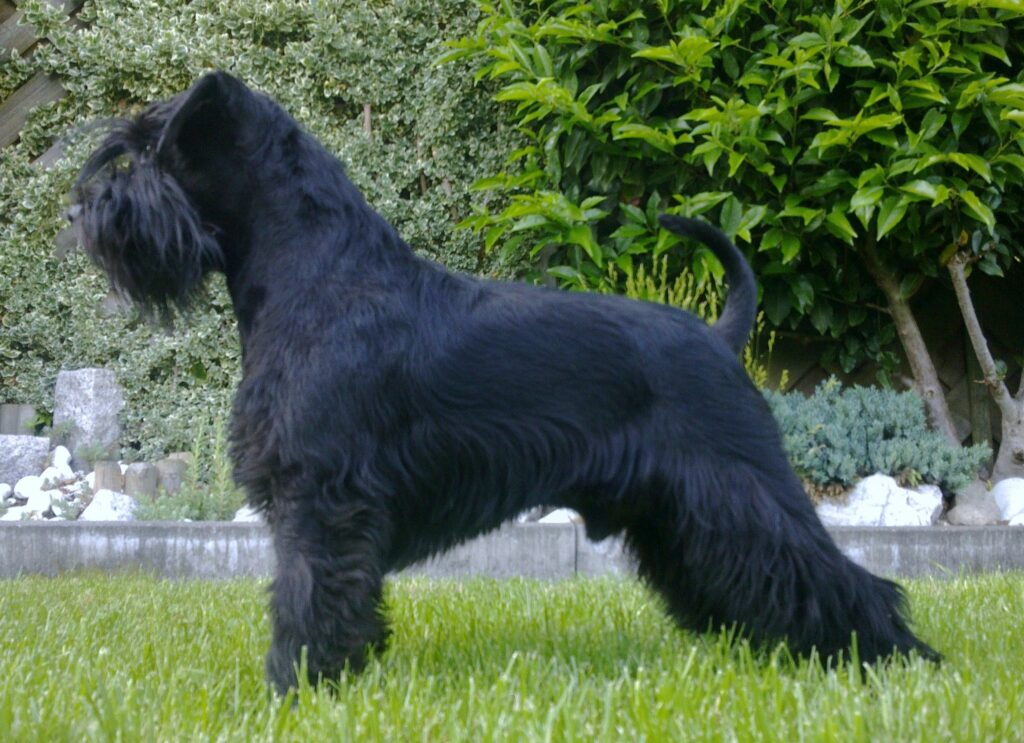
The Miniature Schnauzer (Zwergschnauzer) is the smallest of the three Schnauzers and a breed in its own right, not a scaled-down Standard or Giant. FCI Standard No. 183 calls it a reduced image of the Schnauzer without the faults of dwarfism: same proportions, no deformed head or bone, the whole dog inside a square some thirty-odd centimetres a side. In Britain it is a Utility breed under The Royal Kennel Club, and one of the few whose medicine turns on fat metabolism rather than joints or breathing. Below: the standard at source, the registries’ disagreements, the genetics with gene names, and the British law on this dog’s tail and ears. More about dogs on Tvaryny.
The Miniature Schnauzer at a glance
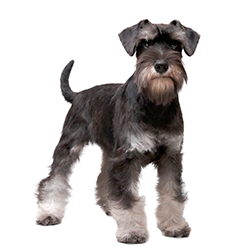
| Characteristic | Description |
|---|---|
| Country of origin | Germany |
| FCI group | Group 2, Section 1, pinschers and schnauzers, without working trial |
| UK group | Utility, under The Royal Kennel Club |
| Purpose in the standard | House dog and companion |
| Height at withers, FCI | 30–35 cm, the same for dogs and bitches |
| Height, Royal Kennel Club | Ideal: dogs 36 cm (14 in); bitches 33 cm (13 in) |
| Weight, FCI | roughly 4–8 kg |
| Coat | Harsh and wiry, dense undercoat; beard and eyebrows |
| Colours, FCI | Pure black, pepper and salt, black and silver, pure white |
| Tail, FCI | Natural, carried sabre- or sickle-fashion |
Those two height figures come from different documents and are not interchangeable. The card at the top uses the FCI range; a section below deals with the British and American registries.
History: how the smallest Schnauzer appeared
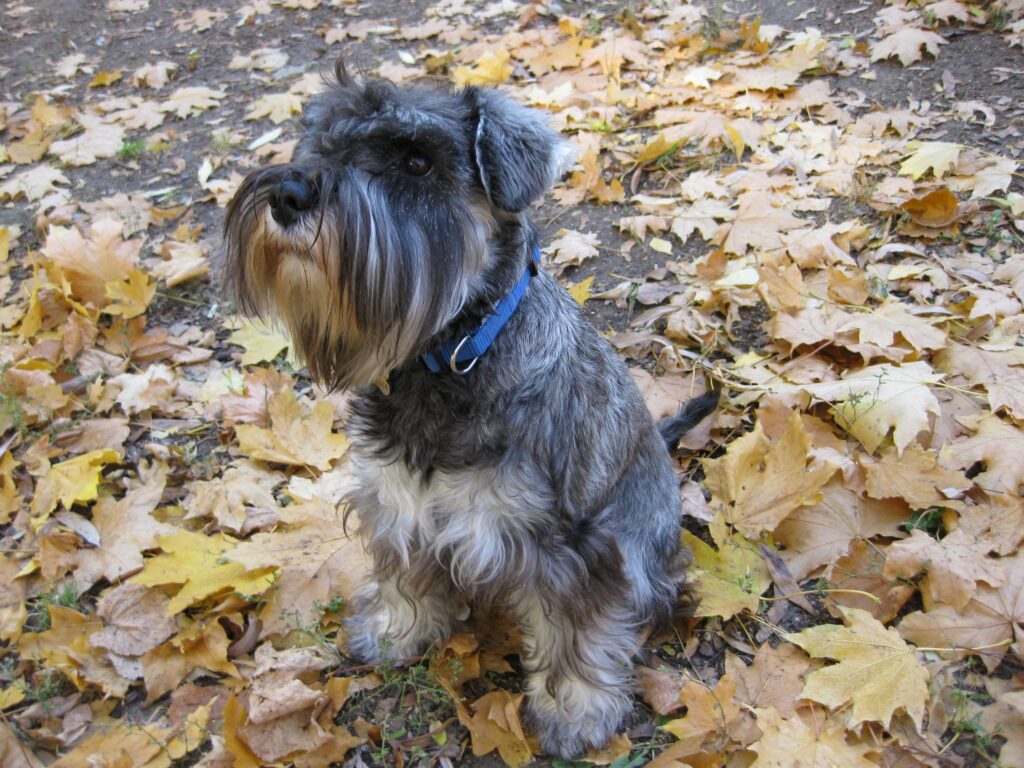
The name is transparent: German Schnauze is “muzzle”, Zwerg is “dwarf” — together, “the little whiskered one”.
The standard tells the history. The FCI’s Brief Historical Summary has the miniature Schnauzer of the Frankfurt am Main area “going its own way” around the turn of the century, still described then as a wire-haired Miniature Pinscher, and admits the difficulty: amid varying shapes, sizes and types and a mixture of harsh, soft and silky coat textures, producing a small dog with the appearance and working qualities of its bigger brother was “no easy task”.
A misunderstanding grew from that: called a wire-haired Miniature Pinscher is a fact about a name, not about ancestors, yet in retelling it became the claim that Miniature Pinscher blood brought the size down. No registry says any such thing.
What they do say is worth comparing. The British club names one donor, the Affenpinscher: in The Kennel Club’s wording, the miniaturisation is thought to have been brought about by an infusion of Affenpinscher blood. The American Kennel Club adds the Poodle, hedged as “said to be descended from”; the American breed club names the Affenpinscher alone. Three official versions, three ancestor lists, none citing a source — “the clubs believe”, not “it has been shown”.
The early dates need the same caution. A first registration in 1888 and a first showing as a separate breed in 1899 come from registries’ short historical notes with no document reference; The Kennel Club’s breed page gives 1888 for the first official record of the miniature variety. Only the FCI database entry is precisely checkable: 13 July 1955, final international recognition.
The three careers diverged: the Giant into service and guarding, the Standard as a general-purpose farm dog, the Miniature into a niche the family lacked — a compact alarm-dog and companion where there is no room for a big dog. The FCI utilisation section is plain: house dog and companion, no working trial.
FCI Standard No. 183: what it actually says
The current edition is dated 2007. Several provisions explain why the dog looks as it does, show ring or not.
- Square format. Height at the withers roughly equals body length; nose tip to occiput equals half the topline from withers to tail set.
- Complete dentition. 42 teeth and a strong scissor bite. A pincer bite is a fault; overshot, undershot and wry mouths disqualify.
- Front angulation in numbers. The shoulder blade lies at about 50° to the horizontal, the upper arm forming 95–105° with it. Unusual — most standards stop at “well angulated”.
- Size policed strictly. Deviation up to 1 cm is a simple fault; over 1 cm but under 2 cm serious; over 2 cm a disqualification. A “smaller Miniature” is not a variety but a dog outside the standard.
- The tail is natural, carried sabre- or sickle-fashion. Docking appears nowhere in the text.
Its closing notes require that only functionally and clinically healthy dogs of breed-typical conformation be bred from — putting a stud dog’s health on the same footing as its show grading.
Three registries, three yardsticks — and the British law
Three Schnauzers in one family
The FCI treats the Miniature, the Standard Schnauzer and the Giant Schnauzer as three separate breeds with three separate standards — and the confusion is not harmless: size, intended use and life expectancy all differ.
British data compare all three in one study. The Dogs Trust analysis published in 2024, built on 584,734 UK dogs (284,734 of them dead) across 155 breeds, puts the median life expectancy of the Miniature Schnauzer at 13.3 years (confidence interval 13.2–13.5), on 1977 recorded deaths in the breed. The Standard gives 13.0 years, the Giant 12.1 — the smallest lives longest. But one figure alone misleads. Three, from different countries and methods, and not collapsible into one:
- 13.3 years — median survival in the British Dogs Trust sample, by the Kaplan–Meier method.
- 11.6 years — median age at death in a British primary-care study of 3857 Miniature Schnauzers; that median rests on only 86 recorded deaths.
- 13.4 years — life expectancy in a Japanese study of Tokyo pet cemetery records (286 dogs of the breed). The all-breed figure in the same sample was 13.7, so in Japan the breed came out below average.
Median survival, median age at death and life expectancy are three distinct quantities, none a promise to an individual dog. The British primary-care authors are candid: they open by asking whether the breed really is the “relatively healthy and long-lived” dog it is held to be — a reputation to test, not a fact.
On numbers: the United Kingdom registered 2956 Miniature Schnauzers in 2025 against 155 Giants and 113 Standards. In Germany the gap is narrower and unstable — in 2025, 579 Miniature puppies to 427 Giants, whereas in 2016 it ran the other way, 843 to 1128. “The most popular Schnauzer” holds for a country in a year, not in general.
Appearance: head, ears and body
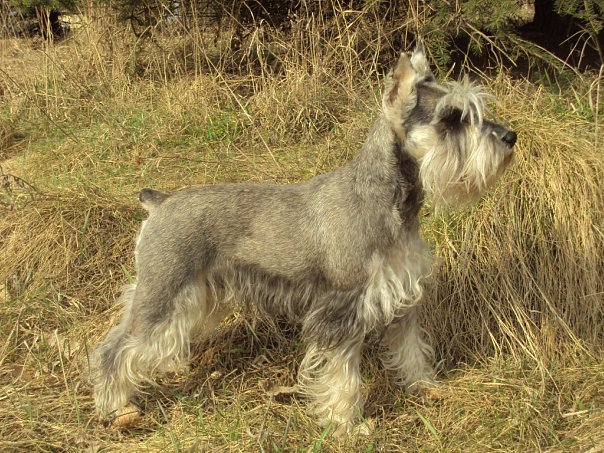
The head is the recognisable part: a strong, long skull without a sharply protruding occiput, a flat creaseless forehead parallel to the bridge of the nose, a muzzle ending in a blunt wedge. The stop looks pronounced because of the eyebrows — coat, not bone, hence the “professorial” expression. The British wording runs in parallel: strong, of good length, narrowing from ears to eyes, a medium stop accentuating prominent eyebrows.
- Eyes: medium sized, oval, set forward, dark, lively; eyelids close-fitting.
- Ears: drop, set high, V-shaped, inner edges against the cheeks, turned forward towards the temples, folds not above the top line of the skull — the British text: “neat, V-shaped, set high and dropping forward to temple”. Cropping is absent from the FCI standard; the American one still describes both a cropped and an uncropped ear. In Britain it is a prohibited procedure under the Animal Welfare Act.
- Nose: well-developed leather, always black. The American standard disqualifies any other colour; the British requires good pigmentation throughout.
- Body: topline falling away slightly from the withers, the highest point; back short and firm, loin short and deep, chest moderately broad, oval in section, reaching to the elbows.
- Feet: short, round, cat-like, closely arched toes, short dark nails; the British text adds firm black pads and feet pointing forward.
The FCI calls the movement supple, elegant, free and far-reaching, forelegs reaching as far forward as possible and hindquarters giving an elastic thrust; pacing is a fault. The British standard asks the same more briefly — free, balanced and vigorous, the topline level in action.
Coat and the four colours
The coat is double: dense undercoat, not-too-short topcoat lying close to the body. The standard requires the topcoat long enough for its texture to be checked — clipped too short, it leaves a judge unable to assess the dog. Neither bristly nor wavy; softer on the legs, short on forehead and ears, with a not-too-soft beard and bushy eyebrows shading the eyes.
- Pure black with black undercoat.
- Pepper and salt. An even, medium peppering with well-pigmented “pepper” and a grey undercoat; all shades from dark iron grey to silver grey allowed. The British standard supplies the mechanism: each hair is banded dark, light, dark — hence the grey tone.
- Black and silver. The standard lists exactly where the white markings belong: above the eyes, on cheeks, beard and throat, in two separated triangles on the forechest, on pasterns and feet, inside the hindlegs and around the vent. Unseparated triangles are a fault.
- Pure white with white undercoat.
Every colour variety requires a dark mask matching the overall colour. Pronounced light markings on head, chest and legs in pepper and salt dogs are undesirable; a patchy coat in black-and-silver and white dogs is a serious fault, as is white or patchy hair in blacks and pepper and salts. The Royal Kennel Club condenses this — good pigmentation is essential in all colours — and closes flatly: any other colour, or combination, is unacceptable. So a white dog that wins in Europe is disqualified under the AKC system, worth knowing if a puppy is bought with showing abroad in mind.
Then the colours in no standard — chocolate, liver and the “parti” patterns. The British registry keeps a public account: its Colour Watch places the Miniature Schnauzer among breeds with more than 2 and up to 10% of registrations in non-breed-standard colours, and publishes the list — chocolate and its combinations, liver and liver and tan, tan and white, a long series of parti patterns. Such dogs exist and are registered, but no standard recognises them, and a “rare colour” is a departure from the breed description, not an advantage. The registry’s note bears repeating: colour is one consideration only, health and temperament come first.
Character, temperament and life in the family
The FCI’s temperament clause is restrained: Schnauzer character in the behaviour of a small dog, with intelligence, fearlessness, endurance and vigilance making an agreeable house dog, watchdog and companion that can be kept without difficulty even in a small flat. The British standard is shorter still: alert, reliable and intelligent — primarily a companion.
In practice: a dog that wants to be present at everything. Unlike the German Spitz breeds — the German Medium Spitz or the German Giant Spitz, which more often keep their distance — the Schnauzer wants participation, not proximity.
Important: the vigilance the standard names as a breed characteristic expresses itself, in a household, as voice. Not a failure of upbringing but what the breed was selected for. It can be managed. It cannot be cancelled.
Children. The breed copes with noisy play and usually joins in, which does not suspend the ordinary rule: a small child’s contact with any dog belongs under adult supervision, and the dog needs a place the child does not enter.
Cats and small animals. With a cat in the same house a Schnauzer more often negotiates than fights. Hamsters, rats and guinea pigs are another matter: the breed came from small farm dogs that cleared rodents out of stables, and counting on that instinct not to fire is unwise. Keep them apart.
Strengths and weaknesses: who the breed suits
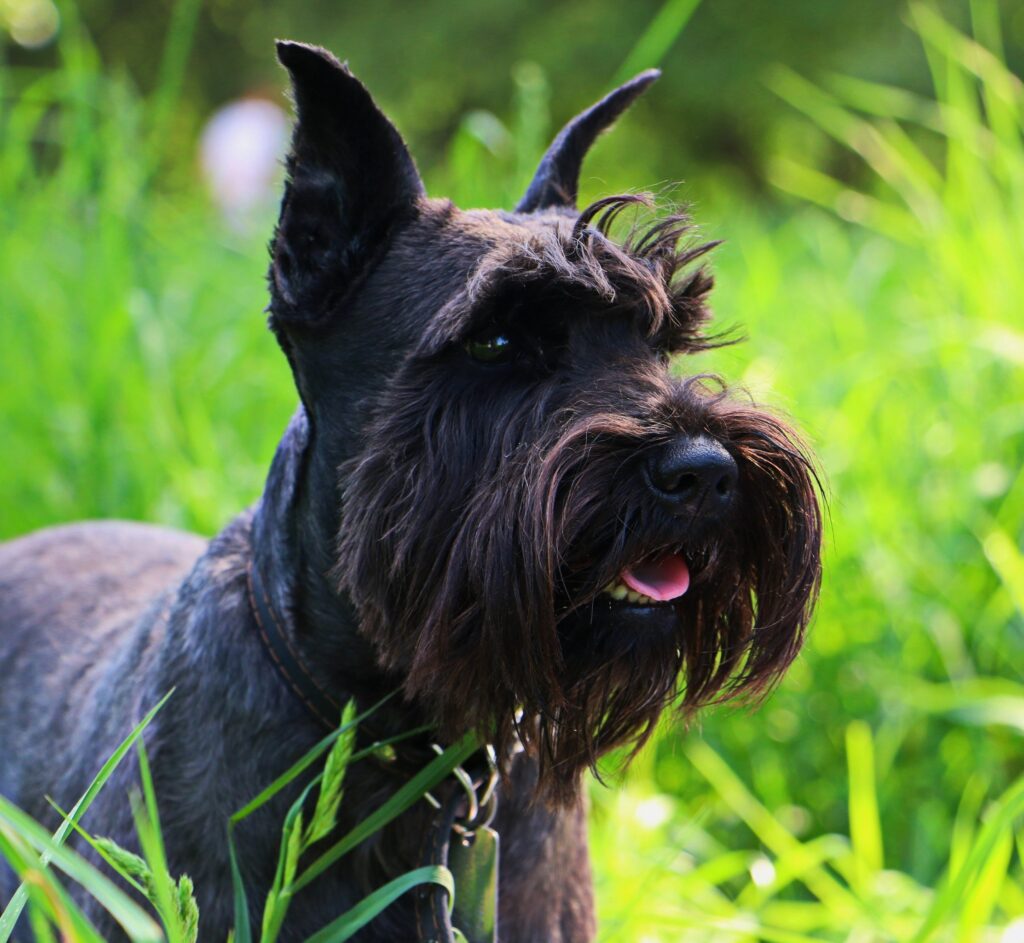
It will suit you if you live in a flat and want a dog interested in you every day; if you go out three times a day not “for five minutes” but for a walk with puzzles and games; if you want an alarm bell, not a guard; if you take coat care as permanent. The Royal Kennel Club’s thumbnail matches: a small flat dog needing up to 1 hour of exercise a day and grooming more than once a week.
It will not suit you if quiet is a hard requirement; if the dog would be alone for many hours daily; if you want a “no-maintenance dog”, since a harsh coat left alone does not clean itself; or if you feed from the table, this breed’s single riskiest domestic habit (see the section on fat metabolism).
The most repeated advantage — “it doesn’t moult” — needs correcting. A harsh coat leaves almost no hair on clothes and furniture, but not because it fails to renew: a dead hair does not fall out but stays in the skin until removed. Moulting has moved from the floor to the grooming appointment.
Then the claim that the breed is hypoallergenic. A direct measurement exists, though not on Miniature Schnauzers: a study in the Journal of Allergy and Clinical Immunology (2012) compared 196 dogs of breeds conventionally called hypoallergenic with 160 of other breeds, measuring the principal dog allergen on the hair, in the coat, in dust and in the air. The result reversed expectation — on the hair and in the coat of the “hypoallergenic” dogs there was more allergen, in the air no difference at all — and the authors conclude there is no basis for classifying particular breeds as hypoallergenic.
This breed was not in that sample, so the conclusion transfers with care — but the Airedale Terrier, closest of the wire-coated breeds, was. The mechanism explains it: the main dog allergens sit in saliva, dander and skin secretions rather than hair, so “little hair on the sofa” and “safe for an allergy sufferer” are different statements.
Grooming: stripping versus clipping
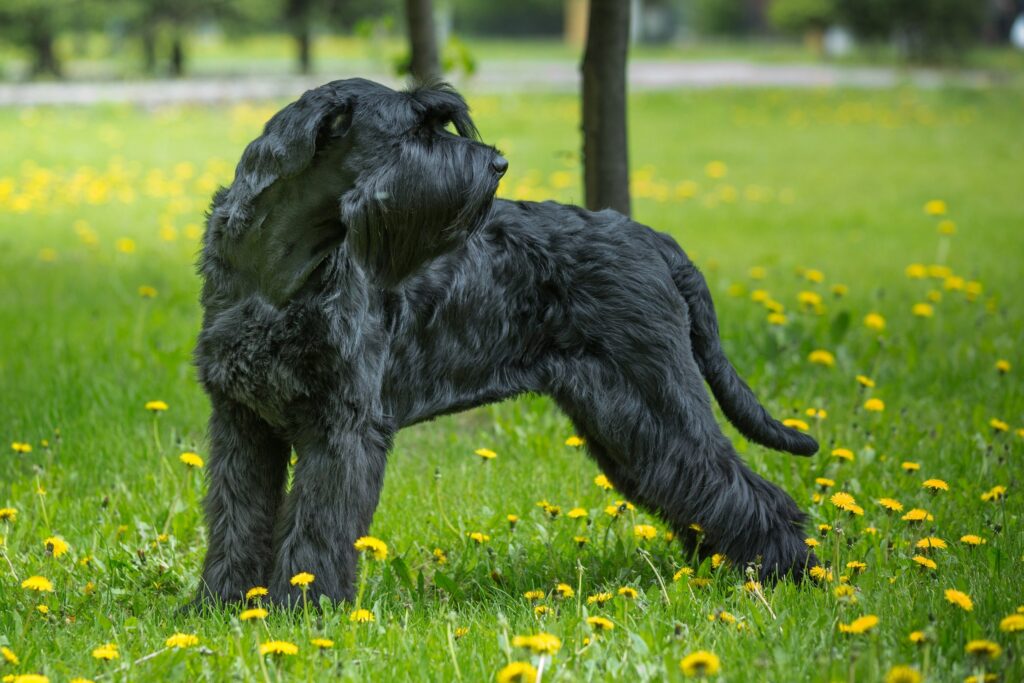
Hand-stripping removes ripe, dead guard hair with its root, and the follicle grows a new one. Clipping cuts the hair and leaves the root: the dead guard hair goes nowhere, and new growth comes through with different properties.
Separate document from practice. The American standard explicitly requires the coat on head, neck, ears, chest, tail and body to be plucked, and in show condition the body coat long enough for its texture to be judged — so for the ring, stripping is a written requirement, not a groomer’s preference. That a coat “softens and dulls” after clippers is generalised experience from groomers and breeders; consistent with the mechanism, but we cite no study behind it.
- Body. Stripping on a schedule agreed with your groomer: harsh coat ripens in cycles, so the procedure follows the coat, not the calendar.
- Clipped rather than stripped: usually only ears, throat, belly and inside the thighs.
- The furnishings — beard, eyebrows and leg “skirt” — are combed daily. Softer hair, and it mats easily.
- The beard after meals. Wipe or rinse it, or it stays permanently damp — a medium for bacteria and a source of smell. Less of a problem with dry food than wet.
- Ears. The canal grows over with hair and is tidied carefully to preserve ventilation. Have a groomer or vet show you — over-thorough removal harms too.
- Nails and teeth. Nails shortened as they grow; teeth brushed regularly, which matters most to the gums in small breeds.
The beard and eyebrows are not merely a haircut. A paper in Science (2009) covering more than a thousand dogs from 80 breeds showed most coat types in pedigree dogs come down to variants of just three genes — RSPO2, FGF5 and KRT71 — RSPO2 governing the facial furnishings, which are therefore inherited, not created by clipping.
Fat metabolism: the breed’s central medical theme
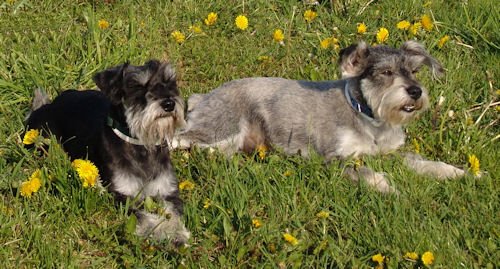
The subject a vet raises first is triglycerides, and it is quantified. A Texas A&M University study in the Journal of Veterinary Internal Medicine (2007) examined 192 clinically healthy Miniature Schnauzers and 38 healthy dogs of other breeds. Triglycerides above the reference interval appeared in 63 Miniature Schnauzers (32.8%) against 2 controls (5.3%). Median triglycerides were higher in the breed; cholesterol did not differ statistically — triglycerides specifically, not “high cholesterol”.
The key finding is the change with age, and it is steep:
| Age | Proportion with raised triglycerides |
|---|---|
| under a year | 15.4% |
| one to three years | 15.7% |
| six to nine years | 43.5% |
| over nine years | 76.7% |
The control group of other breeds showed no such age relationship, and no difference between dogs and bitches. So a blood test from a puppy says nothing about six or eight years old: monitoring must be repeated, not done once.
Read those numbers carefully. The British primary-care study, reviewing clinical records of a random sample, did not find hyperlipidaemia among the twenty-five most frequent diagnoses. No contradiction: 76.7% is the proportion in whom the value was measured and found raised; a diagnosis list reflects what got written into the notes.
The kidneys give one further finding. A 2016 study examined 57 Miniature Schnauzers — 34 with raised triglycerides, 23 with normal values. Urine protein above the threshold appeared in 60% of the raised-fat dogs and none (0%) of the others. The second step matters: in a follow-up by the same group, dogs with this proteinuria were monitored for about a year and a half on average, and their kidney function measures did not deteriorate. Real, but over that horizon clinically quiet.
The same group went further in JAVMA (2011), comparing 28 Miniature Schnauzers with hypertriglyceridaemia and 31 without. Median insulin was higher in the raised-fat group, and the proportion with high insulin was 28.6% against 6.5% (odds ratio 5.8; confidence interval 1.1–30.2) — raised triglycerides here often travel with insulin resistance. A caveat: these studies show association, not a causal chain, and raised triglycerides are not themselves a diagnosis. Causes can be secondary — endocrine disease, medication, an inadequate fast before the sample — so the result is for a veterinary surgeon to interpret, not the owner.
Pancreatitis and associated conditions
Fats are why owners hear “pancreatitis” so often, and the evidence differs by claim. Predisposition to hypertriglyceridaemia is documented above. That “the breed is prone to pancreatitis” is repeated in reviews as settled, but we quote no separate epidemiological risk figure for the Miniature Schnauzer: the classic studies of risk factors for canine pancreatitis name other breeds, or whole groups of breeds.
Direct observation inside the breed does exist. A 2011 study compared 17 Miniature Schnauzers that had had pancreatitis with 34 age-matched dogs of the breed with no such history: even after recovery, raised triglycerides were present in 71% against 33% (odds ratio 5.02; confidence interval 1.4–17.8). Raised fats are not a consequence of the inflammation but a state that stays with the dog. For scale, a British owner survey of 2910 Miniature Schnauzers found pancreatitis diagnosed at some point in 7.6% — a within-breed proportion from owners’ recollections, with no comparison group: it shows how familiar the subject is, not how much riskier the breed is.
The advice does not change, only its basis. Acute pancreatitis often follows a single fatty treat, so a scrap of cheese, sausage or fat is no neutral triviality. Signs needing a vet the same day: repeated vomiting, refusal of food, lethargy, a painful abdomen, the characteristic “praying” posture with forelegs down and rump raised.
Intervention works. In a prospective study from the same laboratory (JVIM, 2020), 16 Miniature Schnauzers with hypertriglyceridaemia moved onto a commercial reduced-fat diet, blood measured twice before the change and twice after. Median triglycerides before: 480 and 493 mg/dl; after, 177 and 168 mg/dl. By lipoprotein profile 15 of 16 dogs (94%) were hyperlipidaemic before and 7 of 16 (44%) after — an intervention with a measured effect in this breed, not a just-in-case recommendation.
One clarification: breed disease lists very often include diabetes mellitus. A British primary-care study of 480,469 dogs aged three and over did find raised odds of diabetes in the Miniature Schnauzer — but only in the simplest model. Once age, sex and neutering were accounted for, the association ceased to be statistically significant, and in a large Swedish insurance sample the breed did not appear among the highest-risk breeds. So: the wariness is understandable, a link with insulin resistance is shown, but “a breed predisposition to diabetes” is not, as things stand, demonstrated.
Urinary stones: why oxalates in particular
The second breed theme is stones in the urinary tract, of characteristic composition. The German laboratory Laboklin analysed 2772 urinary stones by infrared spectroscopy, submitted from practices across Germany in 2017–2019 (Tierärztliche Praxis, 2021). Across all breeds struvite predominated (44.7%), calcium oxalate monohydrate at 24.5%. By breed it differs: among stones from Miniature Schnauzers, calcium oxalate accounted for 54.8% — the highest proportion of any breed named. Median age of dogs with oxalate stones: 10 years.
Read that carefully: 54.8% is the composition of stones in the Miniature Schnauzers whose stones were sent for analysis, not the proportion of the breed that gets stones — which kind to expect, not how often.
The breed’s actual risk is easy to get wrong, and an American study of 258,898 submitted stones from 2010–2015 shows why. Measured against three different comparison groups it yields three different numbers for one breed: an odds ratio of roughly 2 against dogs whose stones were of another composition; around 8 against hospital patients without urinary problems; around 12 against the breed population at large. None is “more correct” — they answer different questions, and a risk figure means nothing without its denominator. All twelve high-risk breeds were small, and mean age at first episode in the study was a little over eight years; hence the advice to start routine urine monitoring in high-risk breeds at about five or six years old, before signs appear.
Why oxalates is partly explained by work from the Virginia veterinary college (JVIM, 2020) comparing 24 male Miniature Schnauzers, 9 with oxalate stones and 15 without. In the stone-formers the urine calcium-to-creatinine ratio was higher throughout all eight hours of observation — they excrete more calcium in the urine. A threshold of 0.06 gave 93% specificity and 56% sensitivity: a positive result carries weight, a negative one rules nothing out.
In daily life: constant access to water, the chance to empty the bladder several times a day without hours of holding on, and an immediate vet visit if the dog strains, passes blood, or makes frequent unproductive attempts. In males a stone can block the urethra — an emergency. As for how the two themes connect, a study in JVIM (2022) showed the odds of oxalate stones rise with blood triglycerides in dogs generally, but part of the analysis deliberately excluded Miniature Schnauzers so the breed would not pull the result towards itself. So: “shown in dogs generally”, not “proven in Miniature Schnauzers”.
Eyes: PRA and the honest story of one DNA test
Progressive retinal atrophy (PRA) is an inherited degeneration of the photoreceptors leading to loss of sight, described here long ago: the Journal of Heredity (1999) documented an early form, photoreceptor dysplasia, autosomal recessive on pedigrees and test matings. Seven candidate genes were checked and four excluded; the causal gene was not established.
- The University of Pennsylvania group (G3, 2019) collected DNA from 51 affected Miniature Schnauzers and 56 clinically normal; mean age at diagnosis in the affected was around 3.9 years. The analysis narrowed the search to chromosome 15 and proposed a complex structural variant of PPT1.
- The University of Helsinki group (PLoS Genetics, 2020) showed the breed carries at least two genetically distinct forms of PRA — loci on chromosome 15 and the X chromosome — and proposed for the first a different variant: a regulatory substitution in an intron of HIVEP3, inside a predicted transcription factor binding site.
Both were right about the locus, and disagreed about the culprit. Rather than polemic they checked each other’s data and published a joint formal comment (PLoS Genetics, 2020), bearing directly on what a breeder gets under the name “PRA test”:
- Both variants lie in the same region, HIVEP3 roughly a million and a half base pairs from PPT1.
- The reported “incomplete penetrance” of PPT1 proved an artefact of method: the markers used to call the zygosity of a complex structural variant are not fit for it, and a dog thought homozygous proved heterozygous.
- The genetic data, they write, do not allow them to distinguish which variant is causal, and the cause may yet be a third in the same region.
- Until that is settled the HIVEP3 variant can still be used in testing — with the authors’ caveat: if HIVEP3 is not the causal gene, recombination between it and the true cause will produce false test results.
So the test is worth using, but as a marker test, not a final answer, and no replacement for regular examination by a veterinary ophthalmologist. Britain has an established route — the BVA/KC/ISDS Eye Scheme, listed by The Royal Kennel Club as best practice here, litter screening included. Cataract is often mentioned too, and the same rule holds: clouding of the lens shows at a routine eye examination, and the examination, not a blood test, finds it early.
Three mutations with ready DNA tests
Unlike PRA, three other breed conditions have an unambiguously identified causal variant, tested directly rather than by marker.
Congenital myotonia. A recessive mutation in CLCN1, the skeletal muscle chloride channel gene (the ClC-1 protein); affected dogs show stiffness, difficulty rising and characteristic changes to the jaws. The 2002 University of Pennsylvania study that produced the test examined 372 Miniature Schnauzers from the United States, Canada, Australia and Europe — 292 (78.5%) clear, 76 (20.4%) carriers, 4 (1.1%) affected; mutant allele frequency 0.113. All carriers and affected dogs traced back to a single popular carrier sire, and that is the lens for reading the numbers: not a random sample but dogs sent in for testing, running back to a common ancestor. So 20.4% is not “the carrier frequency in the breed” but a measure of how far one sire can spread a variant through a closed population.
Persistent Müllerian duct syndrome. A disorder of sexual development in which a genetically male animal retains rudiments of the female tract, and the cause is exact: a single base pair substitution in AMHR2, the anti-Müllerian hormone receptor gene, creates a premature stop codon in the third exon, translation breaks off at the eightieth amino acid, and the receptor is never effectively formed. Autosomal recessive, expressed only in males; the consequences are cryptorchidism, infertility and a raised risk of testicular tumours. A 2018 study genotyped 216 North American Miniature Schnauzers: mutant allele frequency 0.16, carrier proportion 0.27. The conclusion is direct — test breeding animals and males with cryptorchidism.
Susceptibility to mycobacteria. The newest finding, the rarest condition. In 2024 Scientific Reports described a primary immunodeficiency through which adult Miniature Schnauzers develop progressive systemic infection with the Mycobacterium avium complex, which mammals normally resist. Comparing 8 infected dogs, 9 uninfected relatives and 160 controls pointed to chromosome 9, and whole-genome sequencing to a single-codon deletion in CARD9. All infected dogs tested were homozygous for the variant, found in the breed worldwide. This is the first spontaneous animal model of CARD9 deficiency, and no longer academic for British breeders: The Royal Kennel Club now lists a DNA test for Mycobacterium avium complex among best-practice tests, alongside eye testing.
Keep the proportions: myotonia and Müllerian duct syndrome are uncommon, systemic mycobacterial infection rare. The point is not that owners should fear them, but that a recessive condition with a known gene disappears from a breed in a single generation if breeding stock is tested and two carriers are never mated.
Heart, rhythm and skin
Sick sinus syndrome is a disorder of the heart’s own pacemaker: the pulse slows to the point of pauses and the dog may collapse. A retrospective study at North Carolina State University’s teaching hospital (Journal of Veterinary Cardiology, 2016) reviewed 93 cases of sinus node disease, 61 symptomatic and 32 not, listing the Miniature Schnauzer as over-represented with the West Highland White Terrier and the Cocker Spaniel; bitches too. Medical treatment controlled fainting long-term in 54% of symptomatic dogs, 46% eventually receiving a pacemaker — a referral hospital’s figures, describing referral patterns rather than prevalence. The conclusion: fainting or sudden weakness in a Miniature Schnauzer is a reason to do an ECG, not to blame heat or excitement.
Mitral valve disease. A study of 69 Miniature Schnauzers and 65 Yorkshire Terriers with myxomatous mitral valve degeneration (JAVMA, 2021) found the Miniature Schnauzers diagnosed younger and more often showing valve prolapse and fainting, the Yorkshire Terriers coughing more — a difference the authors say may reflect concurrent breed conditions, sinus node disease among them. A heart murmur here deserves an echocardiogram, not a “review next year”.
Schnauzer comedo syndrome is a skin condition almost unique to the breed: along the back, hair follicles plug — blackheads and small bumps that feel like crumbs under the fingers. Mostly cosmetic, but follicles can become infected and need treatment; the veterinary literature describes stubborn cases responding poorly. Squeezing them yourself is the shortest route to inflammation.
What to ask the breeder
Feeding
Training, socialisation and exercise
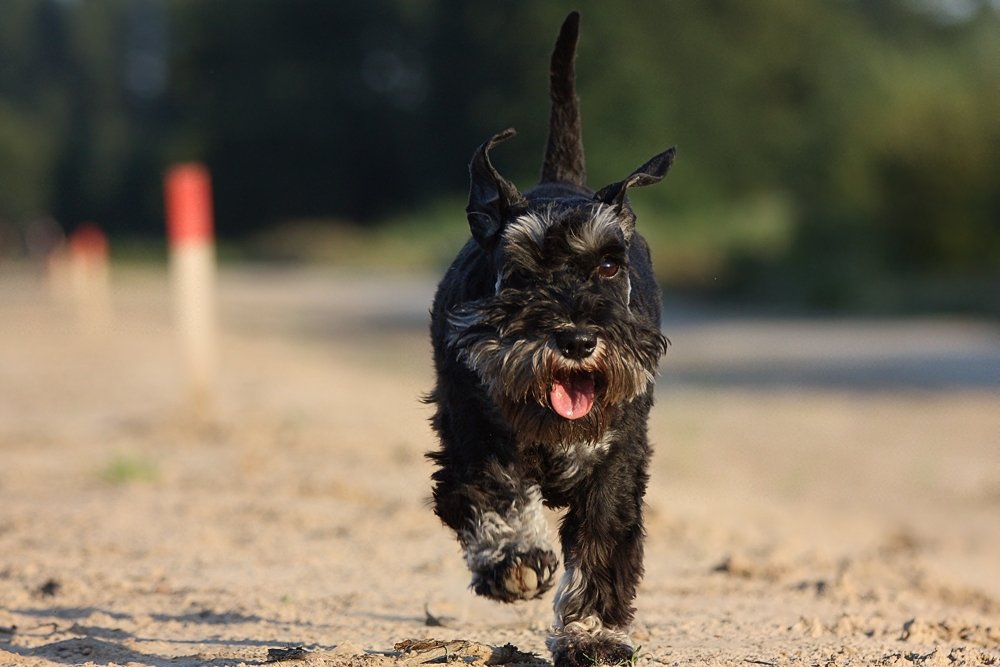
The Miniature Schnauzer learns quickly — and just as quickly what you did not teach it. It tests whether a cue is genuinely compulsory: not stubbornness but a good reading of consistency.
The “intelligence ranking” is owed something honest. In Stanley Coren’s classification the breed occupies 12th position, in the “excellent working dogs” band, whose stated figure is a new command learned in 5–15 repetitions. Two corrections. First, 5–15 repetitions describes the whole band, not this breed: dozens of others sit in it. Second, the ranking rests on a survey of obedience judges, not a cognitive test, and measures only the “working and obedience” variety of intelligence — trainability on the training ground, not cleverness as such.
Socialisation. The first months matter most. Breed vigilance without experience turns into barking at everything that moves — cyclists, runners, strange dogs. The task is not to “teach it not to be afraid” but to bank calm impressions: surfaces, traffic, the lift, a noisy street, friendly dogs of various sizes, each ending neutrally or pleasantly.
Barking. Removing it altogether will not work: it is the vigilance the breed is valued for. A workable scheme: teach a “quiet” cue away from the situation, reinforce not silence “in general” but the specific pause after the signal, and remove the trigger in parallel — blocking the view from a window over the front door, say.
Self-control and exercise. Settling exercises (“bed”, “wait”) serve this temperament better than new tricks: they supply the ability to do nothing. Start with seconds and extend gradually. Compactness does not mean small requirements — the breed does well in sports calling for speed and precision, agility, obedience and scentwork, and scent work suits flat-dwellers especially: searching for treats in grass or boxes tires a dog more than half an hour of running and needs no space. The registry’s up-to-1-hour guideline is a floor, not a ceiling. Harshness does not work: a dog that has decided mistakes are dangerous becomes not more obedient but more cautious and slower to learn.
Interesting facts about the Miniature Schnauzer
- One dog, three groups. Pinschers and schnauzers at the FCI, Utility in Britain, terriers at the AKC. The breed has not changed; the classification systems have.
- The standard admits the breed was hard to make. The FCI’s phrase about a mixture of harsh, soft and silky coat textures is a rare case of an official document describing difficulty rather than result.
- The British registry counts its unofficial colours. Chocolate, liver and the parti patterns sit in a public list of non-breed-standard colours, and its share of such registrations puts it in the higher colour category — evidence that “rare colours” are bred although no standard recognises them.
- The breed became a model for human medicine. The CARD9 defect found in Miniature Schnauzers in 2024 gave the first spontaneous animal model of that immunodeficiency, until then studied largely in knockout mice.
- Steadily popular in the United States. Over the past decade the American Kennel Club has kept the Miniature Schnauzer between 16th and 19th place in popularity — a rare stability for a breed.
- The beard is a gene, not a haircut. The facial furnishings are determined by a variant of RSPO2, the same gene that gives beards and eyebrows to other wire-coated breeds.
- The smallest lives longest — depending on the country. In British data the breed’s median life expectancy beats the Standard’s and the Giant’s; in the Japanese sample it fell below the all-breed average. “Breed longevity” is measured in a particular population.
Frequently asked questions
Are the Miniature, Standard and Giant Schnauzer one breed in three sizes?
No. Three separate FCI breeds with separate standards, differing in purpose as well as size. British medians: 13.3, 13.0 and 12.1 years.
Which height is correct — 30–35 cm or 36?
Both — it depends on the document. FCI 30–35 cm for both sexes; British ideal 36 cm dog, 33 cm bitch; AKC 12–14 inches, disqualifying anything outside. Say which standard you mean.
Is it legal to dock the tail or crop the ears in the UK?
No. Cropping is a prohibited procedure under the Animal Welfare Act; docking is an offence outside the certified-working-dog exemption, which reaches only hunt point retrieve breeds, spaniels and terriers. Showing a docked dog at a ticketed public event is an offence too, wherever the tail was removed.
Do Miniature Schnauzers bark a lot?
Yes — a breed characteristic, not a fault: vigilance is written into the standard. Socialisation, a “quiet” cue and removing triggers help; a silent dog is not what to expect.
Is it true that the breed does not moult and suits allergy sufferers?
Little hair, yes: a dead guard hair stays in the skin until stripped. Safe for an allergy sufferer, no — the main allergens are in saliva, dander and skin secretions. Spend a few hours indoors with an adult of the breed first.
Why does a Miniature Schnauzer need a low-fat diet?
Because raised triglycerides here are documented in numbers — 32.8% of 192 clinically healthy Miniature Schnauzers against 5.3% of other breeds — and a reduced-fat diet measurably lowers them. The content itself is for a veterinary surgeon to set from a blood test.
Which DNA tests should a breeder have done?
Direct tests for CLCN1 (myotonia), AMHR2 (persistent Müllerian duct syndrome) and, since 2024, CARD9; the registry also lists the mycobacterium avium test and eye testing under the BVA/KC/ISDS scheme. The PRA test is a marker test, so an ophthalmologist’s examination stays obligatory.
Can a Miniature Schnauzer live outdoors in a kennel?
No. The standard defines a house dog and companion, and the breed tolerates isolation from its family badly. A small body also loses heat quickly, and the undercoat does not compensate in hard frost.
What does keeping one involve beyond ordinary care?
We give no monetary estimates — an editorial decision. The breed-specific items: professional care of the harsh coat for life; the parents’ DNA tests before a puppy is bought; a routine eye examination by a veterinary ophthalmologist; periodic fasting triglyceride checks in an adult dog, more important with age; and urine monitoring, advised in high-risk breeds from about five or six years old.
Video about the breed
- Leaves almost no hair around the house
- Clever, learns quickly
- Compact, suits a flat
- Attentive alarm-bell watchdog
- Needs regular grooming
- Inclined to bark
- A special metabolism (pancreatitis, stones)
- Can be stubborn
| Miniature Pinscher | West Highland White Terrier | Standard Schnauzer | |
|---|---|---|---|
| Height | 25–30 cm | 25–28 cm | 45–50 cm |
| Energy | 4 | 3.5 | 4 |
| Apartment | 4 | 4 | 3.5 |
| Beginners | 3 | 3.5 | 3.5 |
Are the Miniature, Standard and Giant Schnauzer one breed in three sizes?
Which height is correct — 30–35 cm or 36?
Do Miniature Schnauzers bark a lot?
Is it true that the Miniature Schnauzer does not moult and suits allergy sufferers?
Why does a Miniature Schnauzer need reduced-fat food?
Which DNA tests should a breeder have done?
Why do Miniature Schnauzers get oxalate stones in particular?
Can a Miniature Schnauzer live outdoors in a kennel?
FCI standard No. 183 · Royal Kennel Club · American Kennel Club · United Kennel Club · Journal of Veterinary Internal Medicine · JAVMA · Journal of Veterinary Cardiology · Tierärztliche Praxis · Scientific Reports · PLoS Genetics · G3: Genes, Genomes, Genetics · Science · Journal of Heredity · Journal of Allergy and Clinical Immunology
For apartments · For kids · For beginners · Active · Smartest · Hypoallergenic · All rankings →