

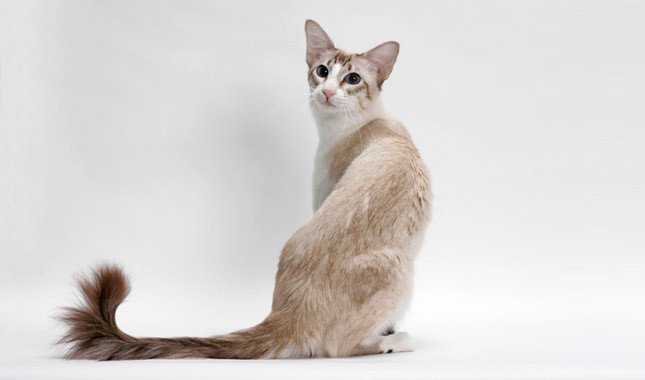
| Weight | 2.5–5 kg |
| Lifespan | 12–18 years |
| Coat | semi-long, no undercoat (low-shedding) |
| Recognition | TICA · CFA · WCF |
| Origin | USA |
Exact ratings
- Liver amyloidosis (as in Siamese cats)
- Progressive retinal atrophy (PRA)
- Hypertrophic cardiomyopathy (HCM)
- Dental disease (gingivitis)
- Squint and tail kink (cosmetic)
Quality food for active cats, with weight control. The semi-long coat without undercoat only needs occasional brushing (it sheds little); the key is plenty of attention, play, high shelves and company.
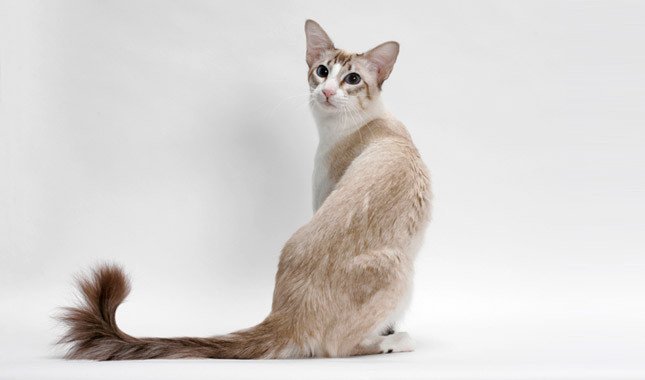
The Balinese, also known as the Balinese cat, isn’t just a separate breed but essentially a long-haired version of the well-known Siamese cat. This elegant breed arose from a natural genetic mutation that gifted Siamese cats with a luxurious long coat. Its exquisite appearance, reminiscent of the graceful dancers from the island of Bali (hence the name) – a grace it shares with other elegant breeds such as the Turkish Angora – and its extraordinary focus on human companionship make Balinese cats increasingly popular pets. If your home often echoes with loud and melodious miaowing (as Balinese cats are known for their “chattiness” and don’t mind a natter, even with themselves), remember to provide them with a warm atmosphere – both literally (they are sensitive to cold and draughts due to their lack of an undercoat) and figuratively (they need a great deal of attention and love). You can find out more about this and other fascinating cat breeds on Tvaryny.
Balinese Cat: A Brief Breed Overview
| Characteristic | Description |
| Origin | United States of America |
| Time of Origin | 1940s–1950s (targeted breeding); CFA recognition – 1970 |
| Other Names | Balinese, Long-haired Siamese (obsolete) |
| Lifespan | 9–15 years (average 12–14, but can live up to 18–20 years with good care) |
| Size | Medium |
| Weight | Males: 3.5–6 kg Females: 2.5–4.5 kg |
| Height at Withers | Around 25–30 cm |
| Coat | Semi-long, silky, without an undercoat |
| Colour | Colourpoint (seal point, blue point, chocolate point, lilac point, as well as red point, cream point, tortie point, lynx point in some associations) |
| Eyes | Almond-shaped, bright blue, set obliquely |
| Temperament | Active, intelligent, inquisitive, gentle, devoted, “chatty”, requires attention |
| Care | Moderate (brushing 1–2 times a week, dental care, warm environment) |
| Compatibility with Children | Good, provided children are gentle |
| Compatibility with Other Animals | Good, especially if raised together |
History of the Balinese Breed
The history of the Balinese cat is inextricably linked with its shorthaired ancestor – the Siamese cat. From time to time, kittens with atypically long, silky fur were born in litters of purebred Siamese. Initially, such kittens were considered defects and excluded from breeding, as the Siamese breed standard stipulated exclusively short fur. They were the result of a spontaneous natural recessive mutation of the longhair gene, which could be passed down through generations without manifesting.
The situation began to change in the 1940s in the USA. Breeders started to notice the beauty and grace of these “long-haired Siamese”. The first to purposefully breed them are considered to be Marion Dorsey of California (Rai-Mar Cattery) and Helen Smith of New York (MerryMews Cattery). It was Helen Smith who named the breed “Balinese” in the 1950s. She felt that the name “Long-haired Siamese” was too cumbersome and did not reflect the elegance and grace of these cats, which reminded her of the movements of dancers from the Indonesian island of Bali.
The path to official recognition was not straightforward. Some Siamese cat breeders были opposed, fearing a “dilution” of the purity of the Siamese breed. However, Balinese enthusiasts insisted on the uniqueness and beauty of their pets. In the 1960s, the breed began to gain recognition from major American feline organisations. The Cat Fanciers’ Association (CFA) granted Balinese cats registration status in 1967 and full championship status in 1970 for the classic points (seal, blue, chocolate, lilac). Later, other point variations (red, cream, tortie, lynx) were designated by the CFA as a separate breed called Javanese. However, most other associations, including The International Cat Association (TICA), consider all colour variations as a single Balinese breed.
Today, the Balinese cat is a recognised and beloved breed worldwide, having retained the elegance and intelligence of its Siamese ancestors while adding a luxurious, low-maintenance long coat.
Appearance of the Balinese Cat: Breed Standard
The Balinese cat is the epitome of grace and elegance. It inherited the refined physique of its Siamese progenitor but complemented it with a luxurious, flowing coat. Despite their visual delicacy, Balinese cats have well-developed musculature and a sturdy frame.
- Body: Medium-sized, long, tubular, slender, and elegant with well-developed but not coarse musculature. Shoulders and hips continue the lines of the body. The abdomen is tucked up. The bone structure is fine.
- Head: A long wedge tapering to a fine muzzle. The profile is straight from the top of the head to the tip of the nose. The skull is flat or slightly convex. The chin is of medium size, its vertical line forming a straight line with the tip of the nose.
- Ears: Very large, wide at the base, pointed, continuing the lines of the head wedge. Set quite low.
- Eyes: Almond-shaped, medium-sized. Set obliquely (“oriental slant”), harmonising with the lines of the head wedge. The colour is a deep, vivid blue. The deeper and more vivid the eye colour, the better.
- Legs and Paws: Legs are long, slender, and proportionate to the body. Hind legs are slightly higher than the front legs. Paws are small and oval.
- Tail: Very long, slender at the base, gradually tapering to a pointed tip. Covered with long, flowing hair, forming a bushy “plume”.
- Coat: Semi-long, fine, silky, without an undercoat. It lies close to the body but flows freely, accentuating the lines of the figure. The longest hair is on the tail.
- Colouring: Exclusively colourpoint. This means the main body colour is light (from white to cream or fawn), while darker markings (points) are located on the face (mask), ears, legs, paws, and tail. The contrast between the light body and dark points should be clear. Traditional colourings recognised by all associations:
- Seal Point: Body pale fawn to cream, points deep seal brown.
- Blue Point: Body bluish-white, cold in tone, points deep blue-grey.
- Chocolate Point: Body ivory, points warm milk-chocolate.
- Lilac Point: Body magnolia white, points frosty grey-pink.
Some associations (e.g., TICA) also include other point variations in the Balinese breed standard, such as Red Point, Cream Point, Tortie Point (tortoiseshell), and Lynx Point (tabby point). The CFA considers these colourings as the Javanese breed.
An important distinction between the Balinese and the Siamese cat is precisely the length of the coat. In all other aspects – body type, head shape, eye colour, and colouring – the standards of these two breeds are very similar or identical. The Balinese often appears “softer” than the Siamese due to its silky fur.
Temperament and Character of the Balinese Cat
The Balinese cat inherited not only its refined appearance from its Siamese ancestors but also a bright, communicative, and intellectual character. These are very social and people-oriented animals that form deep attachments to their owners and strive to participate in all aspects of their lives. Leaving a Balinese alone for long periods is not the best idea, as it can suffer from loneliness and boredom, which sometimes manifests as destructive behaviour or excessive vocalisation.
Key character traits of the Balinese cat:
- Intelligence and Inquisitiveness: Balinese are among the most intelligent cats. They easily learn various tricks, respond to their names, can learn to walk on a lead, and even fetch toys. Their inquisitiveness knows no bounds: they will explore every corner of your home, peek into cupboards and drawers, and “help” you with all your tasks. They need constant mental stimulation in the form of games, interactive toys, and opportunities to climb and explore.
- “Chattiness”: Like their Siamese relatives, Balinese are known for their vocalisation. They have a wide range of sounds – from gentle purring to loud, demanding miaows. They will “talk” to you, comment on events, and express their desires and displeasure. Although their voice is often described as softer and more melodious than that of Siamese, they are still quite vocal.
- Gentleness and Devotion: Despite their activity levels, Balinese are extremely gentle and loving cats. They adore sitting on laps, sleeping next to their owner in bed, rubbing against legs, and demanding affection. They often choose one “favourite” family member to whom they give special attention, though they are generally good with all household members.
- Activity and Playfulness: These are very energetic cats that remain playful throughout their lives. They love to run, jump, and climb high places (shelves, cupboards, special cat complexes). They need regular playtime to burn off energy. Balls, feather wands, laser pointers (used cautiously, always ending the game with a “caught” toy) – all these will help keep a Balinese in good physical and emotional shape.
- Sensitivity: Balinese are very sensitive to their owner’s mood and the atmosphere in the home. They do not tolerate shouting, arguments, or a tense environment well. They need a calm, loving environment.
The Balinese’s character makes it an excellent companion for people who are prepared to give it plenty of attention, interact with it, and play with it. It is not suitable for those seeking an independent, quiet cat that spends most of its time alone. Compared to Siamese cats, Balinese are often perceived as slightly calmer and softer in character, although this can vary individually. They also share many traits with other members of the Siamese-Oriental group, for example, with Oriental Shorthair cats, which are also distinguished by their elegance, intelligence, and sociability.
The Balinese Cat in the Family: Compatibility with Children and Other Animals
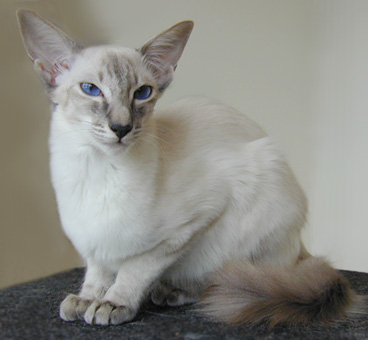
Thanks to its friendly, playful, and social nature, the Balinese cat usually gets along well with children. Its activity and love of games make it an excellent playmate. However, as with any breed, it’s important to teach children how to handle the animal correctly: not to pull its tail, not to squeeze too tightly, and not to disturb it during sleep or meals. Balinese are quite patient, but their delicate build requires gentle handling. Always supervise interactions between young children and the cat.
Regarding compatibility with other domestic animals, Balinese cats generally cohabit well with other cats and dogs, especially if they grew up together or were properly introduced. Their social nature often prompts them to seek companionship, and another animal can help pass the time when owners are absent. However, due to their strong hunting instinct, it is not recommended to keep them with small animals such as rodents (hamsters, guinea pigs), birds, or fish, unless they are in securely closed cages or tanks. An inquisitive Balinese may perceive them as prey.
It is important to remember that the Balinese strives to be the centre of attention. If there are other animals in the house, ensure your Balinese cat receives enough individual attention and affection to avoid jealousy.
Health and Disease Susceptibility of the Balinese Cat
Balinese cats are generally considered a fairly healthy breed with a lifespan of 9 to 15 years, and sometimes longer with proper care. However, like their Siamese ancestors, they have a genetic predisposition to certain diseases. It is important to be aware of these potential problems to detect and treat them promptly.
Hereditary diseases found in Balinese cats:
- Amyloidosis: This is a serious condition where an abnormal protein (amyloid) accumulates in organs, most often the liver or kidneys, leading to their failure. Unfortunately, there is no effective cure, but supportive therapy can alleviate symptoms.
- Progressive Retinal Atrophy (PRA): An inherited eye disease that leads to the gradual degeneration of retinal cells and, eventually, blindness. A genetic test is available to identify carriers of this disease.
- Asthma and Bronchial Diseases: Balinese, like Siamese, can be prone to respiratory problems, including asthma, which manifests as coughing, wheezing, and difficulty breathing.
- Congenital Heart Defects: Such as dilated cardiomyopathy (DCM) or hypertrophic cardiomyopathy (HCM), although the latter is less common than in some other breeds.
- Crossed Eyes (Strabismus) and Nystagmus: Crossed eyes or involuntary eye movements (nystagmus) are sometimes seen in Siamese and Balinese cats. Usually, these conditions do not affect the cat’s quality of life and do not require treatment, although severe strabismus is considered a fault at shows.
- Dental Problems: Gingivitis, periodontitis, and tartar build-up are common problems, so regular oral care is very important.
- Feline Hyperesthesia Syndrome: A neurological disorder проявляється in excessive skin sensitivity, muscle spasms, intense licking or biting of oneself, frantic running, and loud vocalisation.
- Certain Types of Cancer: For example, lymphoma or mast cell tumours.
Prevention:
- Responsible Breeder: Buy a kitten only from reputable breeders who test their breeding animals for genetic diseases (especially PRA).
- Regular Veterinary Check-ups: Annual (or biannual for older cats) visits to the vet will help detect problems at an early stage.
- Vaccination and Deworming: Follow the schedule for vaccinations and parasite treatments.
- Proper Nutrition: High-quality, balanced food supports overall health.
- Dental Care: Regular tooth brushing or using special foods/treats to prevent dental diseases.
- Warm Environment: Since Balinese cats lack an undercoat, they are sensitive to cold. Ensure there are no draughts in the house and the cat always has a warm place to rest.
| Health Problem | Description | Prevention / Management |
|---|---|---|
| Amyloidosis | Protein accumulation in organs (liver, kidneys) | Genetic screening (difficult), supportive therapy |
| Progressive Retinal Atrophy (PRA) | Retinal degeneration, blindness | Purchase from breeders who test for PRA |
| Asthma / Bronchial Diseases | Coughing, wheezing, difficulty breathing | Avoid allergens, treatment as prescribed by vet |
| Dental Problems (gingivitis, tartar) | Gum inflammation, tartar build-up | Regular tooth brushing, professional cleaning by vet, dry food |
| Strabismus / Nystagmus | Crossed or “dancing” eyes | Usually no treatment needed, cosmetic fault |
| Sensitivity to Cold | Lack of undercoat | Keep warm, no draughts |
Caring for a Balinese Cat: Grooming, Hygiene, and Keeping
Despite their luxurious long coat, caring for a Balinese cat is not as complicated as it might first appear. The main advantage of their coat is the lack of a dense undercoat, which means the fur is less prone to matting and doesn’t form tangles as easily as in some other long-haired breeds, such as the Siberian cat.
Grooming:
- Brushing: It’s sufficient to brush a Balinese 1-2 times a week using a stainless steel comb or a natural bristle brush. This will help remove dead hairs, distribute skin oils throughout the coat, giving it shine, and prevent occasional tangles (though this is rare for them). During moulting periods (usually spring and autumn), brushing frequency can be increased.
- Bathing: Balinese are clean cats and usually groom their fur well themselves. Bathe them only when necessary, for example, if the cat is heavily soiled or before a show. Use a special shampoo for long-haired cats. It is very important to dry the cat thoroughly after bathing with a towel or a hairdryer on a low power and temperature setting, as their lack of an undercoat means they can easily catch a cold.
Hygiene:
- Dental Care: This is a critically important aspect of Balinese care due to their susceptibility to dental problems. Ideally, brush their teeth with a special cat toothbrush and toothpaste several times a week. If the cat doesn’t allow this, discuss alternative options with your vet: special foods, dental cleaning treats, gels, or water additives. Regular oral check-ups by the vet are mandatory.
- Eye Care: Check the corners of the eyes daily for any discharge. If present, gently remove it with a soft, damp cloth or special eye wipes. Small, clear, or slightly brownish discharges are normal, but if they are copious, yellow, or green, consult a vet.
- Ear Care: Inspect the ears weekly. Clean ears are pale pink with no visible dirt, excess wax, or unpleasant odour. If you notice dirt, gently wipe the visible part of the ear flap with a cotton pad moistened with a special ear cleaning solution. Never use cotton buds to clean the ear canal. If dark discharge (resembling coffee grounds), redness, or an unpleasant odour appears, consult a vet (this could be a sign of ear mites or an infection).
- Nail Clipping: Trim the claws approximately every 2-3 weeks using special cat nail clippers. Trim only the transparent tip of the claw, avoiding the pink part (the quick), where blood vessels and nerves are located.
Keeping:
- Warmth: Balinese cats need a warm home without draughts. Provide them with soft, warm beds, especially in winter.
- Safety: As inquisitive and active cats, Balinese can get into trouble. Ensure windows and balconies are secured with screens, and potentially dangerous items (chemicals, small objects, poisonous plants) are out of their reach. Due to their value and trusting nature, it is recommended to keep Balinese cats exclusively indoors or to walk them on a harness and lead under supervision.
- Entertainment and Activity: Provide your Balinese with plenty of toys, scratching posts (preferably tall and sturdy), and climbing opportunities (shelves, cat trees). Play with your cat regularly to satisfy its need for activity and mental stimulation.
- Litter Tray: The litter tray should always be clean. Balinese, like most cats, are very clean and may refuse to use a dirty toilet.
| Care Procedure | Frequency | Tools / Products | Notes |
|---|---|---|---|
| Coat Brushing | 1–2 times a week (more often during moulting) | Stainless steel comb, natural bristle brush | Prevents rare mats, removes dead hair |
| Bathing | As needed | Shampoo for long-haired cats | Must be dried thoroughly! |
| Teeth Cleaning | Several times a week (ideally daily) | Cat toothbrush and toothpaste | Very important for preventing gingivitis/periodontitis |
| Eye Check and Cleaning | Daily (check), as needed (cleaning) | Soft damp cloth, eye wipes | Removal of normal discharge |
| Ear Check and Cleaning | Weekly (check), as needed (cleaning) | Cotton pads, ear cleaning lotion | Do not use cotton buds inside the canal |
| Nail Clipping | Every 2–3 weeks | Cat nail clippers | Trim only the transparent tip |
Feeding Your Balinese Cat: Diet Recommendations
Proper nutrition is key to the health, longevity, and well-being of your Balinese cat. Like all cats, Balinese are obligate carnivores, meaning the cornerstone of their diet must be animal-based protein.
Key recommendations for feeding a Balinese:
- High-Quality Protein: Choose foods (both dry and wet) with a high content of quality animal protein (chicken, turkey, beef, fish) listed first among the ingredients. Avoid foods with large amounts of grain fillers (corn, wheat), by-products of unspecified origin, and artificial colourings/preservatives.
- Balanced Diet: The food should be complete and balanced, i.e., contain all necessary vitamins, minerals, fatty acids (Omega-3 and Omega-6 for healthy skin and coat), and amino acids (especially taurine, vital for cats). It is best to choose premium, super-premium, or holistic foods.
- Dry and Wet Food: Combining dry and wet food is often the optimal choice. Dry food helps maintain oral hygiene by mechanically cleaning plaque from teeth (though this doesn’t replace tooth brushing). Wet food provides additional hydration (important for preventing urinary tract disease) and is usually more appealing to cats.
- Portion Control: Balinese can be prone to weight gain, especially after sterilisation/neutering or with age. Follow the dosage recommendations on the food packaging and adjust the portion according to the cat’s age, weight, activity level, and individual needs. Do not overfeed.
- Access to Fresh Water: The cat should always have free access to clean, fresh drinking water. Some cats prefer running water, so a cat drinking fountain can encourage them to drink more.
- Natural Diet (with caution): If you decide to feed your cat a natural diet, it must be carefully balanced by a veterinary nutritionist. It should include meat (frozen or thermally processed), a small amount of offal, vegetables, and vitamin-mineral supplements. Strictly forbidden are: bones (especially cooked chicken bones), raw fish (risk of parasites and thiamine deficiency), raw liver in large quantities (risk of hypervitaminosis A), pork, smoked meats, sweets, salty foods, spices, onions, garlic, chocolate, grapes, raisins.
- Consideration of Age and Health Status: Kittens, adults, seniors, pregnant/nursing, sterilised cats, as well as animals with certain health conditions (e.g., kidney failure, allergies) require different diets. Choose food appropriate for your pet’s age and physiological state, or special veterinary diets prescribed by a doctor.
As noted in the original text, hard pieces of food (e.g., dry food kibble or safe-to-chew treats) can help prevent dental plaque. However, this is only an auxiliary measure and not the primary way to maintain dental health.
Training and Intelligence of the Balinese
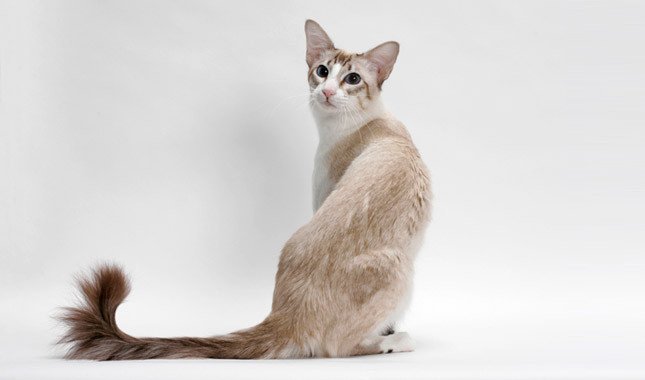
Balinese cats are exceptionally intelligent and quick-witted animals, which makes training them an interesting and relatively easy process. Their natural inquisitiveness, desire to interact with humans, and ability to learn allow them to master various commands and tricks.
Features of training a Balinese:
- Positive Reinforcement: Balinese respond best to training methods based on positive reinforcement. Use treats, praise, affection, or a favourite toy as a reward for correctly performing a command. Never punish the cat physically or shout at it – this can cause fear, stress, and destroy trust.
- Short and Interesting Sessions: A cat’s attention span is not as long as a dog’s. Conduct short training sessions (5-10 minutes) several times a day so the cat doesn’t get tired or lose interest. End sessions on a positive note.
- Utilising Intelligence: Since Balinese are very smart, they quickly get bored with monotonous tasks. Use their intelligence: teach them various tricks (sit, give a paw, fetch a toy, jump through a hoop), use interactive puzzle toys where effort is needed to get a treat.
- Acclimatising to Harness and Lead: Many Balinese adapt well to a harness and can enjoy safe outdoor walks under the owner’s supervision. Start acclimatisation gradually, first letting the cat get used to the harness indoors, then adding the lead.
- Socialisation: Although Balinese are naturally social, early socialisation is important. Introduce the kitten to different people, sounds, and situations so it grows up confident and well-balanced.
- Addressing Behavioural Problems: If problems arise (e.g., scratching furniture), do not punish the cat, but offer an alternative (an attractive scratching post) and redirect its attention. Understand the cause of the unwanted behaviour (boredom, stress, a medical problem) and eliminate it.
Thanks to their close bond with their owner and desire to please, Balinese often enthusiastically participate in training games. It’s important to maintain their interest and reward them for their efforts. Their natural intelligence and agility contribute to the rapid learning of new skills.
Pros and Cons of the Balinese Cat Breed
Like any breed, Balinese cats have their advantages and disadvantages. Before getting such a pet, it’s important to weigh all the pros and cons to understand if this breed is right for you and your lifestyle.
Pros of the Balinese Breed
- High intelligence: Easy to train, quick-witted, understand their owner.
- Extraordinary devotion and gentleness: Become very attached to people, love affection, are companionable.
- Playfulness and activity: Remain energetic and cheerful throughout their lives, excellent playmates.
- Elegant appearance: Refined physique, luxurious silky coat, bright blue eyes.
- Relatively simple coat care: Despite its length, the coat without an undercoat rarely mats and only needs brushing 1–2 times a week.
- Get along well with children and other animals: With proper socialisation and gentle handling.
- Not hypoallergenic: There is no such thing as a hypoallergenic cat. The main cat allergen, Fel d 1, is produced by every cat without exception: it is made in the salivary and sebaceous glands, so it is present in saliva, on the skin and in the coat.
Cons of the Balinese Breed
- Demand a lot of attention: Do not tolerate loneliness well, require constant communication and interaction with their owner. Not suitable for people who spend a lot of time away from home.
- Very “chatty”: Have a loud voice and love to “talk”, which can annoy some people.
- High activity level: Need plenty of space for games, climbing, and expending energy. Can be destructive if bored.
- Sensitivity: Susceptible to stress, changes in environment, and the owner’s mood. Do not tolerate shouting and a tense atmosphere well.
- Prone to certain hereditary diseases: Like Siamese, they can have dental problems, amyloidosis, PRA, and asthma.
- Sensitivity to cold: Lack of an undercoat makes them vulnerable to low temperatures and draughts.
- High cost: Purebred Balinese kittens from responsible breeders can be quite expensive.
Interesting Facts About Balinese Cats
- Dancing Grace: The name “Balinese” was given to the breed by Helen Smith not because of its geographical origin (the breed was developed in the USA), but because of the extraordinary grace and fluid movements of these cats, which reminded her of exotic dancers from the island of Bali.
- “Long-haired Siamese”: The original name for the breed was precisely this, but it was changed to the more elegant and melodious “Balinese”.
- Javanese – Sibling or Not?: The CFA distinguishes Balinese with point colourings different from the classic four (seal, blue, chocolate, lilac) as a separate breed – the Javanese. The name is also “island-themed” and related to Bali (Java is a neighbouring island). However, most other feline organisations consider Javanese cats simply a colour variation of the Balinese breed.
- “Hypoallergenic” is a myth: How much allergen a cat produces varies far more from one individual animal to another than from breed to breed. If you have an allergy, spend time with the particular cat you are taking home and make the decision together with an allergist — the breed guarantees nothing.
- Born White: Like Siamese kittens, Balinese are born completely white. The characteristic dark markings (points) only begin to appear a few days or weeks after birth. This is due to temperature-sensitive albinism: the gene responsible for colour is activated only at lower temperatures, so cooler parts of the body (ears, face, paws, tail) become darker.
- Blue-Eyed Beauties: All purebred Balinese cats have expressive almond-shaped eyes of a deep blue colour. This is also linked to the colourpoint gene.
Frequently Asked Questions About the Balinese Cat Breed (FAQ)
Do Balinese cats shed a lot?
Despite their long fur, Balinese cats shed moderately as they do not have a dense undercoat. Regular brushing (1-2 times a week) helps to control shedding.
Are Balinese cats suitable for people with allergies?
There is no such thing as a hypoallergenic cat. The main cat allergen, Fel d 1, is produced by every cat without exception: it is made in the salivary and sebaceous glands, so it is present in saliva, on the skin and in the coat. How much allergen a cat produces varies far more from one individual animal to another than from breed to breed. If you have an allergy, spend time with the particular cat you are taking home and make the decision together with an allergist — the breed guarantees nothing.
Can a Balinese cat be left alone at home all day?
Balinese cats are very social and do not tolerate loneliness well. If you are regularly away from home for 8-10 hours, a Balinese may suffer from boredom and loneliness. In such cases, it is better to get them a companion (another cat or dog) or consider another, more independent breed.
Are Balinese cats noisy?
Yes, Balinese are known for their “chattiness”. They have quite a loud voice and enjoy communicating with their owners through a variety of sounds. If you value quiet, this breed may not be for you.
What care does a Balinese cat’s coat require?
Care is relatively simple: brushing 1-2 times a week with a comb or brush. Bathing only when necessary. It is important to remember the lack of an undercoat and the need for thorough drying after bathing.
Are Balinese cats generally difficult to care for?
The main difficulty lies not so much in grooming, but in the need to give them a lot of attention, provide activity and mental stimulation. Regular dental care is also important due to their predisposition to dental problems.
How long do Balinese cats live?
The average lifespan is 9-15 years, but with good care, proper nutrition, and regular veterinary visits, they can live up to 18-20 years.
Conclusions
The Balinese cat is a marvellous combination of the elegance of its Siamese ancestor and a luxurious silky coat. This is not just a beautiful animal, but also an exceptionally intelligent, devoted, and sociable creature that will become a true member of the family. The Balinese requires a lot of attention, communication, and active games, does not tolerate loneliness well, and loves to be at the centre of events. Its care is not overly complicated, especially regarding the coat, but it demands diligence in matters of dental hygiene and ensuring a warm, safe environment. If you are ready to dedicate a lot of time to your pet, offering it love and intellectual challenges, the Balinese cat will respond with boundless affection and devotion, becoming a wonderful, albeit slightly noisy, companion for many years.
- Very clever and “dog-like” devoted
- Affectionate, people-oriented
- The semi-long coat without undercoat sheds little
- Active, playful, ideal for a flat
- Very talkative and demanding of attention
- Cannot bear solitude at all
- Needs play and high shelves for climbing
- A tendency to the hereditary diseases of Siamese cats
| Siamese Cat | Oriental Shorthair | Seychellois | |
|---|---|---|---|
| Weight | 3–5 kg | 3–5 kg | 3–5 kg |
| Energy | 4.5 | 4.5 | 4.5 |
| Apartment | 5 | 5 | 5 |
| Beginners | 3 | 3 | 3.5 |
Is the Balinese a separate breed or a long-haired Siamese?
Is the Balinese cat noisy?
Can the Balinese be left alone?
TICA / CFA / WCF standards (Balinese)
For apartments · For kids · For beginners · Most affectionate · Quietest · Hypoallergenic · All rankings →