

| Weight | 3–5 kg |
| Lifespan | 9–15 years |
| Coat | hairless (fine down) |
| Recognition | TICA · CFA · WCF |
| Origin | Canada |
Exact ratings
Common health issues
Nutrition
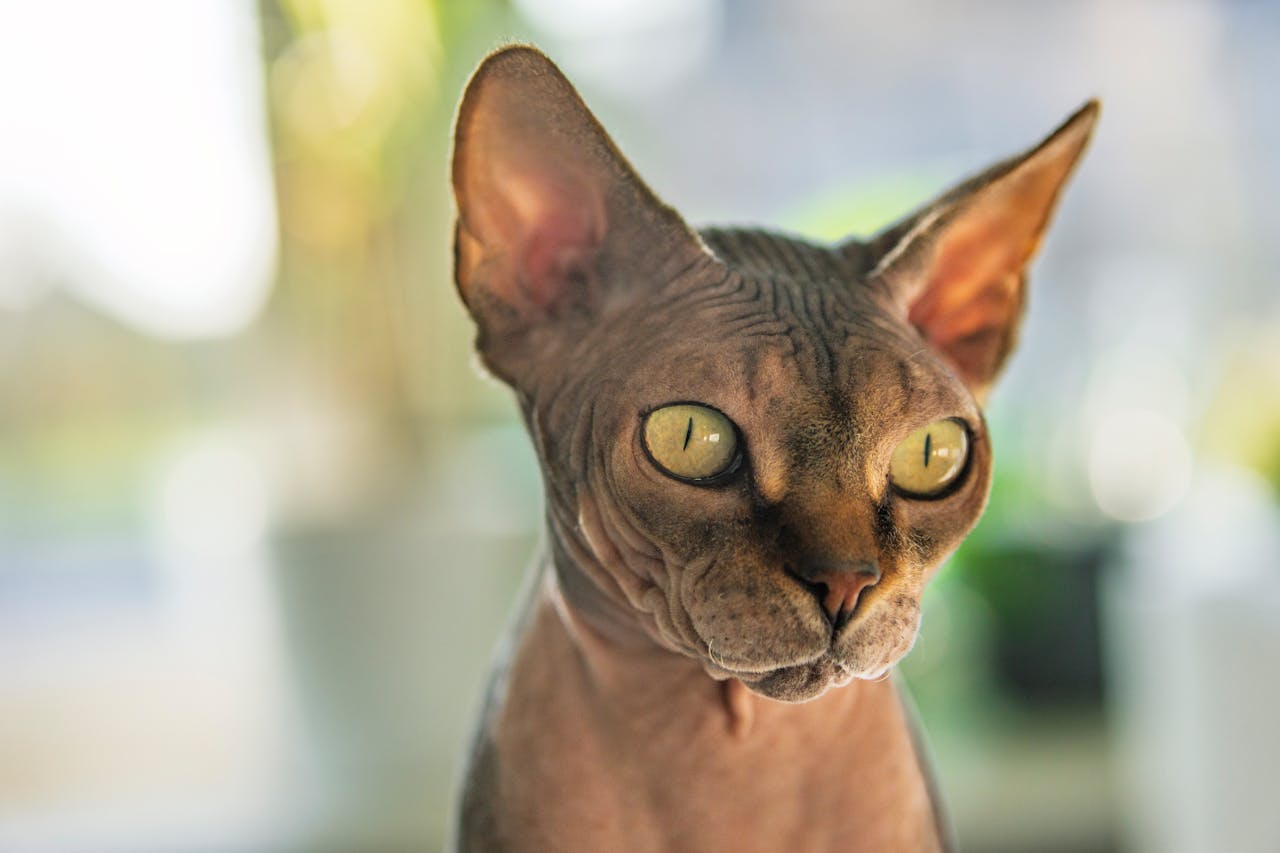
The Sphynx is a breed of cat that instantly captures attention with its unique appearance. These affectionate pets evoke a whole spectrum of emotions in anyone декоративніfirst encounters an almost completely hairless cat. Although a barely noticeable downy fuzz is present on their skin, it’s the deep wrinkles of their warm, velvety-to-the-touch skin that create the dominant impression. This unusual “coat” requires special, perhaps even more meticulous, care than the long fur of other breeds; more on this at Tvaryny. Therefore, this marvellous heir to the enigmatic beauty of Egyptian statues should be considered by families prepared to dedicate plenty of time, love, and attention to their pet.
Sphynx: A Brief Breed Overview

| Characteristic | Value |
|---|---|
| Origin | Canada |
| Time of Breed Origin | 1960s (modern line) |
| CFA Recognition | 2002 |
| Lifespan | 13–15 years (sometimes longer) |
| Size | Medium |
| Weight | Males: 4–6 kg, Females: 3–5 kg |
| Temperament | Affectionate, social, energetic, inquisitive, intelligent |
| Grooming Needs | High (skin, ear, and claw care) |
| Shedding | None (but skin produces oil) |
| Hypoallergenic | No — there is no such thing as a hypoallergenic cat: every cat produces Fel d 1 |
Detailed History of the Sphynx Breed’s Origin
The history of the Canadian Sphynx is a captivating tale of genetic chance, human curiosity, and dedicated selective breeding. Although hairless cats have been mentioned in various cultures throughout centuries (for instance, the Aztecs supposedly kept such animals), the modern Sphynx breed has clearly documented Canadian roots.
It all began in 1966 in Toronto, Canada. An ordinary domestic shorthair cat gave birth to a kitten named Prune, who was completely bald. This occurred due to a spontaneous natural recessive mutation of the gene responsible for hair growth. Prune’s owner, understanding the kitten’s uniqueness, initiated a breeding programme, backcrossing him with his mother and other shorthair cats to obtain more hairless offspring.
The initial attempts were fraught with difficulties. The population was small, and the gene pool limited, leading to health problems in some kittens. Sadly, the early line of Sphynx cats, started by Prune, died out.
However, the idea of a hairless cat did not disappear. In the mid-1970s, fate smiled upon enthusiasts once more. In Minnesota, USA, two hairless kittens, Epidermis and Dermis, were born on a farm to an ordinary cat. They were sent to a well-known breeder, Kim Mueske, who used them to revive the breed. Almost simultaneously, in 1978, three more hairless kittens (two females and one male) were found in Toronto and successfully rescued. The distinctive appearance of these cats, while unique, might bring to mind the elegance of a Neva Masquerade or the exotic charm of a Seychellois cat, though their coats are, of course, worlds apart.
These very cats became the foundation for the modern lines of Canadian Sphynx. To expand the gene pool and improve the breed’s health and type, breeders began to cross Sphynx cats with other breeds. Cats of the Devon Rex breed played a particularly crucial role in shaping the modern look and temperament of the Sphynx. Their curly coat is controlled by a different gene, so such crossbreeding allowed for the preservation of the Sphynx’s hairlessness gene while simultaneously improving their constitution and vitality. American Shorthair cats were also occasionally used.
The path to official recognition was not straightforward. Some felinological organisations were initially wary of the breed due to potential health issues associated with the lack of fur and a limited gene pool. However, thanks to the persistent work of breeders to improve health and standardise the breed, the Sphynx gradually gained recognition. The International Cat Association (TICA) accepted the breed for registration in the 1980s, and the Cat Fanciers’ Association (CFA) granted it championship status in 2002. Other major organisations also recognised these unique cats.
It’s important to note that other hairless cat breeds exist, such as the Don Sphynx and the Peterbald, which originated independently in Russia. Their hairlessness is caused by different genetic mutations (dominant), and they have their own standards and characteristics.
What Does a Sphynx Look Like: A Detailed Description of Appearance
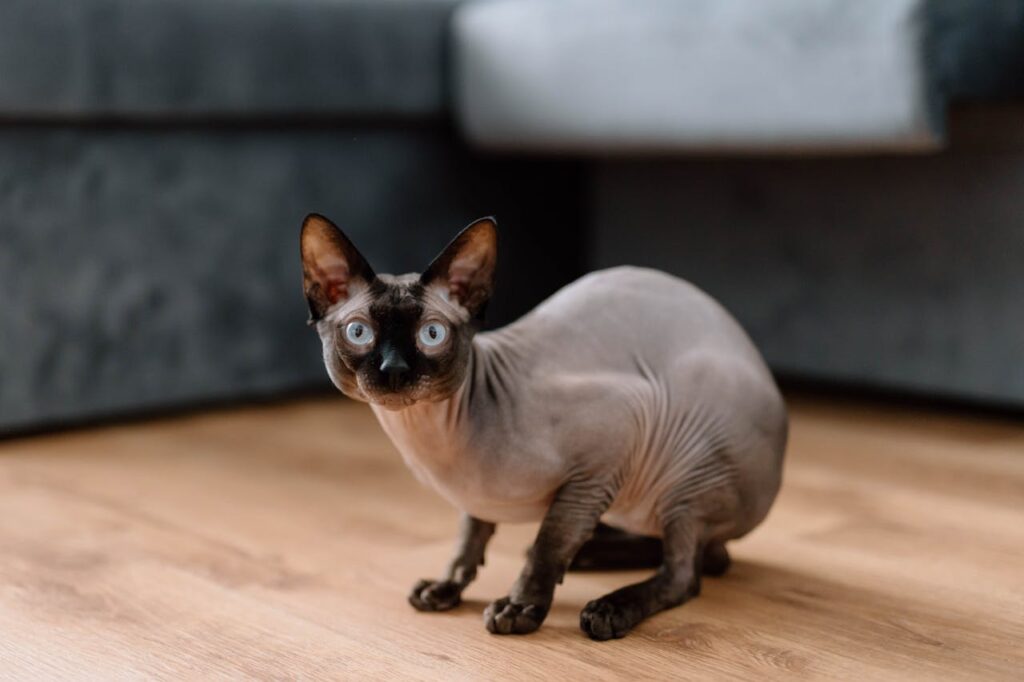
The appearance of a Sphynx leaves no one indifferent. It is a medium-sized cat with a strong yet elegant body that radiates power and grace. The main feature is the absence of visible fur, although the skin may be covered with a fine, barely noticeable peach-fuzz-like down, especially on the nose, ears, paws, and tail. To the touch, the skin is warm, soft, and resembles suede or velvet.
- Head: Wedge-shaped, slightly longer than it is wide, with prominent, high cheekbones and a distinct chin. Whiskers (vibrissae) may be short, broken, or entirely absent.
- Eyes: Large, lemon-shaped, set wide apart and slightly slanted. Eye colour is bright and intense, harmonising with the skin colour (can be green, gold, blue, or odd-eyed). The gaze is very expressive, often described as “alien” or “wise”.
- Ears: Very large, broad at the base, with rounded tips, set wide apart. The inside of the ears is completely hairless. Their size is one of the most characteristic features of the breed.
- Body: Medium in length, muscular, with a broad chest and a rounded abdomen (the so-called “Buddha belly”), which is not considered a sign of obesity in this breed. The backline rises slightly towards the rump.
- Skin: Thick but very elastic, forming numerous wrinkles, especially on the head, neck, shoulders, and legs. These wrinkles are particularly noticeable in kittens. Skin colouration can be any, including all possible colours and patterns (solid, tabby, bicolour, colourpoint, etc.), just as in ordinary cats. Skin pigmentation is clearly visible.
- Limbs and Paws: Limbs are long, slender, and proportional to the body, with the hind legs slightly longer than the front. Paws are oval-shaped, with long, elegant toes and thick pads, giving the impression that the cat is walking on “air cushions”. Claws are clearly visible.
- Tail: Long, flexible, whip-like, thick at the base and tapering to the tip. Sometimes, there may be a small tuft of fur at the tip of the tail (“lion tail”).
| Body Part | Description | Features |
|---|---|---|
| Skin | No visible coat, possible light down | Warm, wrinkled, pigmented |
| Head | Modified wedge, high cheekbones | Strong chin, whiskers short or absent |
| Eyes | Large, lemon-shaped, slanted | Colour depends on skin pigmentation |
| Ears | Very large, wide at the base | Hairless inside, set wide apart |
| Body | Medium, muscular, rounded belly | Backline rises towards the rump |
| Tail | Long, whip-like | Possible tuft of fur at the tip |
Sphynx Character: Temperament and Behaviour
Behind the Sphynx’s extravagant appearance lies an incredibly affectionate, sociable, and human-oriented character. These are not cats that “walk by themselves.” Sphynxes adore being the centre of attention, participating in all household activities, and literally following their owner at their heels.
Key Character Traits:
- Attachment: They form a very strong bond with their family members. They physically need human presence, affection, and cuddles. They love to sleep under the duvet with their owner, sit on their lap or shoulder. They tolerate solitude poorly, so it is not recommended to get a Sphynx if you spend a lot of time away from home and the cat will be left alone.
- Sociability: Sphynxes usually get along wonderfully with children (provided they are handled gently), other cats, and even dogs. They are not prone to conflict and often become the life of the party among household pets.
- Energy and Playfulness: These are quite active and agile cats. They love to play, run, and explore every corner of the house. Their curiosity knows no bounds. They happily play with various toys, a laser pointer, and can also invent their own entertainment. Their energy persists into adulthood.
- Intelligence: Sphynxes are very clever cats. They learn quickly, can master simple commands and tricks, and understand their owner’s mood. Their intelligence sometimes leads to inventive antics – they easily learn to open doors, cupboards, and find hidden treats.
- Talkativeness: Some Sphynxes are quite “chatty” and have a whole arsenal of sounds – from gentle purring to expressive meows and peculiar “conversations.”
- Friendliness: Aggression is absolutely not characteristic of this breed. Sphynxes are very patient and not vindictive. Even if they dislike something (like bathing or ear cleaning), they are more likely to express their displeasure vocally than to use their claws or teeth.
Due to their high social needs and energy levels, Sphynxes need a home where they will receive a lot of attention. They will become ideal companions for people who value a close emotional bond with their pet and are ready to interact with them actively.
Sphynx Care: Hygiene Specifics for a Hairless Cat
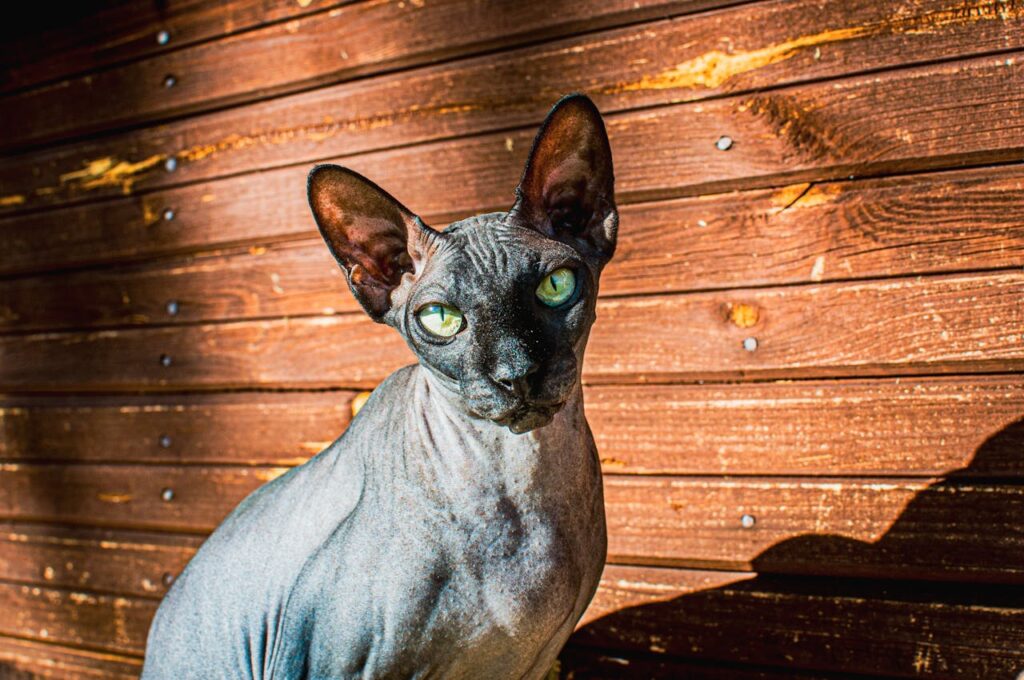
A common misconception is that the absence of fur means an absence of grooming. In reality, caring for a Sphynx is quite specific and requires regularity. Their skin needs special attention.
Bathing:
- The skin glands of Sphynxes secrete a natural oily substance (sebum), which in ordinary cats is distributed throughout the fur. In Sphynxes, this oil accumulates on the skin, attracting dust and dirt. If the cat is not bathed, the skin becomes sticky, dirty, and may have an unpleasant odour.
- Bathing frequency is individual and depends on the specific cat (usually once every 1-4 weeks). Some Sphynxes get “dirty” faster than others.
- Use special shampoos for Sphynxes or mild hypoallergenic cat shampoos (or even baby shampoos) with a neutral pH.
- The water should be warm (around 36-38°C).
- After bathing, the cat needs to be thoroughly dried with a soft towel or even wrapped in it to prevent chilling. Some owners use a hairdryer on a low setting, but the cat must be gradually accustomed to this.
- Between baths, the skin can be wiped with damp, alcohol-free, and fragrance-free wipes.
Ear Care:
- The large ears of Sphynxes lack fur inside, which would normally trap dirt and wax. Therefore, a dark, waxy build-up quickly accumulates in their ears.
- Ears need to be cleaned regularly (1-2 times a week) using special ear cleaning lotions for cats and cotton pads or buds (use buds cautiously, only for the visible parts of the ear canal).
Eye Care:
- Sphynxes do not have eyelashes, so natural secretions can accumulate in the corners of their eyes. These should be gently removed daily with a soft cloth or cotton pad moistened with warm boiled water or a special eye lotion.
Claw Care:
- A dark build-up (a mixture of skin oil and dirt) can also accumulate on the claws of Sphynxes. This needs to be cleaned periodically.
- Claws should be trimmed regularly (every 2-3 weeks) with special clippers to prevent ingrowing and injury.
Protection from Sun and Cold:
- A Sphynx’s skin is sensitive to direct sunlight and can easily get sunburnt. In sunny weather, limit the cat’s exposure to direct sun or use special sunscreens for animals (after consulting with a vet).
- Due to the lack of fur, Sphynxes are very sensitive to cold and draughts. They always seek warm places – radiators, blankets, computers, their owner’s lap. In cold weather, they may need warm clothing (jumpers, bodysuits). It is important to maintain a comfortable temperature indoors.
Sphynx Health: Common Diseases and Prevention
Sphynx Nutrition: Key Recommendations
Training and Socialisation of the Sphynx
Sphynxes are not only affectionate companions but also exceptionally intelligent and quick-witted cats, which makes them quite trainable. Although training a cat differs from training a dog, Sphynxes are capable of learning certain rules of behaviour, commands, and even tricks.
Key Aspects of Training and Socialisation:
- Early Socialisation: It is very important to accustom a Sphynx kitten to different people, sounds, environments, and other animals (if they are present or planned) from an early age. This will help it grow into a confident, well-balanced, and sociable cat. Introduce it to grooming procedures (bathing, ear cleaning, claw trimming) as early as possible, making these experiences positive.
- Positive Reinforcement: Sphynxes respond best to training methods based on positive reinforcement. Use praise, affection, games, and favourite treats (small pieces) as rewards for desired behaviour. Never physically punish the cat or shout at it – this can cause fear, stress, and destroy trust.
- Teaching Rules: Accustom the cat to the litter tray and scratching post from the first days in its new home. Sphynxes usually quickly understand where their toilet is. If the cat scratches furniture, calmly redirect its attention to the scratching post; special attractant sprays can be used.
- Teaching Commands and Tricks: Thanks to their intelligence, Sphynxes can learn to come when called, sit, give a paw, and perform other simple tricks. Training sessions should be short (5-10 minutes), interesting, and conducted in a playful manner.
- Using Interactive Toys: To satisfy the Sphynx’s high intelligence and curiosity, use interactive toys and puzzle feeders for cats, which stimulate mental activity and prevent boredom.
- Consistency and Patience: Be consistent in your demands and patient. Training requires time and regularity.
- Interaction: Sphynxes require a lot of communication and play with their owner. Regular games not only strengthen your bond but also help channel their energy in a positive direction.
Training a Sphynx is more a process of upbringing and establishing mutual understanding than strict drilling. Their natural curiosity and desire to interact with humans make this process enjoyable and effective if approached with love and an understanding of the breed’s peculiarities.
Pros and Cons of the Sphynx Breed
Before getting such an exotic pet as a Sphynx, it is important to weigh all the pros and cons. This breed has many wonderful qualities, but also certain peculiarities that can be a challenge for some owners.
| Pros (+) | Cons (-) |
|---|---|
| Incredibly affectionate and human-oriented character: Sphynxes adore human company, become very attached to their owners, love cuddles and physical contact. | High need for attention: Tolerate loneliness poorly, may suffer if left alone for long periods. Not suitable for people who spend a lot of time away from home. |
| High intelligence and quick-wittedness: Easy to train, inquisitive, interesting to interact with. | High grooming needs: Regular bathing, cleaning of ears, eyes, claws. Skin needs protection from sun and cold. |
| Playful and energetic temperament: Always ready for games, active, bring life to the home. | Sensitivity to temperature: Need a warm environment, prone to hypothermia and sunburn. Additional costs for cat clothing and heating may be incurred. |
| Get along well with children and other animals: Usually very sociable and non-confrontational. | Predisposition to certain diseases: HCM, skin problems, dental issues. Require regular veterinary check-ups and potential treatment costs. |
| Absence of fur on furniture and clothing: A big plus for those who dislike finding fur everywhere. | Greasy marks on furniture and fabrics: Skin oil can leave stains on light-coloured surfaces if the cat is bathed infrequently. |
| Not hypoallergenic: Hairlessness does not reduce Fel d 1 production: the allergen is made in the salivary and sebaceous glands, not in the coat. Without fur, all that changes is how it is spread around the home — meanwhile the allergen-laden sebum sits directly on the skin, so direct contact can transfer even more of it. Frequent bathing, which a Sphynx needs anyway because of the sebum, removes the allergen from the surface only temporarily. | High appetite and tendency to overeat: Require dietary control to prevent obesity. |
| Unique and exotic appearance: Attract attention, evoke admiration for their unusualness. | High cost of a kitten: Purebred Sphynxes from responsible breeders are not cheap. |
Interesting Facts About Sphynxes
- Not entirely “bald”: Most Sphynxes have a very fine, short down, similar to peach skin, which makes their skin feel velvety to the touch.
- Warm to the touch: Due to the absence of insulating fur, their body heat is easily felt upon touch. Their body temperature is slightly higher than that of most cats, but they are not “hotter” internally.
- Variety of colours: Although they have no fur, Sphynx skin can have any colour or pattern inherent in other cats (black, white, red, blue, chocolate, tabby, bicolour, colourpoint, etc.). Pigmentation is clearly visible.
- “Wrinkles” – a sign of quality: A large number of skin folds, especially in kittens, is a desirable breed trait according to the standards of many associations.
- Mr. Bigglesworth: One of the most famous Sphynxes in pop culture is Dr. Evil’s cat in the Austin Powers films. Although the character is depicted somewhat menacingly, he significantly increased the breed’s recognition.
- Sweat through their skin: Unlike most cats, which sweat primarily through their paw pads, Sphynxes can sweat over their entire body surface.
- Sensitive whiskers (or lack thereof): Whiskers (vibrissae) in Sphynxes can be short, twisted, broken, or completely absent. This does not affect their daily life in a domestic environment.
- Comfort lovers: Sphynxes instinctively seek out the warmest places in the house – under a blanket, on a radiator, near operating appliances, or on their favourite owner’s lap.
- Not of Egyptian origin: Despite the name, which is associated with Egyptian statues, the breed has no connection to Ancient Egypt. The name was likely chosen due to the similarity of their elegant physique and enigmatic appearance to the mythical Sphinx.
Frequently Asked Questions About the Sphynx Breed (FAQ)
Is it true that Sphynxes are completely hypoallergenic?
There is no such thing as a hypoallergenic cat. Hairlessness does not reduce Fel d 1 production: the allergen is made in the salivary and sebaceous glands, not in the coat. Without fur, all that changes is how it is spread around the home — meanwhile the allergen-laden sebum sits directly on the skin, so direct contact can transfer even more of it. Frequent bathing, which a Sphynx needs anyway because of the sebum, removes the allergen from the surface only temporarily. How much allergen a cat produces varies far more from one individual animal to another than from breed to breed. If you have an allergy, spend time with the particular cat you are taking home and make the decision together with an allergist — the breed guarantees nothing.
Do Sphynxes get cold in a flat?
Yes, Sphynxes are very sensitive to cold. Even at normal room temperature (20-22°C), they may seek additional sources of heat. It is important to provide them with warm beds, blankets, access to sunny spots (but avoid overheating), and possibly special cat clothing during the cold season. Draughts are particularly dangerous for them.
How often should a Sphynx be bathed?
Bathing frequency is individual, but on average it is from once a week to once a month. This depends on how quickly your cat’s skin becomes oily and dirty. Observe the condition of the skin and choose an optimal schedule. Bathing too frequently can dry out the skin, while too infrequent bathing can lead to dirt accumulation and skin problems.
Do Sphynxes need special clothing?
In the cold season or in cool rooms, clothing may be necessary to maintain a comfortable body temperature. There are special jumpers, bodysuits, and t-shirts for Sphynxes. It is important that the clothing is made from soft, breathable, natural fabrics and does not chafe their delicate skin.
Is the care for a Canadian Sphynx different from the care for a Don Sphynx?
Yes, there are some differences, mainly related to the genetics of hairlessness. In the Don Sphynx, the hairlessness gene is dominant, and they come in different types of “undressing” (from completely bald to “brush” with coarse fur). Skin care is similar (bathing, protection from sun/cold), but Don Sphynxes may have their own nuances depending on skin type and residual fur. The Canadian Sphynx (recessive gene) has a more stable type of “velvety” skin.
How much does a Sphynx kitten cost?
The cost of a Canadian Sphynx kitten can vary significantly depending on pedigree, kitten class (pet, breed, show), breeder reputation, and region. Typically, prices for purebred kittens from responsible breeders who test parent animals for genetic diseases are quite high. Beware of suspiciously low prices, as this may indicate health problems or poor living conditions.
Conclusion
The Canadian Sphynx is not just a cat; it’s a true family member, a companion with a big heart and a unique appearance. Its exotic look, combined with an incredibly affectionate, playful, and intelligent character, makes it a desirable pet for many. However, potential owners should remember the high demands of caring for its delicate skin, its sensitivity to temperature changes, and its immense need for human attention and love. If you are prepared to dedicate enough time, care, and warmth to this amazing creature, the Sphynx will gift you years of loyal friendship and unforgettable moments.
- An extraordinarily affectionate, sociable extrovert
- Clever, playful, “dog-like”
- Practically no shedding (no coat)
- Gets on well with children, dogs and cats
- Needs special skin care (bathing)
- Feels the cold — needs warmth and clothing
- Cannot bear solitude (people-dependent)
- A tendency to heart and skin problems
| Don Sphynx | Devon Rex | Cornish Rex | |
|---|---|---|---|
| Weight | 3.5–7 kg | 2.5–4.5 kg | 2.5–4.5 kg |
| Energy | 4 | 4.5 | 4.5 |
| Apartment | 5 | 5 | 5 |
| Beginners | 3 | 4 | 3.5 |
Is the Sphynx really completely bald?
Is the Sphynx hard to care for?
What is the Sphynx's character?
TICA / CFA / WCF standards (Sphynx)
For apartments · For kids · For beginners · Most affectionate · Quietest · Hypoallergenic · All rankings →