

The Rough-haired Italian Hound, or Segugio Italiano a Pelo Forte, isn’t just a hunting dog; it’s a living piece of Italian history. This ancient breed, which combines an aristocratic appearance with incredible stamina and a gentle, docile nature, is now winning hearts among not only hunters but also ordinary families. Its ability to be a keen and tireless assistant in the field while being a tender and loyal companion at home makes it truly unique. The soft temperament and good manners of this hunting dog make it a great choice as a companion and family pet. It forms a strong bond with its owner and is highly sensitive to their mood. It’s affectionate with children but reserved and wary of strangers. You can find out more about all aspects of this fascinating breed here on Tvaryny.
Rough-haired Italian Hound: A Brief Breed Overview
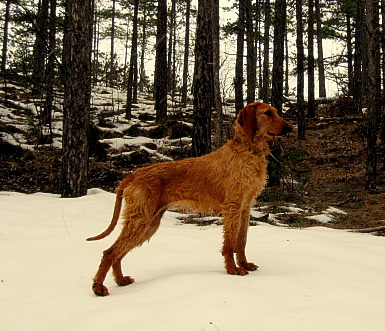
| Breed Name | Rough-haired Italian Hound / Segugio Italiano a Pelo Forte |
| Country of Origin | Italy |
| FCI Classification | Group 6 (Scenthounds and Related Breeds), Section 1.2 (Medium-sized Scenthounds). Working trials are mandatory. |
| Lifespan | 11-14 years |
| Height at Withers | Males: 52-60 cm, Females: 50-58 cm |
| Weight | Males: 20-28 kg, Females: 18-26 kg |
| Temperament | Energetic, resilient, passionate hunter; calm, loyal, and sensitive at home. |
| Physical Exercise Needs | Very high |
| Relationship with Children | Good, patient, and affectionate |
| Relationship with Other Animals | Wary; strong prey drive towards cats and small animals. |
| Tendency to Bark | High; has a loud, melodious voice |
| Coat Care | Minimal |
History of the Rough-haired Italian Hound
The history of the rough-haired Italian Hound traces its roots back to antiquity, making it one of the oldest hound breeds in Europe. It’s believed that its ancestors were ancient Egyptian hounds that were brought to the Apennine Peninsula by Phoenician traders. These dogs, known for their speed and keen sense of smell, were crossed with local dogs, including Roman Molossers, which added to their strength and endurance.
Images of dogs that closely resemble the modern Segugio can be found on ancient Roman and Lombard artefacts. This shows that the breed was popular and highly valued for its working abilities thousands of years ago. During the Renaissance, hunting became a favourite pastime of the Italian aristocracy, and Segugio were an essential part of every grand hunting expedition. They were kept at the courts of dukes and nobles, and their beauty and grace were celebrated in the literature of the time.
In the 19th century, the breed was unofficially divided into two main branches: the Lombard (lowland) and the Alpine types. This was due to the dogs’ adaptation to different hunting conditions. However, official recognition and standardisation came much later. The first breed standard was drawn up in 1881, but it wasn’t until the 1920s, thanks to the efforts of enthusiasts and the Italian Segugio Lovers’ Club (Società Italiana Pro Segugio), that the breed began to develop actively and take on its modern appearance. Two variations were officially recognised: the rough-haired (a Pelo Forte) and its closest relative, the Shorthair Italian Hound (a Pelo Raso). Today, both breeds are recognised by the FCI and remain incredibly popular in their homeland, where they are still actively used for hunting hares, foxes, and wild boar.
Breed Standard and Appearance of the Italian Hound
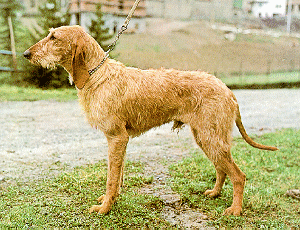
The Rough-haired Italian Hound is a dog of robust yet elegant build, combining strength and speed. Its appearance reveals it to be a typical hound, bred for long chases across difficult terrain. The body is mesomorphic, almost square in shape, with well-developed muscles but no unnecessary bulk.
- Head: Long and narrow (dolichocephalic). The skull is oval, and the stop is gradual but noticeable. A characteristic feature is the slightly curved bridge of the nose, the so-called “Roman nose.”
- Eyes: Large, almond-shaped, and expressive. The colour is dark ochre. The gaze is soft, a little sad, but attentive.
- Ears: Long, broad, and triangular, set at the level of the cheekbones. They hang down, lying close to the cheeks, and are covered with shorter hair. The tips of the ears are rounded.
- Body: The topline is straight. The chest is deep and well-developed but not too wide, providing ample space for the lungs and heart. The abdomen is moderately tucked up, giving the dog a slender appearance.
- Tail: Set high, thick at the base, and tapering gradually towards the tip. When at rest, it hangs down in a saber shape. During movement or when excited, it may be raised, but not above the level of the back.
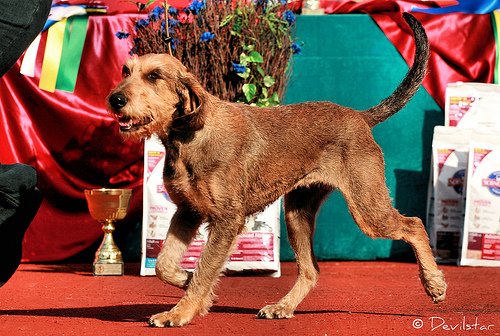
- Coat: The main distinguishing feature of the breed. The coat is hard and coarse to the touch, about 5 cm long all over the body. On the muzzle, it forms a characteristic beard and moustache, and above the eyes, thick eyebrows. This coat provides excellent protection for the dog from bad weather and thorny bushes while hunting.
- Colour: Various shades of red are permitted (from pale fawn to deep red) as well as black and tan (a black saddle on a red background). A small white “star” on the chest is also allowed.
Character: The Italian Hound’s Dual Nature
The temperament of the Rough-haired Italian Hound is a wonderful combination of two opposite worlds. When hunting, it’s a restless, passionate, and independent worker, but at home, it’s a calm, gentle, and deeply devoted family member.
While working, the Segugio completely transforms. Its main driving force is its hunting instinct. It can chase prey for hours, or even all day, tirelessly covering miles of difficult terrain. It’s known for its characteristic loud and melodious howl (“voice”), which an experienced hunter can use to determine the stage of the chase. This independence in decision-making can sometimes be perceived as stubbornness during training, so the owner must be patient and consistent.
However, once it crosses the threshold of its home, this hunter becomes an exemplary companion. It’s very people-oriented and forms a strong attachment to its owner and all family members. Its behaviour is calm and balanced. The Segugio is affectionate with children, patiently enduring their games. It approaches strangers with some caution and reserve but without aggression. This breed needs constant human presence and tolerates loneliness poorly, which can lead to destructive behaviour and anxiety.
An important characteristic is its innate sensitivity and a certain timidity. Harsh treatment, shouting, or physical punishment can permanently undermine the dog’s trust. Therefore, early and gentle socialisation is key to raising a confident and well-adjusted dog. Its energy is similar to that of other tireless hunters, such as the Griffon Nivernais or the Bosnian Coarse-haired Hound (Barak).
Pros and Cons of the Breed
| Pros (+) | Cons (-) |
|---|---|
| Excellent Health: One of the healthiest breeds, with a minimal number of genetic diseases. | Very High Energy Needs: Not suitable for apartment living without daily intensive exercise. |
| Loyalty and Attachment: Becomes a faithful friend to the whole family. | Strong Hunting Instinct: Dangerous for cats and other small pets. Prone to running off if it catches an interesting scent. |
| Low-Maintenance Grooming: The coarse coat doesn’t require complex grooming. | Tendency to Bark: Has a loud and ringing voice that it uses actively. |
| Child-Friendly: Patient and gentle in its interactions with children. | Needs an Experienced Owner: Independence and stubbornness make training a challenge for beginners. |
| Stamina and Hard Work: Ideal partner for hunting and active recreation. | Tolerates Loneliness Poorly: Can suffer from separation anxiety if left alone for too long. |
Italian Hound Health: Typical Ailments and Prevention
The Rough-haired Italian Hound is a breed that can boast of excellent natural health. Centuries of natural selection, where the strongest and most resilient individuals survived, have made it resistant to many genetic diseases that plague other breeds. However, like any dog, the Segugio has certain vulnerable points that an owner should be aware of.
- Ear Infections (Otitis): Long, floppy ears create a warm, moist environment that is ideal for the proliferation of bacteria and fungi. This is the most common problem for the breed. Prevention: regular inspection and cleaning of the ears (1-2 times a week) with a special lotion. An alarming symptom requiring immediate veterinary attention is frequent head shaking, scratching at the ears, and a foul smell.
- Musculoskeletal Diseases: Although hip dysplasia is rare, it is possible, as in any other medium-to-large breed. It is important not to over-exercise puppies until their skeleton is fully formed.
- Bloat and Gastric Torsion (GDV): Dogs with deep chests have an increased risk of this dangerous condition. Prevention: feeding smaller portions 2-3 times a day instead of one large one; avoiding physical exertion immediately after eating.
- Hunting Injuries: When working in the field, the dog can get cuts, scratches, insect bites, or ticks. It’s important to always have a first-aid kit with you and to regularly treat the dog for ectoparasites.
Overall, with proper care, a balanced diet, and sufficient physical activity, the Italian Hound will rarely get sick and live a long, active life.
Care and Maintenance of the Italian Hound
Caring for the Rough-haired Italian Hound is not difficult, but it has its own peculiarities related to its origin and purpose. The ideal living conditions for it are a private house with a large, securely fenced garden in a rural area or a suburb. A high fence is mandatory, as its keen sense of smell and hunting instinct can prompt the dog to go on an adventure, ignoring the boundaries of its territory.
Coat: The Segugio’s coarse coat should be brushed once a week with a metal brush or furminator to remove dead hair and dirt. This also stimulates blood circulation in the skin. The dog does not require frequent bathing, only in case of heavy soiling. Its coat has a self-cleaning property. Periodically, you need to trim the hair between the paw pads and check the beard for food debris.
Physical Exercise: This is a key aspect of maintenance. The Segugio needs at least 1.5-2 hours of active walks daily. These cannot be slow walks on a lead. The dog needs the opportunity to run and explore the area. Ideal activities would be jogging with the owner, trips to the woods or a field where it can safely run off-lead (provided it has a perfect recall command). An insufficient amount of exercise will lead to boredom, stress, and destructive behaviour at home. Its energy is similar to that of other tireless hunters, such as the Small Blue Gascony Hound or the Bosnian Coarse-haired Hound (Barak).
Apartment Living: This is possible but highly not recommended. The owner must be prepared to dedicate a significant part of their day to meeting the dog’s physical and mental needs. In addition, you should remember its loud voice, which may not be popular with the neighbours.
Training and Socialisation
Training an Italian Hound is a task that requires patience, consistency, and an understanding of the dog’s hunting nature. It’s intelligent and quick-witted, but also very independent. It will only obey an owner it respects and with whom it has been able to establish a strong bond. You shouldn’t entrust its upbringing to strangers or trainers who use harsh methods — this can break the dog’s sensitive psyche.
The foundation of training should be positive reinforcement: praise, treats, and play. Commands should be practised persistently but without pressure. Special attention should be paid to the recall command, as the hunting instinct can cause the dog to ignore everything around it when it’s on a scent.
Early socialisation is critically important. From a young age, the puppy needs to be introduced to different people, sounds, places, and other dogs. This will help overcome its natural timidity and raise a confident companion. However, socialisation is powerless against its predisposition towards cats and other small animals. Peaceful cohabitation with them is only possible if the puppy grew up with them from a very young age, and even then, constant supervision is required.
Italian Hound Nutrition: Key Recommendations
The Rough-haired Italian Hound is not fussy about food, but its diet must be high-quality, balanced, and meet its high energy needs. The key principle is that the amount of food should depend on the dog’s activity level. A hound that regularly hunts or trains needs significantly more calories than a companion dog that leads a calmer lifestyle.
| Nutrient | Source | Importance for the Hound |
|---|---|---|
| Proteins (25-30%) | Lean meat (beef, turkey, chicken), fish, offal. | Building blocks for muscles, important for strength and stamina. |
| Fats (15-20%) | Fish oil, vegetable oils, fatty meat. | Main energy source for long-lasting exercise. Improves coat condition. |
| Carbohydrates | Cereals (rice, buckwheat), vegetables. | Additional energy source, fibre for good digestion. |
| Vitamins and Minerals | Vegetables, fruits, specialised supplements. | Supports the immune system, bone, and joint health. |
You can choose either a ready-made premium or super-premium dry food for active medium-sized dogs or a natural diet. For natural feeding, the basis of the diet (about 60-70%) should be meat and offal. You should avoid fatty pork, tubular bones, and food from the owner’s table.
It’s important to divide the daily food allowance into 2-3 meals to reduce the risk of bloat. And, of course, the dog should always have access to clean drinking water, especially after physical exertion.
Interesting Facts About the Breed
- Ancient Roots: This is one of the few breeds whose history can be continuously traced for over 2,000 years.
- A Voice, Not a Bark: The sound the Segugio makes during a chase is called a “voice.” It is very melodious and ringing, and hunters can distinguish its tone, understanding whether the dog has found a scent or is already seeing the prey.
- Two “Coats”: The existence of two variations—rough-haired and shorthaired—allowed the breed to adapt to the different climatic conditions and types of terrain in Italy.
- Not Just Hares: Although the main prey for the Segugio is traditionally the hare, it is successfully used for hunting foxes, wild boar, and even birds. This is similar to what you’d see with the universal European hounds.
- National Heritage: In Italy, the Segugio is considered a national heritage and an integral part of the country’s hunting culture.
Frequently Asked Questions About the Breed
Is the Italian Hound suitable for a family with children?
Yes, provided the family leads an active lifestyle. The Segugio is very patient and gentle with children. However, as with any dog, interactions with small children should be supervised.
Can the Italian Hound live in the same house as a cat?
This is extremely risky. Its hunting instinct is very strong. Peaceful coexistence is only possible if the puppy grew up with the cat from a very young age, and even then, complete safety is not guaranteed.
How much physical exercise does it need?
A lot. A minimum of 1.5-2 hours of intense activity daily. A simple walk on a lead will not meet its needs. It needs to run, preferably off-lead in a safe place.
Does the rough-haired hound shed a lot?
Shedding is moderate. The coarse coat holds dead hair well, so regular brushing (once a week) helps keep the home clean.
Is it easy to train?
Yes and no. It’s intelligent and learns quickly, but its independence and stubbornness can be a challenge for a novice. It needs a patient, consistent owner who can be its leader.