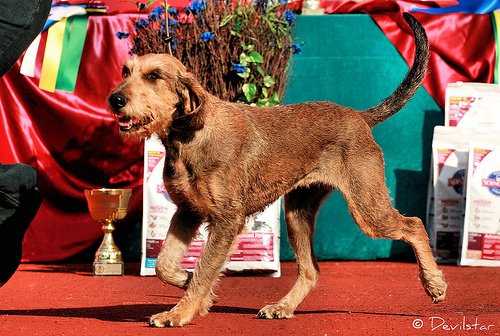
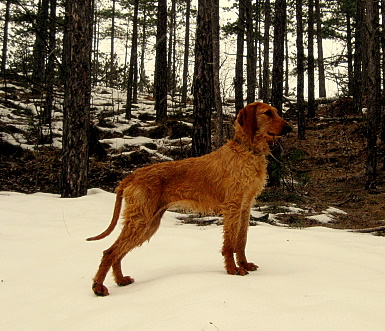
An aristocratic bearded Italian hound with a soft heart — hardy and gentle: keen in the field, biddable at home, devoted and people-oriented. The Italian Hound (Segugio, coarse-haired) is the wiry variety of the ancient Italian breed; it combines a hunter's tirelessness with a soft, biddable character, so it increasingly becomes not just a working dog but a gentle family companion.
Apartment · not suitableKidsCats · not suitableOther dogsBeginners · with caveats
The Rough-haired Italian Hound, or Segugio Italiano a Pelo Forte, is more than just a hunting dog; it's a living piece of Italian history. This ancient breed combines an aristocratic appearance, incredible stamina, and a gentle, compliant nature. Today, it's winning the hearts of not only hunters but also everyday families. Its ability to be a passionate and tireless partner in the field while remaining a tender and devoted companion at home makes it truly unique. The soft temperament and good manners of this hunting hound make it an excellent choice as a companion and family pet. It forms a deep bond with its owner and is highly sensitive to their mood, affectionate with children, and reserved with strangers. To learn more about this and other incredible breeds, check out what’s next on Tvaryny.
The Rough-haired Italian Hound: Breed at a Glance
The Rough-haired Italian Hound: Breed at a Glance · 12
Breed Name
Rough-haired Italian Hound / Segugio Italiano a Pelo Forte
Country of Origin
Italy
FCI Classification
Group 6 (Scent hounds and related breeds), Section 1.2 (Medium-sized hounds). Working trial is mandatory.
Life Expectancy
11–14 years
Height at Withers
Males: 20.5–23.5 inches, Females: 19.5–23 inches
Weight
Males: 44–62 lbs, Females: 40–57 lbs
Temperament
Energetic, resilient, passionate hunter; at home—calm, loyal, and sensitive.
Exercise Needs
Very High
Relationship with Children
Good, patient, and affectionate
Relationship with Other Animals
Reserved; strong hunting instinct toward cats and small animals.
Tendency to Bark
High, has a loud and melodious voice
Coat Care
Minimal
The Segugio's Dual Nature
The temperament of the Rough-haired Italian Hound is a fascinating blend of two opposite worlds. In the field, it's an unstoppable, passionate, and independent worker, but at home, it's a calm, gentle, and deeply loyal family member.
When working, the Segugio completely transforms. Its primary driving force is a hunting instinct. It can chase prey for hours, or even a full day, tirelessly covering miles of difficult terrain. It's known for its characteristic loud and melodious baying ("voice"), which an experienced hunter can use to determine the stage of the chase. This independence in decision-making can sometimes be perceived as stubbornness during training, so owners must be patient and consistent.
However, once it crosses the threshold of home, this hunter becomes an exemplary companion. It is very people-oriented and forms a strong bond with its owner and all family members. Its behavior is calm and balanced. The Segugio is affectionate with children, patiently enduring their games. It is somewhat cautious and reserved with strangers but not aggressive. This breed needs constant human presence and does not cope well with solitude, which can lead to destructive behavior and anxiety.
An important character trait is its innate sensitivity and a certain timidity. Rough handling, yelling, or physical punishment can permanently undermine the dog's trust. Therefore, early and gentle socialization is key to raising a confident and well-balanced dog.
Interesting Facts About the Breed
Ancient Roots: This is one of the few breeds whose history can be continuously traced for over 2000 years.
A "Voice," Not a Bark: The sound the Segugio makes during a chase is called a "voice." It is very melodious and clear, and hunters can distinguish its tonality to understand if the dog has found a scent or already sees the prey.
Two "Coats": The existence of two variations—the rough-haired and the shorthaired—allowed the breed to adapt to different climatic conditions and types of terrain in Italy.
More Than a Rabbit Hunter: Although the main prey for the Segugio is traditionally the hare, it is successfully used to hunt foxes, wild boars, and even birds. In this, it resembles versatile European hounds like the Small Blue Gascony Hound.
A National Treasure: In Italy, the Segugio is considered a national treasure and an integral part of the country's hunting culture.
The History of the Rough-haired Italian Hound
The history of the Rough-haired Italian Hound is rooted in antiquity, making it one of the oldest hound breeds in Europe. It's believed that its ancestors were ancient Egyptian hounds brought to the Apennine Peninsula by Phoenician traders. These dogs, known for their speed and sharp sense of smell, were crossed with local dogs, including Roman Molossians, which added strength and stamina.
Images of dogs strongly resembling the modern Segugio can be found on ancient Roman and Lombard artifacts. This suggests the breed was popular and highly valued for its working abilities thousands of years ago. During the Renaissance, hunting became a favorite pastime of the Italian aristocracy, and Segugios were an integral part of every grand hunting expedition. They were kept in the courts of dukes and nobles, and their beauty and grace were celebrated in the literature of the time.
In the 19th century, the breed was informally divided into two main branches: the Lombard (for the plains) and the Alpine. This was due to the dogs' adaptation to different hunting conditions. However, official recognition and standardization happened much later. The first breed standard was established in 1881, but it wasn't until the 1920s, thanks to the efforts of enthusiasts and the Italian Segugio Lovers Club (Società Italiana Pro Segugio), that the breed began to develop actively and take on its modern form. Two variations were officially recognized: the Rough-haired (a Pelo Forte) and its close relative, the Shorthair Italian Hound (a Pelo Raso). Today, both breeds are recognized by the Fédération Cynologique Internationale (FCI) and remain incredibly popular in their homeland, where they are still actively used to hunt hares, foxes, and wild boars.
Breed Standard and Appearance
The Rough-haired Italian Hound is a dog of robust yet elegant build, combining strength and speed. Its appearance reveals a typical hound, bred for long chases over rugged terrain. The body is mesomorphic, almost square-shaped, with well-developed muscles but without excess bulk.
Head: Long and narrow (dolichocephalic). The skull is oval, and the stop is gradual but noticeable. A characteristic feature is a slightly arched nasal bridge, known as a "Roman nose."
Eyes: Large, almond-shaped, and expressive. The color is dark ochre. The gaze is soft, a bit sad, but attentive.
Ears: Long, wide, and triangular. They are set at the level of the cheekbones, hanging close to the cheeks, and covered with shorter hair. The tips of the ears are rounded.
Body: The topline is straight. The chest is deep and well-developed, but not too wide, providing ample room for the lungs and heart. The abdomen is moderately tucked up, giving the dog a lean appearance.
Tail: Set high, thick at the base, and tapering toward the tip. When at rest, it hangs in a saber shape. When moving or excited, it can be raised, but not above the topline.
Coat: The main distinguishing feature of the breed. The coat is hard, rough to the touch, and about 2 inches long all over the body. On the muzzle, it forms a characteristic beard and mustache, and above the eyes, thick eyebrows. This coat provides excellent protection against bad weather and thorny bushes while hunting.
Color: Various shades of fawn (from pale fawn to rich red) and black and tan are permitted. A small white "star" on the chest is possible.
Pros and Cons of the Breed
Pros (+)
Cons (-)
Excellent Health: the absence of described hereditary disease is not the absence of risk — breeding animals are screened all the same.
Very High Energy Needs: Not suitable for apartment living without intense daily exercise.
Loyalty and Affection: Becomes a faithful friend to the entire family.
Strong Hunting Instinct: A danger to cats and other small pets. Prone to escaping if it catches an interesting scent.
Low-Maintenance Grooming: The rough coat doesn't require complex grooming.
Prone to Baying: Has a loud and clear voice that it uses actively.
Child-Friendly: Patient and gentle with children.
Requires an Experienced Owner: Its independence and stubbornness can be a challenge for novices.
Stamina and Work Ethic: An ideal partner for hunting and active recreation.
Does Poorly with Solitude: Can suffer from separation anxiety if left alone for long periods.
Training and Socialization
Training the Italian Hound is a task that requires patience, consistency, and an understanding of the dog's hunting nature. It is smart and clever but also very independent. It will only obey an owner it respects and who has established a strong bond with it. Entrusting its training to strangers or instructors who use harsh methods is not recommended—it can break the dog's sensitive psyche.
The basis of training should be positive reinforcement: praise, treats, and play. Commands should be practiced persistently but without pressure. Special attention should be given to the recall command ("come!"), as the hunting instinct can make the dog ignore everything around it when it's on a scent.
Early socialization is critically important. From a young age, the dog should be introduced to different people, sounds, places, and other dogs. This will help overcome its natural timidity and raise a confident companion. However, socialization is powerless against its strong prey drive toward cats and other small animals. Coexistence with them is only possible if the puppy grew up with them from a very young age, and even then, constant supervision is necessary.
Care and Maintenance
Caring for the Rough-haired Italian Hound is straightforward but has its peculiarities related to its origin and purpose. The ideal living situation for it is a house with a large, securely fenced yard in a rural or suburban area. A high fence is mandatory, as its keen sense of smell and hunting instinct can prompt the dog to go on an adventure, ignoring the boundaries of its territory.
Coat: The Segugio's rough coat only needs to be brushed once a week with a metal brush or a furminator to remove dead hair and dirt. This also stimulates blood circulation in the skin. The dog doesn't need frequent baths, only when it gets very dirty. Its coat has a self-cleaning property. The hair between its paw pads should be trimmed periodically, and its beard should be checked for food residues.
Exercise: This is a key aspect of ownership. A Segugio requires at least 1.5–2 hours of active walks every day. These can't be slow strolls on a leash. The dog needs the opportunity to run and explore. Ideal activities include jogging with the owner, hiking in the woods or fields where it can safely run off-leash (assuming it has a perfect "come!" command). Insufficient exercise will lead to boredom, stress, and destructive behavior at home. Its energy is similar to other tireless hunters like the Griffon Nivernais or the Bosnian Coarse-haired Hound.
Apartment Living: It is possible but highly discouraged. The owner must be prepared to dedicate a significant portion of their day to meeting the dog's physical and mental needs. Additionally, you should remember its loud voice, which may not be popular with neighbors.
Nutrition
Feeding Your Segugio: Key Recommendations
Health and risks
Health of the Segugio: Typical Ailments and Prevention
Frequently Asked Questions · 5
Is the Italian Hound suitable for a family with children? Yes, provided the family leads an active lifestyle. The Segugio is very patient and gentle with children. However, as with any dog, interactions with small children should be supervised.
Can the Italian Hound live in the same house with a cat? This is extremely risky. Its hunting instinct is very strong. Peaceful coexistence is only possible if the puppy grew up with the cat from a very early age, and even then, complete safety is not guaranteed.
How much exercise does it need? A lot. A minimum of 1.5–2 hours of intense activity every day. A simple walk on a leash will not satisfy its needs. It needs to run, preferably off-leash in a safe area.
Does the rough-haired hound shed a lot? Shedding is moderate. The rough coat holds onto dead hair well, so regular brushing (once a week) helps keep the home clean.
Is it easy to train? Yes and no. It is intelligent and learns quickly, but its independence and stubbornness can be a challenge for a novice. It requires a patient, consistent owner who can establish themselves as a leader.
FAQ
Is the coarse-haired Segugio good for a family?
Yes — thanks to its soft, biddable character and good manners it increasingly lives not just as a working dog but as a gentle, devoted family companion, good with children.
How does it differ from the shorthaired Segugio?
Only in coat type: the coarse-haired (a pelo forte) has a wiry coat, smoother on the head, ears and legs; the shorthaired a dense, smooth one. Size and character are the same.
Is the breed suited to an apartment?
Poorly — despite its soft character it is a hardy hunter with high exercise and scent-work needs; in an apartment without a job it grows bored.