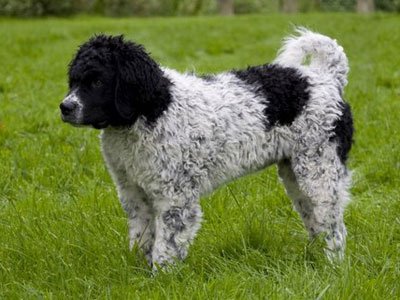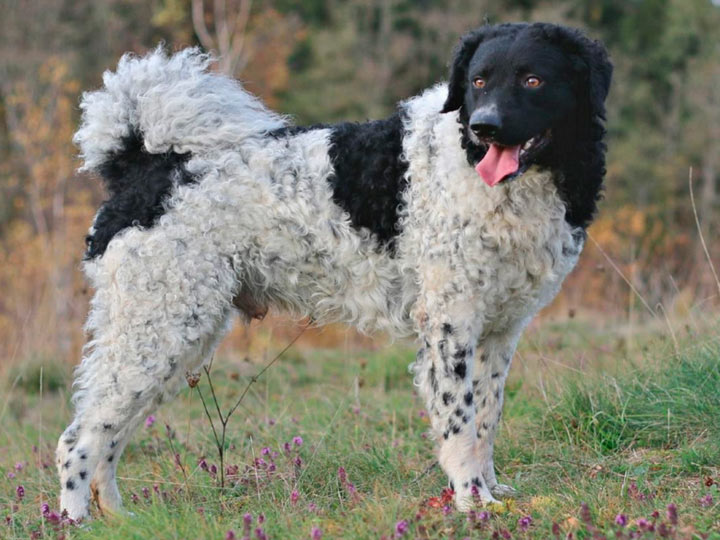
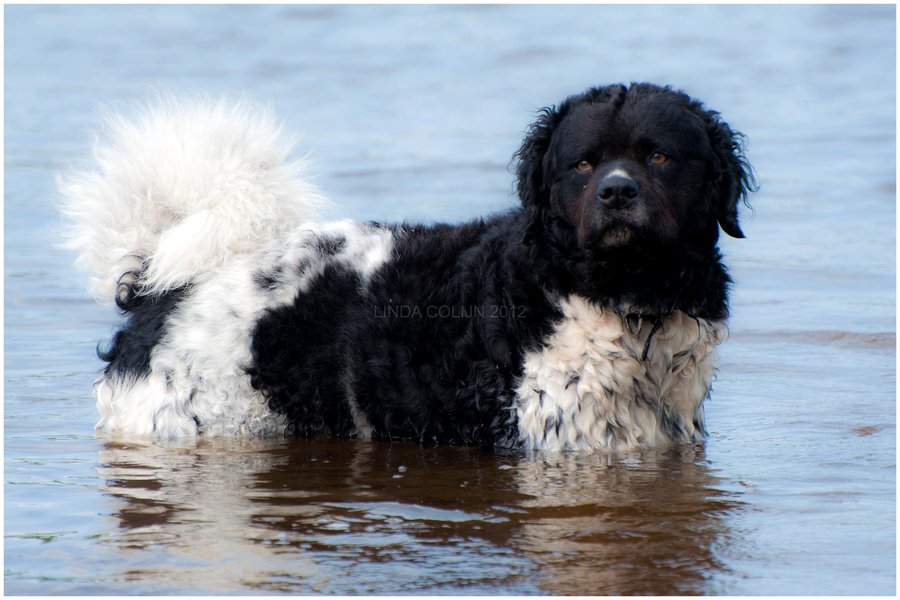
The Wetterhoun, or Frisian Water Dog, is a rare Dutch breed with a curly, all but waterproof coat. It was developed in Friesland to hunt otter and other small predators and to guard the yard, and that work shaped its character: self-willed, reserved with strangers, able to decide for itself far from the hunter.
The most interesting thing about this breed, though, is not its looks. The Wetterhoun is one of very few breeds whose population bottleneck is not described in vague terms but measured in numbers and treated under a plan with a stated end date. The Dutch breed association publishes kinship coefficients, the share of failed matings and the list of breeds used to widen the gene pool. What follows rests on those documents. Find out more at Tvaryny.
Wetterhoun: key breed information
Wetterhoun: key breed information · 9
| Name | Wetterhoun, Frisian Water Dog |
|---|---|
| Origin | Friesland, the Netherlands |
| FCI recognition | Standard No. 221, Group 8 (retrievers, flushing dogs, water dogs), Section 3 (water dogs), with working trial |
| Use per the standard | Hunting dog and water dog, traditionally otter hunting; guarding the yard |
| Height at withers (ideal) | Males 59 cm, females 55 cm — the standard gives two single figures, not a range |
| Weight | Males approximately 34 kg, females approximately 28 kg |
| Life expectancy | 13 years, per the AKC breed page |
| World population | About 1000 dogs — the estimate given in the FCI standard |
| Temperament per the standard | Self-willed by nature; affectionate as a family dog; watchful in the house; may be reserved with strangers but should not be fearful |
What "66 % kinship" actually means
It is often written of the Wetterhoun that every dog in the breed is related "more closely than brother and sister", with the figure 66 % attached. The figure is real, but on its own it means nothing until you are told relative to what it was calculated. This is the single most useful thing to understand about the genetics of rare breeds.
Kinship and inbreeding coefficients are always counted from some reference population — a notional set of ancestors treated as unrelated. Change that base and the very same dogs yield a completely different number. In the Wetterhoun this is plain to see, because the breed's own documents count in different ways and say so openly:
What "66 % kinship" actually means · 6
| Measure | Value | Counted from |
|---|---|---|
| Inbreeding of any permitted combination | at least 32 % | all available generations of pedigree, which is 14–16 generations |
| Inbreeding across the whole population per year | 31.88 % in 2000 → 35.53 % in 2011 | pedigree at full depth |
| Genomic inbreeding coefficient (Embark DNA test) | about 36 % | DNA itself, no pedigree |
| Kinship between animals | about 66 % | comparison with a brother-and-sister pair |
| Ceiling allowed by the breeding rules | no more than 10 % | only four generations |
| Expected coefficient of the Laika outcross pair | under 1 % | DNA, cross-breed pair |
Look closely at the first and fifth rows. The same dogs, the same population, the same year — and simultaneously "at least 32 %" and "no more than 10 %". There is no contradiction: the first number is counted from the entire known depth of the pedigree, the second only over four generations. The shorter the memory of the calculation, the fewer shared ancestors it manages to see and the lower the result. The breeding rule uses the short base deliberately, because on the long base no pair in the breed would pass at all.
By the same logic you cannot set 66 % against 36 % as if it were a contradiction: the first is kinship between two animals, the second an inbreeding coefficient, and they are different quantities on different scales. Whereas 32 % from the pedigree and 36 % from a DNA test are two independent methods that landed close together, which is precisely why the estimate can be trusted.
The practical conclusion for a buyer is simple: if a breeder quotes you an inbreeding percentage for a puppy, ask over how many generations it was calculated. Without that qualifier the number is comparable to nothing.
How the narrow gene pool showed up in fertility
Inbreeding in the Wetterhoun stopped being an abstraction the moment it became visible in matings. The association reviewed every mating from 2005 to 2011: 249 attempts under 236 issued permits, involving 78 different stud dogs. On average it took 2.25 attempts per litter, and only 47 % of matings produced one.
To see how low that is you need a benchmark, and the association supplies it: the reproduction department of the Utrecht veterinary faculty works on the assumption that in dogs at least 80 % of intended matings should end in a litter. The breed was running at roughly half the expected rate. Over the same period 24 % of stud dogs produced no litter at all, and of 102 bitches that produced 116 litters, 27 % of the bitches offered never conceived.
The decline shows in the yearly snapshots the association compiled while preparing the program:
How the narrow gene pool showed up in fertility · 6
| 2005 | 2008 | 2010 | |
| Bitches offered for breeding | 28 | 36 | 45 |
| Of those, mated that year | 26 | 29 | 43 |
| Litters obtained | 15 | 9 | 21 |
| Puppies born | 140 | 89 | 107 |
| Registered in the studbook | 113 | 82 | 94 |
The association itself lists the signs by which this is recognized: in bitches, irregular and split seasons, reduced sexual drive, failure to conceive after mating and interrupted pregnancies; in males, reduced willingness to mate and poorer semen quality.
The inbreeding management program, 2013–2028
The answer was a document with a name, dates and a deadline: the "Beleidsplan Fokkerij Wetterhounen 2013–2028", a breeding policy plan running 15 years, to 31 December 2028. The road to it was long: the breeding advisory committee raised the alarm in 2008, at the end of 2009 obtained permission from the Dutch kennel authority to prepare a plan, held four breeders' councils from January 2010 onwards, and the plan was adopted on 19 March 2012. The work drew on the foundation for rare domestic breeds, the bureau for preserving living heritage, and staff of the universities of Wageningen and Utrecht.
The design of the plan is worked out in detail, and every restriction has a reason:
- Ten stud dogs from at most eight breeds over twelve years. Many different donors rather than a few "successful" ones, so that the gene pool widens genuinely broadly and recessive traits from a single outside line do not accumulate.
- The drip method. Outside blood is introduced in small doses: a Wetterhoun bitch is mated to a male of another breed, and the descendants are returned into the breed gradually, so the diversity gained is not diluted away and lost.
- Separate registers. Offspring enter supplementary sections of the studbook — G-0, G-1 and G-2 — and receive a pedigree marked with a limited registration. It is lifted only after selection at around 18 months of age.
- Limits on stud dogs. Under the breeding rules a male may sire at most four litters in his lifetime, and a bitch three, no more than two in 24 months and with a gap of at least eight months. Separately, a Wetterhoun stud that has already produced three litters free of hereditary defects is allowed at most two further matings, and only with bitches from the outcross generations.
- A reserve for the future. Together with the foundation for rare domestic breeds a semen bank has been set up, so that the authentic genes remain available decades from now.
- Independent assessment. Every step is overseen by an appointed jury of four to six specialists; the term is five years, renewable twice.
- An insurance policy on purity. The plan explicitly requires that fully purebred combinations always remain available and produce offspring, with an annual report.
It is worth noting how the association describes its own setbacks. In the Barbet outcross it had to exclude two first-generation dogs on the basis of their hip scores for the first time, and in another combination it stopped work because of a health problem in a selected dog. A source that reports its own losses deserves more trust than one that reports only successes.
Eight outcrosses: which breeds, and why those
As of September 2025 the association had published a list of eight outcross lines with the birth dates of their first litters:
Eight outcrosses: which breeds, and why those · 8
| No. | Donor breed | First litter born |
|---|---|---|
| 1 | Labrador Retriever | 20 November 2014 |
| 2 | Standard Poodle | 18 December 2014 |
| 3 | Airedale Terrier | 11 November 2017 |
| 4 | Barbet | 9 July 2019 |
| 5 | Labrador Retriever | 27 March 2021 |
| 6 | West Siberian Laika | 2 September 2023 |
| 7 | Stabijhoun | 3 December 2024 |
| 8 | Irish Water Spaniel | 31 January 2025 |
The reasoning differs from case to case. The West Siberian Laika was chosen deliberately as a breed of primitive type: such breeds sit genetically far from the Wetterhoun and therefore add the most diversity. A DNA test bore the calculation out — the expected inbreeding coefficient for that pair came out at under 1 %, meaning the dogs are effectively unrelated, whereas within the breed the figure sits at about 36 %. The same test produced a surprise: the combination could yield brown puppies, even though that color is hardly ever seen in the Laika — a recessive gene had long gone unnoticed.
By the count of the chair of the breeding advisory committee, 130 puppies were born within the program between the first first-generation litter and the last second-generation one.
The Stabijhoun: the neighboring Frisian breed people keep confusing it with
The seventh row of the table above deserves a pause of its own. In December 2024 the outcross donor was the Stabijhoun — the very second Frisian breed the Wetterhoun had been stopped from crossing with in 1938–1942 precisely to preserve what was distinctive about each. Eight decades later it was deliberately brought back into breeding, but now as a controlled instrument for widening the gene pool rather than as unmanaged mixing.
The two should still not be confused, and the simplest distinction is formal. The Wetterhoun belongs to FCI Group 8 (water dogs), the Stabijhoun to Group 7 (pointing dogs). The sizes differ too: the Stabijhoun's ideal height is 50–53 cm in males and 48–50 cm in females, with a tolerance of two centimeters either way. So does the work: the Wetterhoun is a sturdy, self-reliant hunter of otter and predators, the Stabijhoun a softer all-round pointing dog. Nor do they look alike: the Wetterhoun's firm, greasy curls and spiral-carried tail are not to be mistaken for the Stabijhoun's longer, straight coat.
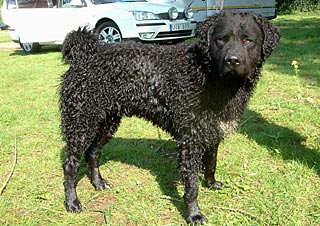
The Wetterhoun should also be told apart from the Curly Coated Retriever: despite a superficially similar curly jacket, that is an English breed from a different group, a different history and a different purpose.
Interesting facts about the Wetterhoun
- The standard legalises pacing. The Wetterhoun's tendency to pace is called less desirable but acceptable in the standard itself. Most breed standards penalise that gait.
- Ear hair is a breed point in its own right. The standard describes it separately: curled and longer at the base of the ear, shortening downwards, with the lower third of the ear covered in short hair.
- Looking like the opposite sex is a fault. Among severe faults the standard lists lack of sexual dimorphism: a dog should look like a dog, a bitch like a bitch.
- A breed whose rescue plan has an end date. The inbreeding management program runs exactly to 31 December 2028 — a rare case of gene-pool work having a deadline rather than continuing "as long as it takes".
- The Stabijhoun was first separated, then brought back. The two Frisian breeds were pulled apart in 1938–1942 and reunited in December 2024 — this time by protocol and under a jury's supervision.
- A number in the standard is older than the standard. The estimate of "about 1000 dogs worldwide" appears in the current edition, but the English version dates it to 2013.