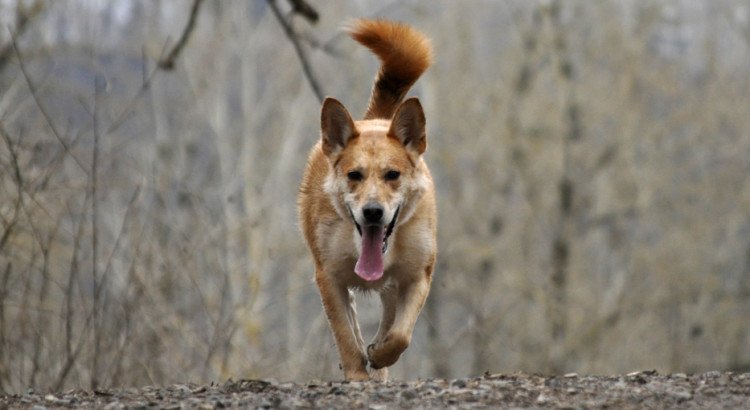
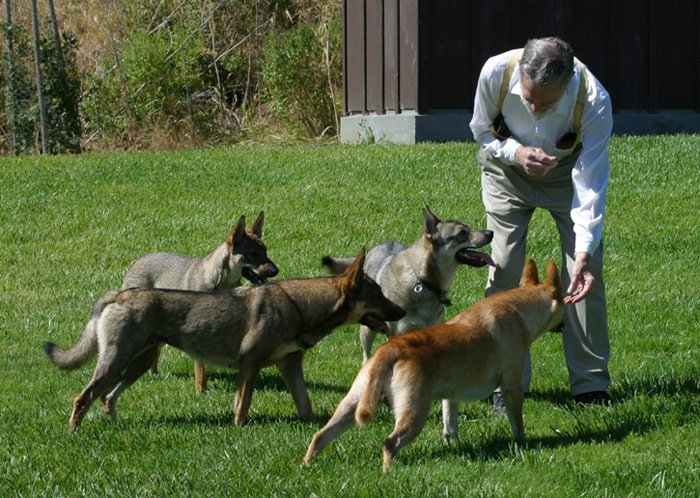
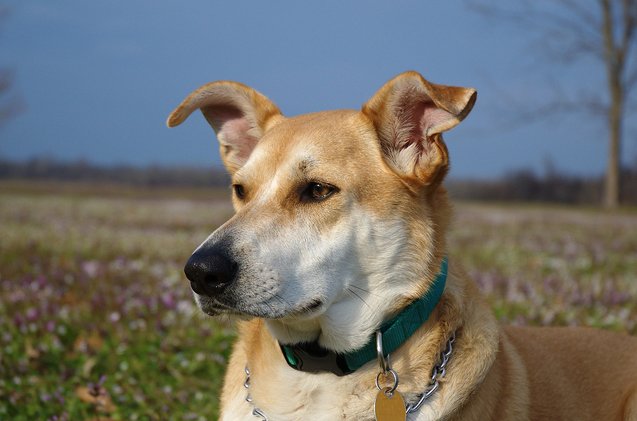
The Carolina Dog (American Dingo) is a free-ranging population from the southern United States, described by ecologists in the 1970s and only later entered in registries. UKC recognized it on January 1, 1995 and placed it among sighthounds and pariah dogs; AKC keeps it in the Foundation Stock Service; the breed is not in the FCI nomenclature. Shyness towards strangers is written into the standard as the norm, not as a fault. The genetics give a genuine but partial pre-Columbian component: the maternal lines show it, while no indigenous paternal lines were found.
Reserve towards strangers is written into the standard
Strong hunting instinct — a danger to small animals
An escape artist: serious fencing required
Needs space and an experienced owner
Size
ToySmallMediumLargeGiant
Compatibility
Apartment · with caveatsKids · with caveatsCats · not suitableOther dogsBeginners · with caveats
The Carolina Dog, also called the American Dingo, is a rare case in the dog world: not a breed shaped by people for a job, but a free-ranging population that ecologists described first and registries recorded afterwards. The dogs were found in the 1970s in the swampy, wooded country of the southern United States, which is why they can be discussed in the language of population genetics rather than breed legend alone. More on dogs across our site: Tvaryny.
The same population is variously called the American Dingo, the Dixie Dingo, or simply the Carolina Dog. These are different names for the same dogs, not separate ancestral breeds — an easy trap when reading popular retellings.
Carolina Dog (American Dingo): the breed in brief
Carolina Dog (American Dingo): the breed in brief · 8
Country of origin
United States (South Carolina, Georgia)
Registry status
UKC — recognized on January 1, 1995, Sighthound & Pariah Dog Group; AKC — Foundation Stock Service; not in the FCI nomenclature
Type
Primitive pariah dog of free-ranging origin
Life expectancy
12–15 years (figure from the AKC breed page)
Height at withers
18–24 inches, roughly 46–61 cm (standard; not split by sex)
Weight
approximately 35–50 pounds, that is 16–23 kg (standard)
Activity level
High
Trainability
Demanding: needs experience and patience
Two organizations record these dogs in the United States. The United Kennel Club (UKC) recognized the Carolina Dog on January 1, 1995 and placed it in the Sighthound & Pariah Dog Group; that is written into the UKC standard itself, whose current revision is dated January 1, 2023. The American Kennel Club (AKC) keeps the breed in the Foundation Stock Service, the recording service for breeds not yet admitted to the main groups; the AKC breed record carries a zero where a year of full recognition would go, meaning there is none. The standard AKC publishes is signed not by the club itself but by the breeders' association: "Breed Standard Per Carolina Dog Fanciers of America". The distinction matters to a reader: this is the breed club's position, not an AKC ruling. The club's own site dates its becoming the AKC parent club for the breed to April 2022.
How the dogs were found: the Savannah River Site and the 1970s
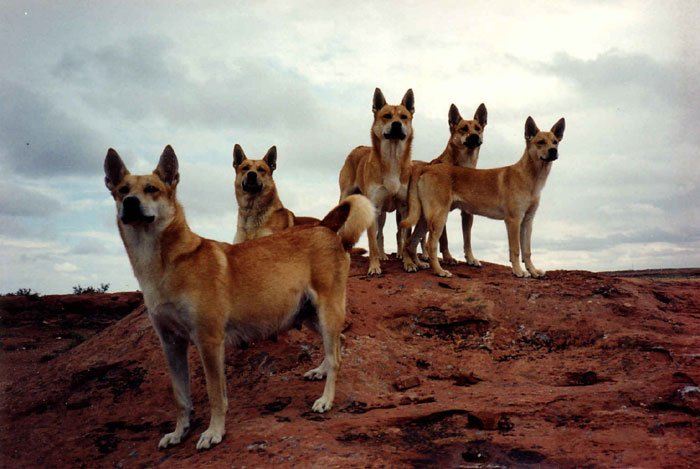
This population's story is bound to one particular place. The Savannah River Site is a Department of Energy facility in South Carolina covering 302 square miles (about 780 square kilometers). Roughly a tenth of it is developed for industrial activity; the other nine tenths are Upper Coastal Plain ecosystems — floodplain forests, pine woods, sandhills, blackwater streams and over 300 geographically isolated wetlands. In 1972 the site was designated the nation's first National Environmental Research Park.
Ecology arrived there before the dogs did. The University of Georgia's Savannah River Ecology Laboratory (SREL) traces its origins to 1951, when Eugene Odum began a biological inventory of the then Savannah River Plant at the request of the Atomic Energy Commission. The ground was surveyed methodically for decades — and it was the access regime that produced what no ordinary countryside could: a large tract into which outside dogs barely entered.
In the 1970s the SREL ecologist Dr I. Lehr Brisbin Jr noted and trapped free-ranging dogs in natural habitats of the south-eastern United States, and they were named Carolina Dogs. That wording is taken verbatim from the history section of both standards, UKC and AKC. The scientific framing came with Brisbin and Risch's paper "Primitive dogs, their ecology and behavior" in the Journal of the American Veterinary Medical Association (volume 210, issue 8, April 15, 1997, pages 1122–1126).
What follows is the most interesting part of the page — and the most hazardous for a reader.
…and what those studies are said to have shown
The popular retelling runs roughly like this: the Carolina Dog is a direct descendant of the first dogs in the Americas, a living museum piece that has reached us almost unchanged. That is a stronger claim than any of the authors made. Set them side by side.
What is usually written
What the papers actually say
"Pre-Columbian origin is proven"
Van Asch words it carefully: the breed "may have an ancient Asian origin"; it is called the first DNA-based evidence, not a settled conclusion
"Descended from the dogs that crossed Beringia"
What is confirmed is that part of the maternal lines are non-European. No indigenous paternal lines were found in American dogs anywhere outside the Arctic
"The dogs survived unchanged"
The autosomal estimate is 10–35% pre-Columbian ancestry, i.e. an admixed population, not an isolated one
"Ancient genomes confirmed the kinship"
The 2018 work found the signal in three dogs and said itself that it could not tell it apart from modern Arctic admixture
"The oldest breed in the Americas"
That same work showed pre-contact American dogs almost entirely vanished after Europeans arrived, leaving a minimal trace in modern populations
The most telling result of the 2018 paper is not about breeds at all: the closest living lineage to the pre-contact dogs of the Americas turned out to be the canine transmissible venereal tumor — a contagious cancer clone descended from a single animal that lived up to 8,000 years ago. The tumor outlived the dogs it came from.
The honest formulation, the one we are willing to sign: the Carolina Dog is a free-ranging population with a genuine but partial and largely maternal pre-Columbian component. That is rare and valuable material for science. It is not an unbroken ancient line.
For scale: the earliest securely dated dog remains in North America are about 9,900 calibrated years old, from the Koster site in Illinois — roughly 6,000 years later than the earliest unambiguous evidence of people in North America.
Where the registry parts company with the science
The history section of both standards opens the same way: when the first humans crossed the Bering land bridge they were accompanied by primitive dogs that "could have resulted from the beginnings of the original domestication of middle eastern wolves". That is the registry's position, and current data do not support it: the 2018 work places the pre-contact American dog lineage in Siberia, while Shannon and colleagues argue for a Central Asian origin for the dog as a whole. Write "the standard states", not "the breed descends from".
Yet the same standard does something club texts rarely do — it qualifies itself: "Additional studies support this hypothesis although additional ancestry and genetic studies are needed to reach a fully definitive conclusion about their origins." The registry expressly declines to call the question closed. That is stronger than any outside commentary.
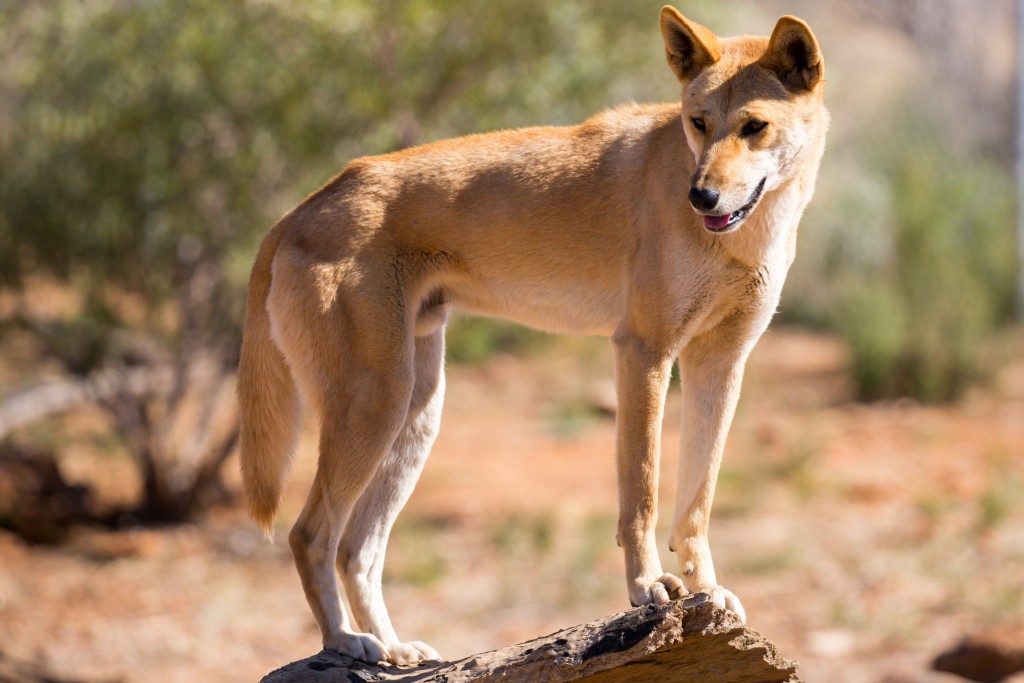
And there is one more place where the standard refutes the breed's most popular legend. The resemblance to the Australian Dingo is offered as proof of kinship. The standard explains it differently: pariah dogs, also known as village dogs, live all over the world on the fringe of human settlement, and "commonly have upright ears, pointed snouts, lean bodies and fish-hook tails". The dingo-like look, in other words, is the worldwide village-dog form, not a pedigree certificate. What links the Carolina Dog to the New Guinea Singing Dog and the Australian Dingo is a way of life and a mode of selection, not a documented shared line.
Size: why the figures wander between references
This is where most pages about the breed print meaningless numbers, and the cause is quite specific. One and the same organization publishes two different sets of measurements.
Source
Height
Weight
UKC standard (revised January 1, 2023)
18–24 inches
approximately 35–50 pounds
CDFA standard as published by AKC
18–24 inches
approximately 35–50 pounds
AKC breed page vitals
17.75–19.5 inches
30–55 pounds
The two standards agree word for word. The marketing vitals on the same AKC site give a narrower height and a wider weight. What happens next is simple: a compiler takes the lower bound from one set and the upper bound from the other, and cites both "per AKC". That is where ranges such as "15–25 kg" come from — figures that appear in no document at all.
We take the standard: 18–24 inches (about 46–61 cm) and 35–50 pounds (about 16–23 kg).
A word on the sexes. On breed pages the male and female height ranges normally must not be merged, because standards give different ones. Here it is otherwise, and the standard says so itself: "Females are generally lighter in build than dogs, but the sexes overlap broadly in both size and weight." The absence of a split is not a compiler's sloppiness; both standards decline to make one deliberately. Both texts add that type and symmetry matter more than size, and that overfed dogs are to be penalized.
Ivermectin and MDR1: why this is not about this breed
The claim that "like many herding and primitive breeds, Carolina Dogs may carry the MDR1 mutation and be sensitive to ivermectin" stood on this page in every language. We have taken it out — openly, because a medical claim attached to the wrong breed does more harm than no claim at all.
The grounds are not that we failed to find something; they are what two publications positively show.
Neff and colleagues (PNAS, volume 101, issue 32, pages 11725–11730, 2004) showed that the mdr1–1Δ mutation is a single allele, identical by descent: every carrier descends from one dog that lived in Great Britain before breeds were genetically isolated by registry, around 1873. The mutation marks the emergence of modern breeds from an admixed population of working sheepdogs — not "primitive type" as a category.
Mealey and Meurs (Journal of the American Veterinary Medical Association, volume 233, issue 6, pages 921–924, 2008) genotyped 5,368 dogs between May 1, 2004 and September 30, 2007. The ABCB1–1Δ allele was identified in nine breeds and in many mixed-breed dogs. The list is named outright: Collie, Longhaired Whippet, Australian Shepherd (standard and miniature), Shetland Sheepdog, Old English Sheepdog, Border Collie, Silken Windhound and German Shepherd Dog.
What matters is not the length of that list but its logic. The two sighthounds on it — the Longhaired Whippet and the Silken Windhound — are there precisely because their pedigrees include collie input; Neff and colleagues describe them as breeds not expected to share collie ancestry. The marker tracks one specific pedigree, not a body type and not a breed's "antiquity". The Carolina Dog has nothing to do with that pedigree.
The practical conclusion for an owner. None of this means antiparasitic drugs can be given at random. It means there is no breed-based reason to suspect MDR1 in a Carolina Dog specifically, and that dosing and drug choice are questions for a vet, not for a breed page.
Interesting facts about the Carolina Dog
A standard written against show polish. The purpose of the CDFA standard is to preserve the breed's ability to survive and reproduce unaided. The dog is shown in a natural condition, whiskers stay on, and overfed animals are penalized — the opposite of ordinary ring logic.
A sighthound with upright ears. UKC files the Carolina Dog with sighthounds and pariah dogs, and both standards call for a double-suspension gallop, the gait of true sighthounds. It looks like a spitz; structurally it is not.
A haplotype that was not in the databases. A184, the commonest maternal haplotype in the 2013 sample, had never been reported in GenBank at all.
The oldest relative is not a dog. The closest living lineage to the pre-contact dogs of the Americas turned out to be a contagious cancer clone rather than any modern breed.
Geography did more than breeders. A tract of 302 square miles with a controlled access regime and research-park status since 1972 preserved the population better than any breeding program could.
What the Carolina Dog looks like under the standard
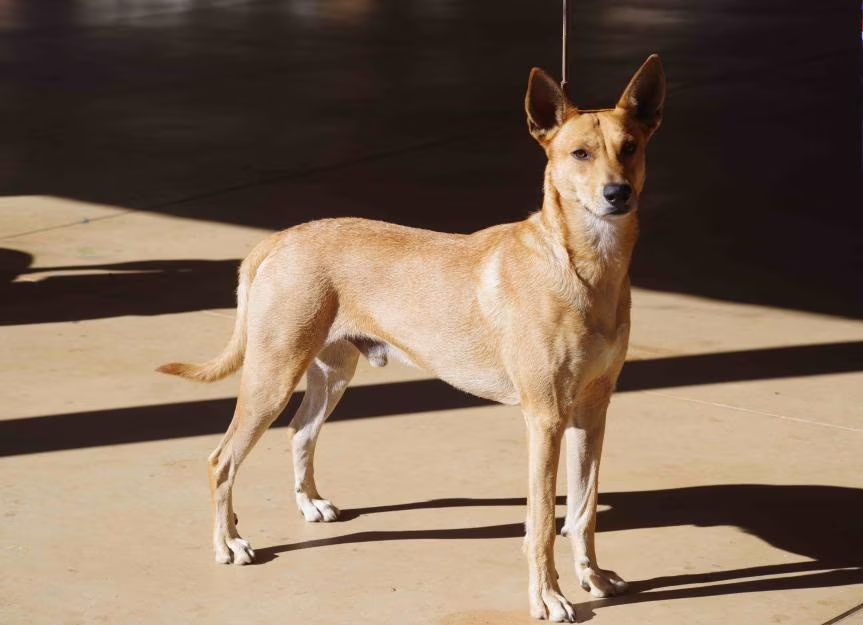
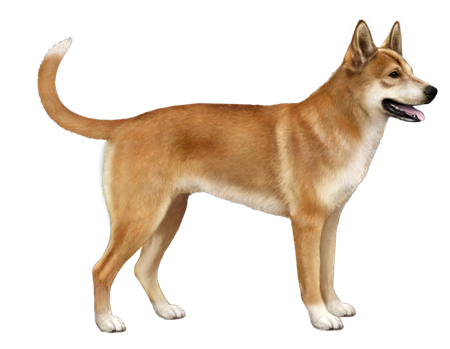
Both standards describe a medium-sized dog of light to medium bone with the look of "a small jackal" combined with the features of a medium-sized sighthound. The body is rectangular, the back straight, the waist distinct, the tuck-up deep. That is why UKC places the breed among sighthounds and pariah dogs rather than among spitzes, despite the upright ears. A similar combination of dry build and heat adaptation belongs to the Caravan Hound (Mudhol Hound).
Head. Seen from above it forms a triangle tapering to a strong, pointed muzzle set off by highly developed jaw muscles. The stop is slight but distinct. Younger dogs often show fine wrinkling on the forehead, giving a frown effect. Muzzle length is roughly equal to the cranial portion of the skull.
Neck. The most functional description in the whole standard: strongly crested and muscular, it gives the animal "a means of making rapid and effective downward stabbing movements with the head when hunting in tall grass". A short or throaty neck is a serious fault.
Ears. Mobile, triangular with a wide base, fine in texture and slightly rounded at the tip; carried upright when alert but able to rotate back along the head and neck. The standard even describes the characteristic pose: one ear firmly pricked, the other rotating to listen to the surroundings. Semi-prick ears are permitted but penalized to the degree of deviation.
Eyes. Almond-shaped, brown, amber or yellow, set at a slight angle so the outer edge sits higher than the inner. Eye rims are black and unbroken. Any other color is a fault, and blue eyes are a disqualification in both standards.
Tail. The most recognisable feature. Set horizontally as a continuation of the spine, with approximately the last third bending back toward the head — the fishhook. When the dog is alert the tail is often held at about 45 degrees above the horizontal. It must never curl fully over the back. A straight tail is a serious fault; a tail without a fishhook at the end is a fault. The tip is often white.
Limbs. The forelegs are straight and often set closer together than in many breeds; the flexible pasterns have a 15 to 20-degree angle. Rear pasterns are longer than the front ones. Rear dewclaws may be present and may be doubled.
Coat and color. The coat lies close and its length varies with the season: the winter coat, and the coat of dogs in colder climates, is distinctly heavier than the summer one. On the head, ears and front legs the hair is short and smooth; coarser guard hairs, longer than the undercoat, run over the neck, withers and back, standing erect when the dog is aroused and sometimes reading as a darker ridge.
The commonest color is any shade of ginger, from reddish ginger through light straw to pale yellow or buff, and it may vary across the body. Besides ginger the standards permit solid black (with or without minor white markings), black and tan, and piebald. Ticking is allowed only on white socks and feet, never across the body.
About the "angel wings". The paler buff markings behind the shoulders do have their own name — angel wings. But what the standards actually say is that the ginger coat usually carries them, as do some black and tan dogs. They are not a mark of purebred stock and not a test of ancestry; that reading was added by popular writing, not by the standard.
Where the two registries differ. The texts are close but not identical, and the difference touches things that put a dog out of the ring. The UKC standard disqualifies solid white coat color, cryptorchidism (unilateral or bilateral) and viciousness or extreme shyness; none of those three appear in the disqualification list of the Carolina Dog Fanciers of America standard. Smaller but telling: under UKC the tongue may be "fully pink, blue-black spotted, or fully black", while the CDFA version adds purple. Do not merge two registries into a single truth: name who says what.
Temperament, in the standard's own words
No guesswork is needed here: both registries describe the temperament identically and very directly. "A generally shy and suspicious nature is characteristic of this breed, but excessive fear and resistance to examination is not desirable. No individual should be expected to be friendly and outgoing, or to enjoy physical contact with strangers."
Read that sentence again before taking a puppy. The standard does not present reserve as a flaw to be corrected; it presents it as the breed norm. The line is drawn cleanly all the same: UKC lists "outward aggression toward humans" as a very serious fault, and viciousness or extreme shyness as an outright disqualification. Caution yes, aggression no.
Within the family these are undemanding dogs: they stay close without asking for constant attention. Many owners describe cat-like manners — fastidiousness, a fondness for high vantage points. In that the Carolina Dog resembles the Basenji, another primitive breed with a reputation for independence and cleanliness. With strangers it behaves unlike a guarding breed: unlike the Kangal Shepherd Dog, which confronts a threat head-on, the Carolina Dog keeps its distance and signals with its voice.
The unusual side of the behavior
A few traits have been passed from observer to observer since the first trappings. We give them as observations, which is what they are, rather than as documented breed constants.
"Snout pits". These dogs are described as digging small conical hollows in soft ground with the muzzle rather than the forepaws. The behavior is linked to extracting roots or insects and is reported even in animals raised away from natural habitat.
An annual reproductive rhythm. Bitches are said to come into season once a year, as wild canids do, rather than twice. That fits the primitive type, but we have not had a breed-specific publication with figures in our hands, so we present it as observation.
Voice. Beyond ordinary barking the repertoire includes howls and drawn-out calls — the usual way a pack keeps in touch across distance.
What is firmly on the record is the functional frame of the breed itself. The Carolina Dog Fanciers of America standard opens with a sentence that almost never appears in a breed text: it exists so the breed can still "survive and reproduce on its own, without human assistance in the wild habitat to which it has been adapted by natural selection for thousands of years". And further: the seriousness of any fault is weighed by its effect on "the dog's ability to survive and reproduce in its original free-ranging state under natural conditions". This is not a companion breed given a wild biography; it is a population whose standard is written around survival.
Training and socialization
Training rests on patience and motivation rather than force. The intelligence of these dogs is aimed at solving their own problems, not at performing commands for approval, so positive reinforcement and food motivation work well — the foraging instinct is strongly developed.
Socialization is the critical stage, and here it is worth returning to the standard's text. It does not promise that the dog will become friendly to strangers: no individual should be expected to. The aim of early socialization is different — to keep natural caution as caution, and stop it turning into panicky timidity or fear aggression, which UKC treats as an outright disqualification. Introduce a puppy to people, other dogs, city noise and traffic as early as possible. The same need for insistent early socialization belongs to the Canaan Dog, another primitive breed developed from a free-ranging population.
Important: this breed's shyness is not the result of poor rearing and not something coercion "cures". Harsh methods produce the opposite: the dog either shuts down or goes on the defensive.
Pros and cons of the breed
Advantages
Drawbacks
Minimal coat care; the standard requires a natural look with no trimming
Strong hunting instinct: small animals in the house are a serious problem
Fastidious, with almost no doggy odor
Reserve toward strangers is written into the standard, not trained out
Independent, good at solving problems unprompted
That same independence makes classic obedience training hard
Strongly attached to its own group, quiet at home
An escape artist: climbs, digs, finds the weak spot in a fence
A rare breed with real scientific literature about its origin
No breed health statistics — the owner decides without figures
Keeping one: fencing, space, coat
A cramped city apartment is a poor choice, and the reason is not the dog's size but the way it is built: this is an animal whose standard is written around foraging for itself over a wide range. It needs room to move and investigate, ideally a house with a securely fenced yard.
The perimeter. An ordinary picket fence is no obstacle. Fencing should be solid, sunk into the ground or backed by an anti-dig apron, with the top angled inwards. Plan from the assumption that the dog will look for a way out, not from "let's see, maybe it won't try".
The leash. Do not let the dog off in unfenced ground. The hunting drive fires faster than a command can land.
Coat. Grooming is minimal: brushing once a week, daily during the seasonal shed. The standard requires the dog to be shown in a natural condition, without trimming or scissoring, and whiskers are not to be removed. Bathe only when genuinely needed.
Nails. If the dog gets little movement on hard ground the nails grow long and interfere with walking — keep an eye on their length.
Think about other pets in advance: the standard describes the dog as a versatile and resourceful predator of small game. A cat or a small rodent in the house is not a question of training but of design.
Nutrition
Feeding
Health and risks
What the genetic studies actually showed
The Carolina Dog has been examined at least three times, with three different marker sets. Each study answered a different question, which is precisely why their conclusions do not line up.
1. Mitochondrial DNA — the maternal line. Van Asch and colleagues (Proceedings of the Royal Society B, volume 280, article 20131142, 2013) read the mtDNA control region in 19 Carolina Dogs — captive animals descended from free-ranging stock. The haplotypes came out like this:
A184 — 37% (7 dogs). A novel haplotype not previously reported in GenBank, belonging to subclade a5, which is specific to East Asia. In other words: not European, and found nowhere else.
A39 — 5% (1 dog). Outside this sample it turns up only among Chinese non-breed dogs and the Japanese Shiba Inu.
A16, A18, A19, B1 — 58% (11 dogs). Universal haplotypes, common in both Europe and East Asia. They cannot discriminate origin at all.
Every haplotype found belongs to dog clades A and B — so the maternal lines in this sample carry neither wolf nor coyote admixture.
2. Autosomes, mtDNA and the Y chromosome together. Shannon and colleagues (PNAS, volume 112, pages 13639–13644, 2015) ran 4,676 purebred dogs from 161 breeds and 549 village dogs from 38 countries on an array of 185,805 markers, including 336 Y-chromosome markers, of which 207 proved polymorphic and passed quality control. For Carolina Dogs they recorded three things at once, and all three matter:
Carolina Dogs (and Xoloitzcuintlis) carry segregating indigenous mitochondrial haplotypes — the maternal line confirms a signal;
no unique Y haplotypes indicative of indigenous ancestry were found in American dogs outside the Arctic — that is, on the paternal side there is no signal at all;
on autosomal markers, Carolina Dogs carry between 10% and 35% pre-Columbian ancestry, an estimate derived from clustering with East Asian dogs.
3. Ancient genomes. Ní Leathlobhair and colleagues (Science, volume 361, issue 6397, pages 81–85, 2018) sequenced 71 mitochondrial and 7 nuclear genomes from archaeological dogs of North America and Siberia spanning about 9,000 years. The pre-contact dogs of the Americas (PCD in the paper) formed a distinct monophyletic lineage: they were not descended from North American wolves, and their closest ancient relatives are the roughly 9,000-year-old dogs of Zhokhov Island in the eastern Siberian Arctic. The common ancestor of all PCD is dated to about 14,600 years ago (95% highest posterior density interval 16,484 to 12,965).
The same work tested Carolina Dogs, this time with nuclear data. An ADMIXTURE analysis detected between 0% and 33% "PCD or Arctic" ancestry in three individual Carolina Dogs. Then comes the caveat that vanishes first in retellings: the analysis could not distinguish pre-contact ancestry from Arctic ancestry, and the authors state plainly that they cannot rule out admixture from modern Arctic dogs rather than pre-contact ones. The f4-ratio analysis in the same paper detected no significant signal of pre-contact ancestry in any modern American dogs of European descent.
Health: what is known, and how to read it
Frequently asked questions about the breed (FAQ) · 5
Is the Carolina Dog a wild animal?
No. It is a domestic dog of a very primitive type that lived free for a long time. Every maternal line examined belongs to dog clades, not to wolf or coyote ones. Behaviorally, though, this is an animal that has only recently returned to close contact with people, and the standard records that plainly.
Is it really a direct descendant of the pre-Columbian dogs of the Americas?
Partly. The maternal lines give a strong signal: in the 2013 sample 37% of dogs carried a unique haplotype from an East Asian subclade. The 2015 autosomal estimate is between 10% and 35% pre-Columbian ancestry. But no indigenous paternal lines were found in American dogs outside the Arctic, and the 2018 work, on three dogs, could not separate a pre-contact signal from modern Arctic admixture. So: a genuine but partial component, not an unbroken line.
Is an MDR1 test needed before antiparasitic treatment?
There is no breed-based reason for one: the ABCB1–1Δ allele is described in nine breeds tied together by a shared British ancestor from the sheepdog lineage, and the Carolina Dog is not among them. Drug choice and dose should still be agreed with a vet.
Is the breed suitable for a first-time owner?
Mostly not. The standard warns outright that friendliness toward strangers should not be expected, and fencing and the leash become a daily discipline. It takes space, patience and a willingness to accept the dog as the registries describe it.
Can they live with cats?
Risky. The standard describes a predator of small game and the hunting drive is high. An exception is possible when a puppy grows up with a cat from the start, but it should not be relied on as a rule.
Video about the breed
FAQ
Is the Carolina Dog a wild animal?
No. It is a domestic dog of a very primitive type that lived free for a long time; every maternal line examined belongs to dog clades, not to wolf or coyote ones. Behaviourally, though, this is an animal that has only recently returned to close contact with people.
Is it really a direct descendant of the pre-Columbian dogs of the Americas?
Partly. In the 2013 sample 37% of dogs carried a unique maternal haplotype from an East Asian subclade, and the 2015 autosomal estimate is between 10% and 35% pre-Columbian ancestry. No indigenous paternal lines were found in American dogs outside the Arctic. So the component is genuine but partial.
Is an MDR1 test needed before antiparasitic treatment?
There is no breed-based reason for one: the ABCB1-1Δ allele is described in nine breeds tied together by a shared British ancestor from the sheepdog lineage, and the Carolina Dog is not among them. Drug choice and dose should still be agreed with a vet.
Is the breed suitable for a first-time owner?
Mostly not. The standard warns outright that friendliness towards strangers should not be expected, and fencing and the lead become a daily discipline.
Can they live with cats?
Risky: the standard describes a predator of small game. An exception is possible when a puppy grows up with a cat from the start, but it should not be relied on as a rule.