

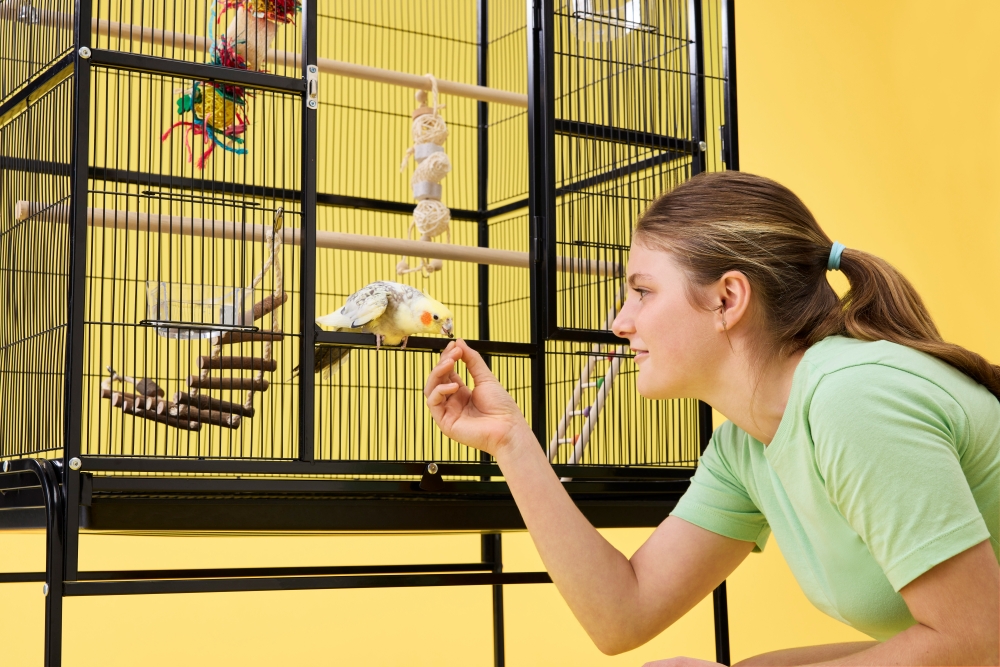
Picture this: a family dinner, distinguished guests, a cozy atmosphere. Suddenly, a loud, crystal-clear word erupts from the cage in the corner, making even the adults blush. Your beloved parrot, whom you so diligently taught to say “Hello,” has decided to show off his “shadow” vocabulary. Sound familiar? You aren’t alone. This is one of the most common issues faced by owners of talkative birds – from parakeets to intellectual African Greys. The good news is that bird behavior can be corrected, though it will require patience. The bad news? Parrots don’t undestand the concept of “shame,” so moral lectures won’t do a thing here. In this article, we’ll break down the only working strategy for re-education, based on animal psychology. Learn more on Tvaryny.
Why does the parrot choose “those” specific words?
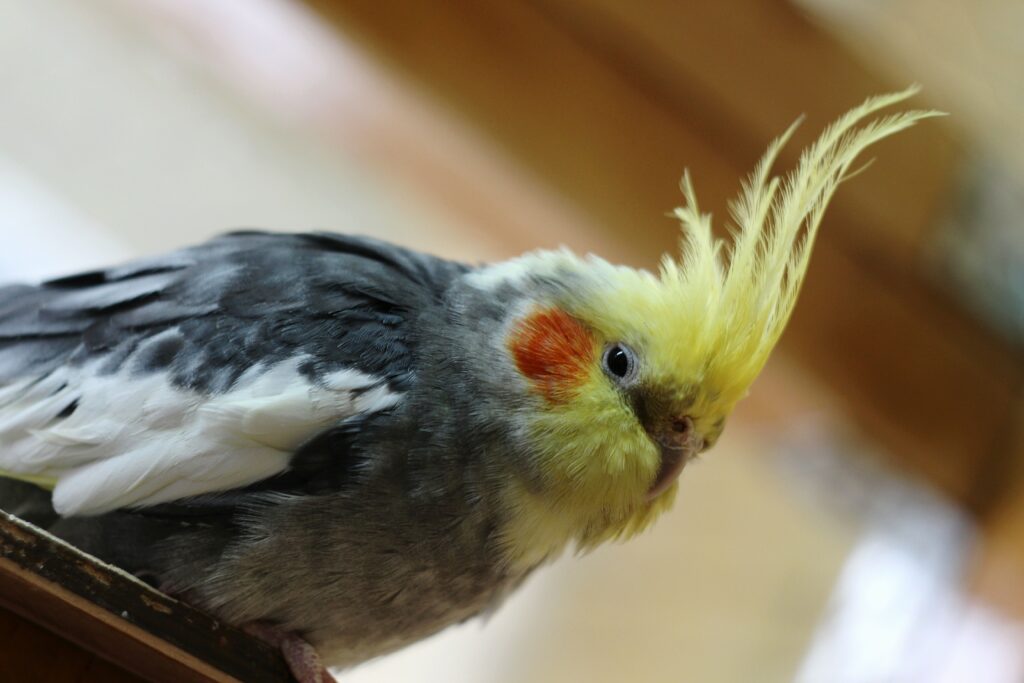
Before you start the “treatment,” it is vital to understand the cause of the “disease.” Parrots don’t learn swear words to offend you. To them, a four-letter word is simply a cluster of sounds with one unique property: it triggers a reaction.
In nature, parrots are social creatures. They learn to communicate by mimicking the sounds of the flock. In your apartment, the “flock” is you. Humans typically pronounce curse words:
- Loudly.
- Clearly.
- With emotional coloring (expression).
For a bird, this is the ideal audio signal. He thinks: “Wow, when the owner dropped the hammer on his foot, he made such an interesting sound! I have to remember that; it must be important for communication.” A parrot is a mirror of your home’s emotional background. By the way, your pet’s ability to remember and reproduce words depends on their intelligence level, so we suggest you check out our ranking of the smartest parrot species.
The Main Mistake Owners Make: The Trap of Emotional Reinforcement
The worst thing you can do when a bird says a bad word for the first time is to laugh or start yelling at them.
The Golden Rule: Any attention (positive or negative) is a reward for a parrot.
If you laugh, the bird understands: “I entertained the flock, I’m a good boy.”
If you yell “Shut up!” or run to the cage waving your arms, the bird thinks: “Awesome! I made a sound and a fun game started, the owner is paying attention to me.”
Even a stern look can be perceived as encouragement. That is exactly why swear words stick much faster than “polite” phrases.
The “Total Ignore” Strategy: How to Wipe the Word from Memory
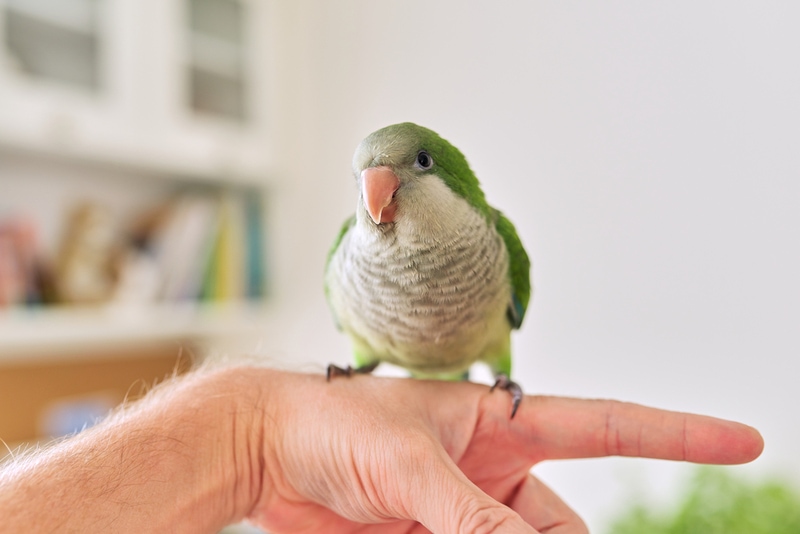
To stop a parrot from swearing, you need to make the word “boring.” It must stop working as a tool for grabbing attention. This technique is called extinction.
Here is the algorithm of actions when you hear the forbidden word:
- Instant Freeze. Do not look at the bird. Do not turn your head. Do not change your facial expression.
- Silence. Do not say “shush,” “no,” or “quiet.” Complete silence.
- Disengage. If the bird is sitting on your shoulder, silently remove him and place him on a perch or in the cage. Then turn away or leave the room for 1-2 minutes.
This is harsh for a social animal, but it is the only way to show: “This sound leads to the disappearance of my favorite human.” If the parrot realizes that swearing leads to solitude, he will stop wasting energy on it.
The Replacement Method: Fighting Fire with Fire
Simply ignoring is not enough, especially if the swearing has already become a habit. You need to provide an alternative. This situtation requires replacing the “bad” sound with a “good” one.
Parrots often swear in specific situations: when you come home, when the phone rings, or when they want food. Identify the trigger and offer a different word.
Example:
Every time the parrot is about to let an expletive fly (or if you know he is about to do it), beat him to it and say, for example, “Hello!” or whistle a pleasant tune. If the parrot repeats “Hello” – throw a party: praise him, give him a treat, scratch his neck.
We use the principle of competition: the bird sees that word “X” leads to being ignored, while the word “Hello” leads to a peanut. The choice for him is obvious.
Games with Sounds
Try teaching the bird sounds that are physically impossible to articulate at the same time as swearing. This could be:
- Artistic whistling.
- A kissing sound.
- Clicking your tongue.
Birds often like these sounds even more than words because they are resonant and easy to mimic.
The Boredom Factor: When Swearing Is a Cry for Help
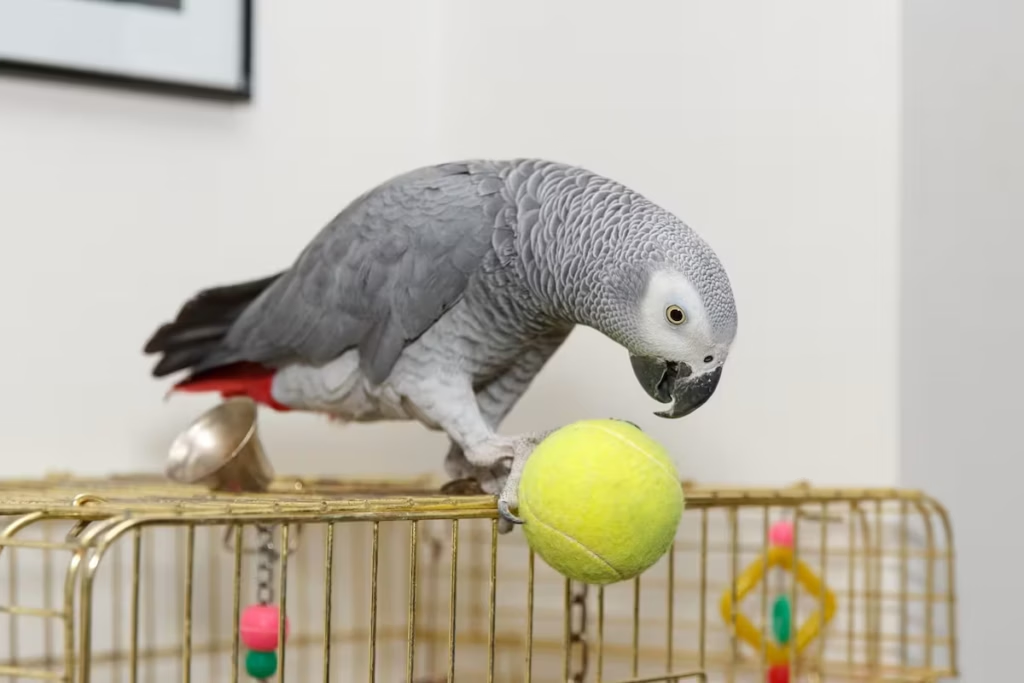
Often, parrots start vocalizing (screaming or swearing) simply out of boredom. In the wild, a bird spends 70-80% of its time searching for food. In a cage, however, the bowl is full, and there is nothing to do.
The Solution – Environment Enrichment:
- Foraging toys. Don’t just put food in a bowl. Hide it in paper bags, cardboard boxes, or special toys. Let the bird work with his beak to get the nut, rather than using it to cuss out the cat.
- Toy rotation. Change the toys in the cage every week so they don’t get boring.
- Trick training. Learning commands like “turn around,” “shake,” or “fetch” taxes the bird’s brain just as much as physical exercise. A tired and satisfied parrot is a quiet parrot.
What to Do About Guests?
The trickiest moment is when friends visit. Guests are almost guaranteed to laugh when they hear the parrot telling them exactly where to go. This can undo weeks of your hard work.
Instructions for guests:
- Warn them in advance: “We’re currently training Buddy out of using bad words.”
- Ask them to completely ignore the bird if he swears.
- If the situation gets out of hand, it is better to cover the cage or move it to another room for the duration of the visit so as not to reinforce the unwanted behavior.
Conclusion
Breaking a parrot’s swearing habit is a marathon, not a sprint. The process can take anywhere from a few weeks to several months, depending on how long the habit has been ingrained. The main thing to remember is: the bird is not to blame. He just wants your attention. Give him that attention in the right form, and the need for a “dirty” vocabulary will disappear on its own.
Be consistent, hold back the laughter, and stock up on treats for the “good” words. Your feathered friend will definitely appreciate the new rules of the game.