

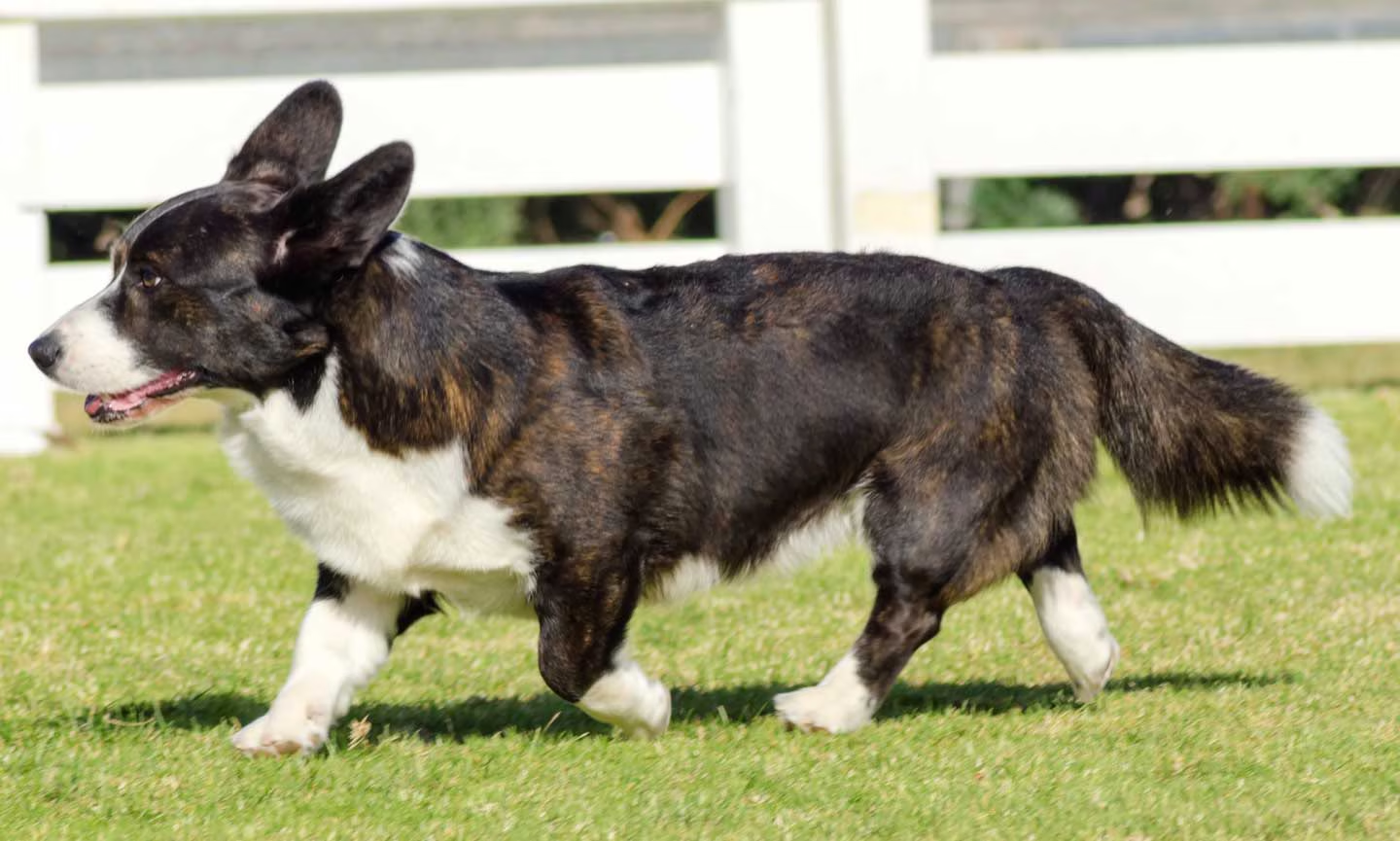
| Height | 27–33 cm |
| Weight | 11–17 kg |
| Lifespan | 12–15 years |
| FCI group | 1 · sheepdogs |
| Origin | United Kingdom |
Exact ratings
- Intervertebral disc disease (IVDD, ~20%)
- Progressive retinal atrophy (PRA)
- Hip dysplasia
- Degenerative myelopathy (DM)
- Congenital deafness, glaucoma
Quality food with strict weight control (excess weight harms the long back). Protect the spine from jumps off a height; enough exercise and activity.
The Cardigan Welsh Corgi is an ancient British herding dog breed with smart eyes and a friendly, almost smiling, expression. With its large, upright ears, refined muzzle, well-proportioned, sturdy body, bushy tail, and luxurious “trousers,” this “little fox” is striking for its modest height and unusual coat colors. This devoted and dignified companion dog will always be by your side. Adorable, undemanding, alert, cheerful, playful, balanced, and confident, Cardigan Corgis possess all the qualities to be a practically ideal family dog. This detailed review has been prepared for you by Tvaryny, your reliable guide in the world of pets.
Cardigan Welsh Corgis have captured the hearts of many dog lovers thanks to their unique looks, intelligence, and loyalty. They are one of two Welsh Corgi breeds, and while often confused with the Welsh Corgi Pembroke, Cardigans boast their own rich history and distinct features. For centuries, these dogs were invaluable helpers to shepherds, and today, they are increasingly becoming cherished family members around the globe.
Cardigan Welsh Corgi: A Quick Breed Overview
| Characteristic | Description |
|---|---|
| Origin | Great Britain (Wales, Ceredigion) |
| FCI Classification | Group 1 (Sheepdogs and Cattle Dogs, excluding Swiss Cattle Dogs). Section 1 (Sheepdogs). No working trial. Standard Number 38. |
| Year of First Official Mention/Recognition | Recognized as a separate breed by The Kennel Club in 1934 (prior to this, Pembrokes and Cardigans were exhibited together) |
| Life Expectancy | 12-15 years |
| Height at Withers | Ideal 12 inches (30 cm) (slight deviations are acceptable, but proportions and overall balance are more crucial) |
| Weight | Males: 30-38 lbs (14-17 kg); Females: 26-33 lbs (12-15 kg) (weight should be proportionate to height) |
| Temperament | Intelligent, alert, active, loyal, balanced, not shy or aggressive. |
| Use | Historically – herding dog (for cattle), today – companion dog. |
History of the Cardigan Welsh Corgi Breed
The Cardigan Welsh Corgi is one of the oldest herding breeds in Great Britain, with a history spanning over a thousand years. It’s believed that the ancestors of Cardigans were brought to Wales by Celtic tribes around 1200 BC. Another theory suggests their roots lie with dogs brought to Wales by Vikings in the 9th-10th centuries. These dogs belonged to the Teckelhund group, which also includes Dachshunds, explaining some similarities in body structure—a long body and short legs.
The name “Corgi” has several proposed origins. The most popular theory suggests that “corgi” is derived from the Welsh words: “cor” (dwarf) and “ci” (dog), literally meaning “dwarf dog.” Other sources explain the origin of “corgi” as a modified form of “cur” (to watch, to guard) and “ci” (dog), meaning “guard dog.” Cardigans were also called “ci llathaid” (“yard-long dog”), as their length from nose to tail tip was approximately equivalent to a Welsh yard (about 40 inches or 102 cm).
For centuries, Cardigan Welsh Corgis faithfully served the farmers of Ceredigion—a mountainous and isolated region of Wales. They were used to drive cattle, sheep, and even ponies. Their low stature allowed them to deftly dodge kicks from hooves, while their bravery and endurance made them indispensable helpers. They not only herded livestock but also guarded farmsteads and were excellent companions to their owners.
For a long time, the Cardigan Welsh Corgi and the Welsh Corgi Pembroke were considered a single breed, even though they originated from different regions of Wales and have different roots (Pembrokes are believed to descend from Spitz-type dogs). It wasn’t until 1934 that The Kennel Club officially recognized them as two separate breeds. Cardigans have always had tails, unlike Pembrokes, whose tails were traditionally docked (though increasingly, Pembrokes are born with natural tails or are not docked due to prohibitions in many countries).
What Does a Cardigan Welsh Corgi Look Like: A Detailed Description of Appearance
The Cardigan Welsh Corgi is a strong, resilient, active dog, long in proportion to its height, with a low-slung body. Despite its stature, it should not appear overly squat or clumsy.
General Appearance and Proportions
The first thing that catches the eye is the long body and short, yet powerful legs. The length of the body from the point of the shoulder to the rear of the rump significantly exceeds the height at the withers. The ideal height at the withers is about 12 inches (30 cm). Weight should be proportionate to height, typically 30 to 38 lbs (14 to 17 kg) for males and 26 to 33 lbs (12 to 15 kg) for females. It’s important that the dog is not overweight.
Head and Muzzle
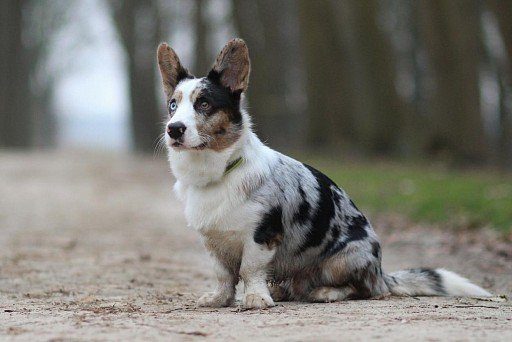
The head is fox-like in shape and appearance. The skull is wide and flat between the ears, gradually tapering towards the eyes. The stop (transition from forehead to muzzle) is moderately defined. The muzzle tapers towards the nose, which is always black. Lips are tight-fitting and black. Jaws are strong, with a perfect, regular, and complete scissor bite (upper incisors closely overlapping the lower ones and set squarely to the jaws). Eyes are medium-sized, set fairly wide apart, with an intelligent, alert, but kindly expression. Eye color varies depending on coat color, but dark shades are preferred. Blue merle dogs may have blue eyes (one or both, partially or completely).
Ears
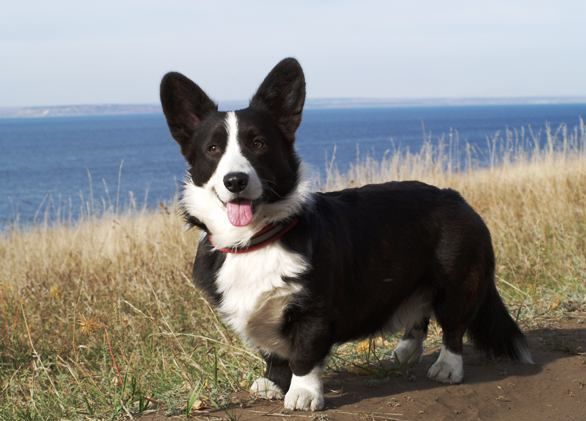
A Cardigan Welsh Corgi’s ears are noticeably large, upright, with slightly rounded tips. They are wide at the base, set fairly far back on the skull. When alert, the ears are directed slightly outwards and forwards.
Body and Limbs
The neck is muscular, well-developed, and proportionate to the overall build. The topline is level. The chest is moderately broad, with a well-defined forechest, and deep. Ribs are well-sprung. Limbs are short, but with strong bone. The front legs are slightly turned outwards (approximately 30 degrees relative to the longitudinal axis), which provides stability and maneuverability. Elbows are held close to the sides. Hindquarters are strong, muscular, with well-angulated hock joints. Paws are round, compact, with firm pads.
Tail
The tail of a Cardigan Welsh Corgi is long, resembling a fox’s brush, set on a line with the body. When at rest, it is carried low, and when moving, it may be carried slightly above the topline, but never curled over the back. This is one of the key distinctions from the Welsh Corgi Pembroke, whose tail is often docked or naturally short.
Coat and Color
A Cardigan’s coat is double, of medium length, with a dense, soft undercoat that provides protection from the weather. The outer coat is straight, somewhat harsh to the touch, and should not be too soft, wavy, or wiry. Permissible coat colors for the Cardigan Welsh Corgi are diverse:
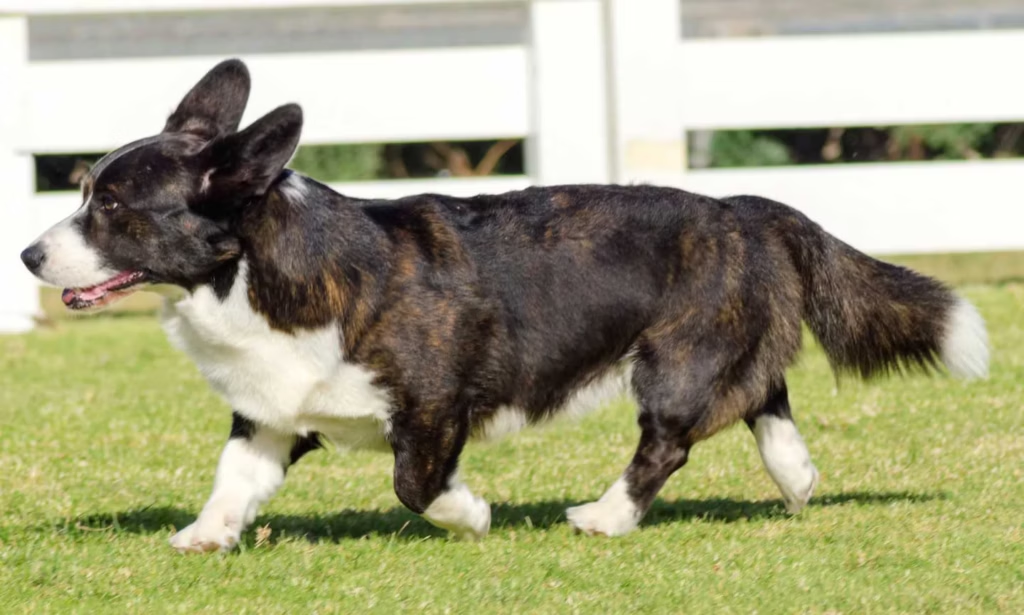
- Brindle: various shades from golden to dark brown with dark brindling.
- Red: all shades of red, from light fawn to rich red.
- Sable: red with black-tipped hairs (blackening).
- Tricolor: black with tan (points) and white markings.
- Blue Merle: a silvery-blue background with black patches (marbled). Dogs of this color often have blue eyes.
White markings are permissible on the neck (as a collar), chest, legs, lower part of the muzzle, tail tip, and as a narrow blaze on the head. However, white should not predominate. The nose and eye rims are always black, with the exception of blue merle, where lighter pigmentation is acceptable.
Cardigan Welsh Corgi Temperament: Character and Behavior
The Cardigan Welsh Corgi is a dog with a big heart and considerable intelligence. They are known for their devotion to family, zest for life, and balanced character. This isn’t just a cute appearance; beneath it lies a true worker with a developed sense of self-worth.
General Character Traits
Cardigans are endowed with immense vitality, a sense of humor, liveliness, friendliness, and innate intelligence. They are alert and attentive, which makes them good watchdogs—they will always warn of approaching strangers with a loud bark, but without undue aggression. These are dogs who love to be at the center of their family’s attention but are not intrusive. If their owner is busy, a Cardigan will patiently wait, finding something to occupy themselves or simply observing.
Attitude Toward Owners and Family Members
The Cardigan Welsh Corgi forms deep bonds with its people and strives to please. They are loyal to all family members, though they may choose one “main” owner. With all household members, they maintain excellent relationships, without overtly showing favoritism, but will “keep their distance” from those who do not accept them. This makes them wonderful family dogs.
Cardigan Welsh Corgi and Children
Cardigans generally get along very well with children, especially if they grow up together. They are patient and playful. However, due to their herding instincts, a young Corgi might try to “herd” children by nipping at their heels. This behavior should be corrected from a young age. It’s also important to teach children how to interact with a dog properly and gently.
Interaction with Other Animals
With early and proper socialization, Cardigan Welsh Corgis usually coexist well with other dogs and even cats. They are not prone to dominance for dominance’s sake but can stand their ground if necessary. Some Cardigans may display hunting instincts towards small rodents, so introductions to such pets should be cautious and supervised.
Activity and Play
Despite their short legs, Cardigans are quite active and resilient dogs. They enjoy long walks, outdoor games, and various dog sports such as agility, obedience, or flyball. They need regular physical exercise to maintain their fitness and expend energy. However, they are not hyperactive and can adapt perfectly to apartment living provided they get sufficient exercise.
Interestingly, some of a Cardigan’s character traits might resemble those of a Saarloos Wolfdog, especially their alertness and a certain reserve towards strangers, although Cardigans are significantly more people-oriented and easier to socialize.
Cardigan Welsh Corgi Health: Typical Ailments and Prevention
The Cardigan Welsh Corgi is generally considered a robust and healthy breed with a lifespan of 12-15 years. However, like any breed, they have predispositions to certain genetic and acquired diseases. Responsible breeders test their breeding dogs for hereditary conditions to reduce the risk of passing them on to offspring.
Main Health Issues Cardigan Welsh Corgis Are Prone To:
- Progressive Retinal Atrophy (PRA): This is a group of genetic eye diseases that lead to progressive degeneration of the retina and, consequently, blindness. DNA tests are available to identify carriers of the PRA gene.
- Intervertebral Disc Disease (IVDD): Due to their long backs and short legs (chondrodystrophic body type), Cardigans are prone to back problems, particularly slipped discs. It’s crucial not to let the dog jump from heights (e.g., off furniture), maintain a healthy weight, and avoid excessive strain on the spine, especially during puppyhood.
- Canine Hip Dysplasia (CHD): Although this condition is more common in larger breeds, it can also occur in Cardigans. It is an abnormal development of the hip joint, which can lead to arthritis and pain.
- Glaucoma: Increased intraocular pressure that can damage the optic nerve and lead to blindness.
- Tendency to Gain Excess Weight: Cardigans love to eat and can easily gain weight if overfed or not provided with enough physical activity. Obesity can exacerbate the risk of back problems, joint issues, and other diseases.
- Dental Problems: Like many small and medium breeds, Cardigans are prone to plaque and tartar buildup. Regular teeth cleaning and professional dental care can help prevent gum disease and tooth loss.
Preventative Measures to Maintain a Cardigan Welsh Corgi’s Health:
- Regular Veterinary Check-ups: Annual (or twice-yearly for older dogs) visits to the vet for preventative check-ups, vaccinations, and discussions about any changes in health.
- Balanced Diet: Feeding high-quality food appropriate for the dog’s age, activity level, and health status. Portion control to prevent obesity.
- Sufficient Physical Activity: Daily walks and games to maintain muscle tone, a healthy weight, and mental well-being.
- Dental Care: Regular teeth brushing with a special dog toothbrush and paste, using dental treats or toys.
- Avoiding Back Injuries: Do not allow your Cardigan to jump from high surfaces. Lift your dog correctly, supporting the chest with one hand and the hindquarters with the other.
- Timely Parasite Treatment: Regular prevention against fleas, ticks, and worms.
- Genetic Testing: When choosing a puppy, inquire about the health test results of its parents.
It’s important to remember that prevention and early diagnosis are key to a long and healthy life for your Cardigan Welsh Corgi.
How to Care for a Cardigan Welsh Corgi’s Coat
Caring for a Cardigan Welsh Corgi’s coat isn’t overly complicated but requires regularity, especially during seasonal shedding. Their double coat provides good protection from the elements but also needs attention to keep it in good condition and minimize hair around the house.
Brushing
Cardigans shed quite heavily twice a year (spring and fall), and moderately throughout the year. It’s recommended to brush them 1-2 times a week with a slicker brush or a deshedding tool to remove dead undercoat and guard hairs. During intense shedding, daily brushing may be necessary. Regular brushing helps prevent matting (though they aren’t very prone to it), stimulates skin circulation, and promotes healthy coat growth.
Bathing
Frequent bathing isn’t necessary for Cardigans, as their coat has natural water-repellent properties and a self-cleaning ability. They should be bathed as needed, approximately once every 2-3 months, or if the dog becomes very dirty. Use a quality dog shampoo designed for double coats. After bathing, it’s important to thoroughly dry the coat, especially the undercoat, to avoid skin irritation and chills. You can use a towel and a hairdryer on a low or medium setting.
Other Grooming Aspects
- Nail Care: Nails should be trimmed approximately every 3-4 weeks if they don’t wear down naturally during walks. Clicking nails on the floor is a sign it’s time for a trim.
- Ear Care: Regularly check ears for dirt, redness, or an unpleasant odor. Clean ears with a special dog ear cleaner and cotton pads as needed.
- Dental Care: As mentioned, regular teeth cleaning is crucial for preventing dental diseases.
- Eye Examination: Daily check eyes for discharge. Small accumulations can be gently removed with a damp cloth.
Remember, a Cardigan Welsh Corgi puppy should be accustomed to all grooming procedures from an early age so they accept them calmly.
Training and Socialization of the Cardigan Welsh Corgi
Cardigan Welsh Corgis are intelligent and clever dogs who generally respond well to training. They have a desire to please their owner but can also display a certain stubbornness and independence, a legacy of their herding past. Successful training and socialization require patience, consistency, and a positive approach.
Training Fundamentals
Training a Cardigan Welsh Corgi should begin from an early age. They quickly learn new commands, especially if training is done in a playful manner and with positive reinforcement (treats, praise, play). Cardigans respond well to reward-based methods. Avoid harsh methods and punishment, as this can lead to a loss of trust and an unwillingness to cooperate.
It’s important to establish clear rules and boundaries from the outset. Be consistent in your demands. Basic commands such as “sit,” “lie down,” “come,” “heel,” and “leave it” are essential for any dog. Thanks to their intelligence, Cardigans are capable of mastering more complex tricks and skills.
Socialization
Early and comprehensive socialization is extremely important for the Cardigan Welsh Corgi. Introduce your puppy to different people (adults, children), other animals (dogs, cats), sounds, places, and situations. This will help them grow into a confident, well-balanced, and friendly dog who won’t show fear or aggression in unfamiliar circumstances. Walks in parks, attending puppy classes, meeting friends’ dogs—all these will contribute to proper socialization.
Herding Instincts
Don’t forget about the Cardigan’s herding instincts. They may try to “herd” family members, especially children, or other pets, by gently nipping at their heels. This behavior should be gently but firmly corrected, redirecting their energy towards toys or other permissible activities. Participating in dog sports such as agility, treibball, or herding trials (if available) can help satisfy their natural needs.
Territoriality
Cardigans can be territorial and good watchdogs. They will alert you to guests’ arrival or anything unusual. It’s important to teach them to distinguish between a real threat and ordinary occurrences to avoid excessive barking.
Overall, the Cardigan Welsh Corgi is a dog well-suited for active owners willing to dedicate time to its upbringing, training, and physical exercise. Their intelligence and willingness to work make the training process interesting and rewarding.
Cardigan Welsh Corgi Diet: Key Recommendations
Proper nutrition is the cornerstone of your Cardigan Welsh Corgi’s health, longevity, and well-being. As this breed is prone to gaining excess weight, controlling their diet and food intake is extremely important.
Types of Feeding
There are two main approaches to feeding dogs:
- Commercial Foods: High-quality dry or wet foods of a super-premium or holistic class, formulated to meet the needs of medium-sized dogs with moderate activity. The advantage is a balanced composition and convenience of use. Choose food appropriate for your pet’s age (puppy, adult dog, senior dog) and health status.
- Natural Diet: A diet consisting of natural products (meat, organ meats, fish, grains, vegetables, fermented dairy products). This type of feeding requires careful calculation of the balance of nutrients (proteins, fats, carbohydrates), vitamins, and minerals. Consultation with a veterinary nutritionist is recommended for compiling a proper natural diet and selecting vitamin and mineral supplements.
Each owner decides what is best to feed their pet, based on their capabilities and veterinary recommendations.
Key Feeding Rules for the Cardigan Welsh Corgi:
- Stick to a Schedule: Feed adult dogs 1-2 times a day at the same time. Puppies are fed more often (3-5 times a day), gradually reducing the number of feedings with age.
- Control Portions: Adhere to the recommended daily food allowance specified on the packaging or calculated by your vet. Do not overfeed! Cardigans have a good appetite and are prone to obesity.
- Ensure Constant Access to Fresh Water: A bowl of clean water should be available to the dog 24/7.
- Avoid Feeding from the Table: Human food is often harmful to dogs (salty, sweet, smoked, fatty, spices).
- Limit Treats: Treats should constitute no more than 10% of the daily ration. Use them for training or as a rare reward.
- Monitor Weight and Condition: Regularly weigh your pet and assess its condition (ribs should be easily palpable but not protruding, a waist should be noticeable). Adjust the diet if necessary.
- Do Not Give Forbidden Foods: Chocolate, onions, garlic, grapes, raisins, avocado, bones (especially cooked poultry bones) are toxic to dogs.
Approximate Daily Food Allowance for a Cardigan Welsh Corgi:
Typically, for an adult Cardigan Welsh Corgi weighing 30-38 lbs (14-17 kg) leading a moderately active lifestyle, the daily dry food allowance is approximately 5-9 ounces (150-250 grams), divided into two meals. However, this figure is approximate and may vary depending on the caloric content of the specific food, age, activity level, individual metabolic characteristics, and the dog’s health condition.
| Product | Approximate Daily Amount | Notes |
|---|---|---|
| Meat (beef, turkey, chicken – lean) | 9-12 ounces (250-350 g) | Raw or lightly boiled, boneless |
| Organ Meats (liver, heart, tripe) | 1-2 times a week, instead of part of the meat | Boiled |
| Sea Fish (boneless) | 1-2 times a week, instead of meat | Boiled |
| Grains (rice, buckwheat) | 3.5-5.3 ounces (100-150 g) (cooked porridge) | Well-cooked |
| Vegetables (carrots, pumpkin, zucchini, broccoli) | 3.5-5.3 ounces (100-150 g) | Raw (grated) or stewed/boiled |
| Fermented Dairy Products (kefir, low-fat cottage cheese) | 1.7-3.5 ounces (50-100 g) | Several times a week |
| Vegetable Oil (flaxseed, olive) | 1 teaspoon | Add to food |
| Egg (boiled) | 1-2 pcs per week | |
| Vitamin-Mineral Supplements | As prescribed by a vet | Essential for a natural diet |
Important: This table is for illustrative purposes only. Before transitioning your dog to a natural diet, be sure to consult a veterinary surgeon or nutritionist to create an individually balanced diet.
Pros and Cons of the Cardigan Welsh Corgi Breed
Like any breed, the Cardigan Welsh Corgi has its advantages and disadvantages. It’s important to objectively assess them before getting such a dog to ensure it suits your lifestyle.
Pros of the Breed:
- High Intelligence and Cleverness: Cardigans are quick learners, rapidly grasp commands, and enjoy mental stimulation.
- Loyalty and Affection Toward Family: These are true companions who form deep bonds with their owners.
- Friendliness: Generally get along well with children and other animals (with proper socialization).
- Good Watchdog Qualities: Alert and attentive, they will always warn of approaching strangers.
- Moderate Activity Level: They need regular walks, but are not overly energetic and can adapt to apartment living.
- Undemanding Coat Care (compared to some long-haired breeds): Regular brushing and occasional bathing.
- Robust Health (in general): With proper care and prevention, they live long lives.
- Unique and Attractive Appearance: A “fox-like” face, large ears, and a long, bushy tail leave no one indifferent.
- Sense of Humor: Cardigans are often amusing and playful.
Cons of the Breed:
- Prone to Gaining Excess Weight: Requires strict dietary control and sufficient physical exercise.
- Risk of Back Problems (IVDD): Due to their long body and short legs. Jumping from heights and excessive strain should be avoided.
- Heavy Shedding: Especially twice a year, hair will be everywhere.
- Potential Stubbornness and Independence: Requires patient and consistent upbringing.
- Herding Instincts: May try to “herd” people or animals by nipping at heels. This behavior needs correction.
- Territoriality and Tendency to Bark: Can be noisy if not taught to control barking.
- Need for Early and Thorough Socialization: To avoid behavioral problems.
- Not for Sedentary People: Though not hyperactive, they need regular walks and activity.
- Can be somewhat reserved with strangers: Though generally not aggressive.
It’s important to remember that many “cons” can be minimized with proper upbringing, training, socialization, and care.
Interesting Facts About the Cardigan Welsh Corgi
- One of Britain’s Oldest Breeds: The history of Cardigans spans over 3,000 years, making them among the first dogs to appear in the British Isles.
- “Yard-Long Dog”: The ancient Welsh name “ci-llathed” literally means “yard-long dog” (a Welsh yard = 40 inches or 102 cm), which corresponded to the dog’s length from nose to tail tip.
- Fairy Steeds: A Welsh legend states that Corgis were a gift from fairies and elves. The markings on the backs of some Corgis, especially Pembrokes, are supposedly saddle marks from where these mythical creatures rode.
- Two Distinct Breeds: Although the Cardigan Welsh Corgi and the Welsh Corgi Pembroke are similar, they are two separate breeds with different origins. Cardigans are older and descend from Teckelhund-type dogs, while Pembrokes are from Spitz-type dogs.
- Always with a Tail: Unlike Pembrokes, whose tails were traditionally docked (or they are born with short tails), Cardigans have always had a long, bushy “fox-like” tail. This is one of the key visual differences.
- “Heelers” for Shepherds: Their low stature was an advantage when working with cattle—they could deftly dodge kicks from hooves, nipping at cows’ heels to direct the herd.
- Royal Favorites (but different ones): While the British Royal Family is famous for their love of Welsh Corgi Pembrokes, Cardigans also have their admirers, though they are less “publicized.”
- Variety of Colors: Cardigans have a wider palette of permissible colors than Pembrokes, including the unique blue merle and various brindle options.
- “Big Dog in a Small Body”: This phrase is often used to describe Cardigans due to their bravery, endurance, and self-confidence, despite their small size.
- Participants in Dog Sports: Thanks to their intelligence and agility, Cardigans successfully compete in various dog sports such as agility, obedience, flyball, and even herding trials.
Frequently Asked Questions About the Cardigan Welsh Corgi (FAQ)
Do Cardigan Welsh Corgis shed a lot?
Yes, Cardigans have a double coat and shed quite noticeably, especially twice a year during seasonal shedding (spring and fall). Regular brushing will help control the amount of hair in the home.
Are Cardigan Welsh Corgis suitable for apartment living?
Yes, Cardigans can live well in an apartment provided they get sufficient daily walks and physical activity. They are not too large and don’t require vast spaces, but they do need an outlet for their energy.
Is it easy to train a Cardigan Welsh Corgi?
Cardigans are intelligent and generally respond well to training, especially if positive methods are used. However, they can be somewhat stubborn, so patience and consistency are needed.
How do Cardigan Welsh Corgis get along with children?
Usually very well, especially if they grow up together. They are patient and playful. However, due to herding instincts, a puppy might try to “herd” children by nipping at their heels. This behavior should be corrected.
Are Cardigan Welsh Corgis noisy?
They can be prone to barking as they are alert watchdogs. It’s important to teach them from an early age to control their barking and not to bark without reason.
What are the main health problems in Cardigan Welsh Corgis?
Typical problems include Intervertebral Disc Disease (IVDD), Progressive Retinal Atrophy (PRA), Canine Hip Dysplasia, and a predisposition to obesity. Regular veterinary check-ups and prevention are important.
How long do Cardigan Welsh Corgis live?
The average lifespan of a Cardigan Welsh Corgi is 12–15 years.
How does a Cardigan Welsh Corgi differ from a Welsh Corgi Pembroke?
The main differences: Cardigans are older in origin, larger and heavier, have a long fox-like tail (Pembrokes are often tailless or have a short tail), more rounded ears (Pembrokes have pointier ones), and a wider range of colors, including blue merle. There are also differences in body structure (Cardigans have more bowed front legs) and, according to some owners, in temperament (Cardigans are considered slightly calmer and more serious, although this is individual).
Do Cardigans need a lot of physical exercise?
They need regular daily walks (at least 1–1.5 hours a day) and the opportunity to run off-leash in a safe area. They enjoy active games and mental challenges.
Can a Cardigan Welsh Corgi be left alone at home for a long time?
Like any dog, Cardigans don’t enjoy prolonged solitude. If left alone for long periods regularly, they may become bored, which can lead to destructive behavior or excessive barking. Gradual acclimatization to being alone and providing toys can help.
Video about the Cardigan Welsh Corgi
- Clever and trainable
- Devoted, a good “doorbell” guard
- Compact, adaptable
- A sharp herding companion
- A long back — risk of disc disease
- A herding instinct (nipping)
- A tendency to gain weight
- Prone to barking
| Welsh Corgi Pembroke | Swedish Vallhund | Dachshund | |
|---|---|---|---|
| Height | 25–30 cm | 31–35 cm | 20–27 cm |
| Energy | 4 | 4.5 | 3.5 |
| Apartment | 3.5 | 3.5 | 3 |
| Beginners | 3.5 | 3.5 | 3 |
How does the Cardigan differ from the Pembroke?
Is the Cardigan prone to back problems?
Is the Cardigan good for a family?
FCI Standard No. 38 · The Kennel Club
For apartments · For kids · For beginners · Active · Smartest · Hypoallergenic · All rankings →