

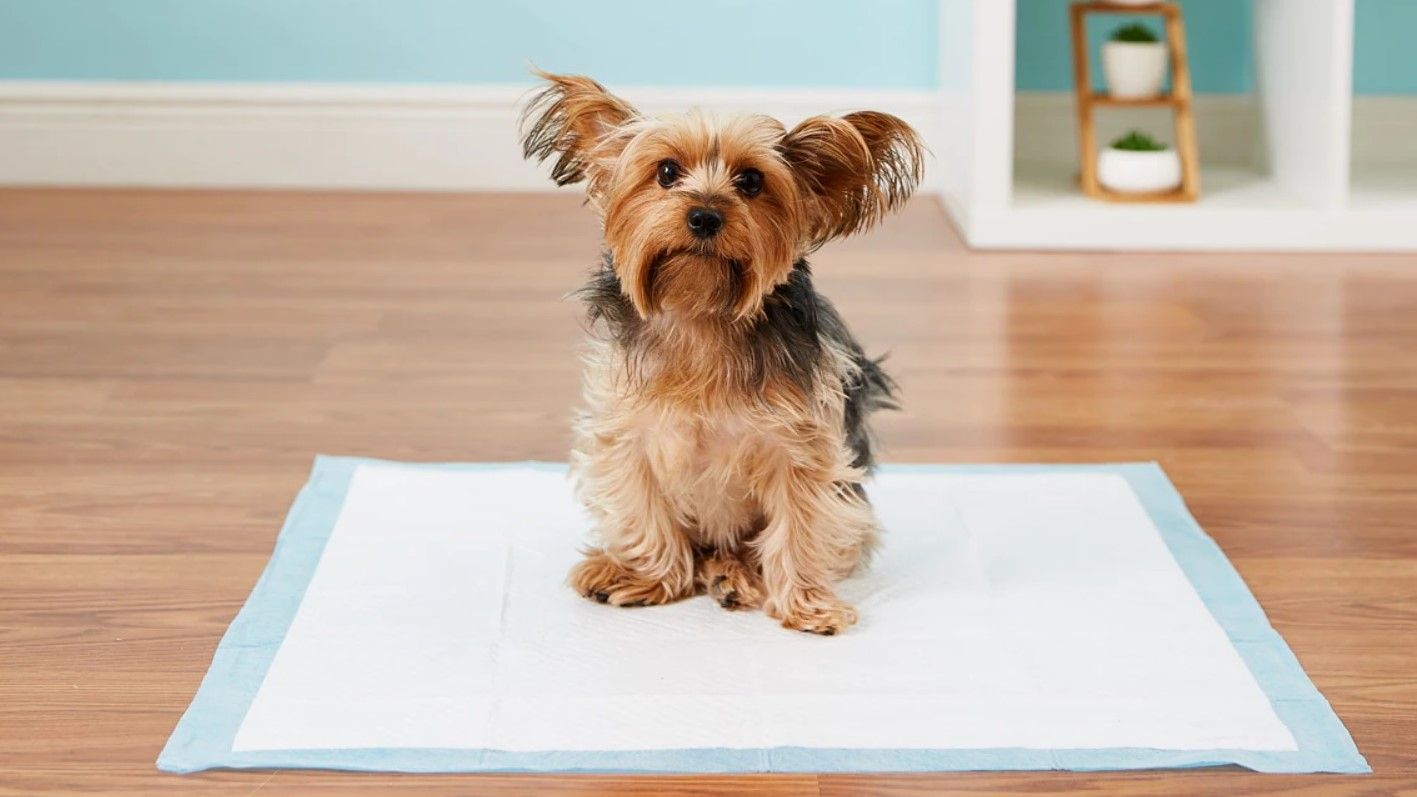
Congratulations on the new four-legged member of your family! Bringing a small puppy into your home is, without a doubt, one of life’s most joyful events. Those clumsy paws, that wet nose, and the endless devotion in their eyes can melt any heart. But along with this joy comes a great deal of responsibility. And one of the first household tasks every new owner faces is potty training. If you live in an apartment or have a small-breed dog, pee pads become a real lifesaver. The process might seem daunting, but don’t worry. We’ve prepared the most complete guide to help you navigate this journey calmly, effectively, and with love.
In this article, we’ll break down everything in detail: from choosing the right pads and the ideal spot for them to a step-by-step plan and troubleshooting the most common problems. The most important thing to remember is that patience and consistency work wonders. More on this at Tvaryny.
Why Pee Pads? The Pros and Cons of This Method
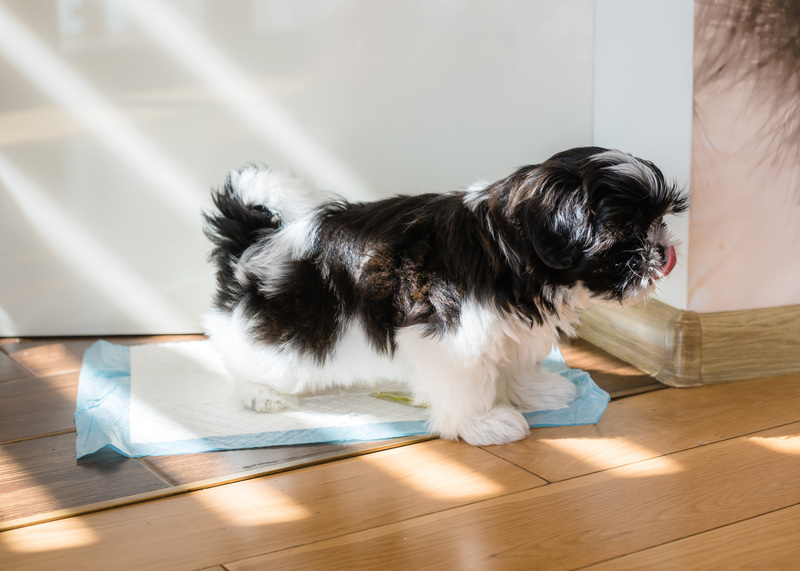
Before we start, let’s explore why pee pads are such a popular choice and what their specific features are. They aren’t a one-size-fits-all solution, but they are ideal for many situations.
Pros:
- The quarantine period. Young puppies can’t go outside until they have completed their full course of vaccinations. A pee pad becomes the only hygienic solution during this crucial time.
- Ideal for apartments. If you live on a high floor, getting a puppy outside “that very second” can be physically impossible. A pad gives you and your pet the necessary buffer time.
- Comfort for small breeds. Many toy breeds (like Toy Terriers, Chihuahuas, and Yorkies) can comfortably use a pad for their entire lives, especially in bad weather (rain, snow, or severe frost).
- Convenience for senior or ill pets. If a dog has health problems or mobility issues, a pad is a vital necessity.
Cons and Myths:
- Potential confusion. The main risk is that the puppy may get used to going indoors and won’t understand why you later demand they go exclusively outside. (We’ll tell you how to avoid this).
- Odor and hygiene. If pads aren’t changed promptly, an unpleasant odor can develop in the apartment.
- Myth: “The dog will never learn to go outside.” This is untru. With the right approach, the pad becomes just a temporary step that is easily replaced by walks.
Stage 1: Preparation – Your Arsenal for Success
Proper preparation is 50% of the success in puppy pad training. Before your little one even crosses the threshold of your home, you should have everything ready.
Essential Shopping List
- Pee Pads (lots of them!). In the beginning, they will be used up very quickly. You can choose disposable (with a gel absorbent) or reusable (washable) ones. To start, it’s best to get disposable pads, perhaps with an attractant (a special scent that draws the puppy).
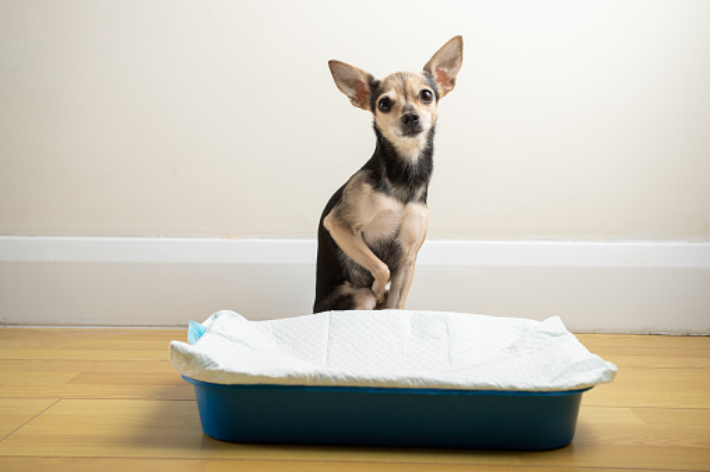
- A pad holder or tray (highly recommended). This is a plastic frame or a low-profile tray that fixes the pad in place. It will stop the puppy from chewing, tearing, or dragging the pad all over the apartment.
- Enzymatic cleaner for “accidents”. This is critically important! Regular cleaning products (especially those with bleach or ammonia) do not eliminate the smell of urine for a sensitive dog’s nose. Worse, ammonia can actually encourage a puppy to go in that spot again. An enzymatic spray breaks down the urine molecules, completely neutralizing the odor.
- Treats for encouragement. Small, tasty morsels that your puppy adores. This will be your main “currency” for positive reinforcement.
- A crate or playpen (optional). Limiting space in the initial stage significantly speeds up the process. If the puppy is in a small pen with only its bed, bowls, and a pad, it simply has no other choice for where to go to the toilet.
Choosing the Perfect “Toilet” Spot
The place where the pad will lie is crucial. It must meet three criteria:
- 24/7 access. The puppy must have free access to the pad at any time of day or night. No closed doors.
- Away from food and sleep areas. This is instinctive. Dogs are clean animals and do not go to the toilet where they eat or sleep. Place the pad in the opposite corner of the room from the bowls and bed.
- Quiet and calm. Don’t put the pad in a busy hallway, near a loud television, or by the washing machine. The puppy needs a calm, somewhat secluded spot where it won’t be disturbed.
The best option is to cover the chosen area with several pads, overlapping them to create a large “toilet zone”. This gives the puppy a better chance of hitting the target. Gradually, as they get used to it, you can reduce this zone to a single pad.
Stage 2: A Step-by-Step Guide to Pad Training Your Puppy
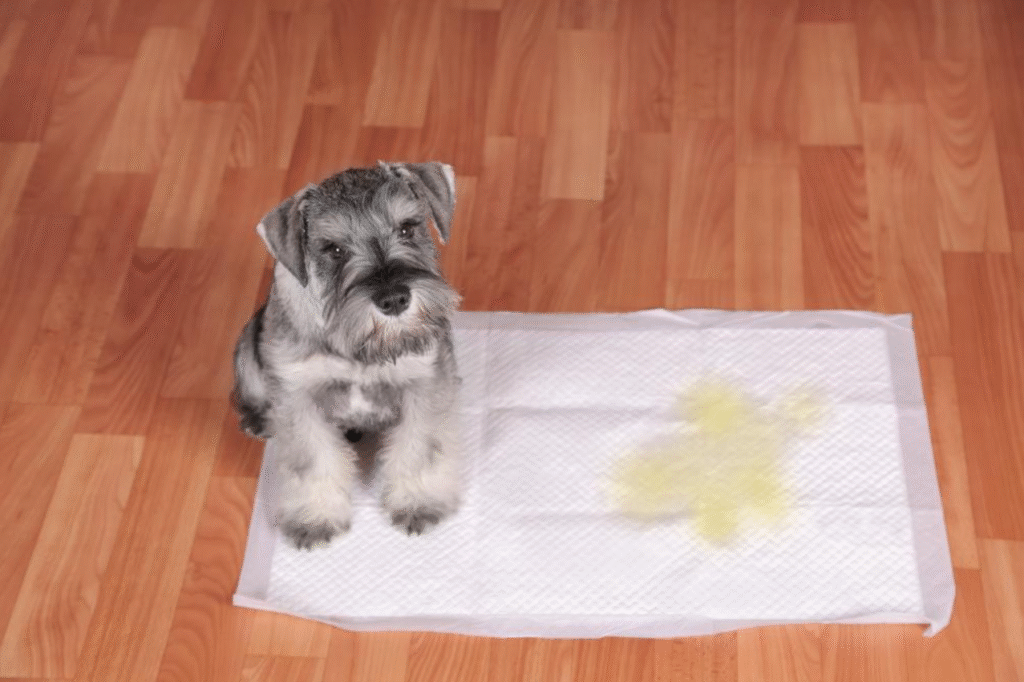
So, everything is ready, and the puppy is home. Let the fun begin. The entire process is built on three pillars: observation, anticipation, and positive reinforcement.
Step 1. The Right Introduction
As soon as you bring the puppy home, don’t let it run all over the apartment. Gently place it on the pad. Let it have a good sniff. You can use a “magic” cue word, like “Go potty” or “Go pee.” Repeat it in a calm, friendly tone. Of course, it won’t do anything straight away. Just praise it for standing on the pad and let it go.
Step 2. Catch the “Golden Moments”
Small puppies have very fast metabolisms. They need the toilet at highly predictable times. Your job is to pre-empt this and take them to the pad at these moments.
A puppy most often needs to go:
- Immediately after waking up. (First thing after a nap – carry them to the pad).
- 10-15 minutes after eating or drinking. (They’ve eaten – wait 10 minutes – take them to the pad).
- After a session of active play. (Played hard for 5-10 minutes – carry them to the pad).
- Just before bedtime for the night.
When you’ve taken the puppy to the pad, stand nearby and calmly repeat your cue word (“Go potty”). Don’t play with them or distract them. Give them time. It might take 5-10 minutes.
Step 3. Positive Reinforcement is Everything!
This is the most important step. The very second the puppy starts to do its business on the pad, begin to praise it calmly and joyfully: “Good boy/girl, smart dog, well done!”. As soon as it finishes – throw a “party”! Give the tastiest treat, praise enthusiastically, and give the a scratch behind the ears. Your reaction should be as if the puppy has just won the Olympics.
Pro Tip: Always keep a small jar of treats near the “toilet zone.” The reward must be immediate – within 1-2 seconds of the correct action. If you praise them a minute later, they won’t understand what it’s for.
Step 4. What to Do If an “Accident” Happens
Accidents will happen. This is 100% normal. It’s part of the learning process. The key is your reaction.
WHAT NOT TO DO:
- Never punish the puppy. Don’t yell, frighten it, or, heaven forbid, rub its nose in the puddle. This is a barbaric method that does not work.
- Why doesn’t it work? The puppy won’t understand that going to the toilet is bad. It will understand that going to the toilet in front of you is dangerous. The result? It will start hiding its “business” behind the sofa, under the bed, or in a closet, and you will lose its trust.
WHAT YOU SHOULD DO:
- If you catch the puppy in the act: Don’t scare it. Make a sharp, clear sound like “Ah!” or “No!” to interrupt the process. Quickly pick it up and move it to the pad. If it finishes its business on the pad – praise it enthusiastically, as if for a major victory!
- If you find a puddle later: Clean it up without a word. The puppy has already forgotten about the incident. There is no point in scolding it.
- Proper clean-up: Thoroughly wipe up the puddle. Then, just as thoroughly, treat the spot with an enzymatic spray according to the instructions. This is essential to ensure the puppy doesn’t find the same spot again by scent.
Common Problems and Their Solutions
Even with a perfect plan, sometimes things go wrong. Let’s look at the most common mistakes in pad training and how to fix them.
Problem 1: “The puppy goes *near* the pad, but not on it”
The puppy seems to be aiming but misses – the puddle ends up on the edge of the pad or just next to it.
- Cause: A small puppy still has poor body control. Or the pad is too small. Or (especially with males) it’s trying to “mark” the edge.
- Solution:
1. Buy larger pads.
2. Cover the floor with several pads to create a large “safe zone”.
3. Use a pad holder tray. Its edges will create a physical barrier and “center” the puppy.
Problem 2: “The puppy chews, tears, or plays with the pad”
The pad becomes a toy. This is a very common problem.
- Cause: Boredom, teething, or the pad just makes a fun crinkly sound.
- Solution:
1. A pad holder with a mesh grid. This is the best solution. The pad is securely hidden under the grid, and the puppy physically cannot get to it.
2. Redirect attention. As soon as you see the puppy start to chew the pad, say a firm “No!” and immediately offer an attractive chew toy instead.
3. More activity. Perhaps the puppy is simply bored. Add more active play and mental stimulation.
Problem 3: “The puppy slept on the pad”
This means the boundaries have become blurred for the puppy. The toilet area has become a rest area.
- Cause: The pad is too close to the bed, or the puppy doesn’t have its own comfortable-enough sleeping spot.
- Solution:
1. Clearly separate the zones. Move the pad far away from the bed.
2. Make sure the puppy’s own bed is very comfortable and inviting (soft, warm, with its toys). It must *want* to sleep there, not on the pad.
Problem 4: “Everything was going well, but suddenly accidents started again (regression)”
This happens to almost everyone. Don’t panic.
- Cause: The “teenage” phase (4-6 months), testing boundaries, stress (a move, new people), or you stopped praising too early.
- Solution:
1. Go back a step. Start actively praising and giving treats again for every successful hit.
2. Increase supervision, as if you have a tiny puppy all over again. Take it to the pad more frequently.
3. Important! Rule out medical reasons. Sudden regression can be a sign of a urinary tract infection (UTI). If the problem persists, consult your vet.
How long does it take to pad train a puppy?
This is the most popular question, and there is no exact answer. Don’t believe articles that promise “training in 3 days.” That’s a marketing gimmick.
The reality is: the process takes from several weeks to several months. It depends on:
- The puppy’s age. (The younger it is, the less bladder control it has).
- The breed. (Some breeds are quicker to learn than others).
- Your consistency. (The most important factor! Are you watching them? Are you praising? Are you cleaning up properly?).
Be prepared for a stable result to appear after 2-4 weeks of your active work, but occasional accidents can happen up to 6-8 months of age.
From Pads to Outside: The Transition Plan
If your goal is for your adult dog to go to the toilet exclusively outside, then after the quarantine period ends (ask your vet!) you need to start a smooth transition. Don’t do it abruptly.
- Introduce walks. Start taking the puppy outside during those same “golden moments” (after sleeping, eating, playing).
- Transfer the cue word. When you are outside, use the same command (“Go potty”). When the puppy does its business on the grass – throw an even bigger “party” than you did for the pad.
- Gradually “move” the pad. Start slowly, day by day, moving the pad 1-2 feet closer to the exit of your apartment. First into the hallway, then towards the front door.
- The pad outside. For a few days, you can take a pad outside with you and place it on the grass so the puppy understands the connection.
- Remove the pads from indoors. When the puppy is reliably going outside (this may take a few weeks), remove the pads from inside the house. Be prepared for a few more accidents – this is normal.
Conclusion: Patience and Love are Your Main Tools
Puppy pad training is not a test of your training skills; it’s a test of your patience, consistency, and love. It’s a marathon, not a sprint. Remember that your puppy is a baby who genuinely wants to please you but doesn’t yet fully understand the rules of this world and cannot always control its body.
Never scold for mistakes, and always praise enthusiastically for successes. Every successful trip to the pad is a shared victory. By following these simple rules, you will not only teach your dog cleanliness but also build a strong foundation of trust and mutual understanding for many years to come.