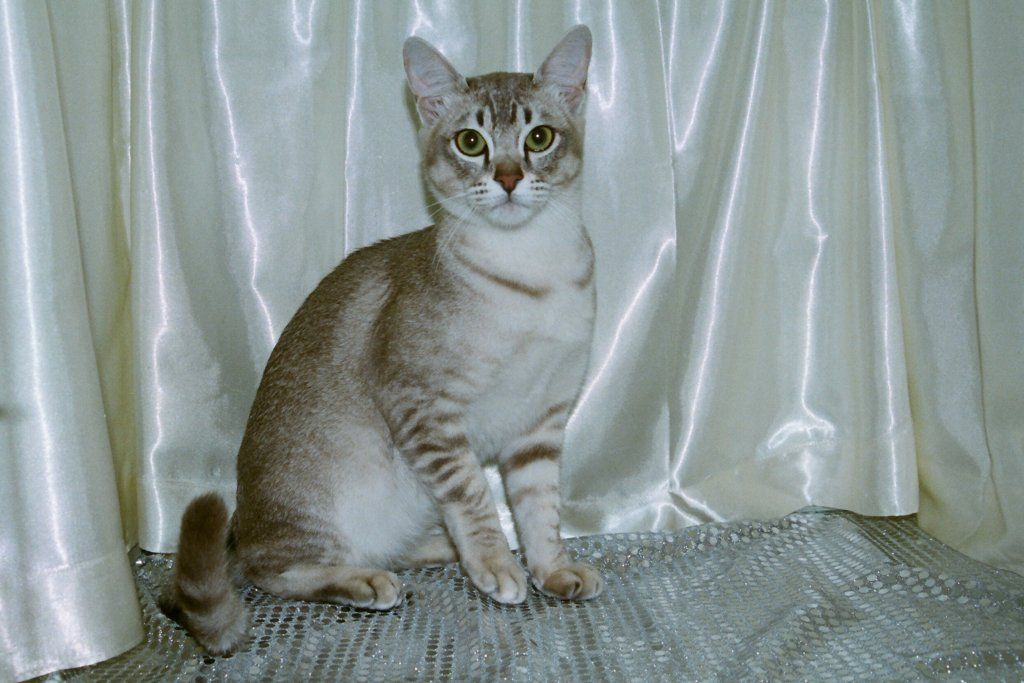
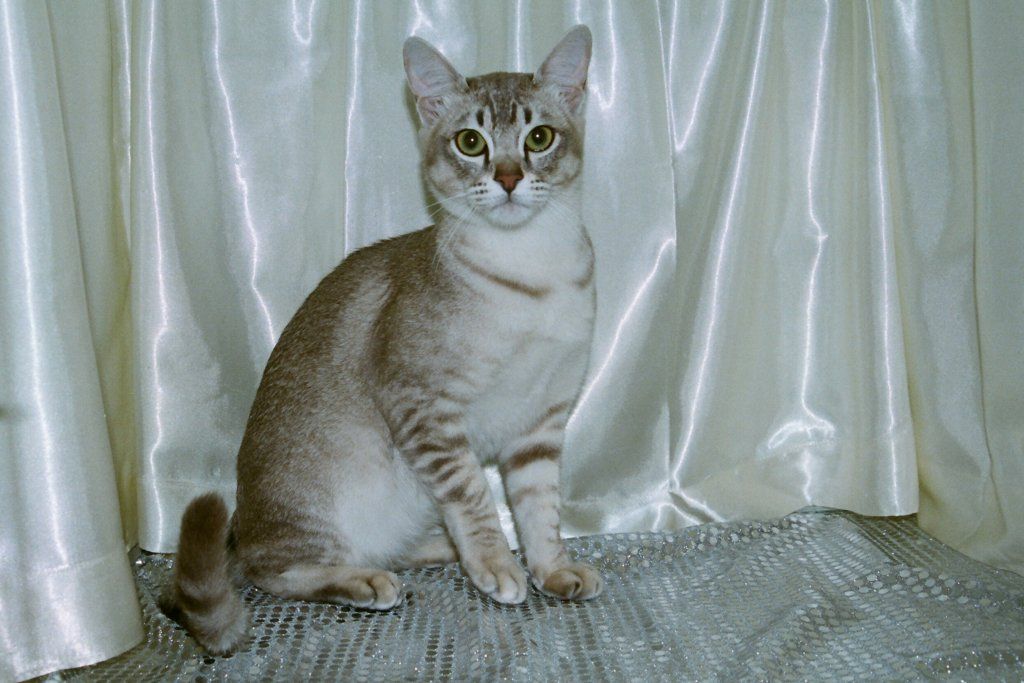
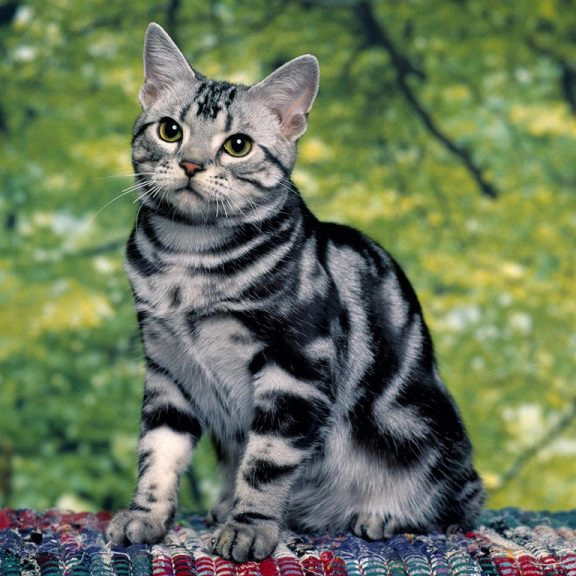
A tabby British beauty of the Burmese type with a gentle heart — sociable and balanced: affectionate, clever, playful and friendly. The Asian Tabby cat belongs to the “Asian” group (related to the Burmilla and Burmese): it has the slim, muscular Burmese-type body, a glossy tabby coat and a gentler, calmer character than the Burmese, becoming an affectionate, sociable companion, good with children and animals.
A tendency to polycystic kidney disease (PKD, from the Persian line)
A tendency to gain weight
Size
ToySmallMediumLargeGiant
Compatibility
KidsDogsOther catsBeginnersTime alone · with caveats
The Asian Tabby cat is not just any feline; it's an embodiment of grace and elegance, adorned with charming and diverse tabby patterns. This relatively young breed, part of the wider Asian Group of cats, wins hearts with its incredible combination of sophisticated looks and a wonderful, sociable nature. You can discover more about them on Tvaryny.
The sheer range of possible colours and patterns is captivating: from the classic mackerel to the refined ticked tabby, set against a backdrop of chocolate, lilac, cream, caramel, or other base colours. The characteristic "M" marking, often referred to as the "scarab mark", on their forehead highlights the exotic origins of these marvellous creatures. Although Asian Tabbies adore being the centre of attention and interacting with their family, they also possess a calm disposition, allowing them to feel comfortable when left home alone.
Asian Tabby Cat: A Brief Breed Overview
Original Name: Asian Tabby
Other Names: Part of the Asian Group of cats
Origin: United Kingdom
Time of Origin: 1980s (start of the breeding programme)
Recognition by Organisations: GCCF (as part of the Asian Group)
Type: Foreign type, similar to the Burmese
Size: Medium
Weight: 4–7 kg (males are usually slightly heavier than females)
Lifespan: 15–18 years (sometimes up to 20 years)
Temperament: Sociable, intelligent, playful, gentle, people-oriented, moderately active
Coat: Short, fine, silky, lying close to the body
Colours: Various tabby patterns (ticked, spotted, mackerel, classic/blotched) on recognised Asian Group colours (black, blue, chocolate, lilac, red, cream, apricot, caramel, cinnamon, fawn, and their tortoiseshell variations; silver and non-silver options)
Grooming: Minimal (weekly brushing)
Interesting Facts About the Asian Tabby Cat
Part of a "Large Family": The Asian Tabby is one of the coat variations within the large Asian Group of cats, which also includes the Burmilla (shaded and tipped), Asian Smokes, Asian Selfs (solid colours), and the semi-longhaired variant – the Tiffany.
"Accidental" Beginnings: The breed originated from an unplanned mating between a Persian Chinchilla cat and a Burmese cat.
Burmese "Look-alike": The main goal of breeders is to preserve the type, build, and character of the Burmese cat in Asians, while expanding the palette of colours and patterns.
Variety of Tabbies: The breed recognises four types of tabby patterns: ticked, spotted, mackerel, and classic (blotched).
British Roots: Despite the name "Asian," the breed was developed in the United Kingdom.
"Scarab Mark": The dark "M" shaped marking on the forehead, characteristic of all tabby patterns, is often referred to as the "scarab mark."
History of the Asian Tabby Cat
The history of the Asian Tabby is closely intertwined with the history of the entire Asian Group of cats and began quite unexpectedly in Great Britain. It all started in 1981 with an accidental mating between a Persian Chinchilla male and a lilac Burmese female. This event is credited to Baroness Miranda von Kirchberg, who subsequently founded the new breeding programme.
The kittens born from this union had shorter coats than Persians but inherited interesting silver colourings from their Chinchilla father and the lovely type of the Burmese cat. They proved so attractive and possessed such a wonderful temperament that the Baroness and other interested breeders decided to create a new breed (or rather, a group of breeds) that would combine the Burmese cat type with a broader spectrum of colours and patterns than was permitted in Burmese.
The aim of the programme was to produce cats identical in type to the Burmese but with new colours and patterns (solid, smoke, tortoiseshell, tabby) and two coat lengths: shorthair (Asian Shorthair) and semi-longhair (Asian Semi-longhair, known as the Tiffany).
To achieve the tabby patterns (spotted, mackerel, classic, and ticked), cats of the Abyssinian breed (to obtain the ticked tabby) and other shorthaired cats with the desired patterns were introduced into the breeding programme. Careful selection and dedicated breeding work over several generations allowed for the desired type and patterns to be established.
The Asian Group, including the Asian Tabby, was officially recognised by the leading British cat fancy organisation, the GCCF (Governing Council of the Cat Fancy). Today, these cats remain relatively rare, especially outside the UK, but their popularity is growing thanks to their beauty and delightful character.
What Does an Asian Tabby Cat Look Like: Breed Standard Description
The breed standard for the Asian Tabby cat, like that of the entire Asian Group, fully corresponds to the Burmese cat standard, with the exception of permitted colours and patterns. It is an elegant, medium-sized cat of Foreign type, but without the extreme features characteristic of, for example, Oriental Shorthair cats.
What Does an Asian Tabby Cat Look Like: Breed Standard Description · 8
Body Part
Standard Description (GCCF)
General Appearance
A cat of medium size, elegant, of foreign type, sturdy, muscular, surprisingly heavy for its size. Overall balance is more important than individual features.
Head
Short, blunt wedge shape, wide between the ears, smoothly tapering to a blunt muzzle. Top of the head slightly rounded. In profile, a distinct stop (transition from forehead to nose) is noticeable. Nose straight. Tip of the nose and chin form a vertical line. Chin firm, well-developed.
Ears
Medium to large in size, broad at the base, slightly rounded at the tips. Set wide apart, continuing the outer line of the upper part of the muzzle. Slightly tilted forward.
Eyes
Large, set wide apart. The upper line of the eye slants towards the nose (oriental slant), the lower line is rounded. Eye colour: from yellow to green, rich shades are preferred. Amber shades are permissible in red, cream, and apricot cats.
Body
Of medium length and size, firm, muscular, with a well-developed, rounded chest. Back straight from shoulders to rump. There should be no signs of cobby or overly elongated type.
Limbs and Paws
Limbs slender, proportionate to the body. Hind legs slightly longer than front legs. Paws neat, oval-shaped.
Tail
Medium length, not too thick at the base, gradually tapering to a rounded tip.
Coat
Short, fine, silky, lying close to the body, with almost no undercoat. Has a natural sheen.
Tabby Patterns in the Asian Breed
It is precisely the tabby pattern that distinguishes these cats within the Asian Group. Four main types of tabby patterns are recognised by the standards:
Ticked Tabby: Each hair has several dark bands (ticking) on a lighter background. Clear stripes or spots on the body are absent, but there may be residual "necklaces" on the neck and stripes on the legs and tail. The forehead bears the characteristic "M" marking. This pattern is inherited from Abyssinian cats.
Spotted Tabby: Clear, separate spots of various sizes and shapes (round, oval) are evenly distributed over the body on a lighter background. A stripe along the spine may be broken into spots. Rings are present on the legs and tail. "M" marking on the forehead.
Mackerel Tabby: Narrow, parallel, vertical stripes run from the spine to the belly, resembling a fish skeleton (mackerel). The stripes should be clear and unbroken. "Necklaces" on the neck, "bracelets" on the legs, and rings on the tail. "M" marking on the forehead.
Classic/Blotched Tabby: Broad, swirling patterns on the flanks, resembling butterfly wings or marble patterns. A clear "M" marking on the forehead, lines from the eyes to the back of the head, "necklaces" on the neck, and rings on the tail and legs. The pattern should be symmetrical.
All these patterns can appear on any of the colours recognised for the Asian Group, in both silver and non-silver variations, creating a vast diversity in the appearance of Asian Tabbies.
Character of the Asian Tabby: Temperament and Behaviour
The Asian Tabby cat is an ideal companion for a wide range of people. It has inherited the best traits from its ancestors: the devotion and gentleness of the Burmese, the playfulness and curiosity of the Abyssinian, and the calm nature of the Persian Chinchilla.
People-Oriented: These cats adore human company. They become very attached to their owners, keen to be involved in all household activities, greet them at the door, and sleep nearby. They are true "shadow" cats.
Intelligent and Inquisitive: Asian Tabbies are clever cats. They learn quickly, easily master the litter tray and scratching post, and can even learn simple tricks. Their curiosity drives them to explore every corner of the house.
Playful and Energetic: They retain their playfulness well into adulthood. They love interactive toys, "hunting" a ball or laser dot, and climbing cat trees. They need regular play sessions to burn off energy.
Sociable and Friendly: They usually get along well with children (provided they are treated respectfully) and other pets, including dogs, especially if raised together. They are not prone to aggression or jealousy.
Moderately "Chatty": Asian Tabbies can be quite vocal, responding to their owner's address or commenting on events with a quiet, pleasant voice, but they are not as insistently loud as some other oriental breeds.
Tolerates Solitude Well: Despite their sociability, an Asian Tabby can calmly spend the day alone while its owners are at work, provided it has things to do (toys, a window to observe) and receives enough attention upon their return.
Gentle and Affectionate: They love affection, happily purring on laps, but are not overly demanding. They sense their owner's mood and can be a wonderful source of emotional support.
Thanks to their balanced and friendly nature, the Asian Tabby is an excellent fit for families with children, single individuals, or elderly couples looking for a loyal and loving friend.
Training and Socialisation of the Asian Tabby Cat
Thanks to their high intelligence and desire to please their owner, Asian Tabby cats are quite easy to train and socialise. They quickly understand house rules and enjoy learning new things.
Socialisation
Early socialisation is key to developing a well-balanced and confident cat. Introduce your kitten to:
Different People: Allow friends and family members to gently interact with the kitten so it gets used to strangers.
Other Animals: If you have other pets, introduce them gradually and under supervision. Asian Tabbies usually get along well with other cats and dogs.
Various Sounds and Situations: Accustom it to household noises (vacuum cleaner, hairdryer), trips in a carrier.
Grooming Procedures: From a young age, get it used to having its ears, teeth, and claws checked, and to being brushed.
Training and Learning
Use positive reinforcement methods – praise, affection, treats.
Litter Tray and Scratching Post Training: Usually straightforward. Show the kitten the location, encourage correct behaviour. Provide several types of scratching posts in different places.
Teaching Commands: Asian Tabbies can be taught simple commands ("come," "sit," "paw") and even to fetch toys. Training sessions should be short, engaging, and rewarding.
Behaviour Correction: Do not physically punish the cat. If it does something undesirable (e.g., scratches furniture), redirect its attention to a scratching post or toy. Use a firm "No."
Intellectual Stimulation: Provide the cat with puzzle toys and interactive games to satisfy its need for mental stimulation.
Remember that Asian Tabbies are energetic cats; they need space for play and physical activity. A cat tree or shelves for climbing will be a great asset.
Pros and Cons of the Asian Tabby Cat Breed
Advantages:
Wonderful Character: Very gentle, sociable, devoted, and people-oriented.
High Intelligence: Easy to train, clever.
Gets Along Well with Children and Other Animals: Ideal for families.
Attractive Appearance: Elegant Burmese type combined with diverse tabby patterns.
Low Grooming Requirements: Short coat needs minimal care.
Adaptability: Can adjust to flat living and tolerate being alone (provided they get enough attention at other times).
Good Health and Longevity: Generally a healthy breed.
Disadvantages:
Needs Attention and Companionship: Not suitable for people who are constantly away and cannot dedicate time to a cat.
Can Be "Chatty": Although their voice is quiet, some individuals enjoy a "conversation."
Requires Play Activity: Needs physical and mental stimulation.
Rarity: Finding a kitten can be challenging, especially outside the UK.
Prone to Weight Gain: Requires careful diet management.
Potential Hereditary Diseases: Although the risk is low, choosing a responsible breeder is important.
How to Care for an Asian Tabby Cat's Coat
Caring for the short, silky coat of an Asian Tabby does not require significant effort. Due to the almost complete absence of an undercoat, their fur is not prone to matting and needs minimal grooming. This sets them apart from breeds requiring more intensive grooming, such as the Anatolian cat with its dense coat, or the American Wirehair with its unique coat texture.
Brushing: It's sufficient to do this once a week. Use a soft brush with natural bristles, a rubber grooming mitt, or simply run a damp hand over the coat. This helps remove dead hairs, distribute natural skin oils, and give the coat an extra shine. During seasonal shedding (spring and autumn), you can brush a little more often, 2–3 times a week.
Bathing: Asian Tabbies are clean cats and usually groom themselves well. Bathe them only when absolutely necessary, for example, if they are heavily soiled or before a show. Use only special cat shampoos and rinse them thoroughly. After bathing, dry the cat well with a towel and keep it warm until completely dry. Frequent bathing can dry out the skin and coat.
Claw Care: Regularly (approximately every 2–3 weeks) trim the tips of the claws with special nail clippers. This is especially important for cats living exclusively indoors.
Ear Care: Inspect the ears weekly for dirt, redness, or an unpleasant odour. If necessary, gently clean the outer part of the ear canal with a cotton pad moistened with a special ear cleaning solution. Do not use cotton buds!
Eye Care: The eyes of an Asian Tabby usually do not require special care. If minor discharge appears in the corners of the eyes, it can be gently removed with a clean, damp cloth or wipe.
Grooming Procedure
Recommended Frequency
Tools/Products
Brushing Coat
Once a week (more often during shedding)
Soft brush, rubber grooming mitt, damp hand
Bathing
As needed (rarely)
Cat shampoo
Trimming Claws
Every 2–3 weeks
Cat nail clippers
Ear Check/Cleaning
Check – weekly, clean – as needed
Ear cleaning solution, cotton pads
Brushing Teeth
Preferably daily or several times a week
Cat toothbrush and toothpaste
Nutrition
Feeding an Asian Tabby Cat: Key Recommendations
Health and risks
Health of the Asian Tabby Cat: Common Diseases and Prevention
Frequently Asked Questions About the Breed (FAQ) · 6
Do Asian Tabbies shed a lot? They shed moderately, like most shorthaired cats without a dense undercoat. Regular weekly brushing helps control the amount of loose hair.
Are Asian Tabbies hypoallergenic? No, Asian Tabbies are not hypoallergenic. Allergies are caused not by the fur itself, but by proteins found in the cat's saliva, skin secretions, and urine.
How long do Asian Tabbies live? With proper care and nutrition, their average lifespan is 15–18 years, and sometimes longer.
Are they suitable for living in a small flat? Yes, they adapt well to living in a flat, provided they have enough opportunities for play, climbing (e.g., a cat tree), and interaction with their owner.
How does the Asian Tabby differ from the Burmese cat? The main difference is in the colouring and pattern. Burmese cats have a specific pointed colouration (Burmese colour restriction), where the extremities are darker than the main body, and they do not have tabby patterns. Asian Tabbies have distinct tabby patterns (ticked, spotted, mackerel, classic) on various base colours. Their body type and character are very similar.
How does the Asian Tabby compare to the Oriental Shorthair cat? Both breeds are of the Foreign type, but the Oriental Shorthair cat has a more extreme, slender, and elongated body type, a wedge-shaped head, and very large ears. The Asian Tabby has a more moderate Foreign type, similar to the Burmese, with a sturdier build and less extreme features of the head and ears. Both breeds can have tabby patterns, but their overall body type differs significantly.
Where can I buy an Asian Tabby kitten? The breed is relatively rare. You should look for specialist breeders who work with the Asian Group of cats. There are not many such breeders in some countries, so you may need to look abroad, particularly in the United Kingdom.
FAQ
What is the Asian Tabby cat?
It is a member of the “Asian” group of breeds (alongside the Burmilla) of the Burmese type: the same slim, muscular build and character as the Burmese, but with a tabby glossy coat in various variants; it descends from crosses of the Burmese, Chinchilla and Abyssinian.
How does the Asian Tabby differ in character from the Burmese?
It keeps the Burmese's sociability and love of people, but is usually a little calmer and less demanding; an affectionate, balanced and friendly cat, good with children and animals.
Is the Asian Tabby hard to care for?
No — the short glossy coat only needs occasional wiping; the key is to give it attention, play and company, and to control its weight.