

| Height | 33–40 cm |
| Weight | 7.5–10 kg |
| Lifespan | 10–13 years |
| FCI group | 3 · terriers |
| Origin | Germany |
Exact ratings
Common health issues
Nutrition
The German Jagdterrier is not just a dog; it’s the embodiment of hunting passion, boundless energy, and unwavering dedication to its purpose. Created in Germany at the beginning of the 20th century, this terrier is the result of a deliberate breeding programme aimed at producing a versatile, fearless, and effective hunting companion. Jagdterriers were bred exclusively for work, and this is key to understanding their character and needs. They should not be kept as ‘lapdogs’ or companions for leisurely strolls in the park. This is a working dog that requires regular hunting or an adequate substitute in the form of intense training and sporting activities. If a Jagdterrier isn’t used for its intended purpose, the consequences can be devastating for both the dog and its owner. You can find out more about the unique characteristics of this breed on Tvaryny.
Without proper exercise and stimulation, these dogs can become destructive and unmanageable, showing aggression, damaging things around the house, and chasing any small animal that catches their eye. Therefore, if you are not a keen hunter or a person willing to dedicate a significant part of your life to active pursuits with a dog, do not make life difficult for yourself or the animal. If, however, you are looking for a tireless, brave, and versatile hunting partner, then a Jagdterrier is the dog for you – you won’t be disappointed. They are truly wonderful, all-purpose hunting dogs, capable of working both underground in burrows and on the surface. They also adore water and will retrieve shot game with immense pleasure.
German Jagdterrier: Key Breed Characteristics
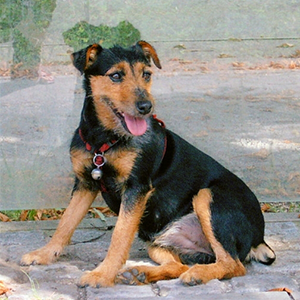
| Characteristic | Description |
| Origin | Germany |
| Time of Origin | 1920s |
| Purpose | Versatile hunting dog (den hunting, tracking wounded game, retrieving from water) |
| Life Expectancy | 13-15 years |
| Height at Withers | Males and females: 33-40 cm |
| Weight | Males: 9-10 kg; Females: 7.5-8.5 kg |
| Temperament | Energetic, fearless, determined, stubborn, loyal to owner, wary of strangers |
| Exercise Needs | Very high |
| Trainability | High, but requires an experienced owner with a firm hand |
| Relationship with Children | Tolerant if raised with them, but requires constant supervision |
| Relationship with Other Animals | Extremely negative, strong prey drive |
| Coat Type | Smooth-haired and wire-haired |
| Coat Care | Minimal |
History of the German Jagdterrier Breed
The history of the German Jagdterrier is inextricably linked to Germany’s hunting traditions and the desire to create an ideal national hunting dog. Work on the breed began after the First World War, in 1923, by a group of hunting enthusiasts led by Walter Zangenberg, Karl-Erich Grünewald, and Rudolf Fries. They separated from the large and popular Fox Terrier Club of the time, believing that Fox Terriers had lost their working qualities in favour of show ring appearance.
Their goal was to create a small, dark-coloured, all-purpose hunting dog with exceptional courage and ferocity towards game. They used four black-and-tan Fox Terrier puppies gifted to them by a zoo director as a foundation. It is believed that these puppies had a strong admixture of Old English Terrier blood. For further selection, they added blood from Wire-Haired Fox Terriers, as well as Welsh Terriers, to improve scenting ability, endurance, and balance. The selection process was extremely rigorous: any signs of cowardice, weakness, or deviation from working standards led to immediate culling from the breeding programme. A preference was given to dogs with a dark coat, as it was believed to be less noticeable to game. The German Jagdterrier’s nature is very different from the much softer temperament of the Irish Soft Coated Wheaten Terrier, which is primarily a companion dog.
In 1926, the “German Jagdterrier Club” was founded. The breed quickly gained popularity among German hunters. However, the Second World War dealt a devastating blow to the population, and it was on the verge of extinction. In the post-war period, enthusiasts had to make titanic efforts to restore the breed. The selection criteria were temporarily relaxed to increase numbers, but as soon as the threat of extinction passed, the requirements became maximally strict once again. In the countries of the former USSR, German Jagdterriers only began to appear in the 1970s, where they were quickly valued for their outstanding working qualities.
Appearance of the German Jagdterrier: Standard and Description

The German Jagdterrier is a compact, strong, and well-proportioned dog whose appearance immediately conveys power, speed, and a readiness for action. It has nothing in common with decorative breeds; every feature of its exterior is functional and aimed at fulfilling hunting tasks.
- Head: Elongated, wedge-shaped, with a strong lower jaw. The skull is flat and wide between the ears, narrowing towards the eyes. The stop (the transition from the forehead to the muzzle) is barely noticeable.
- Muzzle: Slightly shorter than the skull, strong. The jaws are very powerful, which is critically important for holding prey. The bite is a scissor bite.
- Eyes: Small, oval, dark, and deep-set. The gaze is resolute, courageous, and intelligent.
- Ears: High-set, not too small, V-shaped, hanging on cartilage and lying close to the cheeks.
- Body: Rectangular in shape. The neck is strong and not too long. The back is straight and powerful, with well-developed musculature. The chest is deep but not too wide, allowing the dog to easily enter burrows.
- Tail: High-set. Traditionally, it is docked to about one-third of its length to avoid injury while working in a den. In countries where docking is prohibited, it remains in its natural state. The dog carries it slightly raised or horizontally.
- Limbs: Straight and parallel, with well-developed muscles. The paws are compact, with tightly closed toes and hard pads.
Coat Types and Colours
There are two varieties of German Jagdterrier based on coat type:
- Smooth-haired: The coat is short, dense, and smooth, providing good protection against the weather.
- Wire-haired: The coat is thick, harsh, and wiry. On the muzzle, it forms a characteristic “beard”.
In both cases, the coat has a dense undercoat that protects the dog from cold and moisture. The main colour is black, dark brown, or black-grey (grizzle) with clearly defined tan or yellow markings on the eyebrows, muzzle, chest, limbs, and under the tail. A small white patch on the chest and white markings on the toes are permissible.
Character: Temperament and Behaviour of the Jagdterrier
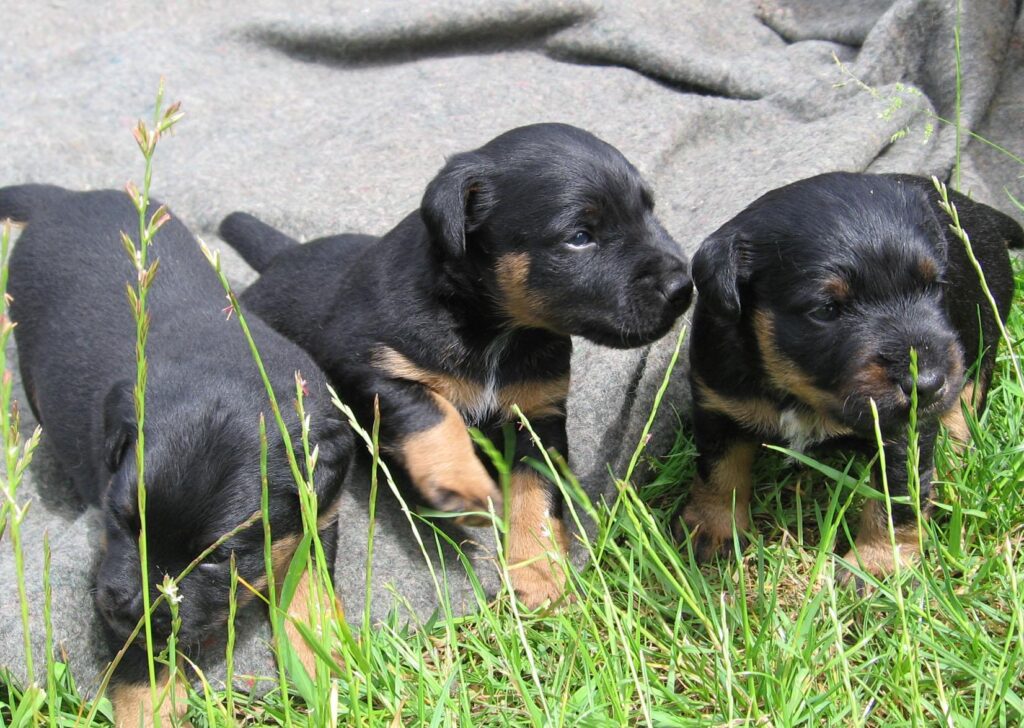
The Jagdterrier’s character is the quintessential hunting spirit. This dog will not be a gentle and affectionate companion in the traditional sense. It’s best not to get one at all if you are not involved in hunting or active sports. This is a fearless, incredibly strong, and resilient dog, strong-willed and stubborn in achieving its goals. Jagdterriers are unwilling to back down, even if an opponent is significantly larger than them, which often leads to injuries.
They are completely untrusting of strangers, viewing them with suspicion and always ready to defend their territory and owner. This makes them excellent guard dogs. With their owner and family members, the Jagdterrier forms a strong bond; it is infinitely loyal, but don’t expect constant cuddles. It expresses its love through shared work and a willingness to follow you to the ends of the earth. Its behaviour is in stark contrast to the softer nature of the Irish Soft Coated Wheaten Terrier, which is first and foremost a companion.
Keeping a Jagdterrier with other domestic animals is a huge problem. Their hunting instinct cannot be suppressed. Any cat, rodent, ferret, or even a small decorative dog will be seen as potential prey. Exceptions are possible if the puppy was raised with another animal from a very young age, but even then, the risk always remains. In this regard, it is very similar to the Patterdale Terrier, a breed also known for its strong prey drive.
Pros and Cons of the German Jagdterrier Breed
Before deciding to acquire a Jagdterrier, you need to soberly assess all the advantages and disadvantages of this complex breed.
| Pros (+) | Cons (-) |
|---|---|
| Outstanding working qualities: A versatile hunter, fearless and effective in the field. | Not suitable for novices: Requires an experienced, strong-willed, and consistent owner. |
| Endurance and robust health: The dog is undemanding and resistant to diseases and weather conditions. | Not a companion dog: Unsuitable for the role of a family pet for a quiet life. |
| Compact size: Convenient for transport and keeping (provided with sufficient exercise). | Very high energy needs: Requires daily, multi-hour physical and mental stimulation. |
| Loyalty to the owner: Forms a very strong bond with one person. | Aggression towards other animals: Extremely difficult to get along with cats, rodents, and other dogs. |
| Good watchdog: Wary of strangers, always ready to protect its territory. | Tendency towards dominance and stubbornness: Will constantly test boundaries. |
| Easy coat care: Does not require complex grooming procedures. | Loudness: Prone to frequent and loud barking. |
Training and Socialisation
Training a Jagdterrier is a challenge that requires patience, consistency, and a deep understanding of the working dog’s psychology. The owner must establish clear rules and hierarchy from the very first day, showing who the leader is. This dog will not forgive weakness or inconsistency.
Early socialisation is absolutely essential. The puppy needs to be introduced to different people, sounds, places, and situations. This will help to raise a more balanced dog that reacts appropriately to stimuli. However, even the best socialisation will not be able to completely suppress its hunting instincts.
Training should be based on positive reinforcement but be very strict and demanding at the same time. Jagdterriers are intelligent and learn quickly, but their stubbornness, similar to that of other working terriers like the Border Terrier, requires an owner with an iron will. In addition to basic obedience commands (“sit”, “down”, “come”), the main focus should be on specialised hunting training (prey work). The “imitation” method is very popular, where a young puppy goes hunting with experienced adult dogs and learns the necessary skills from them. If you have no experience in training hunting dogs, the best solution would be to contact a professional dog trainer.
Jagdterrier Health: Typical Diseases and Prevention
How to Groom and Keep a German Jagdterrier
Jagdterriers are low-maintenance dogs, and caring for them does not require much time or effort. However, there are a few aspects worth paying attention to.
- Coat care: The Jagdterrier’s coat doesn’t require complex care. Brushing it once a week with a hard brush or a Furminator is enough to remove dead hair. Wire-haired dogs should be trimmed 2-3 times a year to maintain the correct coat structure. Bathe the dog only when it is very dirty.
- Physical exercise: This is the most important aspect of keeping the breed. A Jagdterrier needs daily, multi-hour walks with intense activity. This cannot be a slow walk on a lead. The dog must run, train, and follow commands. The ideal option is regular hunting trips. If hunting is not possible, it can be replaced by activities like agility, flyball, or long runs next to a bicycle.
- Living conditions: Keeping a Jagdterrier in a city flat is a terrible idea. The dog will suffer from a lack of space and activity. The best place for it is a private house with a large, well-fenced yard where it can run freely. The fence must be secure and high, as these dogs are prone to escaping and digging.
- Other procedures: Regularly check and clean the ears to prevent infections. Monitor the condition of the teeth and brush them with a special paste if needed. If the claws do not wear down naturally, they need to be trimmed.
Feeding a German Jagdterrier: Key Recommendations
The German Jagdterrier in Action: Hunting Applications

The Jagdterrier is a true all-rounder in the world of hunting. Its bravery, tenacity (persistence in pursuing game), and excellent sense of smell allow it to be used for various types of hunting. It is very similar in its work to other terriers such as the Welsh Terrier and the Border Terrier.
- Den hunting: This is its main speciality. The dog fearlessly goes into a burrow after a fox, badger, or raccoon dog, driving the animal out for the hunter to shoot or engaging it in a fight. Its compact size and powerful jaws are ideal for this. In this respect, it is similar to other specialised terriers such as the Patterdale Terrier.
- Tracking wounded game: The Jagdterrier works excellently on the blood trail of wounded game, helping the hunter find prey, such as a wild boar or roe deer.
- Bird hunting: It enthusiastically flushes birds out of reeds and other thickets, and after the shot, it retrieves the downed game without any problems, including from cold water.
- Wild boar hunting: In a pair or a group, Jagdterriers courageously stop and hold a wild boar, allowing the hunter to approach for the shot. This is a very dangerous job that requires exceptional courage from the dog.
Interesting Facts About the Breed
- The name “Jagdterrier” literally translates from German as “hunting terrier.”
- The creation of the breed had a certain ideological basis – the desire to have a purely German, ideal working terrier that would surpass the then-popular English Fox Terriers.
- Jagdterriers are known for their phenomenal pain tolerance. When working with excitement, they may not even notice serious injuries.
- Due to their uncompromising nature and black colouring, they are sometimes colloquially called “little devils” or “black lightning”.
- Despite their small size, a Jagdterrier’s bite is extremely powerful.
Frequently Asked Questions About the Breed (FAQ)
Is the German Jagdterrier suitable for a family with children?
This is a very difficult question. If the dog grows up with children from a young age and the children are taught how to behave with the animal, a peaceful co-existence is possible. However, the Jagdterrier is not a nanny; it is intolerant of over-familiarity and rough handling. You should never leave a small child alone with this dog unsupervised.
Can a Jagdterrier be kept in a flat?
Theoretically yes, but only on the condition that you can provide it with 3-4 hours of intense physical exercise outside the home every day. In reality, this is almost impossible, so keeping it in a flat is strongly not recommended. The dog will suffer, destroy things, and cause problems.
Can a Jagdterrier be a first dog?
Absolutely not. This breed requires an experienced owner who understands the psychology of working dogs, has a firm character, and is willing to dedicate a lot of time to training and socialisation. A novice simply will not be able to cope with its temperament.
Does the Jagdterrier shed a lot?
Shedding is moderate and seasonal. Regular brushing helps to keep the amount of hair in the house under control. Its coat does not require such meticulous care as, for example, that of a long-haired Welsh Terrier.
Video About the Breed
- Fearless, all-round hunter
- Hardy and robust in health
- Clever, learns the work well
- Compact, undemanding in daily life
- Very high prey drive
- Not for a flat or a beginner
- Gets on badly with small animals
- Needs an enormous workload and a job
| Welsh Terrier | Patterdale Terrier | Wire Fox Terrier | |
|---|---|---|---|
| Height | 36–39 cm | 25–38 cm | 36–39 cm |
| Energy | 4 | 5 | 4.5 |
| Apartment | 3 | 2 | 3 |
| Beginners | 2.5 | 2 | 2.5 |
Is the Jagdterrier suitable for a flat and a family without hunting?
Does the Jagdterrier get on with cats?
Is the breed suitable for a beginner?
FCI Standard No. 103 · Deutscher Jagdterrier-Club
For apartments · For kids · For beginners · Active · Smartest · Hypoallergenic · All rankings →