

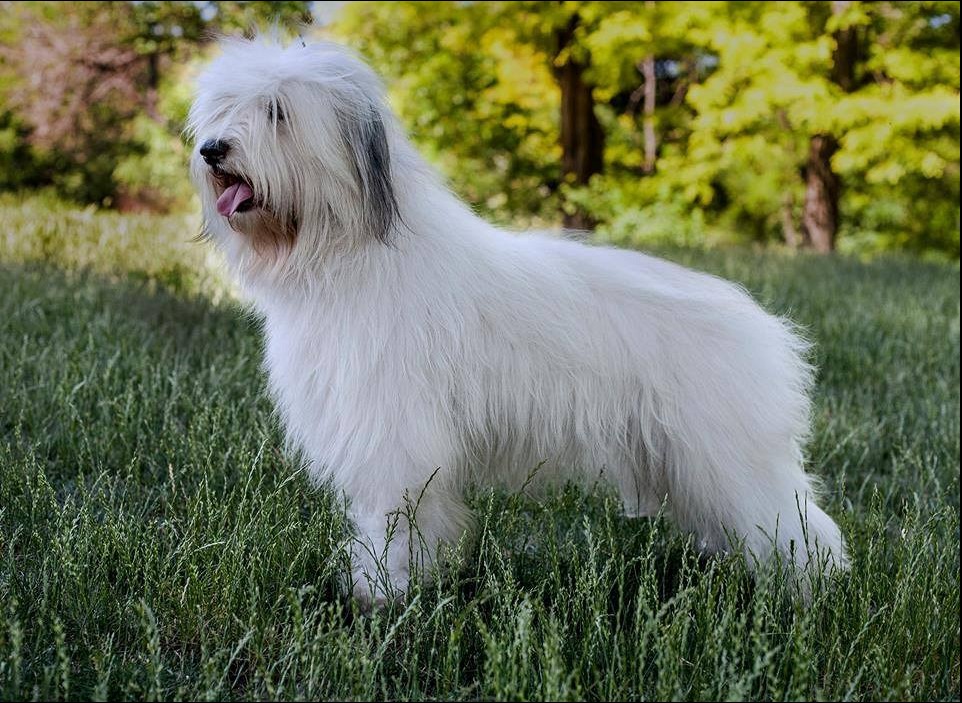
| Height | males 35–39 cm, females 33–37 cm |
| Weight | the UKU standard sets no weight |
| Lifespan | 11–15 years |
| FCI group | not recognised by the FCI (Ukrainian national breed, UKU) |
| Origin | Ukraine (Odesa) |
Exact ratings
Common health issues
Nutrition
The Odis is a Ukrainian companion breed, assembled in Odesa in the late twentieth century from three entirely different breeds. The current Ukrainian Kennel Union (UKU) standard opens with two lines worth reading before any description of character: ‘ORIGIN: Ukraine’ and ‘UTILISATION: companion dog’. The acronym ODIS is read as ‘Odesa Domestic Ideal Dog’ and, by the breed club’s account, was coined not by a cynologist but by a journalist at a press conference in 2004 — the creators liked the joke, and the expansion went official. It is a small shaggy dog with beard, moustache and a topknot over the eyes, which the UKU administers separately from FCI breeds, under national standards. Find out more on Tvaryny.
History: how Odesa assembled a breed out of three
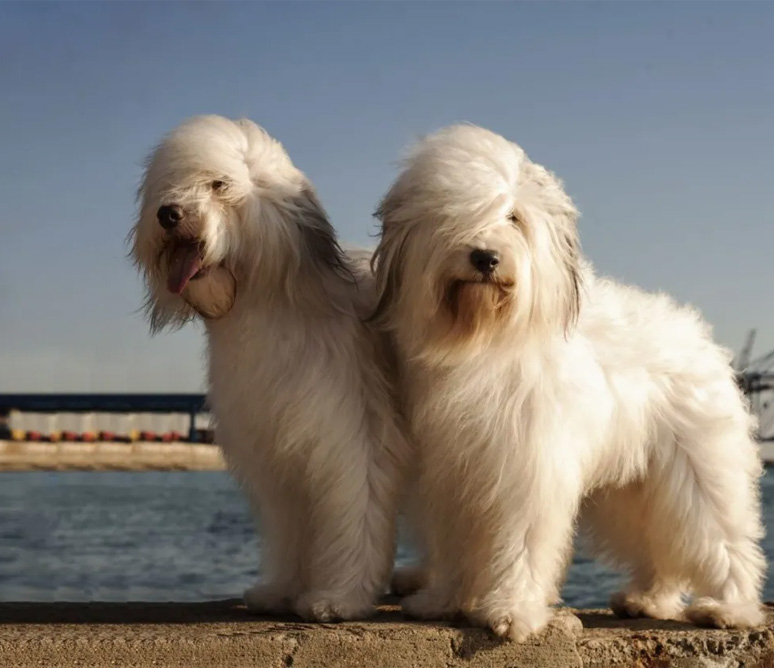
The most reliable source on the breed’s origin is not club retelling but the standard’s own ‘Brief history of the breed’ section. It states: at the end of the 1970s, in Odesa (Ukraine), on the initiative of FCI-UKU judge Tamara Sharhorodska, planned matings — in particular between the breeds Fox Terrier, silver Miniature Poodle and Maltese — produced a breed group of individuals sharing common ancestors and a phenotypic resemblance. Years of breeding work followed, and in 2004 the group received the name ODIS and its first breed standard.
That paragraph holds a detail that vanishes in summaries: the Poodle there is not merely ‘miniature’, it is of silver colour. Not decoration: the choice of one colour line explains where the grey and ‘blue’ tones later written into the permitted coats came from. Likewise the Fox Terrier is named without a variety, though reference descriptions generally mean the wire-haired one — it supplies the guard-hair texture the standard demands today.
By the breed club’s account the pivotal year is 1999: the bitch KROHA LAPUSHKA DIO PRESENT and the dog ZIGFRID produced a litter in which every puppy matched the type the breeders sought, and the bitch FRANSHIKA DIO PRESENT became the reference specimen and foundation dam. The chain closes on the present day: that bitch’s owner is named as Iryna Bakharieva, and Bakharieva Iryna Volodymyrivna is listed as president of the ODIS National Breed Club on the official UKU page. The breed descends from a particular bitch out of a particular litter, and the person who stood beside it still answers for it inside the UKU system.
The idea of ‘assembling the ideal city dog out of pieces’ is not unique — the people behind the Labradoodle reasoned the same way. From there the paths diverge sharply. In most countries the Labradoodle remains a first- or second-generation hybrid with no standard of its own and no closed stud book: every litter is a fresh cross between two other breeds. The Odis has passed that stage: it has a standard text with tolerances in centimetres, lists of faults and serious faults, disqualifying points, a single-breed club and pedigrees of the form the UKU established.
The chronology of the documents looks like this, each date meaning something different:
| Date | What exactly happened |
|---|---|
| late 1970s | Planned matings begin in Odesa, on the initiative of FCI-UKU judge Tamara Sharhorodska |
| 1999 | Per the breed club — the litter in which the foundation dam FRANSHIKA DIO PRESENT was born |
| 2004 | The breed group receives the name ODIS and its first standard |
| 2008 | Per reference descriptions — a decision of the UKU governing bodies approving the standard and opening registration of dogs with pedigrees of the established form |
| 2 September 2017 | Publication date of the version of the standard now in force (stated in the document itself) |
| 19 June 2018 | Amendments to the standard approved by the UKU Breeding Commission |
‘National breed’: what that means in practice
This is the most important and most often distorted point about the Odis, so let us take it from the documents.
The UKU is Ukraine’s national canine organisation and works within the system of the FCI (Fédération Cynologique Internationale); the standard calls Tamara Sharhorodska an ‘FCI-UKU judge’. The UKU website carries two separate sections, ‘List of FCI breeds’ and ‘National standards’, and the Odis lives in the second. That page is headed, word for word, ‘NATIONAL BREED OF UKRAINE — ODIS’, and gives the National Breed Club’s contacts.
In the UKU summary table ‘Breeds recognised at national level in Ukraine’ the Odis line is as concrete as a line gets: group — 0, standard number — 0, country — Ukraine, status — ‘Nationally recognised breed / WITHOUT CACIB’. Three zeros and one ‘without’ hold the whole truth about the breed’s international standing:
- Group 0 — the breed belongs to none of the ten FCI groups. Within the FCI it is simply not classified.
- Standard number 0 — it has no FCI standard number, the one recognised breeds carry.
- WITHOUT CACIB — at shows the Odis does not compete for the CACIB, the certificate leading to the title of International Beauty Champion in the FCI system.
What does work in full: the UKU pedigree, breeding records, breeding certificates, and a national show system with its own titles and judges entitled to assess the breed against its standard. For a dog born outside Ukraine the UKU Breeding Regulations provide a separate route — registration of imported dogs of breeds recognised only at national level, with a UKU.R number and entry in the Appendix to the Stud Book.
One more detail guards against over-reading the word ‘national’. In that same UKU table, ‘Ukraine’ also stands against the Ukrainian Carpathian Hound and the Khortaya (the latter of shared origin). ‘Breed recognised at national level’ is a status, not an exclusivity: it means what the table says, and no more.
It also matters who granted that status: a voluntary association, not the state — and it could not have been otherwise. Article 4 of the Ukrainian law ‘On Pedigree Breeding in Animal Husbandry’ lists the objects of pedigree breeding exhaustively: cattle, pigs, sheep, goats, horses, poultry, fish, bees, silkworms, fur-bearing animals and rabbits. Dogs are not there, so no state register of dog breeds exists in Ukraine. ‘National breed’ in the UKU page title is a canine organisation’s wording inside its own system, and should be read that way.
Another rule from the same table explains how the breed is judged in the ring. Under UKU Order no. 14 of 15 June 2020, nationally recognised Ukrainian breeds provisionally attached to FCI groups are added automatically to the breeds of the full group a judge holds. There is no separate ‘caste of judges’ for the Odis: an expert holding the corresponding group assesses it, simply without a CACIB on offer.
Is anything moving on the FCI side? The most recent document is dated 23 June 2026: UKU Order no. 33 set up, under the organisation’s president, a Working Group on preserving, developing and promoting Ukrainian national dog breeds. Its tasks explicitly include proposals for developing, clarifying and updating the standards of Ukrainian national breeds, and preparing the materials needed to present Ukrainian national breeds to the Fédération Cynologique Internationale. Iryna Bakharieva, president of the ODIS National Breed Club, sits on it. That is the real state of the file: not a recognition under way, but a working group created and told to prepare the paperwork.
Is that bad for the dog? No. FCI recognition turns on time, population size, geographical spread and documented generations, not on an individual animal’s quality. For a buyer the status still has practical consequences: a narrower circle of breeding partners than in recognised breeds; no international career in the FCI system; and quality guarantees resting on the breeder and the single-breed club rather than on international rules.
Appearance: what the standard actually describes
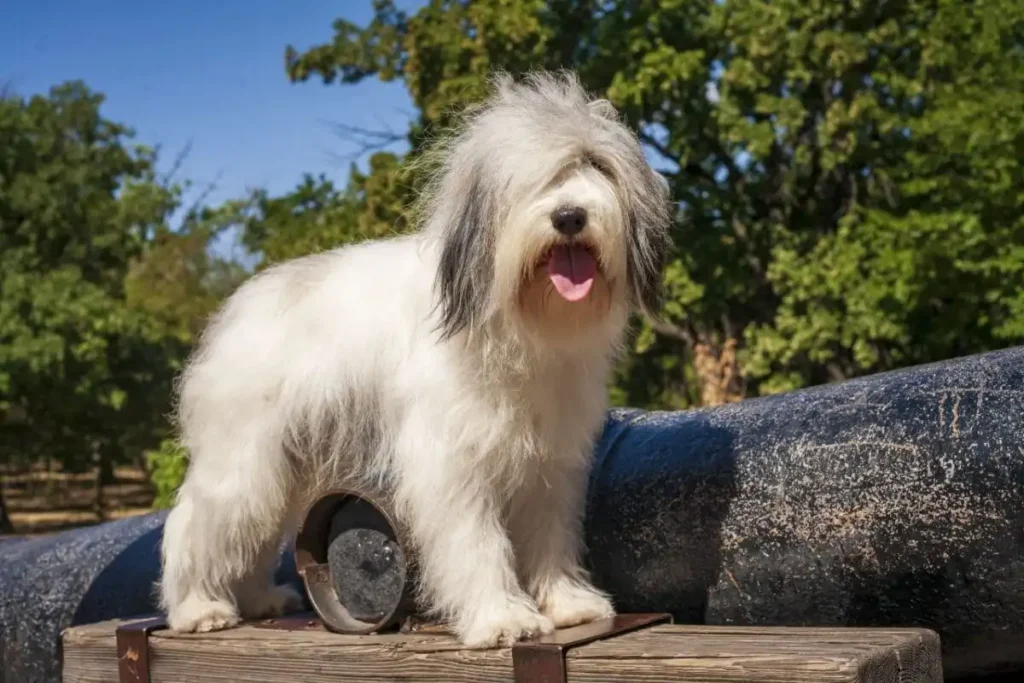
The standard opens with a comparison unexpected in a companion breed: the Odis ‘bears an outward resemblance to the South Russian Shepherd Dog, but is considerably smaller in size’. That shepherd is known in Ukraine as the Ukrainian Shepherd. The document then asks for strength of bone and constitution despite the small size — but stipulates that this is no reason to make the dog clumsy, overloaded or coarse, and that the Odis is ‘on no account leggy or squat’.
The proportions are not left to the eye but set out in figures, and they are what make the silhouette recognisable.
| Parameter in the standard | Value |
|---|---|
| Ideal height at the withers, males | 37 cm, tolerance ±2 cm (i.e. 35–39 cm) |
| Ideal height at the withers, females | 35 cm, tolerance ±2 cm (i.e. 33–37 cm) |
| Weight | the UKU standard sets no weight |
| Body length | exceeds height at the withers by 10–12%; females slightly longer than males |
| Head length | about 40% of height at the withers |
| Muzzle length | roughly ½ the length of the head |
| Height at the elbow | roughly ½ of height at the withers |
| Shoulder-blade / upper-arm angle | about 100 degrees |
Two lines deserve attention. First, male and female heights differ, and merging them into one interval is incorrect: 37 ± 2 and 35 ± 2 are separate corridors. Second, there is no weight in the standard at all. That is neither omission nor carelessness: the document builds the breed around height at the withers and proportions, leaving mass to follow from the constitution. Any ‘it should weigh so much’ about the Odis is someone’s estimate, not a breed requirement.
The standard guards the height limits strictly and asymmetrically. Among the faults: a height above 39 cm, in males and females alike, and below 30 cm in females. Among the serious faults, the harsher level: under 30 cm in a male, or over 41 cm in either sex. The upper boundary is shared while the lower is written separately — a very small female stays within fault territory where an equally small male already tips into a serious fault.
The head, per the standard, suggests a blunt wedge from above and from the side; the distance from the occipital protuberance to the stop roughly equals that from the stop to the tip of the nose. The skull is slightly convex, moderately broad, narrowing gradually towards the eyes; the stop is gentle, an abrupt stop being a fault. The eyes are medium-sized, oval, dark, set slightly obliquely, with well-pigmented eyelid rims; excessively protruding, pale eyes are a fault. The ears are drop ears, set high, medium, triangular, hanging close to the cheek; erect ears are a serious fault, short ears or ears carried back merely a fault.
Pigment is described in detail, because it shows all the more on a predominantly white dog. The nose leather is broad with well-defined nostrils; black in white dogs, in white dogs with grey patches and in grey dogs, and it may be dark brown in fawn dogs. A nose pigmented over half its surface or more is a fault; less than half, a serious fault; a wholly unpigmented nose, grounds for disqualification. The bite is a scissor bite, a level bite permitted in adults; an overshot jaw and a wry jaw disqualify.
The tail is carried low at rest and may rise above the line of the back when the dog is animated, its length reaching the hock. A tail thrown over the back, curled into a ring, too short or not reaching the hock is a fault. Among the disqualifying points the standard also names aggressive or overly timid behaviour, any clear physical or behavioural abnormality, and unilateral as well as complete cryptorchidism.
Coat, topknot and colour: the breed’s central requirement
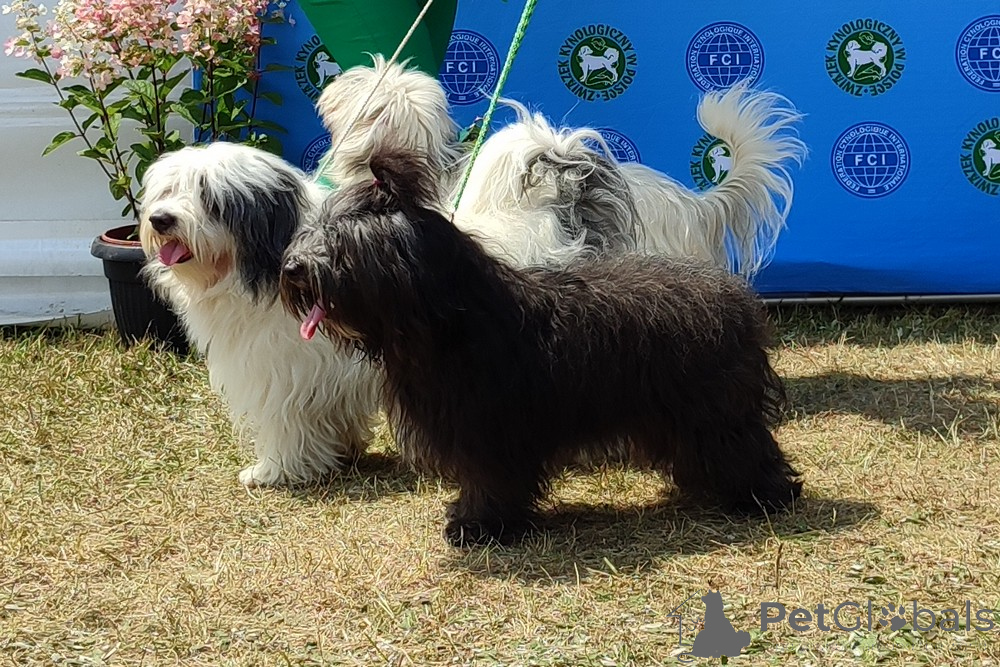
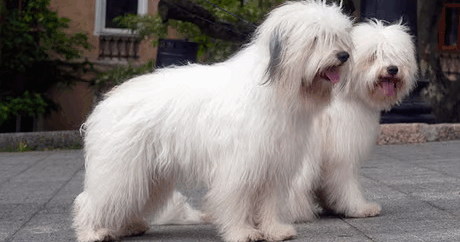
The coat is what the standard describes most minutely. The dog is covered all over in thick, long hair of 7 to 15 cm with a well-developed undercoat. The guard hair is of medium harshness, long, with a slight wave; in young dogs and during moult it may be shorter. On the head the ornamental hair (furnishing hair in the English version of the standard) forms the moustache, the beard and the topknot, which covers the eyes and reaches the nose leather.
This is not a description but a requirement, and the standard protects it from both sides. A short topknot that fails to cover the eyes, and a thinly furnished moustache and beard, are faults. Complete absence of topknot, moustache and beard is a serious fault. ‘Trimming it back so the dog can see’ leads to the bottom of the ring, not a neutral cosmetic decision.
Behind this lies well-documented genetics. Cadieu and colleagues (Science, 2009, vol. 326, pp. 150–153) showed that the whole diversity of canine coats is governed by variants of three genes: RSPO2 controls the ‘furnishings’ — moustache and eyebrows — and is inherited dominantly; FGF5 controls hair length, recessively; KRT71 controls curl, also recessively. The beard and moustache of the Odis are in effect the RSPO2 phenotype, inherited from the terrier and poodle lines; coat length is the work of FGF5.
Now the most interesting part, which overturns the assumption ‘there is Poodle in the breed, so the dog must be curly’. The Odis standard places a curly coat among the serious faults and a soft, excessively wavy one among the faults. From the poodle inheritance the breed takes length, density and furnishings — but not the curl. The third gene of the trio, KRT71, works here against the dog in the ring.
In a separate line the standard forbids something that looks almost revolutionary for a long-coated companion breed: ‘Any clipping that alters the shape of the dog is prohibited.’ Compare the Old English Sheepdog (Bobtail), where show grooming is an art of sculpting the silhouette. The Odis is judged as it was bred, not as it was cut with scissors.
The standard lists the colours exhaustively, and the list is worth reproducing exactly, because it degrades fast in retellings:
- white;
- white with patches of various colours — except liver;
- white with grey (blue);
- dark grey;
- fawn in its various shades — except orange.
The standard does not rank these colours and names none more desirable: all five stand equal. It states clearly what falls outside — any colour it does not provide for, and large vivid patches in the forbidden tones (liver, orange), are written into the serious faults.
Character: a standard that writes ‘sanguine’
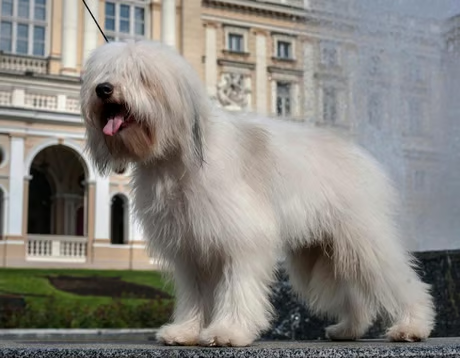
The ‘BEHAVIOUR / TEMPERAMENT’ section of the Odis standard is one word long: sanguine. That is a rarity — most breed standards describe temperament with adjectives (‘balanced’, ‘courageous’, ‘reserved with strangers’), while here the drafters named the type of nervous system outright. The general description adds that the Odis is a cheerful, spirited, energetic dog.
The trait is protected by the harshest instrument cynology has: aggressive or overly timid behaviour is grounds for disqualification. Beside it stands a broader formula — any dog clearly showing physical or behavioural abnormalities is disqualified. For a companion breed that is real insurance: small size is often an excuse for hysteria, and this standard removes it.
The breed club describes the purpose thus: a companion dog, good-natured and friendly towards people and other animals alike, undemanding to keep, easy to train, physically enduring, fond of long walks and able to accompany its owner on country outings. That is a club characterisation, not a clause of the standard — but it explains why the breed was built as it was.
The practical side of ‘sanguine’ is quick switching and orientation towards people. The Odis was not conceived to take independent decisions far from its owner: here it is the opposite of working scenthounds such as the Latvian Hound, for which autonomy in the forest is a professional virtue. The other side of the coin: a dog built around human contact copes badly with long spells alone, and in small companions boredom usually comes out through the voice. Upbringing and routine handle this, but deliberately.
Particulars of grooming and keeping
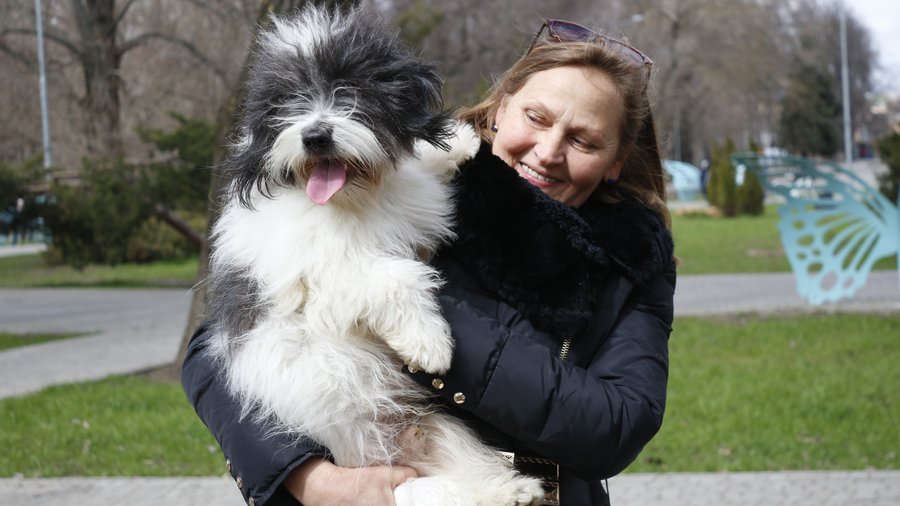
The Odis is genuinely flat-sized, and it is the coat, not floor space, that sets the daily routine. What follows comes from the text of the standard, not from general advice about long-coated dogs.
| Procedure | Frequency | Why exactly this way |
|---|---|---|
| Brushing | 2–3 times a week | A 7–15 cm coat with developed undercoat: dead hair stays inside and, uncombed, packs into mats. Problem zones: behind the ears, in the armpits and the groin. |
| Topknot and eyes | daily, by inspection | The standard requires the topknot to cover the eyes and reach the nose leather. Hair is in permanent contact with the cornea, so a daily look at the eye is the minimum. |
| Beard and moustache | after every meal | Long hair on the muzzle picks up food and water; on a white coat that quickly gives coloured streaks and odours. |
| Bathing | as required | The breed club describes bathing plus drying as an operation of about forty minutes. |
| Clipping | hygienic only | The standard expressly prohibits clipping that alters the dog’s shape. Tidying the feet and the area under the tail is not covered. |
| Ear cleaning | weekly | Drop ears, set high, ‘hanging close to the cheek’ — ventilation of the ear canal is limited. |
The comparison with the Maltese — one of the founding breeds — is telling. Maltese coat is silky, without undercoat, closer in structure to human hair, and show dogs are kept in wrappers to preserve length. The Odis inherited a different construction: guard hair of medium harshness with a slight wave over a dense undercoat. Such a coat breaks less and needs less protection, but the undercoat accumulates dead hair inside — and the work shifts from wrapping to regular brushing.
One further domestic consequence of a long coat with undercoat: in fields and woods it works like a brush for burrs, seeds and grass awns. After such outings the dog must be gone over completely, including between the toes.
Health: what is inherited from the three founding breeds
What the UKU requires of a breeder — and what it merely recommends
Advantages and disadvantages of the breed
| Advantages (+) | Disadvantages (−) |
|---|---|
| A written standard with clear limits, a single-breed club and UKU pedigrees — unlike ‘designer’ hybrids with no standard | No FCI recognition: group 0, standard number 0, shows without the CACIB |
| The standard disqualifies aggression and excessive timidity: the temperament is protected by the document | A small population and a narrow circle of breeding partners, especially outside Ukraine |
| Flat-sized: 35–39 cm at the withers in males, 33–37 cm in females | A 7–15 cm coat with undercoat needs systematic brushing, otherwise mats appear |
| No seasonal moult ‘in clumps’: dead hair stays in the undercoat and comes out on the comb | The standard requires the topknot to cover the eyes — daily inspection of the eyes is obligatory |
| A people-oriented companion, good with children and other animals (per the breed club) | The UKU has set no compulsory breeding tests for the breed — screening of the parents depends on the breeder |
| Clipping that alters the shape is prohibited: no elaborate show trim to maintain | A long coat with undercoat collects burrs, seeds and debris in the countryside |
Interesting facts about the breed
- The standard names the temperament in one word. Under ‘Behaviour / temperament’ it says ‘sanguine’ — a breed document speaking not in adjectives but in types of nervous system.
- The name came from a journalist. Per the breed club, the reading ‘Odesa Domestic Ideal Dog’ was proposed by a journalist at a press conference in 2004, and the creators adopted it as official.
- A curly coat is a serious fault. Despite the Poodle among the ancestors, curl is not wanted: the standard puts curliness among the serious faults and a soft, excessively wavy coat among the faults.
- The scissors are restrained by the document. Any clipping that alters the shape of the dog is prohibited by the standard — a rare clause for a long-coated companion breed.
- Group 0, standard 0. In the UKU table the Odis is entered with a zero group and a zero standard number: the administrative shape of the status ‘breed recognised at national level’.
- The Poodle was not just any Poodle. Among the founding breeds the standard names specifically the silver Miniature Poodle — a detail that disappears from most retellings.
- An exception for fawns. The general rule is a black nose, but in fawn dogs the standard permits dark brown.
Frequently asked questions (FAQ)
Is the Odis breed recognised by the Fédération Cynologique Internationale (FCI)?
No. The Odis is recognised at national level by the Ukrainian Kennel Union: in the UKU summary table it stands with group 0, standard number 0 and the status ‘Nationally recognised breed / WITHOUT CACIB’. Its standard is published in the UKU’s national standards section, not in the list of FCI breeds. In practice the UKU pedigree and titles work, while the international route to the title of International Beauty Champion in the FCI system is closed. The most recent step in that direction is UKU Order no. 33 of 23 June 2026: a Working Group was created and instructed, among other things, to prepare materials for presenting Ukrainian national breeds to the FCI.
What height and weight does the Odis reach?
The standard sets the ideal height at the withers separately by sex: males 37 cm with a tolerance of ±2 cm, females 35 cm with a tolerance of ±2 cm. It sets no weight at all, so any weight figure you meet is someone’s estimate rather than a requirement of the breed.
Is the Odis hypoallergenic?
The breed is often called hypoallergenic because of its poodle ancestry, but the idea of ‘hypoallergenic breeds’ was tested and did not hold up. Vredegoor and colleagues (Journal of Allergy and Clinical Immunology, 2012) compared levels of the major dog allergen Can f 1 in the coat and homes of so-called hypoallergenic breeds (Labradoodle, Poodle, Spanish Water Dog, Airedale Terrier) and of control breeds. The ‘hypoallergenic’ coats in fact held more Can f 1, and no difference appeared in airborne allergen concentrations indoors; the authors concluded there is no basis for classing particular breeds as hypoallergenic. What really sets the Odis apart is how little hair reaches the floor and the furniture, because dead hair is held in the undercoat until brushed out. That is tidiness indoors, not allergy.
Does the Odis shed a lot?
The breed has no seasonal moult ‘in clumps’ as short-coated shepherd dogs show. Dead hair is retained in the dense undercoat, and the owner’s task is to comb it out regularly. Tidiness indoors rests on 2 to 3 brushing sessions a week; skip them and the hair does not land on the floor — it turns into mats on the dog.
Can the Odis be clipped short for the summer?
For a show dog the standard answers on its own: any clipping that alters the shape of the dog is prohibited. For a pet it is the owner’s choice, but a coat backed by undercoat insulates both ways — against cold and against overheating and sun; and on a predominantly white dog with pale skin beneath, sunburn is anything but theoretical. Hygienic tidying (feet, the area under the tail) is not covered by the ban.
Which documents and tests should be asked of the breeder?
Since the UKU has set no compulsory breeding examinations for the Odis, the buyer defines a sensible minimum, and the logical list follows from the founding breeds: a UKU stifle joint examination certificate (patella) for both parents, a BAER certificate for hearing, a DNA test for PLL (ADAMTS17) on the terrier side and for prcd-PRA on the poodle side. It is also worth asking to see the parents’ valid breeding certificate and the puppy’s registration certificate without the note ‘Not for breeding’.
Video about the breed
- Its own UKU standard, a single-breed club and pedigrees — not a hybrid without a standard
- The standard disqualifies aggression and excessive timidity
- No seasonal shedding in clumps: dead hair stays in the undercoat
- Flat-sized and strongly oriented towards people
- A dense coat of 7–15 cm requires systematic brushing
- The standard requires a topknot over the eyes — daily eye checks
- Not recognised by the FCI: group 0, standard no. 0, shows without CACIB
- The UKU has set no compulsory breeding tests for the breed
- Rare outside Ukraine
| Maltese | Miniature Poodle | Bichon Frisé | |
|---|---|---|---|
| Height | 20–25 cm | 28–35 cm | 23–30 cm |
| Energy | 3 | 4 | 3.5 |
| Apartment | 4.5 | 4.5 | 4.5 |
| Beginners | 4 | 4 | 4 |
Is the Odis breed recognised by the Fédération Cynologique Internationale (FCI)?
What height and weight does the Odis reach?
Is the Odis hypoallergenic?
Does the Odis shed a lot?
Can the Odis be clipped short for the summer?
Which tests should be asked of the breeder?
ODIS breed standard · Ukrainian Kennel Union / UKU (version in force 02.09.2017, amendments 19.06.2018) · UKU Breeding Regulations
For apartments · For kids · For beginners · Active · Smartest · Hypoallergenic · All rankings →