Tvaryny ›
Dogs ›
Miniature German Spitz (Kleinspitz)
Group 5 (Spitz and primitive types), Section 4 (European Spitz) · Germany
Miniature German Spitz (Kleinspitz)
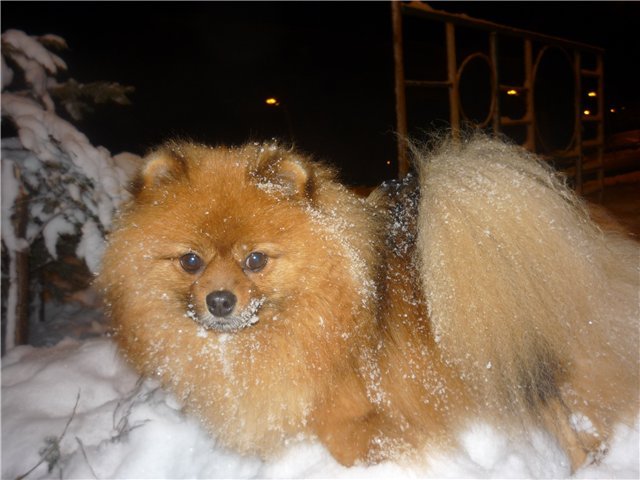
A tiny German "fox" doorbell dog: lively, devoted, alert and brave beyond its size. The German Klein Spitz (Kleinspitz) is a compact watchdog with a dense "mane"; it is clever and affectionate, ideal for a flat, but inclined to announce everything with its voice.
The Miniature German Spitz, also known as the Kleinspitz, is far more than just a cute, fluffy lapdog - it is a personality with a lion's heart within a compact frame. Selfless and loyal, this breed makes a wonderful companion for those seeking not just a pet, but a true friend capable of a deep emotional bond. With a Kleinspitz, your life is certain to become more amazing and diverse. In difficult moments, these dogs will always make you smile, and on happy days, they will share in your joy. They will dilute the loneliness of any individual, and in a large family, they will become loved and respected members of the pack. You can read more on Tvaryny.
Miniature German Spitz (Kleinspitz): A brief breed overview
Miniature German Spitz (Kleinspitz): A brief breed overview · 8
Characteristic
Description
Country of Origin
Germany
First Official Mention
1898 (as a separate size variation in the standard)
FCI Group
Group 5 (Spitz and primitive types), Section 4 (European Spitz)
Lifespan
14–16 years (some individuals live up to 18 years)
Height at Withers
23–29 cm (this is the main distinction from the Pomeranian and Mittelspitz)
Weight
5–10 kg (depends on height and bone structure)
Coat Type
Double: long straight outer coat and thick cotton-like undercoat
Care Level
Medium (requires regular brushing, clipping is not recommended)
Interesting Facts about Kleinspitzes
The famous physicist Isaac Newton had a spitz named Diamond. According to legend, the dog knocked over a candle and burned the scientist's manuscripts, but Newton did not get angry with his pet.
Spitzes have unique facial expressions - they know how to "smile" thanks to the special structure of the jaw and the position of the lips.
Long ago, the breed was not divided so strictly by size, and in one litter, puppies could be born that grew into both small and medium spitzes.
Comparison with other Spitzes
Novices often get confused by the varieties of German Spitz. Let's clarify. The Kleinspitz (Miniature) differs from the Pomeranian (Zwergspitz) primarily in the shape of the muzzle (the Klein has a less "doll-like", more classical muzzle) and size (it is slightly larger and more robust). At the same time, it is smaller than the German Spitz Mittel (Mittelspitz), which is already a more serious dog. And, of course, our hero is significantly inferior in dimensions to the Giant German Spitz (Grossspitz), which is a rare and large variation of the breed.
History and Origins
The history of the Miniature German Spitz goes back to ancient times, and this is no artistic exaggeration. Images of ancient dogs, anatomically very similar to modern spitzes, have been found by archaeologists in many places around the world: in Central and Southern Asia, Europe, Egypt, China, and even Madagascar. This suggests that spitz-type dogs were widespread in almost every corner of the planet and represent one of the oldest forms of domestic dogs.
Most canine specialists adhere to the theory that the direct ancestors of these dogs were the Peat Dogs (Canis familiaris palustris), remains of which have been found in pile dwellings from the Stone Age. Later, their descendants became known as "Pile Spitzes". That is why, even in a sweet-looking Kleinspitz, a rather complex and serious character typical of its wild ancestors can sometimes wake up. There is a hypothesis that wolves are distant relatives of spitzes, which explains their developed pack hierarchy and vocalisation.
The official homeland of origin and standardisation of these dogs is Germany. It was German cynologists who systematised the entire variety of spitzes, dividing them into size categories. This event took place at the end of the 19th century. In 1899, the "Verein für Deutsche Spitze" (Association for German Spitz) was founded, which developed standards for the entire group depending on their size and colour. Before this, the division was quite conditional: large spitzes were used to guard vineyards and barges, while smaller individuals served as indoor pets ("ladies' lapdogs") and alarm bells announcing the arrival of guests.
It should be noted that genetically, the Kleinspitz is a close relative of other European spitzes. For example, it shares common roots with the Icelandic Sheepdog, which has also preserved the primitive spitz look. And if we look to the south of Europe, we can find similarities with the Volpino Italiano - the Italian version of the small spitz, which developed in parallel.
What the Miniature German Spitz looks like: Appearance Standards
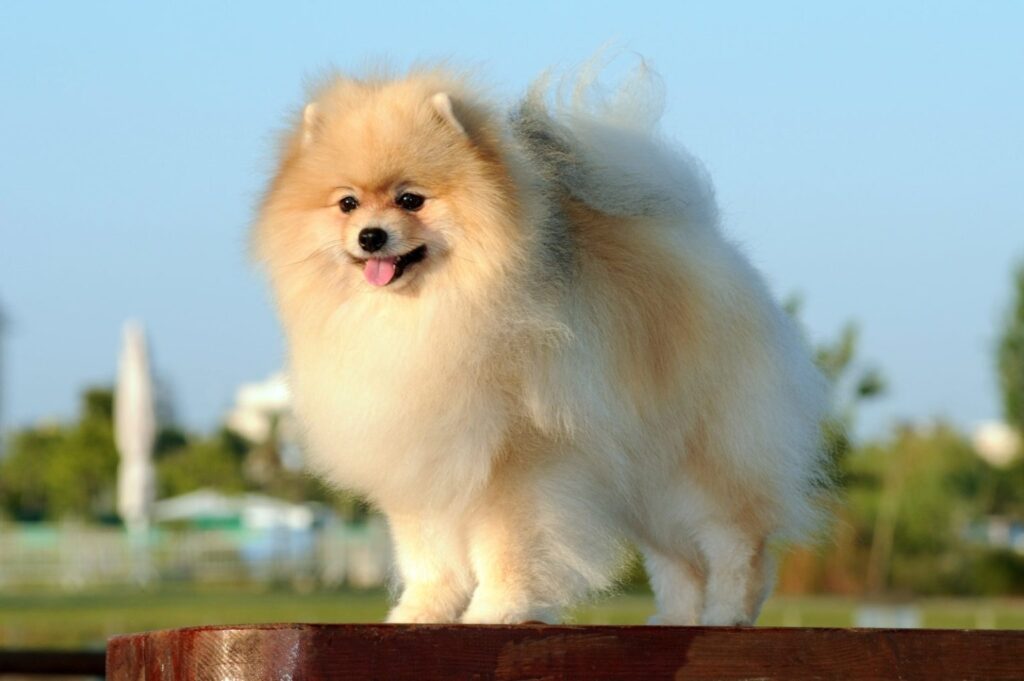
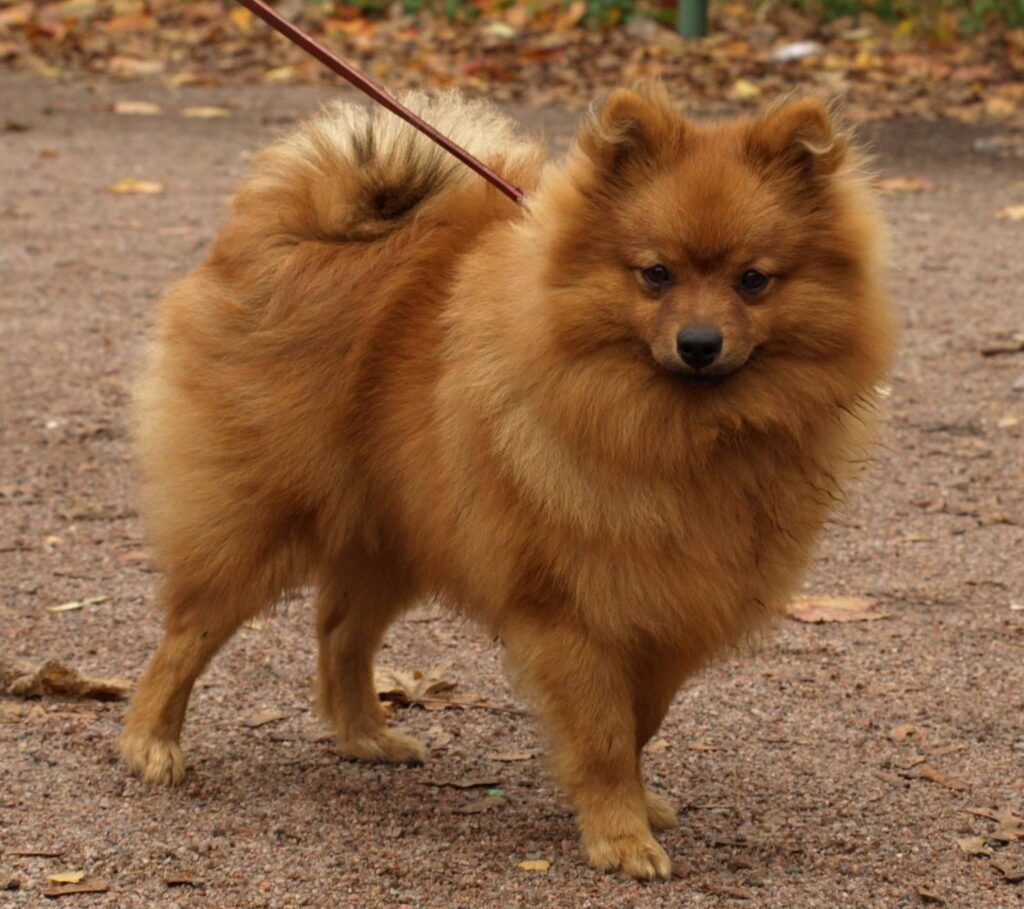
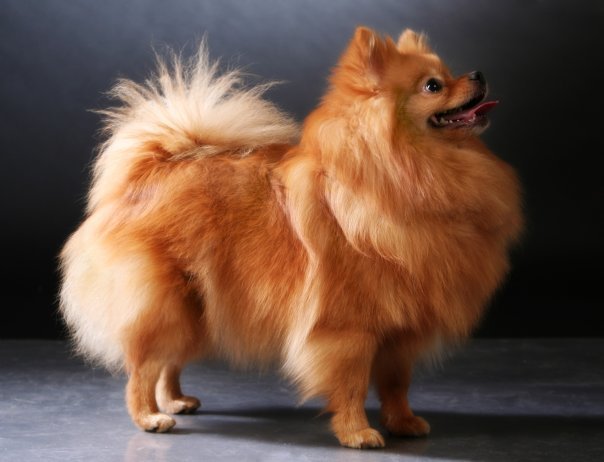
The German Miniature Spitz is a dog of square format, compact, small in stature, but with a sturdy bone structure. It should not look refined or fragile, like, for instance, a Toy Terrier. Its beauty lies in the harmony of its fluffy coat and confident posture.
Head and Muzzle
The head of the Kleinspitz is of medium size, wedge-shaped, and resembles a fox when viewed from above. The skull is broad at the back, tapering towards the nose. The transition from forehead to muzzle (stop) is moderately defined, not as sharp as in Pomeranians, but not smoothed out either. The muzzle is harmonious, not too long, but not "squashed".
Nose: The nose leather is small, round, and predominantly black. In brown dogs, the nose may be dark brown.
Eyes: Medium size, almond-shaped or slightly oval, dark. The look is intelligent, lively, and a bit cunning. Eyelids have black pigmentation (brown in brown dogs).
Ears: These are the breed's calling card. They are small, set high and close to each other, triangular in shape with pointed, stiff tips. The ears always stand vertically, which gives the dog a cheeky look.
Teeth: Jaws are developed, scissor bite (upper teeth closely overlap the lower ones). In small spitzes, the absence of a few premolars is allowed, although full dentition is valued higher.
Body and Limbs
The neck is of medium length, without a dewlap, covered with a thick mane, which visually makes it shorter and more powerful. The back is short, strong, and absolutely straight. The loin is short and wide. The chest is deep, with well-sprung ribs, which is important for stamina. The belly is moderately tucked up.
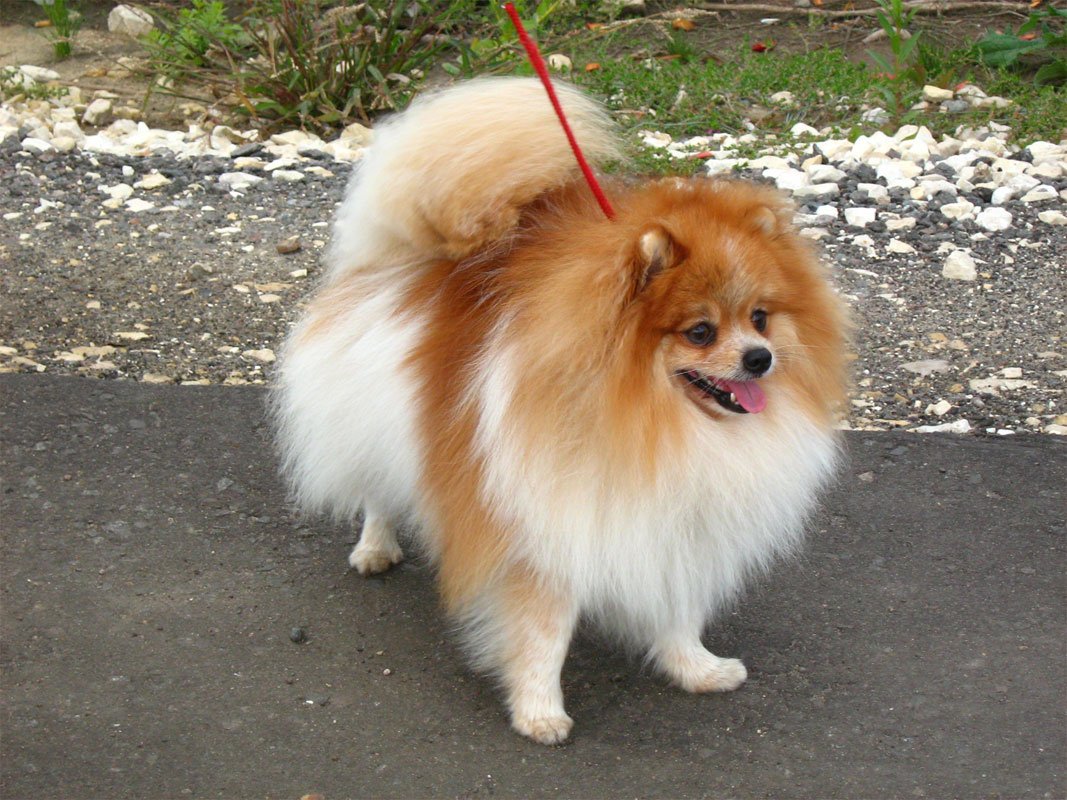
The Tail is another source of pride for the spitz. It is set high, thrown over the back, and curled into a tight ring (sometimes double). The tail is covered with very thick, long, and luxurious hair, making it resemble a pom-pom or a flower.
The limbs are straight, parallel to each other, with good angulation, which ensures the dog has light, springy movements. The paws are "cat-like" - small, round, and compact. Claws and pads are predominantly black.
Coat and Colour
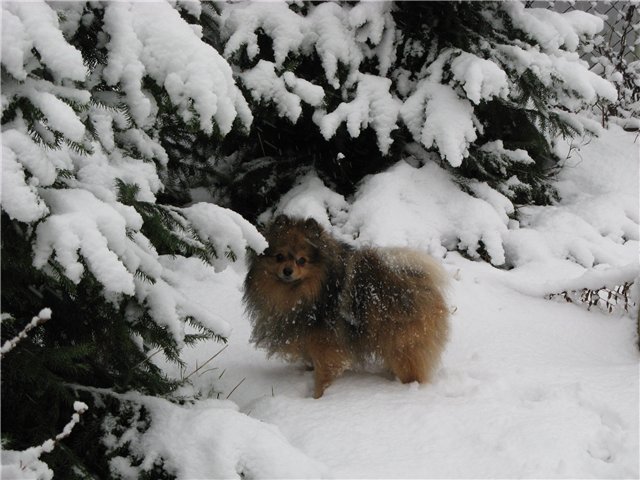
The coat of the Kleinspitz consists of two layers: a long, straight, and harsh outer coat and a thick, soft, cotton-like undercoat that supports the guard hair, preventing it from lying flat against the body. It is thanks to this that the spitz looks like a fluffy ball. On the head, ears, and front side of the limbs, the hair is short and velvety to the touch. On the neck - a rich "ruff", on the hind legs - ample "trousers".
The standard recognises a diverse palette of colours:
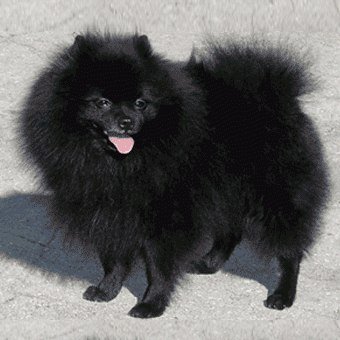
Black: Undercoat and skin must be dark, lacquered black colour without white or russet markings.
Brown: Uniform dark chocolate shade.
White: Pure white colour without yellowing, especially behind the ears.
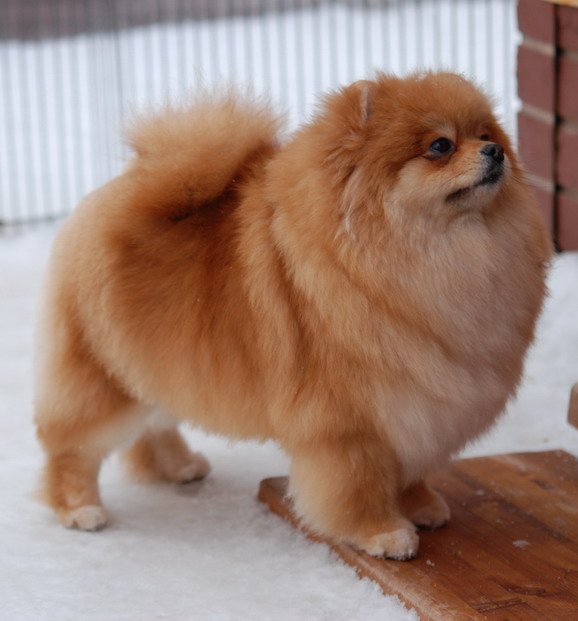
Orange: Uniform colour of medium intensity, one of the most popular.
Wolf-Grey (Grey Shaded): Silver-grey with black hair tips (like the Keeshond, but less common in small spitzes).
Other Colours: This includes Cream, Cream-Sable, Orange-Sable, Black and Tan, and Particolour. In particolour dogs, the main background must be white.
Character: Temperament and Behaviour
Do not be misled by the toy-like appearance - these cute little dogs have a character that is far from simple. At heart, every Kleinspitz feels like a big, formidable dog ready to defend its territory. This is not a "sofa cushion", but an active participant in all family events.
Of course, like all our smaller brethren, they are boundlessly devoted and loyal to their owner, love care and attention, and adore active and fun games. However, their intelect requires constant engagement. Dogs of this breed can be quite demanding due to a lack of attention or boredom. They are known for their jealousy: a Kleinspitz may get offended if you pay too much attention to another person, cat, or dog.
Psychological Features
It must be said honestly that small spitzes are a bit selfish and narcissistic. They, of course, love their owner very much, but sincerely believe that the world revolves around them. They have a rather explosive temperament (choleric or sanguine), which they easily demonstrate to strangers with ringing barks. This is an innate function of the spitz - to be a "bell". They are distrustful of strangers and will not let just anyone pet them, which makes them decent, albeit small, watchdogs.
Important: A spitz needs to be treated like royalty, with respect for its intelligence and personality, and then it will repay you in full, becoming the most obedient and loving friend.
Pros and Cons of the Breed
So that you can weigh all the pros and cons before buying a puppy, we have compiled an honest table of advantages and disadvantages specifically for the Miniature German Spitz.
Pros (+)
Cons (-)
Very attached to the owner, empathic.
Tendency to excessive barking (needs correction).
Compact size, convenient for travel.
Complex coat care (shedding, no shaving allowed).
High intelligence, learns tricks quickly.
Can be cocky towards big dogs ("Napoleon complex").
Long-lived, generally robust health compared to other small breeds.
Teeth require careful care (prone to tartar).
Good watchdogs (alert to guests).
Can be manipulative if they sense weakness in the owner.
Training and Socialisation
German Miniature Spitzes are very active dogs that have an acute need for regular exercise. From birth, they are almost too smart. They have an excellent memory. However, if this intelligence is not directed into the right channel, the dog will start to manipulate you.
Barking Control: This is the most important aspect. Do not encourage barking at every rustle. Use commands like "Quiet" and divert the dog's attention. Breaking this habit is necessary from the very first days.
Take your small spitz with you to the park, the city, or to visit friends more often. They need early socialisation so they do not grow up to be hysterical "nippers". Thanks to their agility and jumping ability, Kleinspitzes show excellent results in agility (mini category) and freestyle (heelwork to music).
How to care for the coat and keep a Kleinspitz?
The German Miniature Spitz is created to adorn your life with its presence, but its beauty is the result of your labour. The Kleinspitz coat has a unique structure and does not have a specific "doggy" smell if properly cared for.
Grooming: Rules and Prohibitions
You will need an arsenal of tools: a slicker brush of medium hardness, a metal comb with long teeth, and a massage brush. You need to brush a small spitz thoroughly 1–2 times a week. It is necessary to separate the hair into partings and comb from the very roots to prevent tangles forming behind the ears, under the armpits, and in the groin.
During the molting period (seasonal or junior), the coat needs to be brushed daily. Spitzes need washing as required, but not too often (once every 3–4 weeks). Breeders warn: the coat structure can be ruined by frequent bathing with harsh shampoos. Use only professional cosmetics for volume and moisturising.
Categorical Ban: Never shave a spitz "to the skin" (for example, a lion cut or "Boo" cut). This disrupts the dog's thermoregulation (the coat protects them from both cold and heat) and can lead to alopecia - the hair may simply stop growing.
Hygiene and Daily Life
Apart from the coat, watch the animal's claws carefully. Due to their light weight, they do not wear down enough on asphalt, so they need to be trimmed every 2 weeks. Teeth need to be brushed with a special brush and paste 3–4 times a week to avoid gum disease.
At home, prepare a place for him away from drafts (spitzes do not like them) and radiators (harmful to the coat). Do not lay down slippery rugs; it is better to choose a surface where paws will not slide to avoid injuring the joints.
Nutrition
Nutrition: Key Recommendations
Health and risks
Health: Typical Diseases and Prevention
Frequently Asked Questions (FAQ) · 3
Do Kleinspitzes shed a lot? Yes, twice a year there is heavy seasonal molting when the undercoat sheds. At this time, there will be a lot of hair in the house. At other times, with regular brushing, the coat does not shed much.
Can they be trained to use a puppy pad? Yes, like most small breeds, the Kleinspitz easily learns to use a toilet pad, which is convenient for apartment dwellers, but this does not negate the need for daily walks for mental health.
Do they get along with cats? If the animals grew up together or the cat shows no aggression, spitzes get along excellently with them and can even sleep together.
Video about the breed
FAQ
Does the German Klein Spitz bark a lot?
Yes — it is an attentive "doorbell" watchdog, inclined to announce everything with its voice; training is needed so the barking does not become excessive.
How does the Kleinspitz differ from the Pomeranian?
The Pomeranian (Zwergspitz) is the smallest variety of the German Spitz; the Kleinspitz is a little larger, but temperament, care and health are similar.
Is the Kleinspitz suitable for a flat?
Ideal — compact, clever and adaptable; the key is to train the barking and give it enough attention.