

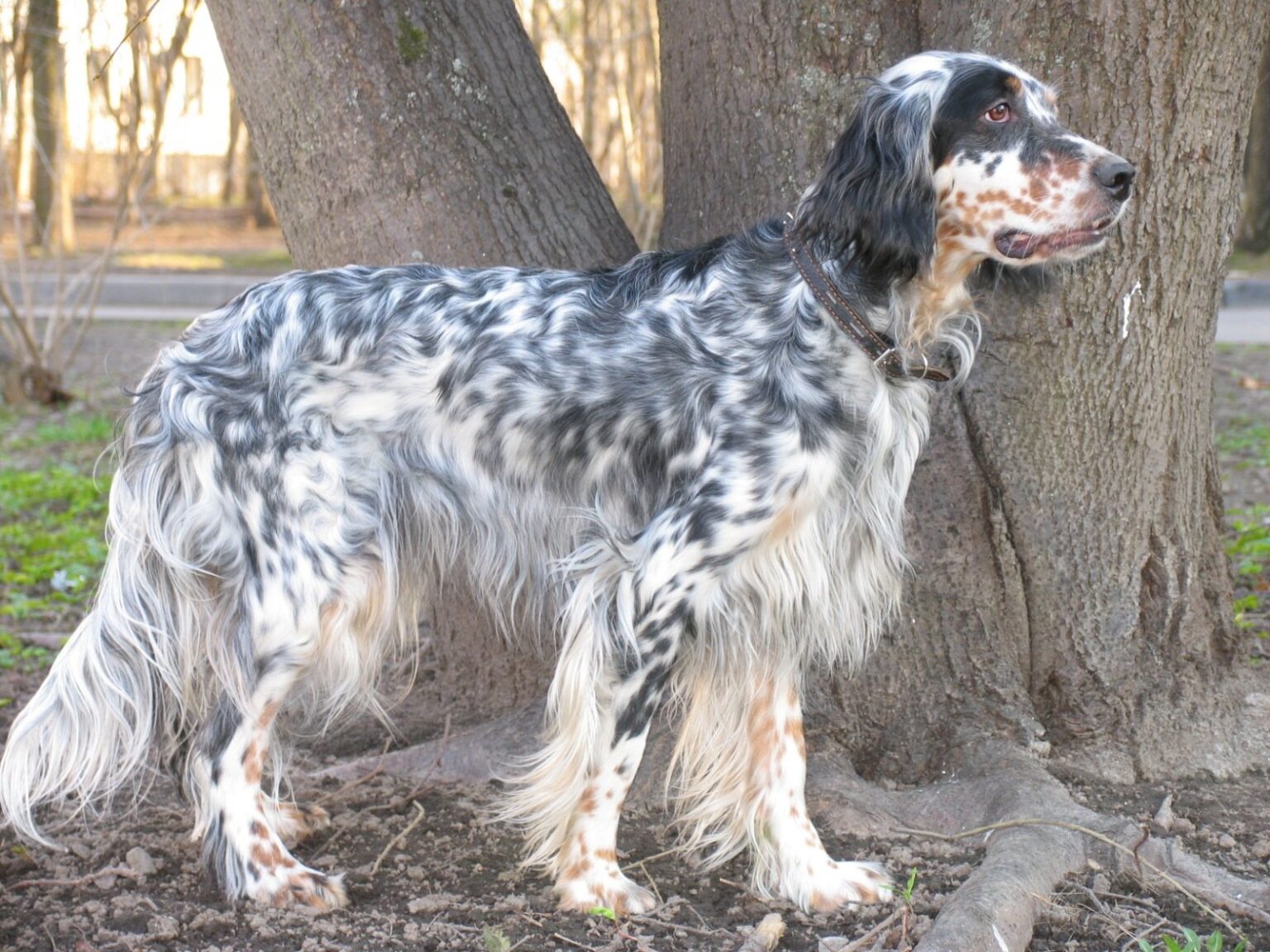
| Height | 61–69 cm |
| Weight | 20–36 kg |
| Lifespan | 10–12 years |
| FCI group | 7 · pointing dogs |
| Origin | United Kingdom |
Exact ratings
Common health issues
Nutrition
The English Setter is the epitome of elegance, intelligence, and inexhaustible energy, rightfully known as the “aristocrat” amongst gun dogs. Combining outstanding working qualities with a soft, friendly character, this breed has become a benchmark of beauty and functionality in the world of cynology. Thanks to its unique appearance, particularly the characteristic “belton” speckled coat, and an innate desire to please its owner, the English Setter feels equally at home hunting in dense thickets or relaxing on a soft sofa with the family. Read more about this on Tvaryny.
English Setter: a brief breed overview
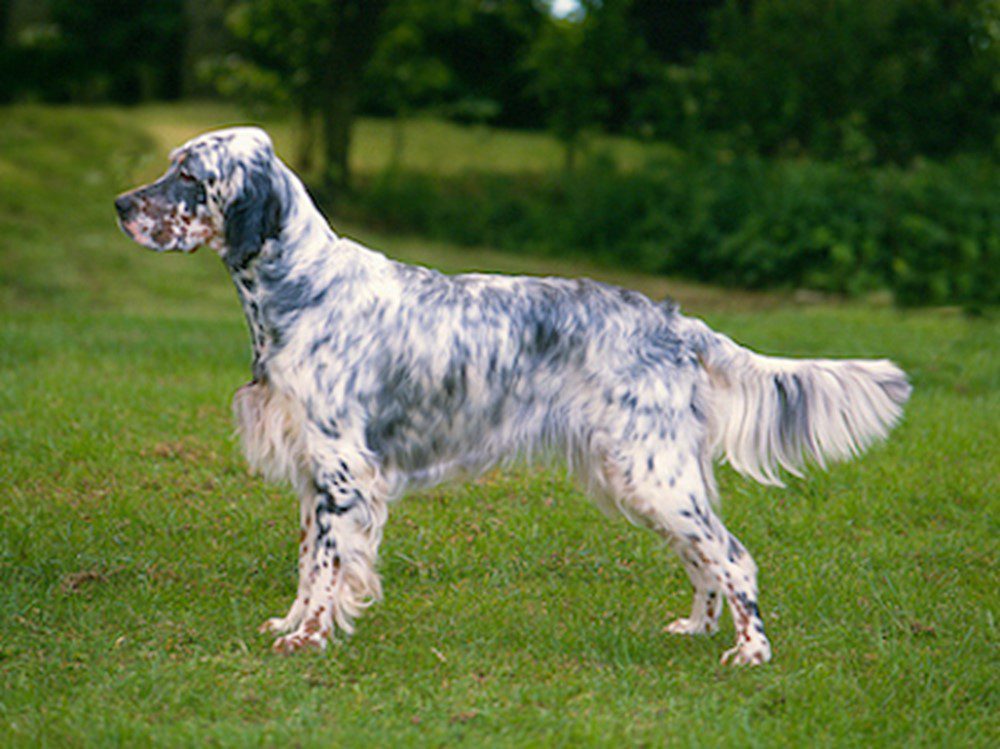
| Origin | Great Britain |
| First Mention / Standard | 1858 (first show), standard approved later |
| FCI Group | Group 7 (Pointing Dogs), Section 2.2 (British and Irish Pointers and Setters) |
| Life Expectancy | 12-14 years |
| Height at Withers | Males: 65-68 cm; Females: 61-65 cm |
| Weight | 25-36 kg (depending on the breeding line) |
| Coat Type | Long, silky, with characteristic speckling (Belton) |
History of the breed: from “netting” dogs to aristocrats
The history of the English Setter goes back centuries, long before the use of firearms in hunting. These magnificent, beautiful, and elegant hunters were bred for a specific job – to find game and indicate it to the hunter. Initially, they were called “setting spaniels”, becuase before the invention of guns, hunting was done with nets. The dog had to find the bird, approach it, and lie down (or set) in front of it so the hunter could throw a net over both the birds and the dog simultaneously.
It is assumed that this type of dog originally appeared through the crossing of the Old Spanish Pointer (Perro de Punta) with Water and Springer Spaniels. However, the true flourishing of the breed began in the 19th century. Dogs of this breed first appeared at a show in England in 1859 in Newcastle.
The Era of Laverack and Llewellin
When discussing the breed’s history, it is impossible not to mention two gentlemen who effectively created the modern English Setter. Sir Edward Laverack began purposeful breeding in 1825. He purchased two dogs, Ponto and Old Moll, and started a rigorous inbreeding programme (crossing close relatives) to fix desirable traits. Laverack managed to create the perfect setter – beautiful, with a wonderful coat and a noble head. It is the “Laverack” type that dominates show rings today.
A little later, another breeder entered the scene – R.L. Purcell Llewellin. He took Laverack’s best dogs and added blood from other lines to improve specifically field and hunting qualities, sacrificing a bit of external gloss. Thus, the “Llewellin Setter” line appeared – faster, keener, and lighter. In the early 20th century, English Setters became extremely popular; they were exported to the USA and other countries, where the division into show and working lines intensified.
What the English Setter looks like: appearance and unique colour
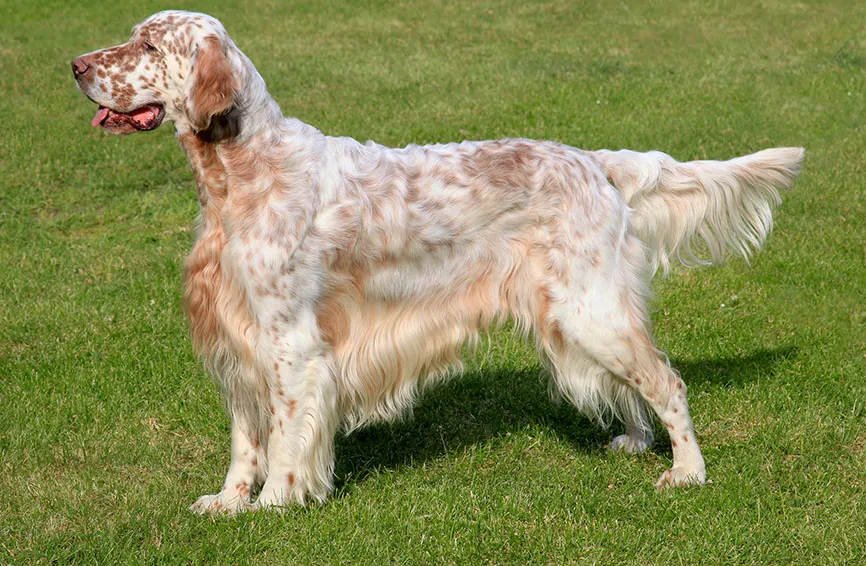
The English Setter is considered one of the most beautiful dog breeds in the world. This is a dog with a strong bone structure and well-developed muscles, yet without coarseness. It is ground-covering with a slightly elongated format, allowing it to move in a free, sweeping gallop.
- Head: Long, dry, with clean lines. The transition from forehead to muzzle (stop) is well defined. The length of the muzzle is practically equal to the length of the skull. The nose bridge is straight.
- Eyes: Round in shape, not protruding but not deep-set either. Colour ranges from hazel to dark brown (the darker, the better). The expression is soft, expressive, and intelligent.
- Ears: Set at eye level, hanging and thin, of medium length with rounded tips, covered with silky hair, lying aesthetically against the cheekbones.
- Body: The neck is long, strong, and muscular, elegantly arched at the top. The chest is of moderate width but deep, with well-developed ribs for lung capacity. The back is straight and short.
- Tail: A continuation of the backline, sabre-shaped. It is never carried above the level of the back (unlike some other breeds). It has a luxurious “flag” of long hair starting slightly below the base.
The Unique “Belton” Phenomenon
A distinctive feature of this breed is its colour. Edward Laverack coined the term “Belton” (after a village in Northumberland) to describe the unique speckled marking. It is important to know: puppies are born completely white (or almost white), and only after a week or two does the characteristic speckling begin to show. The more ticking and fewer large patches, the more valuable the specimen.
Belton colour variations:
- Blue Belton: Black and white speckling (creates a bluish tint).
- Orange Belton: Orange and white speckling.
- Lemon Belton: Lemon and white speckling (lighter than orange).
- Liver Belton: Liver and white speckling.
- Tricolour: Blue Belton with tan markings on the muzzle and legs.
The coat is straight, dense, glossy, and silky. On the ears, the lower part of the chest, the back of the legs, and the underside of the tail, the hair is longer and thicker, forming feathering. Compared to other breeds, the Setter’s coat requires more care than smooth-coated dogs like the English Pointer, but it is not as voluminous and prone to matting as representatives of the Spitz family, such as the German Spitz (Wolfspitz/Keeshond).
Character: a gentleman with a hunter’s soul
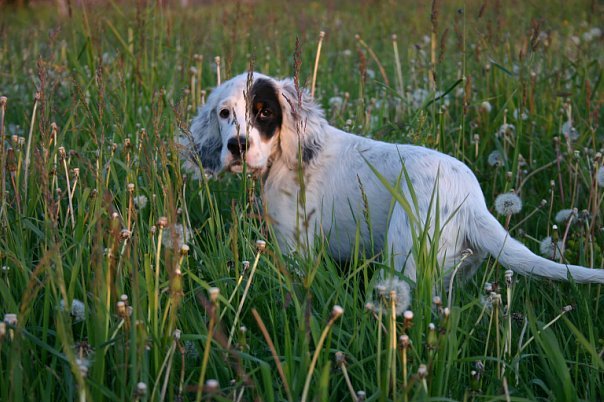
English Setters are among the most intelligent, polite, and balanced dogs. Representatives of this breed are kind, affectionate, faithful, and devoted. They love being around people, especially their close family circle. This is categorically not a “yard dog” for a kennel – without human contact, the Setter degrades and suffers.
They attach incredibly quickly to their master, ready to do anything for them. English Setters are arguably the most compliant and yielding of all gun dogs. However, it is worth remembering their passion for “travelling”. The hunting instinct can play a cruel trick: seeing a bird or catching an interesting scent, the well-mannered “gentleman” may suddenly suffer from “selective deafness” and dash off into the horizon. A tendency to roam is genetically ingrained, so a lead is mandatory for city walks.
Relationships with children and other animals
The English Setter is an ideal nanny. Aggression towards humans is practically absent in them. They are patient with children’s antics, though, of course, this should not be abused. Setters get along famously with other dogs; they are neither bullies nor dominant. However, one must be careful with small pets (hamsters, budgies) – the hunting instinct hasn’t gone anywhere.
Comparing the Englishman’s temperament with his closest relatives, an interesting gradation can be noted. He is calmer than the choleric Irish Red Setter, but softer and more compliant than the solid and sometimes stubborn Gordon Setter (Scottish Setter). He also differs somewhat from the rare Irish Red and White Setter, which is considered the most “work-focused” and serious of the entire group.
Pros and cons of the breed

| Advantages (Pros) | Disadvantages (Cons) |
|---|---|
| Incredible beauty and elegance. | Requires regular coat care (brushing, trimming). |
| Complete absence of aggression towards people. | Lots of hair in the house during shedding season. |
| Excellent companion for active people. | Tendency to escape (if they catch an interesting scent). |
| High intelligence and trainability. | Tolerates loneliness poorly (may howl or chew things). |
| Loves children and gets along with other dogs. | Requires long, active walks (not for the lazy). |
| Robust health with proper care. | Scavenges everything edible and inedible outside (strong nose). |
Health: typical diseases and prevention
How to care for the coat
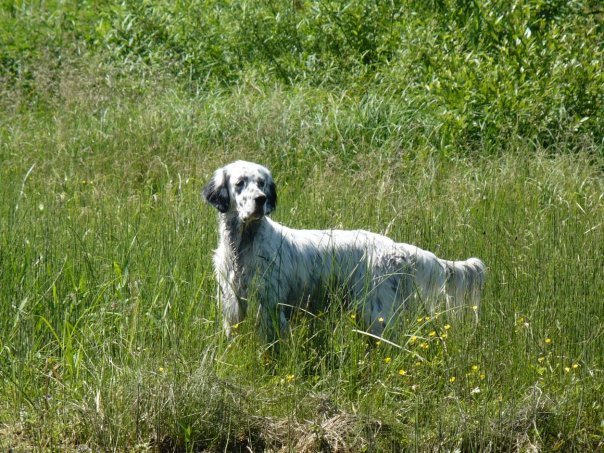
The English Setter is a fairly calm dog suitable for apartment living, provided there are sufficient walks. You need to walk a Setter for at least two hours daily, and this shouldn’t just be walking, but an opportunity to run. If you live in a private house, note that these dogs are not meant for life on a chain. Even in an outdoor kennel, a Setter will find it quite difficult and will start to pine.
Grooming: beauty secrets
The Setter’s coat is its pride, but it requires work. If you do not plan to show the dog, you can limit yourself to a hygienic trim, but even that is necessary.
- Brushing: Needs to be done 2-3 times a week to avoid mats (especially in the armpits, behind the ears, and in the groin). It is best to use a pin brush and a metal comb with long teeth.
- Trimming: Setters are not shaved “down to the skin” with clippers. They are trimmed. The hair on the neck (down to the brisket) and under the ears needs to be plucked or trimmed short to emphasise the noble line of the head.
- Paws: This is an important point. The hair between the toes grows back quickly, trapping dirt, snow, and burrs. It needs to be trimmed regularly, flush with the pads.
- Ears: Since the ears are hanging, they are poorly ventilated. They need to be cleaned weekly with a special lotion, and it is better to trim the hair on the inside of the ear flap.
To ensure the puppy gets used to all hygiene procedures, be sure to give them a treat as a reward. Then the puppy will submit to brushing, bathing, and even ear and teeth cleaning with pleasure.
Training and socialisation: the “soft power” approach
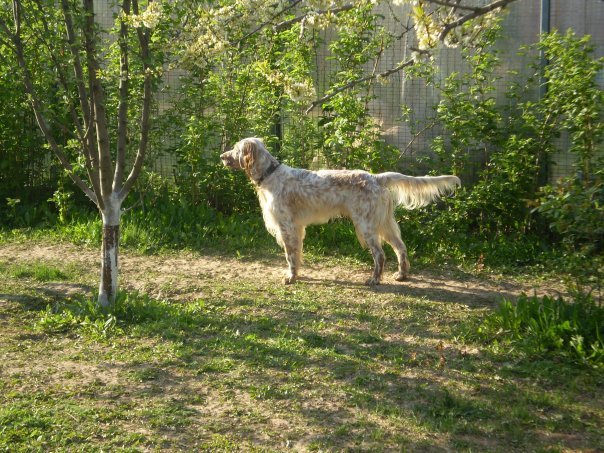
“In the meadows and in the field, everything is clear: open space, grass, crops, the master is always visible… Splendid! But here, in the woods, it’s a completely different matter.” These lines, describing the feelings of a dog finding itself in new conditions for the first time, perfectly illustrate the breed’s sensitivity.
A puppy should not be afraid of unfamiliar sounds and objects. From childhood, give your pet the opportunity to interact with other animals and strangers. The main rule of training an English Setter is no harshness. This is a dog with a delicate soul. If you shout or, God forbid, hit a Setter, they will simply withdraw into themselves and refuse to work. They are not stubborn; they are just very sensitive.
Key commands for a Setter
Besides the standard “sit” and “down”, the following are vitally necessary:
- “Come!” (Recall): Must be obeyed implicitly. Considering the Setter’s wide search range on a walk, this command saves lives.
- “Stay!” or a stop command: For a hunting dog, this is the basis (pointing), but in the city, it allows you to stop the dog before a road.
- “Heel”: Setters tend to pull on the lead because they always need to check what is ahead. Teach walking on a loose lead from the very first days.
Nutrition: key recommendations
Interesting facts about English Setters
- The word “setter” comes from the verb “to set” (to make a stance, to crouch), which describes the dog’s working style.
- English Setters often “talk”. They can make a whole gamut of sounds, from muttering to howling, communicating with their owner.
- This breed is often called a “one-person dog”; although they love the whole family, they choose one “leader” for life.
- In the USA, there are two clearly separated lines: show (larger, with very long hair) and field (smaller, lighter, shorter hair, sharper instincts).
Frequently Asked Questions (FAQ)
Does the English Setter shed a lot?
Yes, they shed. Especially seasonally (spring/autumn). Long white hair will be visible on carpets and clothes if you don’t brush the dog regularly.
Is this breed suitable for a flat?
Yes, but only provided there are active walks. If you walk 15 minutes in the morning and evening, the Setter will tear the flat apart from boredom. They need movement.
Do Setters bark much?
They are not “yappers”. They usually bark for a reason – to warn of a guest or during play. But they are poor guards. They might bark, but attacking a human is not in their nature due to their natural kindness.
Video about the breed
- Gentle and friendly
- Excellent with children and animals
- A hardy hunter
- An elegant flecked coat
- Needs plenty of exercise
- Coat care
- A tendency to deafness
- Not a flat dog
| Irish Setter | Gordon Setter | Pointer | |
|---|---|---|---|
| Height | 55–67 cm | 58–69 cm | 58–69 cm |
| Energy | 5 | 4.5 | 5 |
| Apartment | 2 | 2 | 2 |
| Beginners | 3 | 3 | 3 |
Does the English Setter need a lot of walking?
Is the Setter good with children?
Is the Setter suitable for a flat?
FCI Standard No. 2 · The Kennel Club
For apartments · For kids · For beginners · Active · Smartest · Hypoallergenic · All rankings →