Irish Red Setter

By tvaryny
·
21 Min Read
In short A flame-red beauty with an irrepressible temperament: friendly, playful, devoted, a forever "puppy" at heart. The Irish Setter is an energetic hunter and companion for a very active family; not for the sofa and not for those who live alone.
Apartment ⚠KidsCatsOther dogsBeginners
Parameters
Height55–67 cm
Weight24–32 kg
Lifespan11–13 years
FCI group7 · pointing dogs
OriginIreland
Size
Height at withers 55–67 cmWeight 24–32 kg
Ratings · 12 · Dataset
FamilyKidsBeginnersTrainingEnergyHealthSheddingDroolingBarkingApartmentWeatherPrey dri.
Exact ratings
Family4.5
Kids4.0
Beginners2.5
Training3.5
Energy5.0
Health2.5
Shedding3.0
Drooling2.0
Barking3.0
Apartment2.0
Weather3.0
Prey drive4.0
Common health issues
  • Gastric torsion (bloat)
  • Hip dysplasia
  • Progressive retinal atrophy (PRA)
  • Epilepsy
  • Hypothyroidism
Nutrition

A quality food for active breeds, with weight control; feed small portions (a deep chest — bloat risk). Regular coat care.

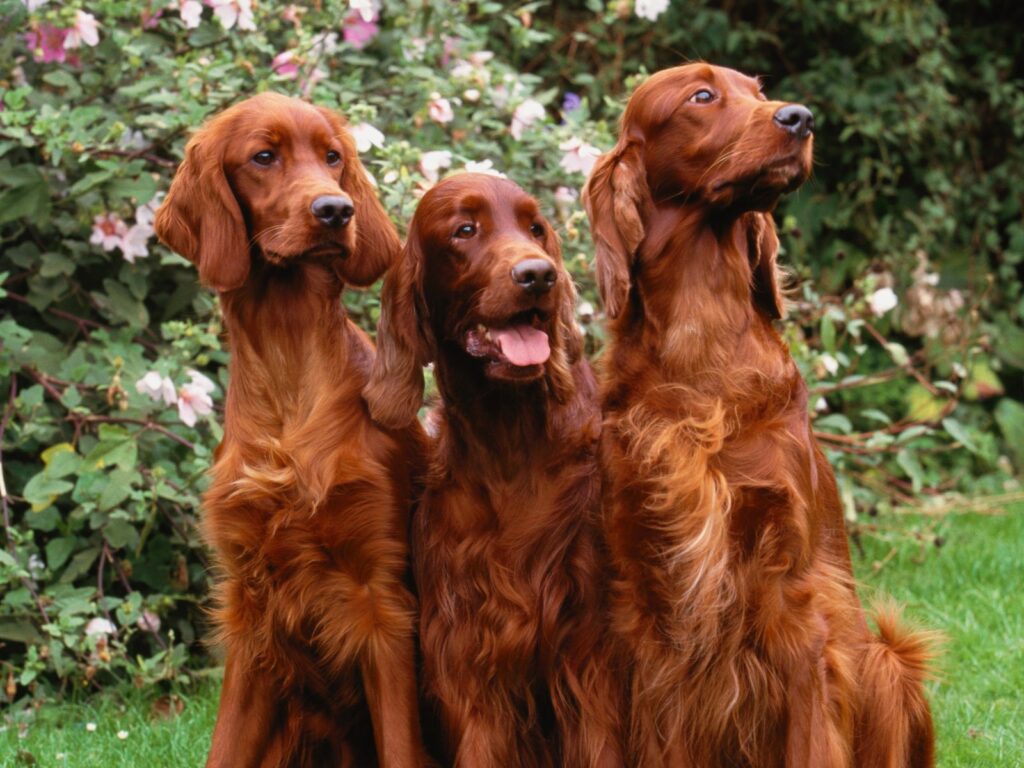
The Irish Red Setter is not just a dog breed; it is the true embodiment of elegance combined with the boundless energy of the Emerald Isle’s wind. These dogs are unmistakable: their fiery coat shimmers in the sun with every shade of mahogany, and their eyes always shine with inteligence and a readiness for adventure. They are one of the most popular and widespread gundogs in the world, having won the hearts of not only hunters but also ordinary families. Learn more on Tvaryny.

Irish Red Setter: A Brief Overview and Breed Profile

Irish Red Setter
Country of OriginIreland
FCI Group7 (Pointing Dogs / Gundogs)
First Mentioned1875 (as an independent type, though roots go back to the 18th century)
Life Expectancy12-15 years
Height at Withers (Dogs/Bitches)58-67 cm / 55-62 cm
Weight24-32 kg (depending on sex and line)
Coat TypeLong, silky, no undercoat
ColourRich chestnut, mahogany
History of the Breed: From Red and White to Solid Flame
Irish Red Setter — photo 2

The history of the Irish Setter is a fascinating journey of selective breeding that began back in the 18th century in Ireland. Initially, the term “setter” was used to describe any dog that found birds and indicated them to the hunter by “setting” (crouching low to the ground). It is assumed that the ancestors of these graceful animals were a complex mix of breeds. Cynologists believe that the following contributed to their formation:

  • Irish Water Spaniel (contributed the passion for water and coat type);
  • Irish Terrier (possibly influenced the temperament);
  • Bloodhound (added incredible scenting ability, though slightly “heavied” some early lines);
  • Gordon Setter (Scottish Setter, which added structure).

Interestingly, the original colour of Irish Setters was predominantly red and white. This was practical, as a patchy dog is more visible in the tall grass and heather on the Irish hills. However, in the 19th century, fashion and aesthetic preferences began to change. In England and Ireland, Irish Setters of a fiery red (solid) colour appeared. They became particularly popular not only among local hunters but also among the aristocracy.

A key role in establishing the solid red colour was played by the Earl of Enniskillen. In his kennel, he purposefully selected only completely red dogs, culling the spotted ones. It turns out that the deep fiery-red coat colour in Setters was finally fixed as a breed trait towards the end of the 18th and beginning of the 19th century. These dogs quickly gained popularity due to their spectacular appearance.

The first show featuring Irish Setters took place in 1859. Representatives of the primary red-and-white colour were present, as well as the newly emerged bright red setters. Over time, the red variety almost displaced its bi-coloured ancestors (which now exist as a separate breed). In 1876, the breed received official recognition, and the first standard was approved in 1885 in Dublin. Since then, the “Red Demon” began its triumphal march across the world.

What the Irish Red Setter Looks Like: Anatomy of Perfection
Setter grooming

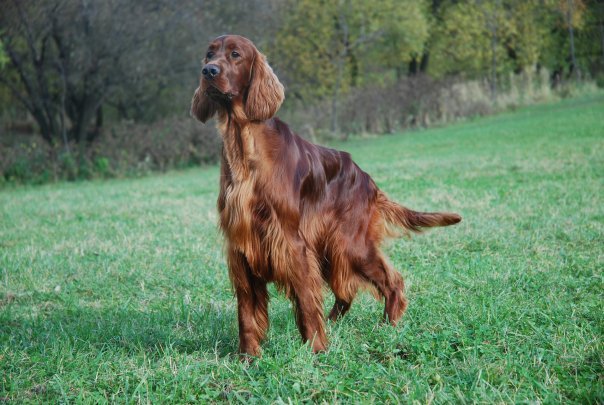
The appearance of the Irish Setter is a balance between strength and finesse. It is a dog of a “dry” constitution, which means no excess weight, flabbiness, or loose skin. Everything about him is built for a fast gallop.

Head and Muzzle

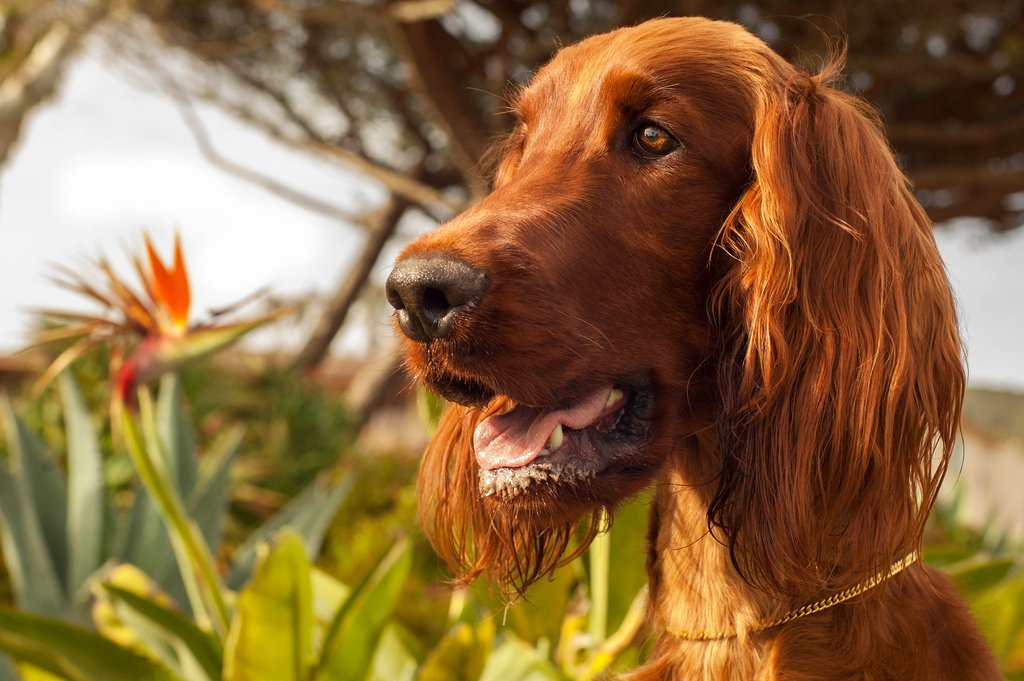
The Setter’s head is long and narrow, giving it an aristocratic look. The skull is oval between the ears, with ample brain capacity. The transition from forehead to muzzle (the stop) is gentle but well-defined, not as sharp as in Pointers. The muzzle is long, deep, and almost rectangular at the end. The bridge of the nose is straight. The nose is large, with wide nostrils (for better scent intake), and can be black, red, or dark walnut – this depends on the pigmentation of the individual dog.

The jaws are strong, with a correct scissor bite. The upper lip is dry, slightly covering the lower one, but does not form heavy jowls. The ears are pendulous, set at eye level and well back, of medium length, fine to the touch, rounded at the ends, and lie close to the cheeks.

Body and Limbs

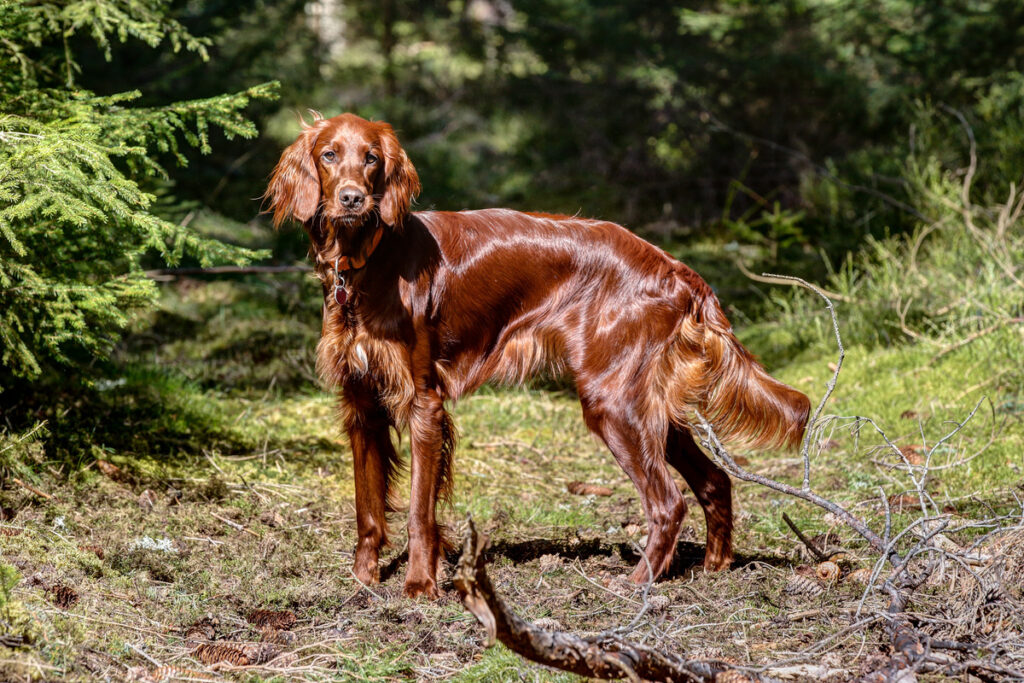
The neck is of medium length, very muscular but not thick, slightly arched, without a dewlap (loose skin on the throat). The back is straight and strong. The loin is short, muscular, and slightly arched – this is the “spring” that propels the dog forward. The croup is wide and slightly sloping. The chest is deep, reaching the elbows, but not too wide, so as not to interfere with the movement of the front legs at a gallop. The abdomen is moderately tucked up.

The limbs are straight, sinewy, and parallel to each other. The angulation of the hind legs is well defined, which ensures a powerful drive. The paws are small, oval (“cat-like” or “hare-like”), with tightly closed toes, between which protective hair grows.

Coat and Colour

The coat is the breed’s main pride. It is straight, dense, of medium length, and silky to the touch. On the head and the front of the limbs, the hair is short and fine. Conversely, on the ears, tail, the back of the front and hind legs, the chest, and the stomach, the hair forms long “feathering”. This is not just decoration, but protection from thorny bushes during hunting.

The colour is exclusively mahogany or rich chestnut, without the slightest trace of black hair. Black in the coat is a disqualifying fault. The tail may have a lighter, golden-chestnut shade. Small white markings on the chest, throat, chin, or toes, as well as a small “star” on the forehead, are allowed (according to the FCI standard). This is a legacy from their red-and-white ancestors.

Temperament: An Eternal Engine with a Gentle Soul
Irish Setter coat

The Irish Setter is the true “life and soul of the party”. If you are looking for a phlegmatic dog that will sleep on the rug all day, this breed is not for you. The temperament of the “Irishman” can be described in three words: energetic, affectionate, extroverted.

These dogs are very sociable; they love to be the centre of attention, but they will never seek it through aggression. They are true intellectuals who can always attract a person’s attention in an unobtrusive way – for example, by resting their head on your knees or performing a funny trick. Irish Setters are friendly with everyone, even strangers, which makes them absolutely unsuitable as guard dogs.

Important: Setters mature late. Cynologists often joke that an Irish Setter remains a puppy until three years old, and sometimes for its entire life. This manifests in their playfulness and occasionally in “selective deafness” when following commands.

However, they are keenly attuned to human moods. If the owner is upset, the Setter will simply sit nearby, trying to offer support through physical contact. They may sometimes growl unfriendlily if they sense a real threat to a child, but they will never be the first to bite or attack. These dogs are wonderful with children; they are gentle and affectionate with them, ready to participate in any mischief. But due to their activity levels, a young dog may accidentaly knock a toddler over, so supervision is required.

It is worth noting their attitude towards other animals. They usually make friends and play with other dogs. They can coexist peacefully with “their own” cats if they grew up together. However, it is not recommended to keep decorative rodents and birds nearby. Instinct takes over – for a Setter, a canary will always be prey. If you gift your love to a dog of this breed, you will gain a faithful and devoted friend forever.

Comparison with Other Breeds in the Group
Setter portrait side view

To better understand the Irish Setter’s place in the world of cynology, it is worth comparing it with its relatives. Beginners are often interested in how it differs from other pointers or hounds.

For example, although both breeds are used for hunting, they work differently: the Black and Tan Coonhound is a hound that works by scent trail and trees the animal, using ground scent and its voice. The Setter, on the other hand, works silently, using air scent, and freezes in a point.

If comparing with its closest relatives, the English Setter is often considered calmer and more “grounded” in its work (the so-called “feline style” of creeping), while the Irishman works at breakneck speeds. Another relative, the Gordon Setter (Scottish Setter), is the heaviest and slowest among the setters, but it is more enduring and capable of working in dense thickets without water for a long time. Also, one should not forget the ancestor – the Irish Red and White Setter, which is considered a more “working” and less decorative version, preserving primal hunting instincts in their pure form.

Health and Genetics
Irish Red Setter — photo 6

Irish Setters generally have good health and can live up to 15 years, which is an excellent indicator for a dog of this size. However, like any purebred breed, they have a predisposition to specific genetic diseases. A future owner should be aware of them in advance.

DiseaseDescription and SymptomsPrevention/Action
Hip DysplasiaAbnormal joint development leading to arthritis and lameness.X-ray of parents before breeding, weight control, moderate exercise for puppies.
Progressive Retinal Atrophy (PRA rcd1)Genetic disease leading to total blindness. Setters have a specific form, rcd1.Mandatory DNA test for parents. Carriers must not be bred.
Gastric Torsion (Bloat)A deadly condition where the stomach twists, blocking blood flow.Feeding after walks (not before!), small portions, avoiding activity after eating.
CLAD (Canine Leucocyte Adhesion Deficiency)Immunodeficiency where the dog dies from simple infections at an early age.DNA testing only. Affected puppies are now rarely seen due to controls.
HypothyroidismLack of thyroid hormones. Symptoms: obesity, hair loss, lethargy.Lifelong hormone therapy.

In addition, hypertrophic osteodystrophy (a bone growth disease in puppies) and spondylosis in old age can occur. To avoid facing such unpleasant ailments, carefully study the pedigree of your future puppy and demand certificates for PRA and CLAD tests. The main prevention against acquired diseases is your care. Nutrition should be balanced; do not overfeed the animal, as excess weight destroys joints.

Care: Beauty Takes Time
Irish Red Setter — photo 7

Irish Setters are suitable for apartment living provided there is active exercise. At home, they behave relatively calmly. Their coat does not have a thick undercoat, so during shedding there is less “fluff” in the house than from a Shepherd, but long guard hairs will still be present. These dogs are very clean and practically do not have that characteristic “doggy” smell.

Grooming

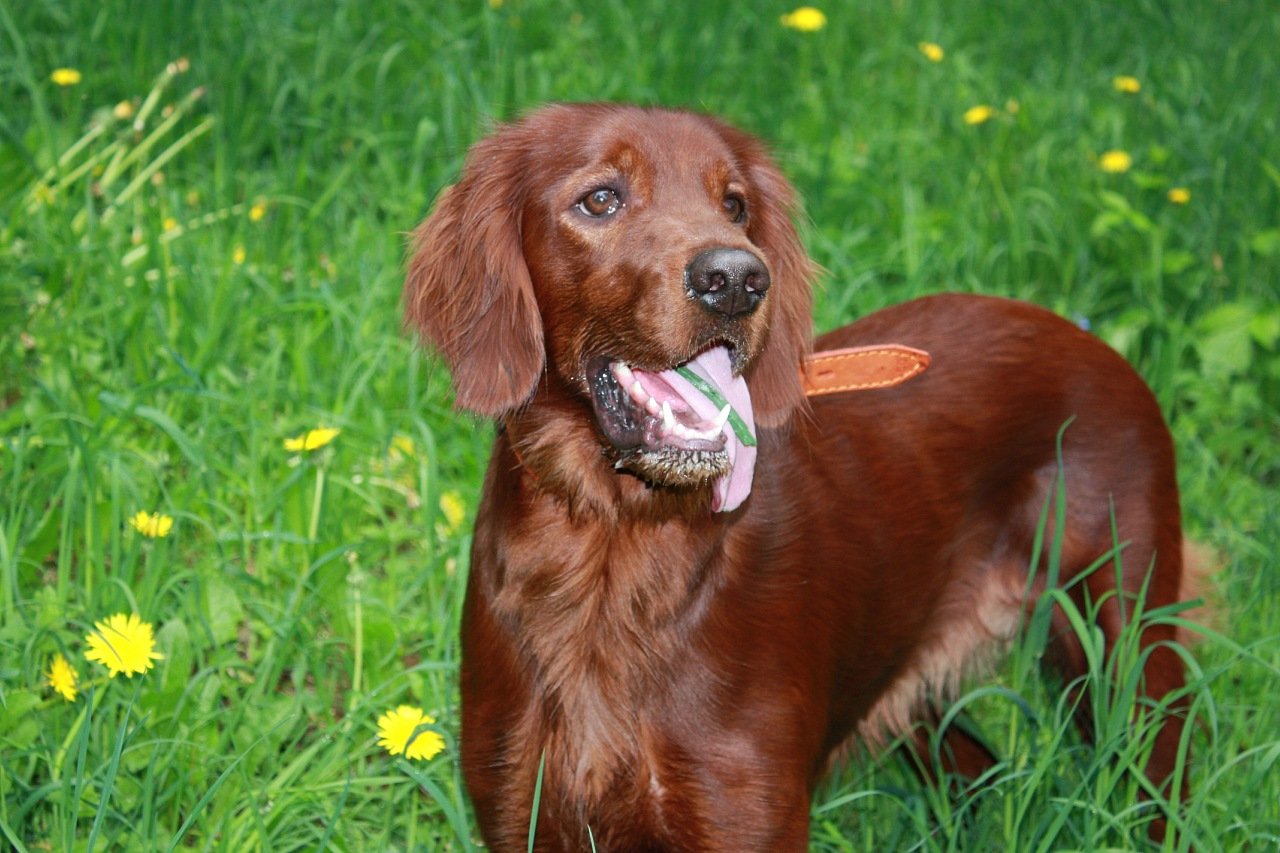
For your Setter’s coat to shine as it does in photos, it needs regular care. This is not a dog you can simply wash once a year.

  • Brushing: 2-3 times a week, and daily during shedding season. Use a metal comb and a massage brush with natural bristles. Pay special attention to the feathering behind the ears and under the armpits, where tangles form.
  • Bathing: Once every 10-14 days or as needed. Use professional shampoos for red dogs (to enhance colour) and definitely a conditioner so the coat doesn’t become static.
  • Trimming: The Irish Setter requires so-called “cosmetic grooming”. The hair is trimmed on the upper third of the ear (to show the set), on the neck down to the brisket (to emphasise the dryness of the neck), and essentially between the paw pads. The “slippers” on the paws need to be trimmed so that mud and snow do not accumulate there.

Ear and Eye Hygiene

Pendulous ears are poorly ventilated, making them an ideal environment for bacteria and fungi. Ears need to be cleaned with a special lotion weekly. Eyes also need attention – wipe them free of dust after walks in the fields.

Training and Socialisation

Training an Irish Setter must begin at an early age, otherwise, you will end up with an uncontrollable hurricane in the house. These dogs are very smart and quick-witted; they memorise information rapidly. However, they have an independent character. Mechanical execution of commands (“drilling”) is not for them. The Setter must want to work with you.

Key moments in education:

  • Positive Reinforcement: Setters are very sensitive to criticism. Harsh methods will cause the dog to shut down. Only treats, toys, and exuberant praise.
  • Recall Training (Command “Come”): This is the most important command for a Setter. Upon seeing a bird, he may forget everything else in the world. Train the recall on a long lead until you are 100% confident.
  • Brain Games: Simple running is not enough. Engage the dog with search games, agility, or frisbee.

The Irish Setter is a dog created specifically for hunting with a wide search range. Of course, if you are not a hunter, your Setter can live without this craft, but only if you can organise intensive walks for him (minimum 2 hours a day) with the opportunity to run free in a safe area.

Nutrition: Fuel for a Champion
Irish Red Setter — photo 9

Your dog’s energy and coat shine depend directly on proper nutrition. The Irish Setter can be fed either high-quality dry food (Super-Premium or Holistic class) or natural products. It is important to remember that this is an active dog with a fast metabolism.

With natural feeding, the diet should include:

  • Meat (beef, turkey, rabbit) – 60-70% of the diet.
  • Offal (tripe, liver) – very beneficial, but in moderation.
  • Sea fish (boneless) – a source of Omega-3 for the coat.
  • Vegetables (carrots, courgette, pumpkin) and a little grain (rice, buckwheat).
  • Fermented milk products (cottage cheese) – especially for puppies.

You can add a little sour cream or vegetable oil to raw chopped fruits and vegetables (flaxseed oil has an excellent effect on the brightness of the red colour). To be sure that your pet is receiving a sufficient amount of microelements, you can give vitamin supplements (in courses, on the advice of a vet). Under no circumstances overfeed the Setter – the ribs should be easily felt but not sticking out. Feed an adult pet twice a day strictly after a walk to prevent gut torsion.

Pros and Cons of the Breed
Irish Red Setter portrait
Pros (+)Cons (-)
Incredibly beautiful appearanceRequires a lot of time for coat care
Lack of aggression towards people and dogsNot suitable for guarding
High intelligence and learning abilityCan be stubborn and inattentive
Ideal friend for active childrenRequires very long walks
Cleanliness in the houseTendency to run off after scents
Interesting Facts About Irish Setters
  • Presidential Dogs: US President Richard Nixon had an Irish Setter named “King Timahoe”. Harry Truman also had a favourite of this breed named Mike.
  • Bus Heroes: In the 1970s, the Irish Setter was the symbol of a bus company in the USA (Greyhound uses a greyhound, but setters were also popular in transport advertising as a symbol of speed).
  • Late Development: Irish Setters are considered one of the breeds that mature most slowly mentally. They remain playful “children” for a very long time.
  • Movie Stars: In the film “The Big Red One” and in the Soviet film “White Bim Black Ear” (although in the book it was a Gordon Setter with incorrect colouring, an English Setter starred in the film, but people often associate this story with setters in general).
Frequently Asked Questions (FAQ)

Does the Irish Setter shed a lot?
Yes, shedding is noticeable, especially seasonally (spring/autumn). But since there is no undercoat, the hair does not fly around in clouds but settles on the floor, which makes cleaning easier.

Can a Setter be kept outside in a kennel?
Categorically no. Firstly, they do not have a warm undercoat and freeze in winter. Secondly, these are social dogs that suffer without constant contact with the family. Isolation will destroy the dog’s psyche.

Is it hard to toilet train them?
Setters are quite clean, but because they mature slowly physiologically, “accidents” at home can happen for longer than with other breeds (up to 6-8 months).

How much should you walk an Irish Setter?
The minimum is two walks of 1-1.5 hours each. And this should not just be walking on a lead, but active running, ball games, or frisbee.

Video About the Breed
Pros
  • Friendly and playful
  • A striking red colour
  • A hardy hunter
  • Excellent with children
Cons
  • Needs enormous exercise
  • Coat care
  • Risk of gastric torsion
  • Matures late, a "forever puppy"
Compared with similar breeds
English SetterGordon SetterGerman Shorthaired Pointer
Height61–69 cm58–69 cm53–64 cm
Energy4.54.55
Apartment222
Beginners333
FAQ
Does the Irish Setter have a lot of energy?
A great deal — it is one of the most energetic hunters, needing hours of running every day; without it, it grows bored and mischievous.
Is the Irish Setter suitable for a novice?
Possibly for an active one — but its late maturing and irrepressibility call for patience.
Is the Setter good with children?
Excellent — it is a friendly, playful dog that adores company.
Sources

FCI Standard No. 120 · The Kennel Club

Share This Article