

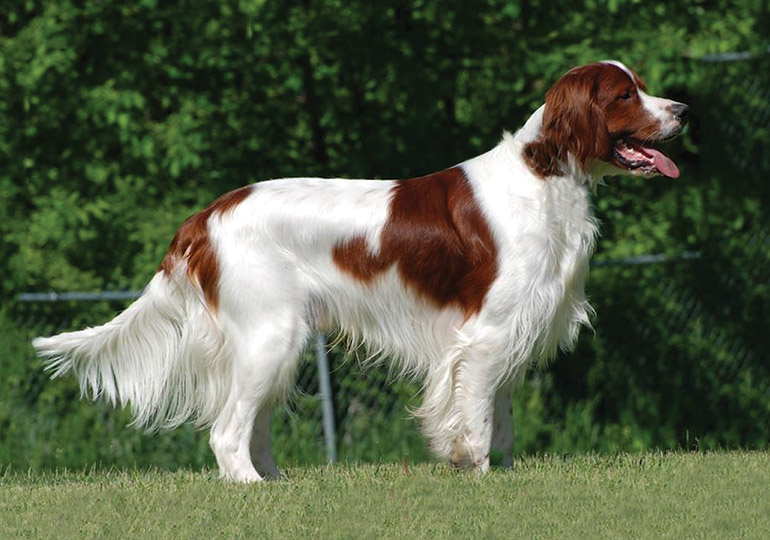
| Height | 57–66 cm |
| Weight | 25–32 kg |
| Lifespan | 11–14 years |
| FCI group | 7 · pointing dogs |
| Origin | Ireland |
Exact ratings
Common health issues
Nutrition
The Irish Red and White Setter is a dog that combines the elegance of an aristocrat with the tireless energy of a professional hunter. His noble appearance draws the eye, whilst his friendly nature makes him a favourite of the entire family. Unlike many other breeds, this setter simply cannot tolerate loneliness – he lives for interaction with his owner. Find out more on Tvaryny.
Irish Red and White Setter: detailed characteristics and overview
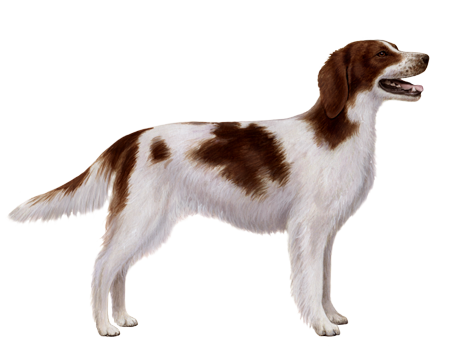
| Characteristic | Description |
|---|---|
| Country of Origin | Ireland |
| FCI Group | 7 (Pointing Dogs) |
| Section | 2 (British and Irish Pointers and Setters) |
| Height at withers (Males) | 62-66 cm |
| Height at withers (Females) | 57-61 cm |
| Weight | 25-34 kg (depending on sex and build) |
| Life Expectancy | 11-15 years |
| Coat Type | Long, silky, with characteristic “feathering” |
| Activity Level | Very high |
History of the breed: from origins to revival
The history of this breed is full of drama. Many people mistakenly believe that the “Red and White” is simply a variation of the ordinary Irish Setter, but in reality, it is quite the opposite. Historical facts suggest that it was the spotted dogs who were the ancestors of all Irish spaniels and setters. The first written mentions of red and white dogs date back to the 17th century. In those times, they were indispensable assistants to Irish smallholders and hunters.
Why did the breed almost disappear? Fashion decided everything. In the mid-19th century, a real boom began for solid red dogs. They looked more striking in the show rings, and breeders began to mass-cull white puppies with patches. This led to the fact that by the beginning of the 20th century, the Irish Red and White Setter was on the verge of total extinction. Only thanks to the efforts of a few Irish families who valued working qualities above all else (and a white dog is easier to see in the field against the backdrop of autumn grass), was the line preserved.
The revival began in the 1920s when enthusiasts, notably the Reverend Noble Huston, started targeted work on restoring the population. Official recognition as a separate breed, independent of the Red Setter, occured much later – in 1978. Today, it is still a rare breed, prized by true connoisseurs.
Appearance of the Irish Red and White Setter
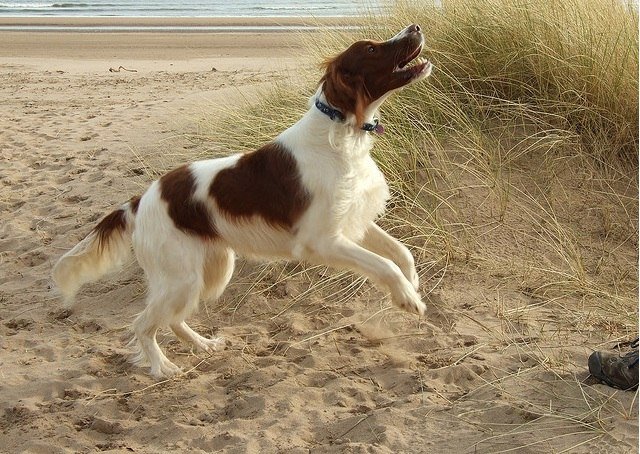
The Irish Red and White Setter differs from his red cousin not only in colour. This is a dog with a more athletic, powerful build. He should not look too light or refined – this is a working dog built for endurance. His movement is the embodiment of power and grace: a sweeping trot, head held high, with the tail continuing the line of the back.
Head and Muzzle
The head is broad in the skull, with a clearly defined but not abrupt stop (the transition from forehead to muzzle). The muzzle is square, and the lips should not be too pendulous. A scissor bite is essential – this is critically important for a working dog retrieving game. The eyes have an expressive, intelligent look, ranging in colour from dark hazel to dark brown. Yellow eyes are considered a serious fault.
Coat and Colouring
The coat is the setter’s pride. It is long, silky, straight or slightly wavy, but never curly. On the head and front of the legs, the hair is short. A characteristic feature is the “feathering” – long hair on the back of the legs, on the chest, stomach, and tail.
Colour: The base is white (preferably a pearl shade), with clear patches of rich red. An important nuance: slight ticking (flecks) is allowed only on the muzzle, feet, and lower legs. Ticking on the body is considered undesirable, although it is not a disqualifying fault if it doesn’t spoil the general impression.
Psychological portrait: character and behaviour
If we talk about character, the Irish Red and White Setter is the intellectual among the pointing breeds. They are slightly calmer and more balanced than the classic red setters, but no less energetic outdoors. At home, they often turn into “couch potatoes” if they have had sufficient physical exercise.
- Loyalty: They become extremely attached to their owner. This is not a dog that will wander off on his own. On a walk, he keeps his master constantly in view.
- Intelligence: The dog learns quickly but can show stubbornness if he doesn’t see the point in a command. Brute force does not work with them – only partnership and motivation.
- Socialisation: They are completely devoid of aggression towards people. This makes them terrible guard dogs (they would most likely joyfully lick a burglar), but ideal companions.
- Relations with children: Setters are patient and playful, although due to their size and activity levels, they might accidentally knock over a very small child.
Comparison with other setters
Often, prospective owners hesitate between different types of setters. Although they are all close relatives, differences do exist. To better understand the distinctions, we recommend reading the detailed descriptions of other breeds:
- If you are looking for a more massive and calm dog with black and tan colouring, pay attention to the Gordon Setter (Scottish Setter).
- For those who prefer classic elegance and a more famous appearance, the Irish Red Setter might be the ideal option.
- And if you are interested in “speckled” beauty and a special working style, read about the English Setter, which is also a magnificent hunter.
Hunting qualities and fieldwork
The Irish Red and White Setter was bred for hunting in open country, primarily for partridge and pheasant. His working style is a wide search at a gallop. The dog works with his head high, catching the scent of the bird carried by the wind. Sensing prey, the dog freezes in a characteristic tense stance (the set), indicating to the hunter where the bird is hiding.
A distinctive feature of the “Red and Whites” is that they often work in closer contact with the hunter than Red Setters. Their white colour is a huge advantage in an autumn field or at twilight – the dog is clearly visible from a distance, which reduces the risk of an accidental shot and makes control easier.
Health and genetic features
Care and maintenance
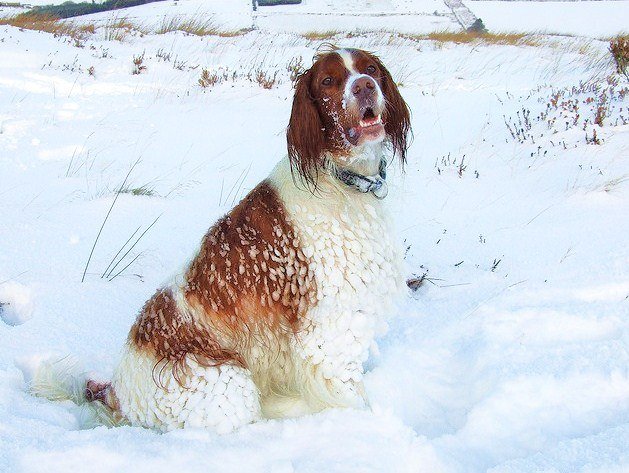
Living with a setter means living actively. This breed is not suitable for people who like to spend their weekends on the sofa. The ideal conditions are a house with a large enclosed garden, but the dog adapts perfectly to a flat too, provided you ensure he gets 2-3 hours of active walking a day.
Grooming
Caring for the coat of a Red and White Setter is simpler than it might seem. The basic rules are:
- Brushing: 2-3 times a week with a metal comb and brush. Pay special attention to the area behind the ears and under the armpits, where mats can form.
- Trimming: Hygienic trimming involves clipping the hair between the paw pads (so that mud and ice don’t collect there in winter), as well as tidying up the “feathering” for a neat look.
- Bathing: Use professional cosmetics for long-haired dogs. Don’t forget conditioner – it makes combing easier and gives the coat a lovely shine.
Pros and cons of the breed
| Pros (+) | Cons (-) |
|---|---|
| Incredibly kind and gentle character. | Requires a lot of time for walking and activity. |
| Lack of aggression towards people and other dogs. | Hunting instinct may force him to chase a cat or bird on the street. |
| High intelligence and trainability. | Long coat collects burrs and mud after walks in the woods. |
| Robust health (subject to genetic testing). | Tolerates loneliness poorly; may howl or damage things out of boredom. |
| Striking appearance that commands admiration. | Quite late maturation (they behave like puppies until 2-3 years old). |
| Excellent partner for running, cycling, and hiking. |
Nutrition: the key to longevity
Interesting facts about the Irish Red and White Setter
- The Older Brother: It is historically proven that Red and White Setters appeared earlier than the Red ones. In fact, the Red Setter is an offshoot of the Red and White branch that became popular through selective breeding.
- Postage Stamp: In Ireland, this breed is considered a national treasure and has even been depicted on the country’s postage stamps.
- Late Development: Owners joke that the setter’s brain matures by the age of three. Until this age, even with significant size, the dog can behave like a cheerful, mischievous puppy.
- Silent Hunters: On the hunt, they work silently, without barking, so as not to scare the bird prematurely.
Frequently Asked Questions (FAQ)
Do they shed a lot?
Shedding is moderate and seasonal (spring and autumn). However, since the coat is long, it can be noticeable on carpets. Regular grooming solves this problem.
Is this breed suitable for a flat?
Yes, but only on the condition that you are ready to walk for at least 2 hours a day actively (running, ball games). Without exercise, the dog can become destructive in the home.
Is it hard to train a setter?
They are clever but do not tolerate drilling. They need an interesting approach. Monotonous repetition of commands bores them quickly. They respond best to game-based methods and positive reinforcement.
Video about the breed
- Friendly, affectionate, excellent with children
- A superb working nose and retriever
- Clever and eager to please
- Sturdier and more level-headed than pure show lines
- Very high energy — not a flat dog
- Cannot bear being alone, needs company
- Stubborn, can be wilful in training
- A strong instinct for birds
| Irish Setter (red) | English Setter | Pointer | |
|---|---|---|---|
| Height | 58–67 cm | 61–69 cm | 58–70 cm |
| Energy | 4.5 | 4 | 4.5 |
| Apartment | 2 | 2 | 2.5 |
| Beginners | 3 | 3 | 3 |
How does the red-and-white setter differ from the solid-red Irish?
Why did the breed almost die out?
Is the breed suitable for a flat?
FCI Standard No. 330 · Irish Kennel Club
For apartments · For kids · For beginners · Active · Smartest · Hypoallergenic · All rankings →