

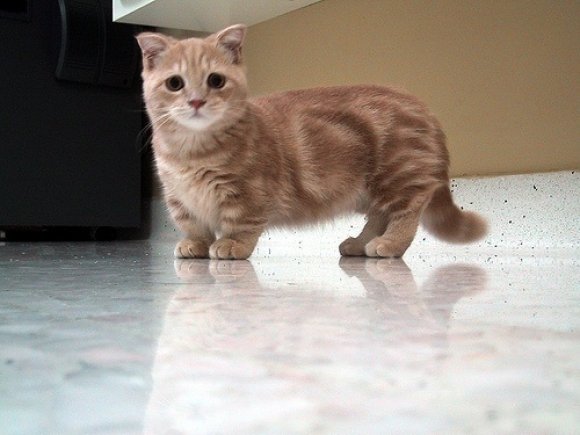
| Weight | 2.5–4 kg |
| Lifespan | 12–15 years |
| Coat | short or long |
| Recognition | TICA |
| Origin | USA |
Exact ratings
- Lordosis (spinal curvature, less often)
- “Funnel chest” (pectus excavatum, less often)
- A tendency to gain weight
- Generally healthy with responsible breeding
- Joint arthritis in old age (less strain on the legs)
Quality food for house cats, with weight control (excess weight strains the spine and joints). Brush the short/long coat according to type; buy a kitten only from a responsible breeder who monitors spinal health.
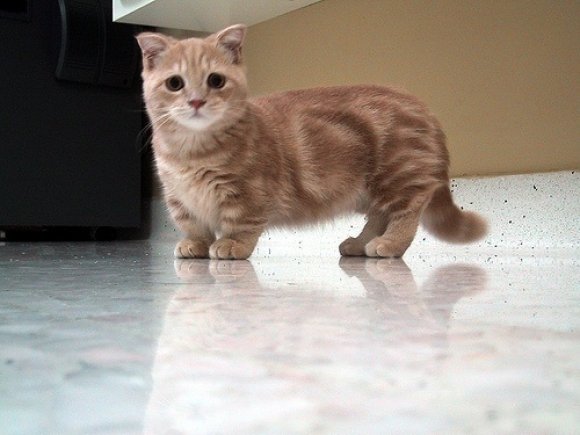
Munchkin cats are a breed that instantly capture attention with their characteristic exceptionally short legs, giving them a comical and endearing appearance, reminiscent of a Dachshund or Basset Hound among cats. You can explore more about their unique features and other fascinating breeds on Tvaryny. Despite their unusual stature, Munchkins are by no means inactive animals. They are surprisingly lively, quick, inquisitive, and playful, retaining a kitten-like energy throughout their lives. These cats are known for their confident, sociable, and affectionate nature. However, the breed is rather controversial in the feline world due to the genetic mutation responsible for their short legs and the potential health concerns associated with it. This makes responsible breeding and care particularly important for Munchkins.
Munchkin: A Brief Breed Overview
| Characteristic | Description |
|---|---|
| Origin | Louisiana, USA |
| Time of origin / recognition | ~1983 (Blackberry found); 2003 (TICA recognition) |
| Lifespan | 12–15 years |
| Height at withers | ~15–20 cm (considerably shorter than average cats) |
| Weight | Females 2–3.5 kg; males 3–4 kg |
| Temperament | Sociable, confident, inquisitive, playful (“perpetual kitten”), affectionate, intelligent |
| Grooming | Moderate: weekly for shorthaired, more often for longhaired |
| Activity Level | High (on the ground); limited jumping height |
| Distinctive features | Very short legs, “kangaroo” stance; controversial breed |
| Compatibility with children | Good |
| Compatibility with other animals | Good |
History of the Munchkin Breed: From Stray Find to Controversy
Although short-legged cats have appeared sporadically in various parts of the world throughout history (with mentions in the UK, Russia, and Germany), the modern history of the Munchkin breed began in 1983 in Louisiana, USA. Music teacher Sandra Hochenedel found two pregnant cats hiding under her car. Both cats had unusually short legs. Sandra kept one of them, a black cat, and named her Blackberry.
When Blackberry gave birth to kittens, half of them inherited her short legs, while the other half had normal-length legs. This indicated that the gene responsible for this trait is dominant. One of Blackberry’s short-legged sons, Toulouse, became a progenitor of many Munchkin lines.
The name “Munchkin” was borrowed from the book “The Wonderful Wizard of Oz,” where the Munchkins were the little people. The breed was first introduced to the general public at a nationally televised cat show organised by TICA (The International Cat Association) in Madison Square Garden in 1991.
However, the breed immediately sparked fierce controversy within the cat fancy. Critics expressed concerns about potential health and mobility issues linked to dwarfism (achondroplasia or similar conditions), deeming the breeding of such cats unethical. Due to these disputes, many major feline organisations, such as the CFA (Cat Fanciers’ Association) in the USA, the GCCF in the UK, and FIFe in Europe, still do not recognise the Munchkin breed.
Despite this, TICA accepted the Munchkin into its new breed development programme in 1994 and granted the breed full championship status in 2003. The breed has its admirers who appreciate its unique appearance and wonderful temperament, and they maintain that, with responsible breeding, Munchkins are healthy and active cats.
The Genetics of Short Legs
The Munchkin’s short legs are caused by an autosomal dominant mutation that affects the growth of the long bones in the limbs. This means that only one copy of the gene (inherited from one parent) is needed for the trait to manifest. The condition is genetically different from the achondroplasia that causes dwarfism in humans or Dachshunds.
An important genetic feature is that embryos inheriting two copies of the Munchkin gene (homozygous form) are considered non-viable and die in the womb. Therefore, all living Munchkins are heterozygous (they have one gene for short legs and one for normal-length legs). When two Munchkins are mated, litters are statistically expected to comprise 50% short-legged kittens (Munchkins), 25% long-legged (non-standard), and 25% non-viable homozygous embryos. Mating a Munchkin with a long-legged cat results in 50% short-legged and 50% long-legged kittens, with no lethal genes involved.
What Does a Munchkin Look Like: A Description of Appearance
The most obvious and defining feature of the Munchkin is its very short legs. However, the breed standard describes other characteristics as well.
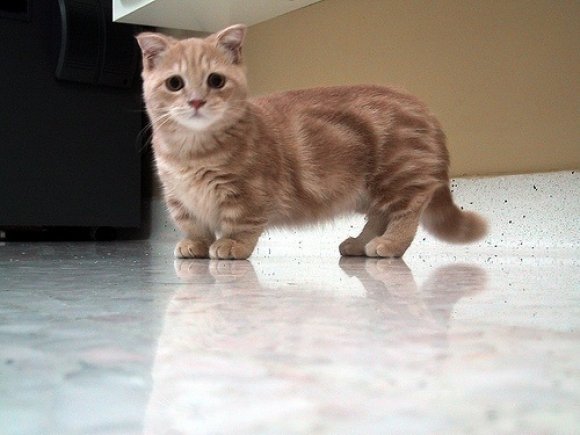
- Legs: Short, sturdy. Forelegs may show slight bowing, and paws may turn out slightly, but this should not impede movement. Hind legs are often slightly longer than the forelegs.
- Body: Medium-sized, neither compact (cobby) nor overly elongated (oriental). Strong boning and well-developed muscles. Chest is broad and rounded. The spine shows a slight rise from shoulders to tail.
- Tail: Medium thickness, tapering to a rounded tip. Tail length is in proportion to the body. When moving, Munchkins often carry their tail erect.
- Head: Modified wedge with rounded contours, in proportion to the body. Forehead is flat. Muzzle is medium length with a firm chin and well-developed whisker pads.
- Ears: Medium to large, broad at the base, with slightly rounded tips. Set fairly high and wide apart. Ear tufts (lynx tips) are possible in longhaired varieties.
- Eyes: Large, expressive, walnut-shaped – rounded yet slightly slanted. Set quite wide apart. Eye colour is independent of coat colour and can be any shade (green, yellow, gold, blue, copper, odd-eyed).
- Coat: Two coat varieties exist:
- Shorthaired Munchkin (Munchkin Shorthair): Medium-length, plush texture, with a moderate undercoat, weather-resistant.
- Longhaired Munchkin (Munchkin Longhair): Semi-long, silky, with a moderate undercoat and a slight ruff and “breeches” (feathering on the hind legs). Tail is well-plumed.
- Colours/Patterns: Absolutely all possible colours and patterns are permissible, including colourpoint, bi-colour, tabby, solid, and others.
The “Kangaroo” Stance
Munchkins are known for their habit of sitting up on their hind legs, bracing themselves with their tail, to get a better view of their surroundings. This pose resembles a kangaroo or a prairie dog and is one of the charming quirks of the breed.
Munchkin Character: Temperament and Behaviour
Despite their unusual appearance and the controversies surrounding the breed, Munchkins have won the hearts of many with their delightful character. Their personality is often as captivating as their unique look, setting them apart from breeds like the elegant Cornish Rex or the striking Korat. They are confident, extroverted, and highly inquisitive cats.
- Playfulness: Munchkins are “perpetual kittens.” They adore playing, chasing toys, and hunting imaginary prey. Their playfulness endures into old age.
- Activity and Agility: Despite their short legs, they are remarkably fast and agile on the ground. They love to dash about and make sharp turns (“like racing cars”). They can jump and climb, albeit not as high as long-legged cats. Low sofas or beds pose no obstacle for them.
- Inquisitiveness: They are curious about everything happening around them and enjoy exploring new objects and places. They often collect and hide small, shiny items (“magpie cats”).
- Affection and Sociability: Munchkins greatly enjoy human company, affection, and attention. They get on well with all family members, including children, as well as other cats and dogs, especially if raised together.
- Intelligence: These are intelligent cats that readily learn house rules and can master some tricks.
- Adaptability: They adapt well to flat living, provided they receive enough attention and stimulation.
The Munchkin is a cheerful, energetic, and loving companion that will bring a great deal of joy to its owners.
Munchkin Health: Potential Problems and Controversies
Munchkin health is a topic of considerable debate. Proponents of the breed assert that the cats are generally healthy and their short legs do not cause them suffering. Critics, however, point to potential problems associated with their altered skeletal structure.
Potential problems associated with the mutation include:
- Lordosis: An excessive inward curvature of the spine (in the lumbar region). In severe cases, it can compress internal organs (heart, lungs) and be fatal. While this can occur in any breed, there are concerns that Munchkins may be more prone to this condition.
- Pectus Excavatum (Funnel Chest): A sunken or “funnel” chest. This is a deformity of the chest wall that can also compress the heart and lungs, causing breathing and cardiac issues. It is also seen in other breeds but is associated with some forms of dwarfism.
- Osteoarthritis: There are concerns that the altered biomechanics of movement due to short legs may lead to increased stress on the joints and spine, heightening the risk of arthritis in later life. Long-term studies are still ongoing.
Weight management is crucial: It is extremely important to keep a Munchkin in good physical condition and prevent obesity. Excess weight places enormous additional strain on their short legs and spine, which can significantly increase the risk of lordosis, arthritis, and other musculoskeletal problems.
Other health considerations: Like all cats, Munchkins require regular veterinary check-ups, vaccinations, parasite control, and dental care.
Health summary: While many Munchkins live long, happy lives without serious issues, potential risks associated with their unique conformation do exist. Choosing a kitten from a responsible breeder who prioritises the health of their animals and does not breed from cats showing signs of lordosis or pectus excavatum, along with careful weight management throughout their life, are key factors for a Munchkin’s well-being.
Munchkin Coat Care and Other Grooming Aspects
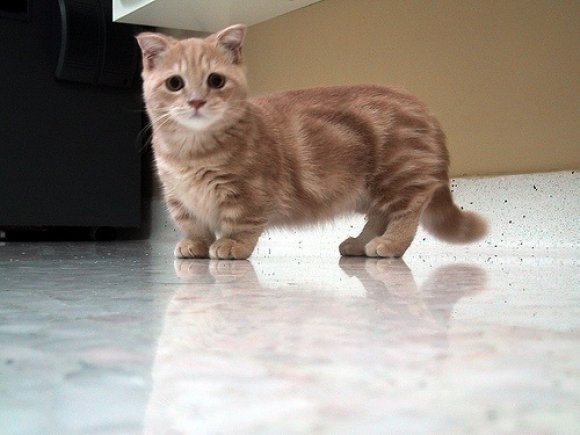
Grooming a Munchkin depends on its coat type but is generally not overly demanding.
- Shorthaired Munchkins: Require brushing once a week to remove dead hairs and keep their coat in good condition.
- Longhaired Munchkins: Need more frequent brushing – 2-3 times a week – to prevent mats from forming, especially around the “breeches” and tail.
- Bathing: Usually not necessary unless the cat gets particularly dirty or its coat becomes greasy.
- Nail care: Regular nail trimming every few weeks.
- Ear and eye care: Periodic checks and cleaning as needed.
- Dental care: Regular tooth brushing to prevent dental disease.
Regarding the need for walks: Munchkins are active cats, but they are perfectly happy in a flat, provided they have plenty of toys, climbing spots (not too high), and attention from their owner. Walks on a lead are possible if the cat is accustomed to it and it is safe, but this is not an essential requirement for the breed.
Training and Socialising Your Munchkin
Munchkins are intelligent cats eager to interact, which makes them quite trainable.
- Training: They respond well to positive reinforcement (praise, play, treats). You can teach them simple commands, tricks, and to fetch toys. It’s important to keep training sessions short and game-like.
- Limitations: Due to their short legs, they cannot jump as high as other cats, so avoid trying to teach them tricks requiring high jumps. However, their agility on the ground is impressive.
- Socialisation: Early socialisation is important for them to grow into confident and friendly adults. Introduce them to different people, sounds, and other animals (under supervision).
- Stimulation: Provide plenty of toys, cat tunnels, low climbing frames, and interactive games to satisfy their need for activity and curiosity.
Feeding Your Munchkin: Key Recommendations
A Munchkin’s diet should be focused on maintaining health and, most importantly, preventing obesity.
- Preventing obesity: This is priority number one. Excess weight puts undue strain on their spine and short legs, potentially leading to serious health problems like arthritis and lordosis. Strictly control portion sizes!
- High-quality food: Choose a high-quality, balanced cat food (dry and/or wet) that is high in protein and moderate in fat. Avoid foods with a lot of fillers (cereals).
- Feeding schedule: Feed 2-3 precisely measured meals per day. Do not leave food freely available.
- Treats: Give treats very sparingly, considering their calorie content.
- Specific foods: Avoid fatty foods (like poultry skin) and raw fish (risk of parasites and thiamine deficiency). Soured milk products (kefir, low-fat cottage cheese) can be given in small amounts if the cat tolerates them well.
- Fresh water: Must always be available.
Pros and Cons of the Munchkin Breed
| Pros | Cons |
|---|---|
| Unique and endearing appearance. | Controversial breed, not recognised by many organisations (ethical concerns). |
| Very sociable, affectionate, and playful nature. | Potential health problems (lordosis, pectus excavatum, arthritis). |
| Intelligent and inquisitive. | Strict weight control is essential to prevent obesity. |
| Gets on well with children and other animals. | Limited ability to jump high. |
| Available in shorthaired and longhaired varieties. | Careful selection of a health-conscious breeder is necessary. |
| Adaptable, suitable for flat living. | May need to adapt the environment (lower surfaces). |
| Available in all colours and patterns. |
Interesting Facts About Munchkins
- Kangaroo Cat: Munchkins are known for their ability to sit up on their hind legs, using their tail for support, to get a better view of their surroundings.
- Name Origin: The breed is named after the little inhabitants of the Land of Oz from L. Frank Baum’s book “The Wonderful Wizard of Oz.”
- Dominant Gene: Their short legs are caused by a dominant gene, so only one short-legged parent is needed for Munchkin kittens to appear in a litter.
- “Magpie Cats”: Munchkins have a penchant for collecting and hiding small, shiny objects.
- Basis for Experimental Breeds: Due to their unique trait, Munchkins are often used to create new experimental breeds by crossing them with other cats (e.g., the Skookum = Munchkin + LaPerm; the Bambino = Munchkin + Sphynx; the Minuet/Napoleon = Munchkin + Persian/Exotic). Another distinctive breed worth noting is the Pixiebob.
Frequently Asked Questions About the Breed (FAQ)
Do Munchkins suffer from health problems due to their short legs? This is a controversial topic. While many Munchkins live healthy lives, their conformation can increase the risk of certain spinal (lordosis) and chest (pectus excavatum) problems, as well as arthritis in later life. It is critically important to maintain their weight within a healthy range and choose a kitten from a responsible breeder.
Can Munchkins jump? They can jump, but not as high as cats with normal-length legs. They compensate with agility and climbing ability.
Do all feline organisations recognise the Munchkin breed? No. Due to ethical controversies surrounding the breeding of cats with a genetic mutation affecting their skeleton, major organisations like the CFA (USA), FIFe (Europe), and GCCF (UK) do not recognise the breed. TICA does recognise Munchkins.
What care do Munchkins need? Coat care depends on its length (weekly for shorthaired, more often for longhaired). Standard care for nails, ears, and teeth is required. The most important aspect is strict weight control.
Is a Munchkin suitable as a first cat? It can be, provided the prospective owner thoroughly researches the breed’s specific needs, understands the potential health concerns, and is prepared to provide proper care, especially regarding weight management and sufficient attention/play.
- Lively, affectionate, sociable
- Agile despite the short legs
- Good with children and animals
- Ideal for a flat and a novice
- Short legs — not all registries recognise them (ethical debate)
- Can't reach high shelves
- A tendency to lordosis and “funnel chest”
- A tendency to gain weight
| Scottish Fold | Devon Rex | American Curl | |
|---|---|---|---|
| Weight | 3–6 kg | 2.5–4.5 kg | 3–5 kg |
| Energy | 2.5 | 4.5 | 3.5 |
| Apartment | 5 | 5 | 5 |
| Beginners | 4.5 | 4 | 4 |
Are the Munchkin's short legs healthy?
Can the Munchkin run and jump?
What is the Munchkin's character?
TICA standard (Munchkin)
For apartments · For kids · For beginners · Most affectionate · Quietest · Hypoallergenic · All rankings →