

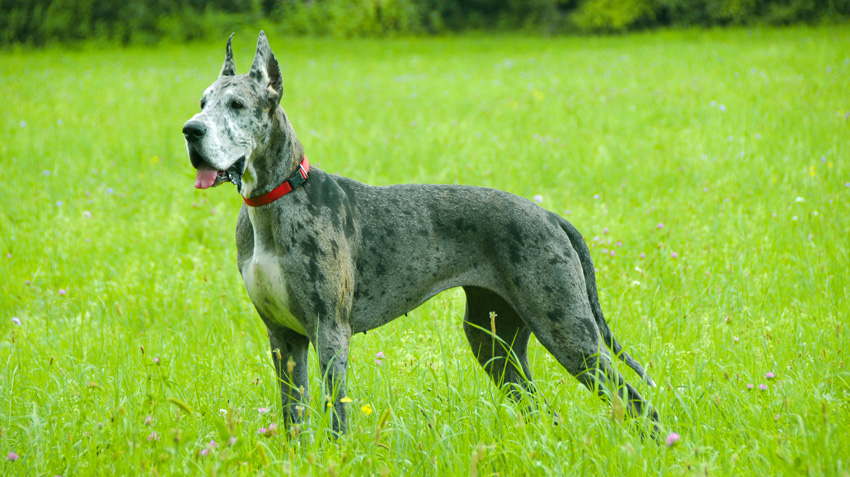
| Height | 71–86 cm |
| Weight | 45–90 kg |
| Lifespan | 8–10 years |
| FCI group | 2 · molossoids |
| Origin | Germany |
Exact ratings
Common health issues
Nutrition
The Great Dane is a breed that embodies grandeur, nobility, and incredible devotion. These colossal yet graceful dogs, affectionately known as “gentle giants,” make wonderful companions for the entire family. Despite their substantial size, they are not suited for outdoor living or kennels. Their short coat, lacking an undercoat, leaves them vulnerable to cold and adverse weather, making the Great Dane exclusively a cherished indoor pet. In this detailed overview, prepared by the experts at Tvaryny, we will explore all aspects of this unique breed, from its historical origins to specific care requirements and health considerations.
The ideal environment for a Great Dane is a private house with access to its own garden, but they can also feel perfectly comfortable in a large flat, provided they receive sufficient outdoor exercise. These are exceptionally loving and affectionate dogs that get along wonderfully with children, showing astonishing patience towards them. Simultaneously, their imposing appearance and deep bark make them excellent guardians, always ready to protect their family, though innate aggression is not characteristic of the breed.
Great Dane: A Brief Breed Overview
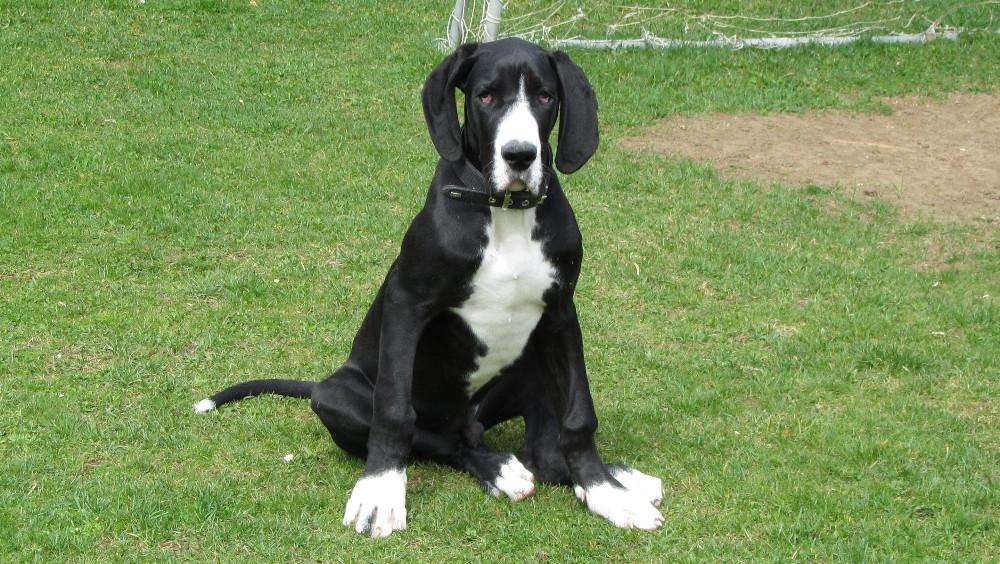
| Characteristic | Description |
| Breed Name | Great Dane (Deutsche Dogge) |
| Country of Origin | Germany |
| FCI Classification | Group 2 (Pinscher and Schnauzer, Molossoid, Swiss Mountain and Cattle Dogs), Section 2.1 (Molossoid Dogs, Mastiff-type). Standard No. 235. |
| Lifespan | 7-10 years |
| Height at Withers | Males: from 80 cm, Females: from 72 cm |
| Weight | Males: 54-90 kg, Females: 45-59 kg |
| Temperament | Friendly, devoted, calm, self-assured, non-aggressive, gentle with children, but wary of strangers. |
| Usage | Companion dog, guardian, family dog. |
History of the Majestic Great Dane
The history of the Great Dane stretches back centuries, although its modern appearance and name were established relatively recently. The predecessors of modern Danes are considered to be ancient Molossian dogs, used as far back as the Roman Empire. However, the direct ancestors of the breed were large and powerful “Bullenbeisser” (bull-baiters) and “Hatz- und Saurüden” (hunting dogs for wild boar), which were something between a powerful English Mastiff and a swift Greyhound.
From the 16th century onwards, these large dogs began to be purposefully bred in Germany, with the strongest and most elegant specimens being imported from England. For a long time, there was confusion with their names: they were called Ulm Dogs, Danish Dogs, English Dogs, even though Denmark has no connection to their origin whatsoever. The name “Danish Dog” was often used for less powerful but more refined representatives.
A pivotal moment in the breed’s history came in 1878 in Berlin, when a committee of seven authoritative breeders and judges, led by Dr. Bodinus, decided to unite all these variations under a single name — Deutsche Dogge (German Mastiff). This was the first step towards their recognition as Germany’s national breed. In 1880, the first breed standard was approved, and in 1888, the National German Dane Club (Deutscher Doggen-Club 1888 e.V.) was founded in Berlin, which continues to deal with standard and breeding issues to this day. Since then, breeders have worked on improving the breed, aiming to create not just a gigantic dog, but a harmonious combination of strength, majesty, and elegance, as we know it today.
Breed Standard and Appearance of the Great Dane
The Great Dane is a true Apollo among dogs. Its appearance is striking due to the harmonious combination of power, strength, and refinement. This is a dog with well-developed musculature, noble body lines, and a proud stance. Sexual dimorphism is clearly expressed: males are significantly more massive and larger than females.
Head and Muzzle
The head of the Great Dane is one of the breed’s key characteristics. It is long, narrow, expressive, with clear lines. The length of the muzzle and skull should be approximately equal. The stop (transition from forehead to muzzle) is clearly defined. The muzzle is deep and rectangular. The lips are pendulous (flews), but not excessively so. Eyes are medium-sized, almond-shaped, with a lively, intelligent, and friendly expression. Eye colour is predominantly dark, although lighter shades are permissible in blue Danes. Ears are set high, hanging, and medium-sized. Previously, ears were traditionally cropped, giving them a pointed shape, but today in most countries, including the UK, cropping is prohibited, and dogs have natural, triangular ears.
Body and Limbs
The neck is long, muscular, with an elegant arch, without a dewlap. The withers are well-defined, transitioning into a short and strong back that slopes slightly towards the croup. The loins are broad and muscular. The chest is wide and deep, reaching the elbow joints, with a well-developed forechest. The abdomen is moderately tucked up. The tail is set high, thick at the base and tapering towards the tip, hanging downwards in a relaxed state. The limbs are strong, straight, and parallel, with well-developed musculature, ensuring a powerful yet agile stride.
Coat and Colour
The Great Dane’s coat is very short, dense, smooth, and glossy, with no undercoat. The FCI standard recognises three distinct colour groups, which are bred independently:
| Colour Group | Description |
|---|---|
| Fawn and Brindle | Fawn: from light golden to deep golden. Black mask preferred. Brindle: main colour fawn with clear black stripes running in the direction of the ribs. Black mask preferred. |
| Harlequin and Black | Harlequin: main colour pure white with irregularly distributed black “torn” patches all over the body. Grey or brown patches are undesirable. Black: rich, glossy black colour. White markings on the chest and paws are permissible (mantle Dane). |
| Blue | Pure steel blue colour. White markings on the chest and paws are permissible. |
Character and Temperament: A Gentle Giant in Your Home
Behind the formidable appearance of the Great Dane lies an exceptionally friendly, calm, and devoted soul. This is one of the few giant breeds that is wonderfully suited to be a family dog. They form a very close bond with their owners and strive to be full members of the family. Leaving a Dane alone for long periods is a bad idea, as they suffer from separation anxiety and may exhibit destructive behaviour.
Great Danes adore children and treat them with astonishing gentleness and patience. However, due to their enormous size, they might accidentally knock over a small child during play. Therefore, any interaction should always be supervised by an adult. With other animals, provided there is early socialisation, Danes usually get along well, especially if they grow up together. They are reserved and wary of strangers but without aggression. Their deep bark and considerable size are usually enough to deter anyone with ill intentions.
Pros and Cons of the Great Dane Breed
Before getting such a giant, it’s important to weigh all the pros and cons. A Great Dane is not just a joy, but also a significant responsibility.
| ✅ Pros | ❌ Cons |
|---|---|
| Majestic and elegant appearance | Very short lifespan (7-10 years) |
| Devoted and loving companion | High cost of upkeep (food, veterinary services) |
| Gentle and patient with children | Requires a lot of space in the home and car |
| Good guardian, not prone to baseless aggression | Prone to serious genetic diseases |
| High intelligence and trainability | Drooling, especially after drinking and eating |
| Minimal coat care | Can be clumsy and accidentally cause damage due to size |
| Calm and unobtrusive at home | Requires early and consistent socialisation and training |
Caring for a Great Dane: Key Aspects
Grooming and Coat Care
Caring for the Great Dane’s short coat is straightforward. It’s enough to wipe it once a week with a rubber grooming mitt or brush to remove dead hairs and maintain its shine. Shedding is moderate. Bathe your Dane only when absolutely necessary, as frequent bathing can strip the skin’s natural protective layer, leading to dryness and irritation. After walks in muddy weather, simply wipe their paws and belly with a damp cloth.
Living Conditions and Physical Activity
The Great Dane is an indoor dog. Ideally, they need a spacious house with a fenced garden. They can also live in a flat, but only if they are provided with two to three long walks daily (at least 1.5-2 hours in total). It is important to remember that puppies and young dogs up to 1.5-2 years old should avoid excessive exercise (jumping, running up and down stairs), as their joints are still developing. For adult dogs, leisurely walks, a light jog, or games of fetch are suitable. They will gladly accompany you on nature hikes. The Dane’s sleeping area should be equipped with a thick orthopaedic mattress to prevent joint problems and the formation of calluses.
Care for Eyes, Ears, and Claws
Regularly check your pet’s eyes and ears. Eyes should be wiped if necessary with a soft cloth moistened with a special lotion. Ears should be cleaned with a cotton pad soaked in an ear cleaning solution, removing dirt only from the visible parts. Claws, if they don’t wear down naturally, need to be trimmed every 3-4 weeks. It’s also important to maintain oral hygiene and regularly brush their teeth with a special toothpaste for dogs.
Great Dane Health: Typical Ailments and Prevention
Training and Socialisation of the Great Dane
Great Danes are intelligent and sensitive dogs who strive to please their owners. However, their training requires patience, consistency, and positive reinforcement. Harshness and physical punishment are absolutely unacceptable — a Dane may become fearful or, conversely, stubborn. Due to their gigantic size, early socialisation and obedience training are critically important. As early as 3-4 months of age, a small puppy should be introduced to different people, sounds, places, and other dogs. Attending obedience classes is highly recommended. It is important to teach a puppy from a young age not to jump on people or pull on the lead, as once the dog grows up, managing them will be physically challenging, similar to powerful breeds like the Rottweiler.
Great Dane Nutrition: Key Recommendations
Interesting Facts about the Great Dane
- Record-breaking Dog. It was a Great Dane named Zeus who was entered into the Guinness World Records as the tallest dog in the world. His height at the withers was 111.8 cm (44 inches).
- Cartoon Star. The globally renowned cartoon character Scooby-Doo is a Great Dane.
- “Bismarck’s Dog.” German Chancellor Otto von Bismarck was a great admirer of Great Danes and kept several representatives of the breed.
- Not “Danish.” Despite the name “Great Dane” in English, the breed has no connection to Denmark. It is purely a German breed.
- Giant Dogs. While Great Danes are often the tallest, they are outweighed by breeds like the English Mastiff. Among giants, they stand out for their elegance, unlike “rawer” breeds. Compared to the Irish Wolfhound, the Dane looks more powerful and has a smoother coat. Another impressive giant breed is the Leonberger.
Frequently Asked Questions about the Great Dane Breed (FAQ)
Is the Great Dane suitable for flat living?
Yes, but only if the flat is spacious enough and the dog is provided with long and quality exercise. At home, they are very calm and spend most of their time sleeping.
How much does it cost to keep a Great Dane?
Maintenance is very expensive. They eat a lot (high-quality food), and veterinary services and medications for a giant breed cost significantly more than for small dogs. Keeping the animal for its whole life always outweighs what you pay at the start, and that is the figure worth thinking about first.
Do they drool a lot?
Yes, Great Danes are prone to drooling, especially after eating and drinking, as well as during hot weather or excitement. Owners should always have a towel handy. However, they don’t drool as much as, for example, Leonbergers or St. Bernards.
Are they difficult to train?
No, they are intelligent and eager to please, which makes them relatively easy to train. However, as with all dogs, especially powerful ones like the Rottweiler, early commencement, consistency, and positive methods are key. Their sensitivity does not tolerate harshness.
Can a Great Dane be left alone at home?
They are very people-oriented and do not tolerate loneliness well. They need to be gradually accustomed to short periods of absence. If you work all day, this breed is not for you.
Is the Great Dane a good guard dog?
Yes, they make excellent guardians. Their size and deep bark deter unwanted visitors. However, they are not inherently aggressive and will only protect the family in the event of a real threat. They are not as ferocious a guard dog as, for example, the Catahoula Leopard Dog; their strength lies in warning.
Video about the breed
- An affectionate “gentle giant”
- Calm and devoted
- Good with children
- A striking, noble look
- Very short life (8–10 years)
- High risk of gastric torsion
- Heart disease
- Needs plenty of space
| Irish Wolfhound | Saint Bernard | Mastiff | |
|---|---|---|---|
| Height | 71–90 cm | 65–90 cm | 70–91 cm |
| Energy | 3 | 2.5 | 2.5 |
| Apartment | 2 | 2 | 2 |
| Beginners | 3 | 2.5 | 2.5 |
How long do Great Danes live?
Is the Great Dane good with children?
How dangerous is bloat in the Great Dane?
FCI Standard No. 235 · The Kennel Club
For apartments · For kids · For beginners · Active · Smartest · Hypoallergenic · All rankings →