

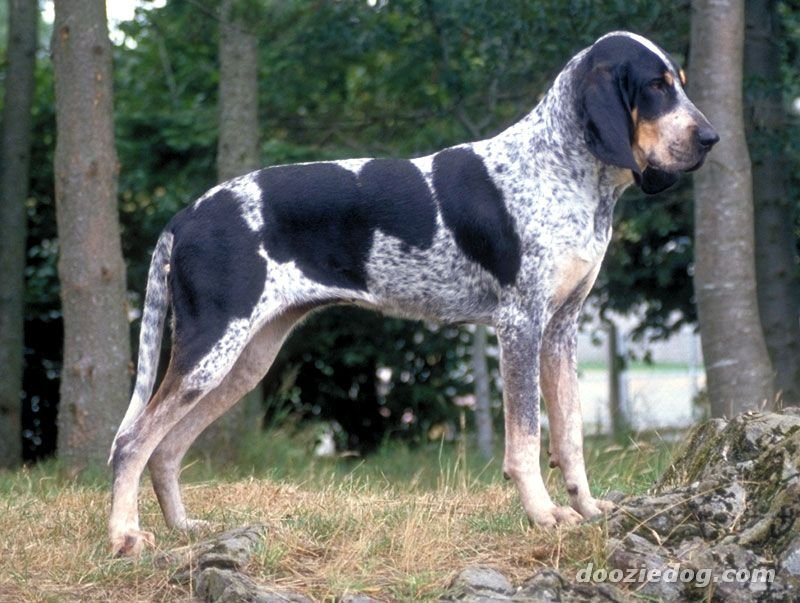
| Height | 50–58 cm |
| Weight | 18–22 kg |
| Lifespan | 12–14 years |
| FCI group | 6 · scenthounds |
| Origin | France (Gascony) |
Exact ratings
Common health issues
Nutrition
The Petit Bleu de Gascogne, or Small Blue Gascony Hound, is not just a hunting dog; it’s a true embodiment of French elegance, nobility, and centuries of hunting tradition. Hailing from the historic region of Gascony, this breed is famed for its incredible scenting ability, melodic voice, and tireless persistence when in pursuit of game. Yet, behind its serious hunting exterior lies a gentle and devoted companion, capable of becoming a full-fledged member of the family. This dog is a choice for experienced owners who can appreciate its intelligence, independence, and provide the necessary conditions for a happy life. We’ll delve into all the intricacies of this aristocratic hunter’s character, care, and history in more detail right here on Tvaryny.
Despite its name, “small,” this hound is a medium-sized dog with a robust and harmonious build. Its unique “blue” coat, created by a blend of black and white hairs, gives the impression that the dog is dusted with a bluish frost. This breed is perfectly suited for hunting small game, particularly hares and rabbits, both alone and in a pack, demonstrating exceptional teamwork. At home, it transforms into a calm and composed pet that values comfort and its owner’s attention.
History of the Petit Bleu de Gascogne
The history of the Petit Bleu de Gascogne is inextricably linked to its larger ancestor—the Grand Bleu de Gascogne. The roots of these dogs trace back to the depths of the Middle Ages, with the legendary Hounds of St. Hubert considered their ancestors. In the 14th century, Gaston III de Foix-Béarn, known as Gaston Fébus, a renowned hunter and author of the famous “Livre de Chasse” (“Book of the Hunt”), kept a pack of large, bluish-coloured hounds in his kennels in Gascony. These dogs, brought from the Ardennes, were crossed with local hounds, which marked the beginning of the Gascony breed’s formation.
For centuries, the Grand Bleu hounds were favourites of the French aristocracy, used for hunting large game—wolves, bears, and deer. King Henry IV himself kept a pack of these magnificent dogs. However, after the French Revolution, large game hunting became less common, and economic conditions changed. There arose a need for a smaller, faster, and more economical dog to keep, one that specialised in hunting hares and other small game. And so, through the careful selection of the smallest members of the larger breed, the Petit Bleu de Gascogne came into existence.
Although a scaled-down version of its ancestor, the “small” Gascon isn’t just a miniature copy. It has a lighter frame, a more refined build, and a slightly different temperament, while retaining all the outstanding hunting qualities. The breed gained official recognition much later. The breed club was established in 1925, and the standard was approved by the Fédération Cynologique Internationale (FCI). Today, the Petit Bleu de Gascogne is one of the most popular hunting breeds in France and is gradually winning over enthusiasts worldwide. It is part of a large family of French hounds, which also includes the Blue Gascony Basset and the Small Gascon Saintongeois Hound, a testament to the region’s rich cynological heritage.
Breed Standard and Appearance
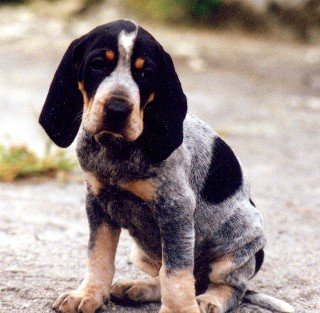
The Petit Bleu de Gascogne is a medium-sized dog that combines strength with elegance. Its appearance speaks of a noble origin and outstanding working qualities. It has a typical hound build but with a lighter and more refined frame than its larger “relative.”
- Head: Long, but not too broad. The skull is slightly domed. The stop (transition from forehead to muzzle) is barely pronounced. The muzzle is straight, roughly equal in length to the skull, with a “Roman nose” (a small bump). The lips are slightly pendulous, covering the lower jaw.
- Eyes: Oval-shaped, dark chestnut in colour. The gaze is soft, a little sad, but at the same time lively and perceptive.
- Ears: This is one of the most characteristic features of the breed. They are thin, rolled into a tube, set low, below the eye line. Their length should reach the tip of the nose or even beyond. The ears are covered with fine hair and are very sensitive.
- Body: Well-balanced. The neck is long, slightly arched, with a small dewlap. The back is strong and straight. The loin is powerful. The chest is well-developed, deep, and reaches the elbows. The belly is slightly tucked up.
- Tail: Thin, saber-shaped. When at rest, it hangs down to the hock joint, and when in motion, it is raised but not curled over the back.
- Coat and Colour: The coat is short, dense, and close-fitting to the body. The colour is the breed’s main “calling card.” It consists of black ticking on a white background, which creates a characteristic bluish-slate hue. The head usually has symmetrical black patches covering the ears and eyes, with a white “star” on the forehead. Tan (fawn) markings are often present above the eyes, on the cheeks, lips, the inner side of the ears, and on the limbs.
| Parameter | Characteristics |
|---|---|
| Height at withers | Males: 52-58 cm Females: 50-56 cm |
| Weight | 18-22 kg |
| Life expectancy | 12-14 years |
| Coat type | Short, dense |
| Colour | Blue ticking with possible black patches and tan markings |
Character and Temperament of the Petit Bleu de Gascogne
The character of the Petit Bleu de Gascogne is a wonderful duality. When hunting, it’s a relentless, keen, and independent pursuer, but at home, it’s a gentle, affectionate, and calm companion. This breed forms a deep bond with its owner and family, showing remarkable loyalty. They get along well with children, especially if raised together, demonstrating patience and caution. However, as with any dog, their interaction with small children should be supervised.
One of the key traits is their ability to work in a pack. This makes them very social dogs who, as a rule, get on wonderfully with other dogs. They are not prone to dominance or aggression towards their peers. However, their strong hunting instinct means that living alongside small animals (cats, rabbits, rodents) can be problematic. Early socialisation can help, but instinct can take over at any moment.
Gascony Hounds are intelligent but also very independent. They were bred for centuries to make their own decisions during a hunt, far from the hunter. This trait can manifest as stubbornness during training. They understand perfectly well what is expected of them but don’t always see the need to comply. Their voice is another important feature. It’s not a typical bark, but a deep, melodic, and very loud howl that they use to signal a found quarry. Neighbours in a block of flats are unlikely to appreciate this “singing.” This breed shares a similar hunting drive with other European breeds, for example, the Polish Hound, which is also known for its powerful voice and persistence.
Pros and Cons of the Breed
Before getting such a serious dog as the Petit Bleu de Gascogne, it’s important to soberly assess all the advantages and disadvantages of the breed. This will help you understand if such a pet fits your lifestyle.
| ✅ Pros | ❌ Cons |
|---|---|
| An outstanding hunter. One of the best hounds for hare hunting. | Not for apartment living. Requires space; an ideal setup would be a kennel and a large plot. |
| A loyal and affectionate companion. Bonds very strongly with the family. | Very high demands for physical exercise. Needs daily long walks and runs. |
| A noble and beautiful appearance. A dog that attracts attention. | Strong hunting instinct. Prone to running off if it catches a scent; dangerous to small pets. |
| Gets along well with other dogs. Has a well-developed pack instinct. | Tendency to howl loudly and frequently. Its voice is a working tool that it uses actively. |
| Robust health. Doesn’t have a long list of hereditary diseases. | Stubbornness and independence in training. Needs an experienced and patient owner. |
| Low-maintenance coat. Regular brushing is sufficient. | Requires meticulous ear care. Prone to ear infections. |
Care and Maintenance
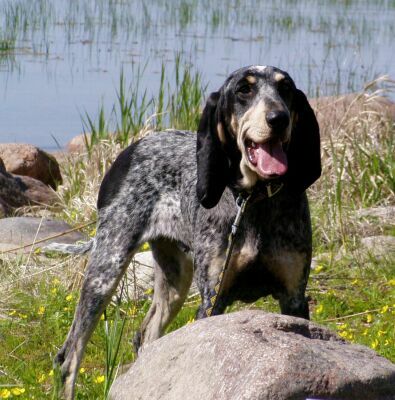
Proper care is the key to the health and happiness of your Gascon. This breed does not require complex procedures, but some aspects need special attention.
Living Conditions and Physical Activity
Definitely not suitable for a flat. This is the most important rule. A Gascon needs space to live and move. The ideal option would be a house with a large, securely fenced garden. The fence must be high and sturdy, as these dogs are prone to digging and escaping if something outside the garden piques their interest.
Physical exercise is a vital necessity. A minimum of 1.5-2 hours of active walks per day. This isn’t a slow walk on a lead, but running, games, and the chance to explore new territories. The best activity for them, of course, is hunting or its imitation (for example, coursing). Without sufficient activity, a Gascon becomes unhappy, may start to chew things, howl continuously, and show other destructive behaviours.
Coat and Skin Care
The Gascon’s short coat does not require complex care. It is enough to use a rubber brush or grooming mitt once a week to remove dead hair and massage the skin. Shedding is moderate and increases seasonally. You should only bathe the dog when absolutely necessary, using special shampoos for short-haired breeds to avoid disturbing the skin’s natural protective layer.
Ear Care
This is the breed’s most vulnerable spot. The long, pendulous ears are poorly ventilated, creating an ideal environment for bacteria and fungi to multiply. You need to check and clean the ears 1-2 times a week. Use a special veterinary lotion. Drip it into the ear canal, massage the base of the ear, and then let the dog shake its head. Gently remove any remaining dirt and lotion from the inner surface of the earflap with a cotton pad. Never use cotton buds!
Training and Socialisation
Training the Petit Bleu de Gascogne is a challenge that requires patience, consistency, and an understanding of the hunting dog’s psychology. They are intelligent, but their independence often borders on stubbornness. It is important to establish clear rules and boundaries from the very first days.
Key training principles:
- Early socialisation: Introduce the puppy to different people, animals, sounds, and situations. This will help to raise a balanced and confident dog.
- Positive reinforcement: Gascons react poorly to harshness and shouting. The best results can be achieved with praise, treats, and games.
- Consistency: All family members must follow the same rules. If something is forbidden today, it must be forbidden tomorrow as well.
- “Come!” command training: This is the most important and most difficult command for any hound. Start training in a quiet place and gradually make the tasks more challenging. Never punish the dog when it comes to you, even if you have been waiting for it for a long time.
- Short and interesting sessions: Gascons quickly lose interest in monotonous repetitions. It is better to have several short training sessions per day than one long one.
The approach to raising this breed should be similar to that used for other French hounds, such as the Nivernais Griffon, who also values a partnership with their owner rather than blind obedience.
Health and Common Ailments
Nutrition for the Petit Bleu de Gascogne
Interesting Facts about the Breed
- “Blue” is an optical illusion. The unique coat colour is not created by a blue pigment, but by dense black ticking on a pure white background, which from a distance looks like a bluish-grey shade.
- Royal lineage. The ancestors of these dogs were favourites of French monarchs and nobility, which gives the breed a special aristocratic charm.
- “Small” doesn’t mean “tiny.” The name “small” (Petit) is used to differentiate it from the “grand” (large) Grand Bleu de Gascogne. This is a fully-fledged medium-sized dog.
- A specialist in hares. Although they can hunt various game, their main “specialisation” has historically been hare hunting, where their speed, scenting ability, and endurance are fully realised.
- A melodic voice. The Gascon’s howl is highly valued by hunters. It is loud, deep, and has various intonations that an experienced hunter can use to determine the stage of the chase.
Frequently Asked Questions about the Breed (FAQ)
Is the Petit Bleu de Gascogne suitable for a beginner?
No, this breed is not recommended for inexperienced owners. Its independent nature, stubbornness, high exercise demands, and specific needs (not for flats, a loud voice) require experience, patience, and knowledge.
Can this dog be kept in a city flat?
Categorically no. This is one of the least suitable breeds for flats. They need space, a garden for running around, and the opportunity to expend their energy. In a confined space, they will suffer both physically and psychologically.
How noisy are they?
Very. They are not prone to barking without reason, but they actively use their signature loud and prolonged howl. This is not a dog that will be quiet if it’s bored or hears something.
How do they get along with children and other animals?
They usually get along well with children, especially if they have grown up together, showing patience. They get on wonderfully with other dogs due to their “pack” instinct. However, keeping them with cats, rodents, and other small animals is dangerous due to their extremely strong hunting instinct.
Do they shed much?
Shedding is moderate and increases twice a year. Regular brushing helps to keep the process under control and doesn’t create major problems.
Video about the Breed
- Excellent nose — follows the faintest scent
- Gentle, devoted, good in a pack
- Melodious, ringing voice on the chase
- Hardy, all-round hunter
- Very vocal — “gives tongue” on the chase
- Independent — for experienced owners
- Strong hunting instinct (risky with cats)
- High exercise needs — not for a flat
| Great Blue Gascony Hound | Blue Gascony Basset | Porcelaine | |
|---|---|---|---|
| Height | 62–72 cm | 34–38 cm | 53–60 cm |
| Energy | 4.5 | 4 | 4.5 |
| Apartment | 1.5 | 3 | 2 |
| Beginners | 2 | 3 | 3 |
Why “small” if it is a medium-sized hound?
Why is the colour called “blue”?
Is the breed suited to a novice?
FCI Standard No. 31 · Société Centrale Canine
For apartments · For kids · For beginners · Active · Smartest · Hypoallergenic · All rankings →