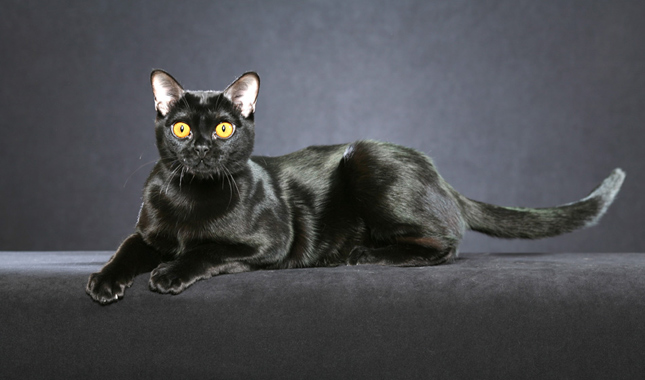
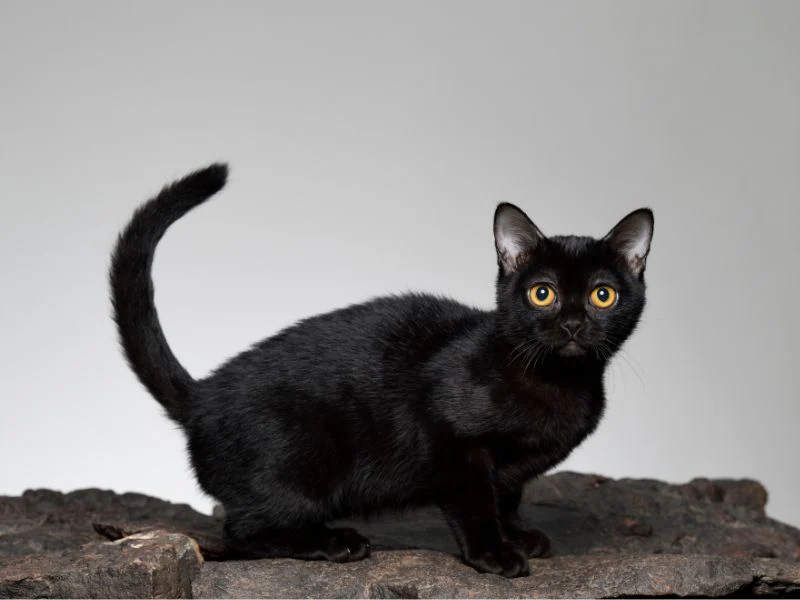
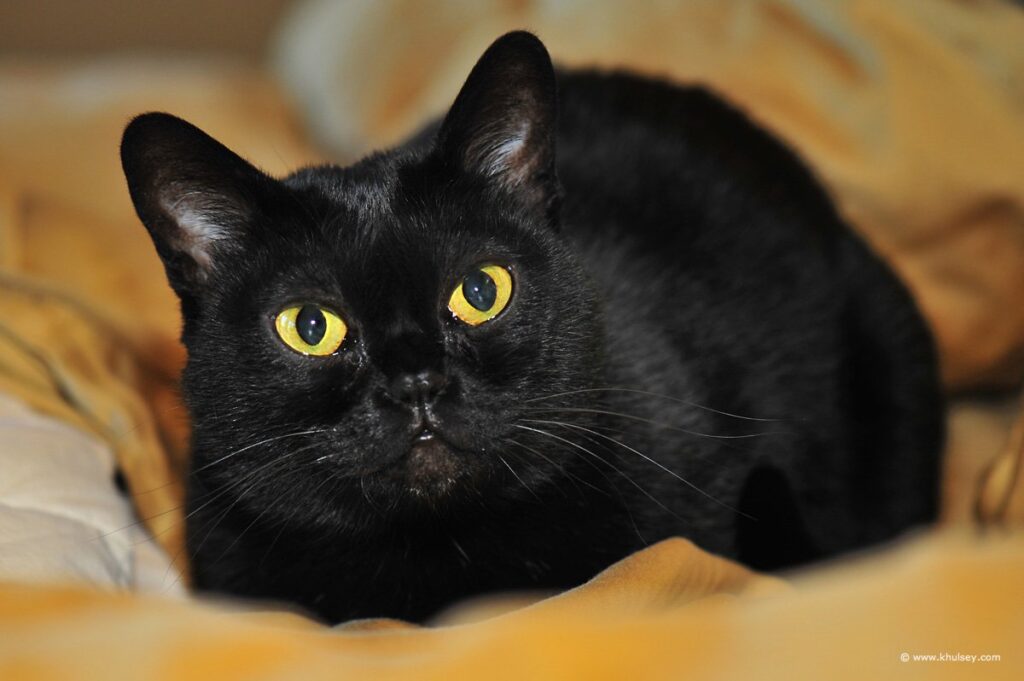
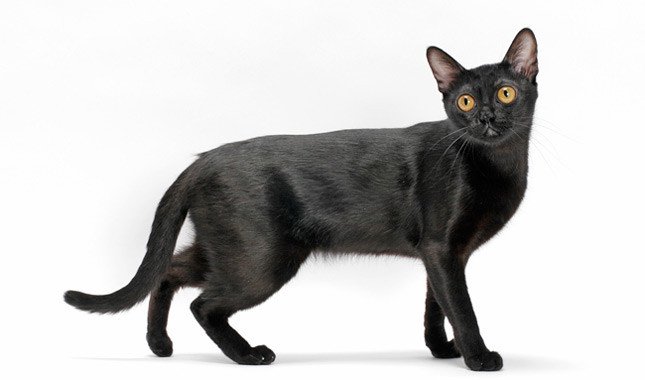
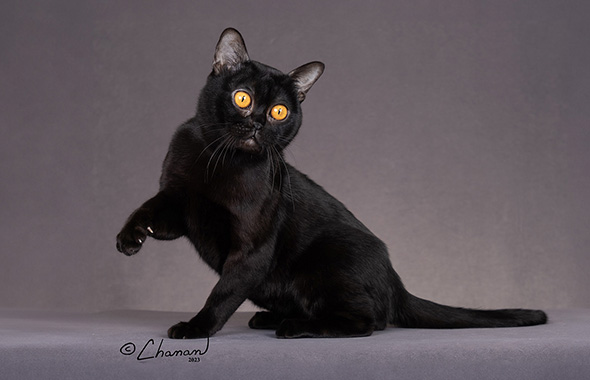
An inky “mini-panther” with copper eyes and a gentle heart — affectionate and sociable: devoted, “dog-like”, playful and people-loving. The Bombay is a compact breed with a glossy, patent-leather-like coal-black coat and expressive copper-gold eyes, developed from the Burmese and the American Shorthair; despite its “wild” panther look, it is an extraordinarily affectionate, people-oriented house cat.
Weight
3–5.5 kg
Lifespan
12–16 years
Coat
Short, fine, lying close to the body, satiny to the touch.
A striking black “patent-leather” coat, copper eyes
Sociable, playful, people-oriented
The short coat needs almost no care
Cons
Cannot bear solitude — needs company
Vocal and demanding of attention
A tendency to heart disease (HCM)
A tendency to tearing and breathing problems (some lines)
Size
ToySmallMediumLargeGiant
Compatibility
KidsDogsOther catsBeginnersTime alone · not suitable
The Bombay cat isn't just a pet; it's a genuine miniature panther right in your home. With its gleaming black coat, resembling patent leather, and striking copper or golden eyes, this breed captivates at first glance. But behind that formidable appearance lies an incredibly gentle, loving, and playful nature. If you're dreaming of an exotic yet affectionate companion, the Bombay cat could be your perfect match. Find out more about this unique breed here on Tvaryny.
This breed is the result of focused selective breeding, with the goal of creating a domestic cat that closely resembles the Indian black panther. And it's safe to say the creators succeeded admirably. Bombays inherited the best traits from their ancestors: grace, intelligence, and incredible loyalty to humans. They're active, inquisitive, and adore being the center of attention, making them wonderful family members.
Interesting Facts about the Mini-Panther
Coat darkens with age. Bombay kittens can be born with small light spots or a reddish tint to their fur, which fades with age, and by 1–2 years old, the coat acquires a deep, charcoal-black color.
"Velcro" and "Hot Water Bottles." Due to their excessive love for cuddles and desire to be constantly by a person's side, Bombays are often called "Velcro cats." And because they love warmth and often sleep under the covers with their owner, they've been dubbed "hot water bottles."
Not just American. Besides the American Bombay type, there's also the British. This was developed by crossing black British Shorthair cats with Burmese cats. British Bombays have a slightly different standard; specifically, their eye color can be green, not just copper.
A dog in a cat's body. Many owners note that the behavior of Bombays often resembles that of a dog. They love to play fetch, easily learn to walk on a leash, and faithfully follow their owner.
Hybrid breed. The Bombay is a prime example of successful hybridization, combining the traits of two different breeds to create an entirely new, unique appearance and temperament. Similar experiments led to the emergence of breeds such as the Australian Mist or the Asian Tabby.
History of the Bombay Cat: A Dream of a Mini-Panther
The story of the Bombay breed is the dream of one woman, an American breeder named Nikki Horner from Louisville, Kentucky. In the 1950s, she became passionate about creating a "parlor panther" - a cat that would look like a miniature copy of Bagheera from "The Jungle Book" - a graceful and mysterious black panther. Her goal was ambitious: to obtain an animal with a body similar to a Burmese cat, but with an utterly black, glossy coat and bright copper eyes.
Initial attempts, starting in 1958, were not successful. Crossing black American Shorthair cats with sable Burmese cats didn't yield the desired result. The kittens lacked the characteristic "lacquered" sheen of their fur and the deep copper eye color. However, Nikki didn't give up. She meticulously selected animals for her breeding program and finally, in 1965, achieved success. She managed to produce kittens that fully met her vision of the ideal "mini-panther".
The breed name "Bombay" was not chosen by accident. It refers to the Indian city of Bombay (modern-day Mumbai), which is associated with leopards and black panthers living in the jungles of India. The breed was officially registered with the CFA (Cat Fanciers' Association) in 1976 and with TICA (The International Cat Association) in 1979. Today, there are two main types of Bombay cats: American and British, which have some differences in standard and origin.
Appearance: The Bombay Breed Standard
The Bombay cat is the embodiment of elegance and power. Its appearance is truly unique and easily recognizable. The main feature of the breed is its deep, rich black coat, with every single hair from root to tip needing to be uniformly colored. The fur is short, very dense, lies close to the body, and possesses an incredible satiny or silky sheen, often compared to patent leather. To the touch, it is silky and soft.
The Bombay's body is medium-sized, muscular, and surprisingly heavy for its build, a legacy from its Burmese ancestors. The chest is broad, the back straight. Limbs are medium length, with neat oval paws. The tail is straight, medium in length, not thick, and tapers slightly to a rounded tip.
The head has a rounded shape with no flat areas. The muzzle is short, broad, with a soft transition from forehead to nose (stop). The nose is slightly flattened, which gives the cat a characteristic expression. The ears are medium-sized, set wide apart, slightly tilted forward, with rounded tips. But the Bombay's main adornment, aside from its fur, are its eyes. They are large, round, and widely set. Eye color ranges from rich golden to deep copper, creating a striking contrast with the black coat. The richer and brighter the eye color, the more valuable the representative of the breed is considered.
Characteristic · 8
Characteristic
Standard Description (CFA/TICA)
Overall Appearance
Medium-sized, muscular cat with rounded forms, resembling a miniature panther.
Head
Rounded, without sharp angles. Broad muzzle with a pronounced, but not abrupt, stop. Strong chin.
Eyes
Large, round, wide-set. Color from golden to copper (copper is preferred).
Ears
Medium-sized, broad at the base, slightly tilted forward, tips rounded.
Body
Compact, muscular, with a broad chest. Heavier than it appears.
Coat
Short, fine, lying close to the body, satiny to the touch.
Coloring
Exclusively jet black. Nose leather and paw pads are also black.
Tail
Medium length, straight, not kinked, tapering to a tip.
Character and Temperament of the Bombay Cat
Despite its exotic and somewhat wild appearance, the Bombay cat is one of the most affectionate and social breeds. They adore human company and are ready to follow their owner's every move, like a shadow. This trait makes them ideal companions for people who spend a lot of time at home. Bombays don't cope well with loneliness and can become bored if left alone for extended periods.
Key character traits of the Bombay:
Sociability: They get along wonderfully with all family members, including children and other pets, especially if raised together. They aren't afraid of guests and often come out to introduce themselves.
Playfulness: Bombays maintain their playful spirit into old age. They love interactive toys, chasing balls, and easily learn various tricks, such as retrieving items.
Intelligence: These are very clever and quick-witted cats. They quickly learn house rules and adapt to the litter box and scratching post. Their minds require constant stimulation, so puzzles and interactive games are highly recommended.
Affection: The Bombay chooses one or more "its" people and bestows upon them boundless love and devotion. They love sleeping with their owner, sitting on laps, and demanding affection, purring loudly.
"Chattiness": While not as vocal as Siamese cats, Bombays enjoy "talking" with their owner, emitting soft and melodious sounds.
This breed is perfectly suited for apartment living. They don't require vast spaces, but they do need attention and interaction. A Bombay will be happy in a family where it is loved and considered a full-fledged member. Their balanced temperament makes them excellent companions for both active individuals and seniors. It's important to remember that due to their trusting nature and human-oriented disposition, they are absolutely unsuited for outdoor life.
Pros and Cons of the Bombay Cat Breed
Before bringing a Bombay cat into your home, it's important to weigh all the pros and cons to ensure this breed aligns with your lifestyle and expectations. Cat breeds with dark coloring, such as the elegant Havana Brown, often attract with their mystery, but each has its unique traits.
✅ Pros
❌ Cons
Incredibly affectionate nature: They adore people, love to sit on laps, and be the center of attention.
Poor tolerance for solitude: Not suitable for people who spend a lot of time away from home.
Exotic appearance: Look like real mini-panthers, attracting admiring glances.
Predisposition to obesity: Require strict diet control and regular exercise.
High intelligence: Learn easily, quickly understand household rules.
Need for attention: Can be demanding, seeking affection and games.
Get along well with children and animals: Thanks to their social nature, they easily become part of a large family.
Possible breathing problems: Due to their brachycephalic muzzle structure, some individuals may snore.
Simple coat care: Don't require frequent brushing and shed little.
High price: Purebred Bombay kittens are not cheap.
Care and Upkeep of the Bombay
Caring for a Bombay cat isn't difficult, but there are a few aspects that warrant special attention to ensure your beloved pet remains healthy and happy.
Grooming: The Sheen of a Lacquered Coat
The Bombay's short coat is not prone to matting and doesn't require frequent brushing. A weekly brush with a rubber brush or grooming mitt is sufficient to remove dead hairs and stimulate blood circulation. This also helps distribute natural oils through the fur, maintaining its incredible luster. Bathing Bombays is only necessary when absolutely needed, using a special shampoo for short-haired cats.
Particular attention should be paid to the eyes and ears. Regularly check them for any discharge or dirt. Eyes can be wiped with a soft cloth dampened in warm water, and ears cleaned with a special lotion. Don't forget to trim their claws approximately every 2–3 weeks.
Nutrition: A Diet for an Athlete
Bombay cats have a tendency to gain weight, especially after sterilization. Therefore, it's crucial to control their diet. The best choice is high-quality dry or wet food of premium or super-premium class with a high protein content (meat) and a low grain content. Adhere to the dosage indicated on the packaging and avoid overfeeding your pet with treats. Ensure constant access to fresh, clean water.
Activity and Play
Bombays are active and playful cats that require daily physical and mental stimulation. Arrange a play area for them with a scratching tree, tunnels, and various toys. They adore interactive games with their owner: feather wands, laser pointers (use cautiously and always end the game with a "caught" toy), and balls. Regular play will help keep your cat in good physical shape and prevent issues related to boredom.
NutritionHealth and risks
Health and Genetic Conditions of the Breed
Frequently Asked Questions about the Breed (FAQ) · 4
Do Bombay cats shed a lot?
No, Bombays shed minimally. Their short, dense coat doesn't have a thick undercoat, so the amount of fur shed is insignificant. Regular grooming with a rubber brush will help minimize shedding.
Are Bombays suitable for allergy sufferers?
Unfortunately, the Bombay cat is not a hypoallergenic breed. Allergies are not caused by the fur itself, but by the Fel d 1 protein, found in the animal's saliva, skin secretions, and urine. Since Bombays shed little, they may spread fewer allergens around the house, but they still produce them. For people with severe allergies, this breed may not be suitable.
How much does a Bombay kitten cost?
The price for a purebred Bombay kitten from a responsible breeder can vary significantly. It depends on the pedigree, conformity to the breed standard (animal class: pet, breed, show), and the reputation of the cattery. Lifetime care always outweighs what you pay up front, and that is the number worth thinking through before you commit.
How does a Bombay differ from an ordinary black cat?
The main difference lies in the breed standard. A Bombay has a unique combination of traits: a medium-sized muscular body, a round head with a short muzzle, large copper eyes, and, most importantly, a short, glossy, close-lying charcoal-black coat without a single light hair. An ordinary black cat (mix) may have a different body structure, head shape, eye color, and fur texture. Furthermore, the Bombay's temperament is a stable breed characteristic.
Video about the Breed
FAQ
Why is the Bombay called a “mini-panther”?
Because of its coal-black glossy coat (from nose to paw pads), muscular build and expressive copper-gold eyes, it resembles a miniature black panther; but it is a fully domestic, affectionate cat.
What is the Bombay's character?
An extraordinarily affectionate, sociable and “dog-like” cat: it adores people, follows its owner, plays fetch, loves warmth and laps, and copes poorly with solitude.
Where does the Bombay come from?
The breed was developed in the USA by crossing the Burmese with a black American Shorthair to create a “house mini-panther”; from the Burmese the Bombay took its affectionate character, from the American its robust health and black color.